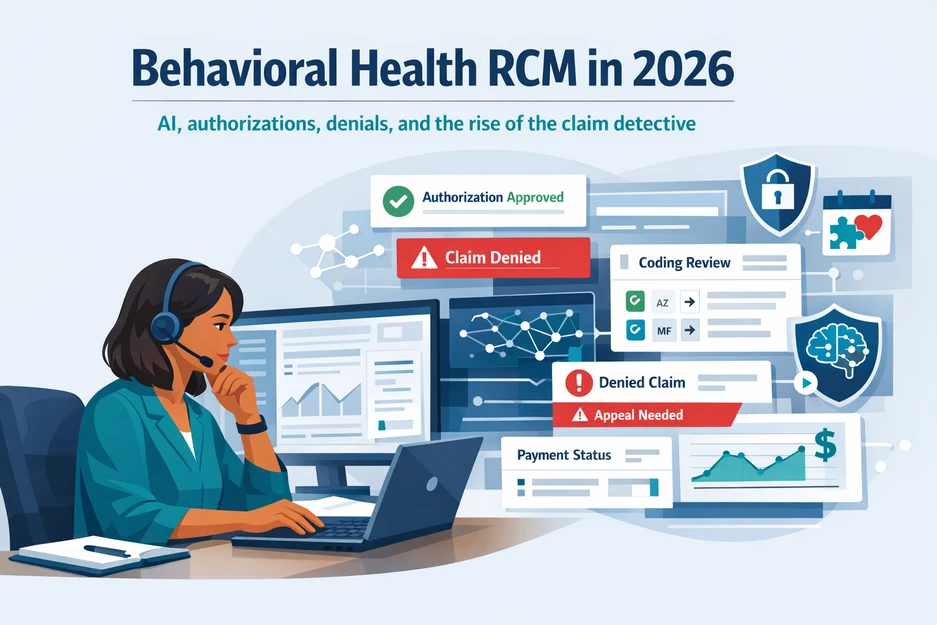
Revenue cycle management in behavioral health is not your standard medical billing gig. One missed modifier on an ABA claim can vaporize weeks of treatment reimbursement.
One misunderstood authorization window in addiction treatment can leave a facility holding six-figure losses. And in 2026, AI is rewriting what these jobs actually look like on a daily basis.
Health revenue cycle management is the comprehensive process that ensures financial health and operational efficiency in healthcare practices, especially in behavioral health.
This guide from BehavioralHealth.Careers covers the career paths, specialized knowledge, certifications, and salary benchmarks for RCM professionals working specifically in behavioral health settings.
Operational efficiency and financial stability are critical outcomes of robust RCM in behavioral health. Behavioral health revenue cycle management (RCM) refers to the end-to-end financial process that behavioral health organizations use to track patient care episodes from intake through final payment.
Effective RCM ensures that behavioral health providers are promptly and accurately reimbursed for their services, maintaining financial stability and supporting the delivery of high quality care.
Whether you’re coming from general medical billing or starting fresh, here’s what you need to know.
At a Glance: RCM in Behavioral Health
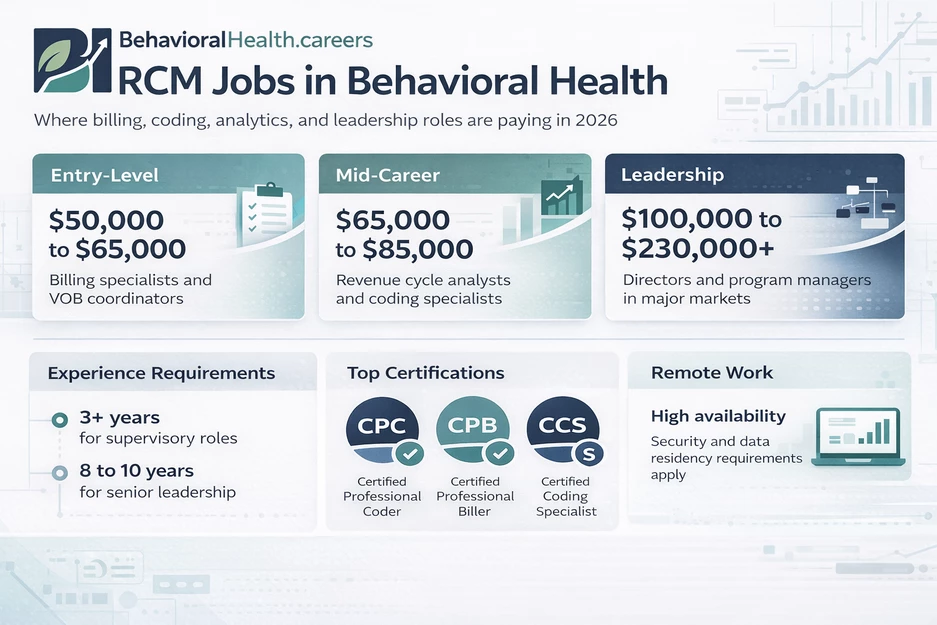
A career in revenue cycle management in behavioral health offers a range of opportunities, from entry-level billing to senior leadership.
Understanding the core components of behavioral health revenue cycle management is essential for career advancement, as it ensures professionals can effectively navigate the complexities of reimbursement and operational efficiency.
- Entry-level salary range: $50,000–$65,000 for billing specialists and VOB coordinators
- Mid-career range: $65,000–$85,000 for revenue cycle analysts and coding specialists
- Leadership roles: $100,000–$230,000+ for directors and program managers in major markets
- Experience requirements: 3+ years for supervisory roles, 8-10 years for senior leadership
- Top certifications: CPC (Certified Professional Coder), CPB (Certified Professional Biller), CCS (Certified Coding Specialist)
- Remote work: High availability, but security and data residency requirements apply
RCM professionals must also be adept at managing financial workflows to support a practice's financial performance, integrating clinical, administrative, and financial processes to drive sustainable growth and enhance patient care.
Why Behavioral Health RCM Is Different
Behavioral health billing operates under a completely different rulebook than general healthcare.
Behavioral health practices must navigate complex payer requirements and payer specific requirements, which include strict authorization processes, varying coverage limits, and detailed documentation guidelines that can lead to claim denials and payment delays.
In addition, regulatory compliance is critical, practices must adhere to HIPAA, 42 CFR Part 2, and state-specific mental health laws, all while managing their revenue cycle.
The three major service categories each present unique challenges: behavioral health billing involves unique CPT codes, specific documentation requirements, and often complex treatment plans that may involve multiple providers or levels of care.
Payers require detailed documentation to justify medical necessity, and high-quality, consistent documentation supports medical necessity and reduces the risk of denials.
Payers audit mental health notes aggressively, requiring clear proof of medical necessity linked to treatment goals. The subjective nature of medical necessity in behavioral health poses additional challenges, as reimbursement relies heavily on detailed documentation rather than objective tests.
Behavioral health RCM faces unique challenges such as complex payer requirements, high self-pay volumes, and staffing shortages.
High denial rates in behavioral health revenue cycle management are often caused by incomplete or inconsistent clinical documentation.
Addiction Treatment: Charting a Path Through Regulatory Complexity
Addiction treatment billing requires fluency in 42 CFR Part 2, the federal confidentiality regulation that’s stricter than HIPAA.
You can’t just pull up a patient’s substance use records without explicit written consent: even if they’re sitting in your clinic for another condition.
Examples of RCM challenges in addiction treatment settings:
- Levels of care coding: Detox (H0010), residential (H0018-H0019), intensive outpatient (H0015), and outpatient (H0004-H0006) all require different authorization approaches
- Prior authorization cycles: Most commercial payers require concurrent review every 3-7 days for residential stays, creating administrative intensity. Prior authorizations are especially important in behavioral health services, as they can expire mid-treatment or have strict caps on the number of sessions allowed, risking interruptions in care.
- Insurance verification: Accurate insurance verification before treatment is essential to confirm coverage for services rendered and to reduce claim denials.
- State Medicaid variations: Reimbursement rates and covered services vary dramatically: what California Medi-Cal covers for MAT (Medication-Assisted Treatment) differs entirely from Texas Medicaid
Implementing robust pre-submission claim scrubbing can significantly improve clean claim rates in addiction treatment billing, ensuring timely and accurate reimbursement.
The RCM professional in this space becomes a regulatory interpreter, not just a biller.
Mental Health: Telehealth Parity and 2026 Updates
Mental health billing saw seismic shifts during 2020-2023 with telehealth expansion. In 2026, those temporary waivers have solidified into permanent parity laws in 48 states: but enforcement remains inconsistent.
Billing for mental health services, including therapy sessions, presents unique challenges due to complex payer requirements, restrictions on the number of sessions, and strict documentation standards.
Billing is often based on session duration and relies heavily on time-based codes and specific modifiers, which increases the risk of billing errors and claim denials if CPT codes or modifiers are incorrect.
What’s changed for RCM roles:
- Place of service codes: Modifier 95 (synchronous telehealth) versus modifier GT (asynchronous) now determines reimbursement eligibility
- Independent billing rights: LMFTs and LMHCs gained independent Medicare billing rights in 2024; by 2026, most commercial payers followed suit, opening new credentialing workflows
- Psychotherapy add-on codes: The 90833, 90836, and 90838 codes (psychotherapy with E/M services) are now standard practice, requiring RCM staff to understand medical necessity documentation
Mental health RCM professionals need to master the intersection of psychotherapy CPT codes and medical coding: a skill set that didn’t exist a decade ago.
Autism/ABA: High-Volume Authorization Management
ABA therapy billing is the most documentation-intensive subset of behavioral health. A single client can generate 20-40 hours of billable services per week, all requiring prior authorization.
Unique RCM demands in ABA:
- HCPCS codes: H2019 (therapy-based behavioral services), H0031 (mental health assessment), H2014 (skills training) require distinct authorization pools
- Authorization cycles: Many payers authorize in 6-month or 12-month blocks, but require utilization reports every 30 days to maintain payment eligibility. Automating insurance eligibility verification before appointments helps confirm coverage and patient responsibility upfront.
- Direct vs. supervision hours: Understanding the ratio of direct therapy (delivered by RBTs) versus supervision hours (delivered by BCBAs) affects reimbursement calculations
Payment collection is a crucial part of the ABA revenue cycle, ensuring that healthcare finances are managed from patient registration to the final payment. Automated billing tools can handle repetitive tasks such as billing, claims processing, and appointment scheduling, reducing errors and improving compliance.
Best practices for revenue cycle management in behavioral health include automating workflows, strengthening patient data verification, and providing staff training on compliance.
ABA billing specialists often manage 100+ active authorizations simultaneously. This is where AI-driven authorization tracking systems became essential in 2025-2026.
Managing Claim Denials and Accounts Receivable
For behavioral health providers, managing claim denials and accounts receivable is a cornerstone of a healthy revenue cycle. In behavioral health organizations, even a small uptick in claim denials can disrupt cash flow, delay timely reimbursements, and threaten overall financial performance.
Unlike general medical billing, behavioral health claims often face unique payer requirements and documentation standards, making denial management a specialized skill set.
A proactive approach is essential. Leading behavioral health practices now rely on automated systems and predictive analytics to monitor accounts receivable and flag potential issues before they escalate. These tools help identify patterns in claim denials, such as recurring documentation errors or payer-specific rejection trends, allowing teams to address root causes quickly and prevent future revenue loss.
By leveraging technology, behavioral health organizations can streamline denial management, reduce delayed payments, and maintain a steady cash flow. Automated workflows not only accelerate claims processing but also provide actionable insights for improving financial outcomes. In 2026, the most successful behavioral health revenue cycle teams are those that combine robust denial management strategies with real-time analytics, ensuring that every claim is accurately reimbursed and outstanding balances are minimized.
The 2026 AI Shift: From Data Entry to Claim Detective
The biggest change in RCM roles over the past two years?
Autonomous coding systems and agentic AI that handle the repetitive work. Modern revenue cycle management in behavioral health now leverages machine learning to improve accuracy, efficiency, and automation in billing, claims processing, and compliance.
Automated solutions not only streamline operations across clinical, administrative, and financial workflows, but also significantly reduce the risk of human error by automating tasks such as claim scrubbing, eligibility checks, and data entry.
Automated claim scrubbing is a key feature that helps catch errors before submission, leading to faster payments. By streamlining processes through advanced RCM technologies, behavioral health organizations can enhance accuracy, reduce administrative headaches, and maximize revenue.
What "Agentic AI" Means in Practice
Agentic AI refers to systems that don’t just suggest codes: they execute the entire claim submission workflow with minimal human oversight. Platforms like Epic’s Cognitive Computing and Athenahealth’s RCM AI now:
- Auto-extract diagnosis and procedure codes from clinical notes
- Cross-reference authorizations in real-time during claim generation
- Flag potential denials before submission based on historical payer patterns
Agentic AI automates claims management, enhancing accuracy and streamlining processes for behavioral health organizations by using advanced RCM software for claim scrubbing, eligibility checks, and electronic submissions.
What this means for your career: Entry-level “data entry biller” positions are vanishing. The jobs that remain: and pay more: require you to act as an AI auditor.
The Claim Detective Role
Modern RCM professionals spend less time entering codes and more time investigating why AI-generated claims failed. You’re troubleshooting:
- Authorization mismatches: AI pulled the wrong auth number because two overlapping authorizations existed
- Medical necessity gaps: AI coded correctly, but the clinical documentation didn’t support the level of service
- Payer-specific rules: The system doesn’t know that Blue Cross of Tennessee requires modifier 59 on this specific code combination, but you do
- Billing errors: Identifying and correcting billing errors is crucial, as these can lead to claim denials and lost revenue if not proactively managed.
- Payer specific requirements: Understanding payer specific requirements is essential to ensure compliance with strict regulations and avoid unnecessary denials.
This requires understanding both the clinical side (what actually happened in treatment) and the payer side (what documentation they demand). It’s investigative work, not clerical work.
Administrative burdens can be reduced by establishing a formal process for tracking and appealing denied claims, helping ensure that no revenue is lost in behavioral health practices.
Career Paths: Entry Points and Advancement
For Newcomers to Healthcare Billing
If you’re starting from scratch, here are the three most common entry points:
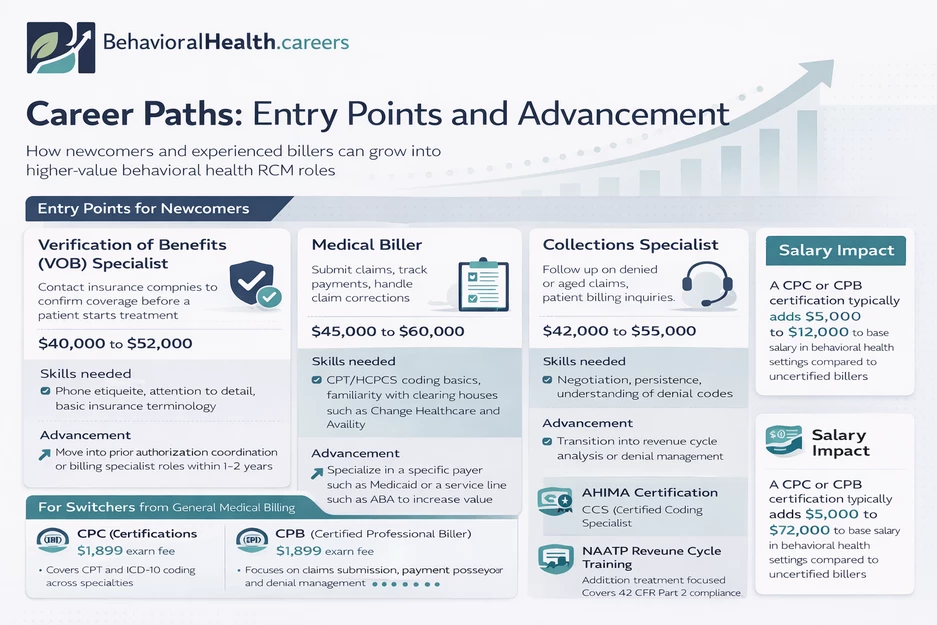
1. Verification of Benefits (VOB) Specialist
- What you do: Contact insurance companies to confirm coverage before a patient starts treatment, including verifying details for high deductible health plans, which can increase patient financial responsibility and impact payment collection.
- Salary range: $40,000–$52,000
- Skills needed: Phone etiquette, attention to detail, basic insurance terminology
- Advancement: Move into prior authorization coordination or billing specialist roles within 1-2 years
2. Medical Biller
- What you do: Submit claims, track payments, handle claim corrections
- Salary range: $45,000–$60,000
- Skills needed: CPT/HCPCS coding basics, familiarity with clearing houses (Change Healthcare, Availity)
- Advancement: Specialize in a specific payer (Medicaid) or service line (ABA) to increase value
3. Collections Specialist
- What you do: Follow up on denied or aged claims, patient billing inquiries. High deductible health plans can make collections more challenging, so offering cost estimates, clear billing communication, and flexible payment plans is essential to improve collections and reduce financial stress for clients in behavioral health.
- Salary range: $42,000–$55,000
- Skills needed: Negotiation, persistence, understanding of denial codes
- Advancement: Transition into revenue cycle analysis or denial management
For Switchers from General Medical Billing
If you’re coming from hospital billing or physician practice management, you already speak the language. Here’s how to position your transition:
- Emphasize payer relations experience: Behavioral health lives and dies on payer relationships: your ability to escalate denials to payer reps is gold
- Highlight authorization management: If you’ve managed pre-auths for surgery or imaging, you understand the workflow; BH just has tighter timelines
- Pursue BH-specific training: Companies like Zealie offer behavioral health billing bootcamps (4-8 weeks) that translate your existing skills into BH contexts
- Look for partners with a proven track record: When considering outsourcing revenue cycle management in behavioral health, prioritize vendors with a proven track record in financial workflows and operational efficiency. Outsourcing RCM tasks to specialized partners can improve financial performance for behavioral health practices.
Salary boost potential: Switching from general medical billing ($55,000 average) to specialized behavioral health billing typically yields a 15-25% salary increase due to complexity premiums.
Certifications That Matter
Certifications signal that you’ve moved beyond on-the-job training into formalized expertise.
AAPC Certifications:
- CPC (Certified Professional Coder): $1,899 exam fee; covers CPT/ICD-10 coding across all specialties
- CPB (Certified Professional Biller): $1,899 exam fee; focuses on claims submission, payment posting, denial management
AHIMA Certifications:
- CCS (Certified Coding Specialist): Broader than CPC; includes inpatient coding (not always relevant for outpatient BH, but valued by large health systems)
BH-Specific Training:Most valuable for rapid skill-building:
- Zealie Behavioral Health Billing Certification: 6-week online program covering addiction, mental health, and ABA billing nuances
- NAATP Revenue Cycle Training: Addiction treatment-focused; covers 42 CFR Part 2 compliance
Salary impact: A CPC or CPB certification typically adds $5,000–$12,000 to base salary in BH settings compared to uncertified billers. In addition to increasing individual earning potential, obtaining these certifications can help improve financial performance for both individuals and behavioral health practices by ensuring more accurate billing and optimized revenue cycle management in behavioral health.
Remote Work: Security, Compliance, and Flexibility
RCM roles are among the most remote-friendly positions in healthcare. Patient interaction is minimal, and the work is entirely computer-based. However, with the rise of remote work, it is crucial to implement robust security measures to protect sensitive patient information.
The year 2026 brings stricter requirements around data security, making it essential to protect sensitive patient information not only for regulatory compliance, such as HIPAA, but also to maintain trust and safeguard organizational reputation.
What Employers Require
- VPN-only access: No public WiFi, no exceptions. Most employers issue company laptops with mandatory VPN software
- HIPAA-compliant home office: Lockable room, privacy screens, shredders for printed PHI
- Background checks: Expect fingerprinting and OIG exclusion list verification during onboarding
Data Residency Trends
The shift toward on-shore RCM accelerated in 2025. Healthcare organizations that previously outsourced billing to offshore teams are bringing operations back to the US due to:
- Increased state-level data residency laws (California, New York, and Massachusetts now restrict offshore PHI access)
- AI integration requires tighter feedback loops between clinical and billing teams
What this means for job seekers: Remote RCM positions now heavily favor candidates in the US, often with state-specific preferences for Medicaid billing roles.
2026 Salary Benchmarks
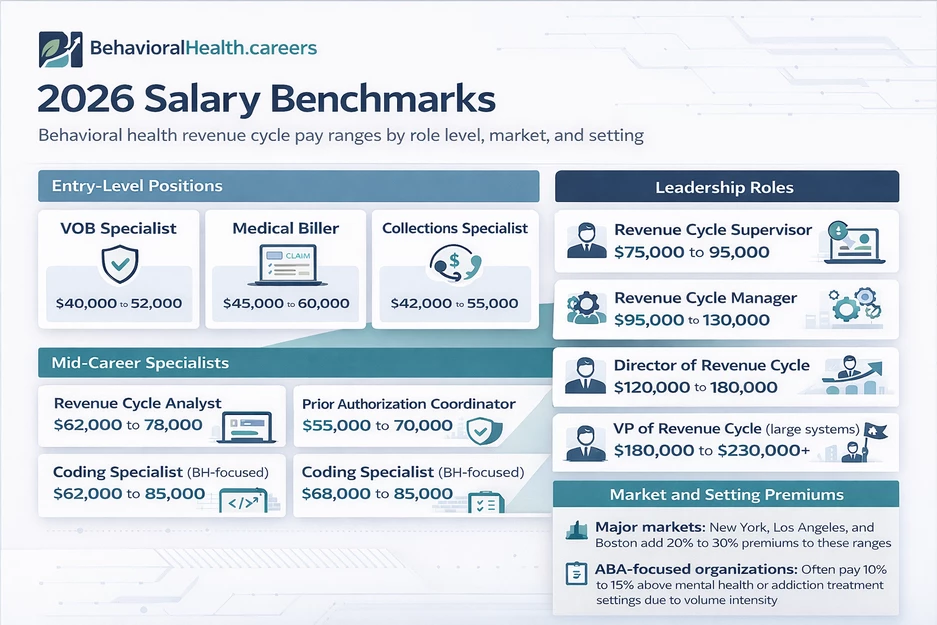
Salaries vary significantly by role level, setting type (nonprofit vs. for-profit), and geography.
Entry-Level Positions:
- VOB Specialist: $40,000–$52,000
- Medical Biller: $45,000–$60,000
- Collections Specialist: $42,000–$55,000
Mid-Career Specialists:
- Revenue Cycle Analyst: $62,000–$78,000
- Prior Authorization Coordinator: $55,000–$70,000
- Coding Specialist (BH-focused): $68,000–$85,000
Leadership Roles:
- Revenue Cycle Supervisor: $75,000–$95,000
- Revenue Cycle Manager: $95,000–$130,000
- Director of Revenue Cycle: $120,000–$180,000
- VP of Revenue Cycle (large systems): $180,000–$230,000+
Major markets (New York, Los Angeles, Boston) add 20-30% premiums to these ranges. ABA-focused organizations often pay 10-15% above mental health or addiction treatment settings due to volume intensity.
Effective revenue cycle management in behavioral health not only supports competitive salaries but also drives revenue growth and improves overall cash flow for organizations.
Practices that invest in end-to-end RCM technology can see a 20-30% improvement in cash flow within the first year, highlighting the importance of optimizing RCM roles and processes to improve cash flow and financial performance.
What Hiring Managers Look For in 2026
Beyond certifications and experience, employers prioritize:
- Payer fluency: Can you speak confidently about the differences between Medicare, Medicaid, and commercial payers without looking it up?
- Denial resolution: Show examples of tracking down why claims were denied and successfully overturning them
- Tech adaptability: Familiarity with Epic, Athenahealth, Kareo, or other EHR/billing platforms signals you won’t need months of software training
- Clinical curiosity: The best RCM professionals ask “Why did the clinician document it this way?” rather than just coding what’s in front of them
- Focus on patient experience and outcomes: Effective revenue cycle management in behavioral health not only streamlines operations but also enhances patient experience and improves patient outcomes by supporting high quality care. Implementing automated solutions can further improve patient experiences through timely billing and clear communication.
Find Your Next RCM Role
Revenue cycle management in behavioral health combines regulatory expertise, investigative problem-solving, and increasingly, AI collaboration.
Streamlining processes and maintaining an optimized RCM process are essential for behavioral health services, as they simplify administrative workflows, speed up reimbursements, and reduce operational headaches.
Behavioral health revenue cycle management includes steps for healthcare providers to manage finances efficiently, beginning with patient registration and continuing through billing and payment collection.
The field rewards specialists who understand the nuances of addiction billing, mental health parity laws, ABA authorization cycles, and the importance of financial management in ensuring process efficiency, accuracy, and revenue optimization.
If you’re ready to move beyond generic medical billing into a higher-complexity, higher-compensation niche, explore current openings at BehavioralHealth.careers, where specialized RCM roles across addiction, mental health, and ABA settings are posted daily.