Disclaimer: Requirements, certifications, and regulations for Community Health Workers vary widely by state. It’s important to check with your state licensing board or prospective employer to understand the specific mandates before pursuing certification or accepting a role.
This comprehensive guide is designed for anyone interested in starting or advancing a career as a community health worker (CHW).
These careers offer meaningful opportunities to improve health outcomes, engage with communities, and develop professionally.
The job outlook is strong, with employment projected to grow 11 percent from 2024 to 2034, much faster than the average for all occupations.
Here, you’ll find insights on the 2026 job market, essential skills, and the evolving shift toward Medicaid-reimbursable service models.
At a Glance: The CHW Career Landscape
If you’re seeking a rewarding role that bridges the gap between clinical providers and the community, here’s a snapshot of the current field:
- Role Synonyms: Health Navigator, Community Health Advocate, Outreach Coordinator, Public Health Aide.
- 2026 Median Salary: Approximately $54,200 nationally, with higher wages in specialized behavioral health hubs. For context, the median annual wage for community health workers was $51,030 in May 2024.
- In major metropolitan areas, starting salaries typically range from $35,000 to $42,000. Experienced CHWs can earn $42,000 to $52,000, and supervisors may make between $52,000 and $60,000.
- Top Hiring States: Pennsylvania, California, New York, Vermont, and New Mexico lead the way in demand.
- The community health worker field is expected to grow between 11% and 13% from 2024 to 2034.
- Several states have introduced credentialing programs to professionalize CHW roles.
- Workforce development is a major focus, with standardized onboarding, cross-training, supervision, and career growth pathways.
- Primary Focus Areas: Public health education, systems advocacy, and resource navigation.
- Technology Trends: Increasing use of mHealth tools and mobile AI decision-support systems to aid field-based patient tracking and care coordination.
What is Community Health?
Community health workers are the heart of community wellness. They serve as trusted guides who help individuals and families navigate the often complex landscape of health and human services.
The term “community health worker” covers a range of roles, such as health educators, outreach workers, and community health representatives, all dedicated to increasing health knowledge and strengthening both individual and community capacity.
CHWs typically work directly with patients, clients, and community members, providing health education, connecting people to essential services, and offering support that is especially valuable for those facing barriers to care.
By bridging the gap between communities and healthcare professionals, CHWs play a vital role in improving access to health services, empowering communities, and promoting a culture of wellness and prevention.
Defining the Community Health Worker Role
A community health worker is a frontline public health professional who acts as a liaison between health and social services and the community.
Unlike Peer Support Specialists, who draw on shared lived experience with recovery, CHWs rely on formal training in public health, community mapping, health education, and advocacy.
CHWs focus heavily on addressing the social determinants of health (SDoH), factors like housing instability, food insecurity, and transportation challenges that can impact a person’s ability to maintain mental health or follow substance use treatment plans.
For example, a community health worker might organize a local health fair to provide screenings or connect a family facing homelessness to housing resources. Cultural understanding is critical to their work, as it helps build relationships, bridge language and cultural gaps, and promote cultural competence within healthcare teams.
The trust CHWs earn from the communities they serve is foundational to their effectiveness, and maintaining that trust is an ongoing responsibility.
CHWs vs Peer Support Specialists: Understanding the Difference
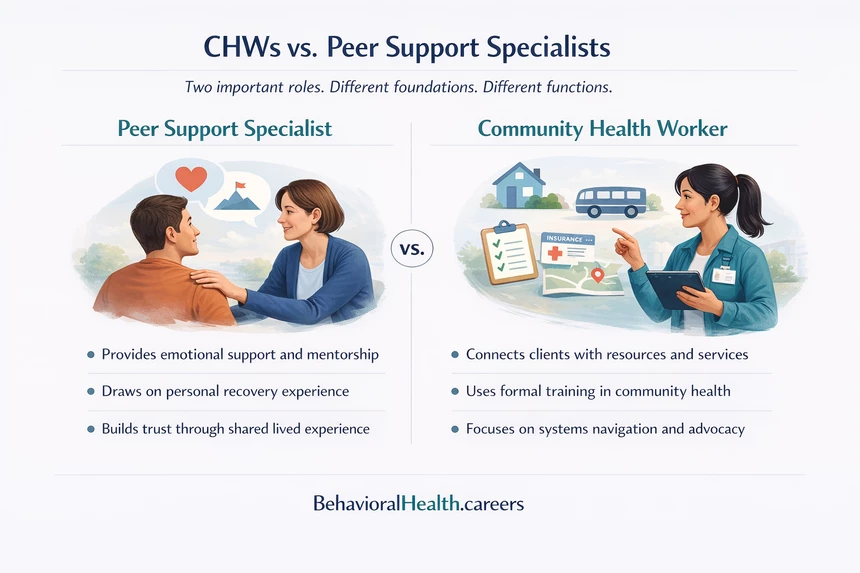
While these roles are often grouped together, they serve distinct purposes:
- Peer Support Specialists: Provide emotional support and mentorship based on personal recovery experience.
- Community Health Workers: Use formal training in community health, systems navigation, and advocacy to connect clients with resources and services.
Where Do Community Health Workers Work?
Community health worker careers have expanded beyond traditional local health departments.
In 2026, CHWs are employed across a variety of settings, including:
- Government agencies: Delivering public health services such as disease prevention, health education, Medicaid enrollment, and community outreach.
- Federally Qualified Health Centers (FQHCs): Playing key roles in integrated care teams.
- 988 Suicide & Crisis Lifeline Teams: Serving as post-crisis follow-up specialists, connecting individuals to ongoing community resources.
- Managed Care Organizations (MCOs): Working to reduce emergency room readmissions among high-risk populations.
- Non-Profit Advocacy Groups: Focusing on specific populations, including rural veterans and urban youth.
- Mobile Crisis Units: Partnering with clinicians to provide immediate resource navigation in the field.
CHWs are essential in improving healthcare access, delivering culturally sensitive health education, assisting with health insurance enrollment, and helping clients navigate complex social service systems.
rMany CHWs are hired for specific health initiatives, which often depend on short-term funding.
Essential Skills for Behavioral Health Community Health Workers
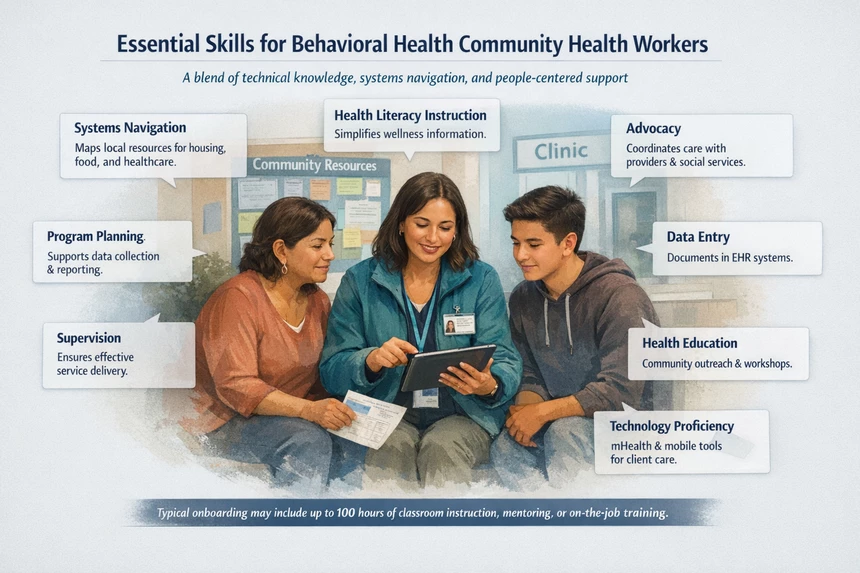
Success in behavioral health CHW roles requires a blend of technical knowledge and interpersonal skills.
Core Competencies:
- Systems Navigation: Mapping local community resources like housing vouchers, food pantries, and low-cost clinics.
- Health Literacy Instruction: Translating complex medical information into understandable wellness plans.
- Advocacy: Representing client needs during interdisciplinary team meetings with healthcare providers and social workers.
- Data Entry: Documenting interventions and social determinants in Electronic Health Records (EHR).
- Health Education: Providing health education and outreach in schools and community settings to raise mental health awareness.
Additional Skills:
- Program Planning: Assisting with data collection, reporting, and evaluation to help improve health initiatives.
- Supervision: Receiving guidance and oversight to ensure consistent service delivery and support workforce development.
Community health workers usually complete a brief period of on-the-job training—often up to 100 hours through classroom instruction, mentoring, or a combination—to gain competency.
Technology Proficiency: Modern CHWs must be comfortable using mHealth tools and mobile AI decision-support systems to provide real-time guidance and track client progress in the field.
Health Education and Promotion
At the core of community health work is health education. CHWs provide clear, accessible information to increase health knowledge among community members and encourage healthy behaviors that prevent illness and support overall wellness.
They organize and participate in community events such as health fairs and workshops, offering basic health screenings and distributing educational materials.
Through informal counseling and one-on-one conversations, CHWs address questions and concerns, helping individuals and families make informed health decisions. By consistently promoting health education, CHWs empower communities to take charge of their well-being and reduce the risk of chronic diseases.
Chronic Disease Management and Prevention
Community health workers play a crucial role in managing and preventing chronic diseases. They provide ongoing education, support, and resources to individuals living with conditions like diabetes, heart disease, and hypertension.
CHWs help clients understand their treatment plans, make healthy lifestyle changes, and connect with healthcare providers and community resources.
By identifying high-risk individuals and delivering targeted interventions, CHWs help prevent disease onset and reduce complications. Their support is vital in ensuring community members receive the education and care needed for effective health management.
Health Screenings and Referrals
Many CHWs conduct basic health screenings, including blood pressure checks, glucose testing, and health risk assessments, to identify individuals at risk for chronic diseases or other health concerns. When issues are detected, CHWs provide referrals to appropriate healthcare providers and community services.
By facilitating access to care, community health workers help individuals and families address health challenges early, improving outcomes and strengthening community health overall.
Cultural Competence in Community Health
Cultural competence is essential for effective community health work. CHWs often serve diverse populations, including Spanish-speaking communities and other minority groups, and must provide care that respects each community’s unique values and beliefs.
By building trusting relationships, CHWs deliver culturally sensitive education and services, ensuring everyone feels understood and supported.
This trust enables CHWs to address social determinants of health, such as education, social support, and economic stability, and advocate for equitable access to healthcare. Prioritizing cultural competence helps reduce health disparities and promotes community health equity.
The 2026 Reimbursement Shift for CHWs: What Employers and Entrepreneurs Should Know
The expansion of G0019 coding for Medicaid reimbursement has transformed CHW sustainability.
This code allows billing for "Community Health Integration" services, enabling CHW roles to shift from grant-funded to revenue-generating positions.
For Employers:
- Sustainable funding streams support long-term CHW staffing.
- CHWs reduce the burden on high-cost clinicians by handling resource navigation, increasing clinic efficiency.
For Freelancers and Entrepreneurs:
- Independent CHW consultants can contract with behavioral health practices to provide "Navigation-as-a-Service."
- Using G0019 and G0022 codes, independent CHWs can build profitable, mission-driven businesses supporting private practices.
The 988 Crisis Response Connection
The 988 Suicide & Crisis Lifeline has become a major employer of community health workers. While clinicians manage immediate crises, CHWs serve as the critical “bridge” to stability.
CHW roles in 988 teams include:
- Conducting 48-hour follow-up calls to ensure safety plans are active.
- Meeting clients in the community to facilitate warm handoffs to outpatient mental health providers.
- Addressing insurance or financial barriers to follow-up care.
- Facilitating access to mental health services for clients and their families.
- Providing outreach and education about behavioral health to students, families, and school staff.
High-Paying States for CHWs and Market Outlook
While demand for CHWs is nationwide, some states stand out for higher pay and strong certification programs:
- Pennsylvania: A leader in Medicaid-funded CHW integration with competitive salaries in urban centers.
- California: High demand for bilingual CHWs, with the most job openings nationally.
- New York: Focus on hospital-based CHW programs and community reinvestment.
- Vermont: Pioneering rural health navigation with attractive pay for frontier-area workers.
- New Mexico: Extensive use of CHWs in tribal health and behavioral health outreach.
What is the Path to CHW Certification?
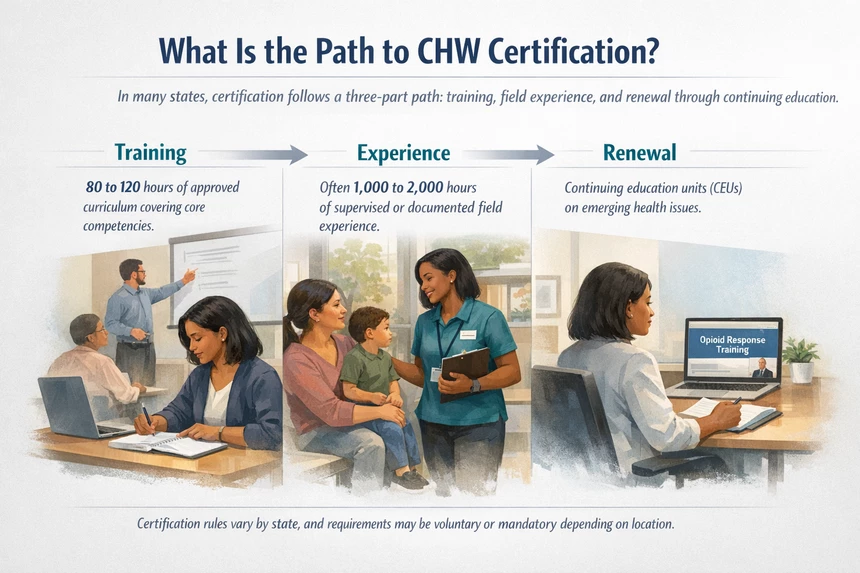
Most states now offer voluntary or mandatory CHW certification, which typically includes:
- Training: 80 to 120 hours of approved curriculum covering core competencies.
- Experience: A required number of hours (often 1,000–2,000) working in the field.
- Renewal: Continuing education units (CEUs) focused on emerging health trends, such as opioid crisis response.
The Challenges of the Role
Working as a community health worker is deeply rewarding but can be emotionally demanding. CHWs often operate in “the gap” where systems have failed individuals.
- Caseload Management: Managing 40–60 active clients at various stages of need is common.
- Field Work: Expect to spend around 70% of your time conducting home visits, shelter outreach, and community engagement.
- Boundary Setting: Maintaining professional boundaries is crucial to prevent burnout, especially since CHWs are trusted community members.
FAQs on Community Health Worker Jobs
Do I need a college degree to be a CHW?
Usually not. Most entry-level behavioral health CHW jobs require a high school diploma plus state-approved training. Some lead or supervisory roles may prefer an Associate’s or Bachelor’s degree in Public Health.
Is this the same as a Social Work Assistant?
There’s some overlap, but Social Work Assistants often focus on case documentation and legal matters. CHWs concentrate on direct community outreach, education, and hands-on resource navigation.
Can I work remotely as a CHW?
Rarely. Most CHW work requires physical presence in the community. However, some 988 follow-up roles offer hybrid options. Check our remote jobs for current opportunities.
The Next Steps to Take to Become a Community Health Worker
If you’re motivated by advocacy and public health, there’s never been a better time to pursue a career as a community health worker.
With Medicaid reimbursement codes providing financial stability and AI-driven tools enhancing precision, CHWs are becoming indispensable in modern behavioral healthcare.
Next Steps:
- Research: Confirm your state’s certification requirements.
- Audit: Build your local community knowledge and resource map.
- Search: Use our job types directory to find CHW and Health Navigator roles near you.
- Apply: Tailor your resume to highlight systems navigation and advocacy skills alongside clinical support.
The demand for community health worker careers is projected to grow by 14% through 2030, outpacing many other healthcare fields.
Start your search today on BehavioralHealth.careers!
References
American Academy of Family Physicians. (2024). HCPCS codes for community health integration (CHI) services: G0019 and G0022. https://www.aafp.org/family-physician/practice-and-career/getting-paid/coding/g0019-g0022-chi-services.html
Association of State and Territorial Health Officials. (2024). Changes to the 2024 Medicare Physician Fee Schedule for community health integration (CHI) services. https://www.astho.org/topic/resource/changes-to-2024-medicare-physician-fee-schedule-for-chi-services/
Centers for Medicare & Medicaid Services. (2024). 2024 Medicare Physician Fee Schedule final rule: Community health integration services. U.S. Department of Health and Human Services. https://www.cms.gov/medicare/payment/fee-schedules/physician
Health Resources and Services Administration. (2024). About the Health Center Program. Bureau of Primary Health Care, U.S. Department of Health and Human Services. https://bphc.hrsa.gov/about-health-center-program
Health Resources and Services Administration. (2025). State of the behavioral health workforce, 2025. National Center for Health Workforce Analysis, U.S. Department of Health and Human Services. https://bhw.hrsa.gov/sites/default/files/bureau-health-workforce/data-research/Behavioral-Health-Workforce-Brief-2025.pdf
National Association of Community Health Workers. (n.d.). Community Health Worker Core Consensus (C3) Project. Retrieved April 2026, from https://nachw.org/projects/community-health-worker-core-consensus-c3-project/
Rosenthal, E. L., Menking, P., St. John, J., Fox, D., Holderby-Fox, L. R., Redondo, F., Hirsch, G., Lee, L., Brownstein, J. N., Allen, C., Haywood, C., Ortiz Miller, J., Ibarra, J., Cole, M., Huxley, L., Palmer, C., Masoud, S., Uriarte, J., & Rush, C. H. (n.d.). The National Council on CHW Core Consensus (C3) Standards reports and website. Texas Tech University Health Sciences Center El Paso. https://www.c3council.org/
Rural Health Information Hub. (2024). Community health integration services: Care management reimbursement. https://www.ruralhealthinfo.org/care-management/community-health-integration-services
Substance Abuse and Mental Health Services Administration. (2023). 988 Suicide & Crisis Lifeline. U.S. Department of Health and Human Services. https://www.samhsa.gov/mental-health/988
Substance Abuse and Mental Health Services Administration. (2024). Peer support services across the crisis continuum: Connected and strong (Publication No. PEP24-01-019). U.S. Department of Health and Human Services. https://988crisissystemshelp.samhsa.gov/sites/default/files/2024-09/tacc-peer-support-services-pep24-01-019.pdf
Substance Abuse and Mental Health Services Administration. (2025). 2025 National guidelines for a behavioral health coordinated system (Publication No. PEP24-01-037). U.S. Department of Health and Human Services. https://988crisissystemshelp.samhsa.gov/sites/default/files/2025-04/national-guidelines-crisis-care-pep24-01-037.pdf
U.S. Bureau of Labor Statistics. (2024). Community health workers. Occupational Outlook Handbook, U.S. Department of Labor. https://www.bls.gov/ooh/community-and-social-service/community-health-workers.htm
U.S. Department of Health and Human Services, Office of Disease Prevention and Health Promotion. (n.d.). Social determinants of health. Healthy People 2030. Retrieved April 2026, from https://health.gov/healthypeople/priority-areas/social-determinants-health
Vibrant Emotional Health. (2023). Crisis center guidance: Follow-up with individuals in suicidal crisis (988 Lifeline guidance document). https://988lifeline.org/wp-content/uploads/2023/07/May-2023-Follow-up-Guidance-Doc.pdf