If you are searching for how to transfer your counseling license to another state, the first thing to know is that most states do not “transfer” licenses in a simple, automatic way.
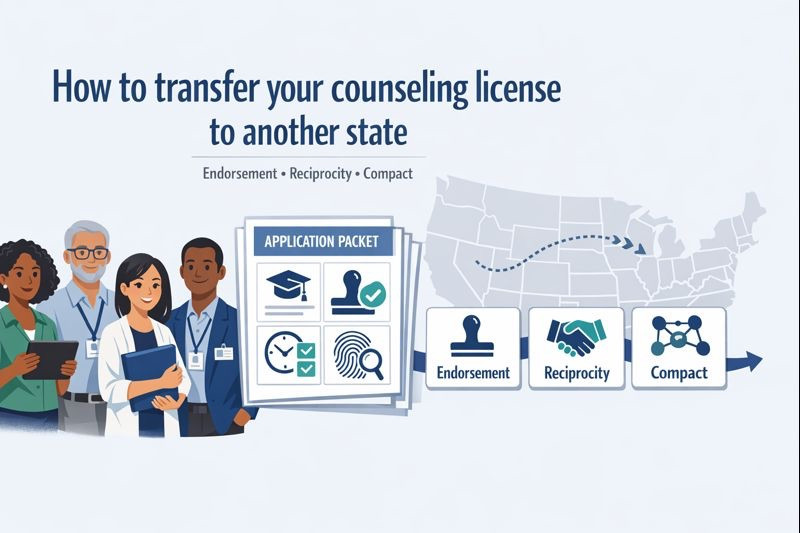
Counseling licensure is state-based, so you usually apply to a new state counseling board through licensure by endorsement (most common), a limited form of reciprocity (when offered), or an interstate compact option (when available). [1][2]
This article is for general informational purposes and is not legal advice. Licensing rules change and vary by state. Always verify requirements with the applicable state licensing board.
What “transferring” a counseling license actually means
A counseling license is issued by a specific state or U.S. jurisdiction. When you move states as a Licensed Professional Counselor (an LPC) or as an LMHC (a related title), your new state counseling board decides whether your existing license and training meet its standards. [1][2]
This process is often referred to as license portability, which means the ability of licensed professionals to practice in other states. License portability is facilitated by mechanisms like endorsement, reciprocity, and interstate compacts.
So “counseling license transfer” usually means one of these:
- You apply for a new license based on your existing license (commonly called licensure by endorsement or “portability”). [2]
- You use a limited reciprocity pathway if your new state offers one (often still requires an application and documentation).
- You use an interstate compact privilege to practice if you and your state are eligible (separate from holding multiple full licenses). [4][7]
The 3 most common pathways when you move to a new state
Licensure by endorsement (most common)
Who it fits: Most fully licensed counselors moving to a new state.
What you usually need:
- Active, unencumbered license in your current state (or clear explanation if inactive)
- Verification of licensure sent directly from your current board
- Official transcripts and degree verification
- Supervised hours documentation (forms, dates, settings, supervisor credentials)
- Documentation of clinical supervision, including verification by your clinical supervisor that you have met the required supervised clinical hours
- Exam score verification (NCE, NCMHCE, or another accepted exam, depending on the state) [9][1]
- Some states require that you hold an unrestricted license and be able to practice independently before you are eligible for endorsement.
- Only counselors licensed in their home state are eligible for endorsement.
Counselors must submit official transcripts, verification of current licenses, supervised clinical hours, and pass state-specific exams when applying for licensure in a new state in order to obtain their new state-specific LPC license.
Common friction points:
- Your license title does not match the destination title (LPC vs LMHC vs LCPC vs LPCC vs LCMHC)
- Missing detail in supervision forms (dates, direct vs indirect hours, supervisor license status)
- Coursework mismatches (credit-hour totals and required content areas vary) [1]
Reciprocity agreements are useful when they exist
Who it fits: Some counselors moving between specific states or into states that offer a defined “reciprocity” route. Some states recognize licenses from other states through reciprocity agreements, but true reciprocity is rare and not universally available.
What you usually need:
- Similar documentation to endorsement, plus specific conditions that vary by state
- Potentially additional requirements, even if reciprocity is offered (jurisprudence exam, extra coursework, or time-in-practice)
Common friction points:
- “Reciprocity” is not uniform. Many states use the term loosely, and the process may still function like endorsement. [2]
- Agreements can be narrow, change over time, or apply only to certain license levels.
Interstate compacts
What the Counseling Compact is: The Counseling Compact is an interstate agreement designed to increase license portability for counselors by allowing practice across compact member states and participating states using a privilege to practice model (including via telehealth), instead of obtaining multiple full licenses.
The Compact enables counselors to practice in other participating states if they hold an unencumbered home state license, and their home state meets specific requirements, such as a 60-hour degree in counseling and passing a nationally recognized examination. Participating states must also require a federal criminal background check for compact eligibility.
The Counseling Compact Commission oversees the process of applying for a Privilege to Practice and will add states as they meet all requirements. As of January 5, 2026, the Compact will be operational for licensees in Arizona, Minnesota, and Ohio. The Compact creates a shared interstate licensure data system for near-instant verification of licensure status, helping improve continuity of care for clients when they or their counselors travel or relocate.
The Compact works with universal license recognition laws to further increase license portability and enhances public protection by ensuring member states share investigative and disciplinary information. [4][7]
What it does and does not do:
- It does: Allow eligible counselors to apply for a privilege to practice in a remote member state once the compact is operational and privileges are being issued. [5][7]
- It does not: Automatically grant multistate practice just because your state enacted the compact. You typically must apply for privileges in each remote state through the compact system. [5]
- It does not: Replace initial licensure rules. States still set requirements for initial licensure. [7]
Current operational reality matters: Compact rollout is staged. For example, compact FAQs and the compact map show that privilege issuance initially opened in a limited way (and the “who can apply where” details can change). Always check the current status before relying on it. [5][6]
Step-by-step: How to transfer your counseling license to another state
Use this as your practical process. Exact steps vary by state, but the workflow below is the most common.
- Identify your destination state counseling board and target license title. Confirm whether you are applying for LPC, LMHC, LCPC, LPCC, LCMHC, or an associate-level credential. Titles and scopes differ by both state and title, with some states referring to practitioners as licensed professional clinical counselors and others simply as 'professional clinical counselors.' [1]
- Download the board’s current application checklist and rules. Do not rely on old PDFs saved from past searches. Boards update instructions. Many states now use an online application process through the state licensing board or regulatory agency website, which can streamline submission and allow you to track your application status. [1]
- Confirm your pathway: endorsement, reciprocity, or compact privilege. Most moves use endorsement. Compact privileges (when available) are a separate pathway from holding a full license in the new state. [2][4][5]
- Compare education requirements and required coursework areas. Some states require 48 credits, others 60, and content-area requirements vary. CACREP status may matter in some states. Verify with the board. [1]
- Confirm exam acceptance and how the board wants proof. Your destination state may require NCE, NCMHCE, or another accepted exam and may require official score verification. NBCC provides score verification reports for third parties when requested. [9][1]
- Gather supervised-hours documentation early. Request supervisor forms, timelines, setting descriptions, and supervisor license details. Missing or vague supervised hours documentation is a common delay.
- Request verification of licensure from your current state board. Many boards require this to be sent directly from the issuing board to the new board. (This often takes longer than you expect.)
- Order official transcripts and any degree verification the board requires. Many boards require transcripts sent directly from the institution. [1]
- Complete background check and fingerprints if required. Requirements vary widely. Some boards require fingerprint-based checks (example: California BBS describes fingerprinting and criminal record checks for applicants). [10]
- Complete a jurisprudence exam if required. Some states require a state law and rules exam (example: Texas requires a jurisprudence examination for LPC candidates). [11]
- Consider a temporary permit if the state offers one. Some states have temporary permissions in specific circumstances (for example, some offer temporary licensing support for military spouses). Always confirm eligibility and limits with the board. Temporary licensure and provisional licenses are a functional option that can allow for employment while the remaining elements for approval are finalized. [12]
- Submit, track, and respond quickly to board requests. Monitor your application portal or board communications and reply fast to deficiency notices. Note that the endorsement process is often time-consuming and can take several weeks to several months.
Estimated timelines (varies by state): Many applications take a few weeks to several months, depending on document delivery, background checks, and board review cycles. Plan your move and job start dates accordingly.
Continuing education mandates to obtain licensure usually differ between state licensing boards, and counselors may need to complete continuing education requirements specific to the new state.
Documents you will almost always need (prepare this before you move)
Prepare these before you give notice or sign a lease. You can control delays here.
- Official transcripts: Typically must be sent directly from your school. [1]
- License verification: Verification of licensure sent from your current board to the new board.
- Supervision verification: Signed forms showing supervised hours documentation, dates, setting, and supervisor credentials.
- Exam scores: Official score verification for NCE/NCMHCE or other accepted exams, if required. [9][1]
- Work history and attestation: Employment verification, role description, and practice dates (if requested).
- References: Some boards request professional references.
- Name change documentation: If your legal name differs from transcripts or past licensure.
- Continuing education records: Sometimes required for endorsement or to prove recent practice (varies).
- Documentation of ability to assess, diagnose, and treat behavioral health conditions: Some states require proof that you are qualified to treat behavioral health conditions as part of your scope of practice.
- Proof of mental health training or experience: Certain states may require documentation of your mental health education or clinical experience as part of the licensure process.
- Telehealth registrations: If you plan to provide telehealth services, you may need to apply for telehealth registrations in some states.
Common problems and how to avoid delays
These issues cause the most frustration in counseling reciprocity and endorsement processes.
- Mismatched titles (LPC vs LMHC vs LCPC vs LPCC vs LCMHC)
Fix: Start with the destination board’s license definition and map your current credential to the closest equivalent. Do not assume titles match across states. [1]
- Missing supervised-hours detail
Fix: Ask your supervisor for complete documentation now. Include setting type, dates, supervisor license number, and whether hours were post-degree (as applicable).
- Expired or inactive license status
Fix: Confirm whether the destination board accepts endorsement from inactive status, or whether you must reactivate first (varies).
- Disciplinary history disclosure
Fix: Answer exactly what the application asks, truthfully and consistently. If the board requests documents, provide official copies. Do not minimize or omit.
- Timing issues with fingerprints and transcripts
Fix: Order early and confirm how documents must be sent. Background check processes can be a bottleneck. [10]
- Telehealth misunderstandings across state lines:
Fix: Assume you must be licensed or otherwise authorized in the state where the client is located, and verify current rules before providing services. Only provide services when you are fully authorized in the client's state, as interstate counseling requires careful attention to both legal and ethical standards.
Federal telehealth guidance highlights multiple cross-state pathways (full license, temporary practice laws, reciprocity, compacts, telehealth registration) and emphasizes confirming patient location. [3] The Counseling Compact also states that counselors must have a license or privilege to practice in the state where the client is located. [5]
When transferring your license or practicing counseling services across state lines, it is essential to adhere to ethical standards, including informed consent, billing practices, and scope of practice, to ensure compliance with both legal and professional guidelines.
Special situations
New grads or associate-level licenses
Associate, intern, resident, provisional, or supervised titles vary by state. Your “license transfer” may actually be an application for a different level in the destination state, with new supervision rules. Start with the destination board’s associate-level pathway and plan supervision early.
Supervisors moving states
If you supervise, expect extra steps. Many states require a separate supervisor credential, board-approved training, or a minimum time-in-practice before you can supervise.
Military spouses
Some states offer expedited processing, temporary licenses, or fee support for military spouses. Check your destination board’s military spouse policies and ask explicitly about available options. [12]
Telehealth-only jobs
Even if a job is remote, licensure is usually tied to the client’s location and state authorization models. Confirm whether the role expects single-state practice, compact privileges, or multiple licenses over time. [3][5]
Moving to multiple states over time
Build a “portability file” you can reuse: transcripts, exam verifications, a clean supervision packet, and an up-to-date work history. This reduces repeat effort for each state counseling board application.
If you are also exploring role options and settings, see our guide to careers in behavioral health as a whole.
Employer guide: Hiring counselors who are relocating or seeking multistate eligibility
For employers and recruiters, multistate hiring succeeds when you plan for licensure timelines and documentation.
- Ask candidates which license they hold today and what title they are seeking in your state (LPC vs LMHC vs LCPC vs LPCC).
- Ask whether they are applying by endorsement, reciprocity, or compact privilege, and what step they are on. [2][4][5]
- Request a document readiness summary: transcripts ordered, verification of licensure requested, supervision forms complete, exam score verification requested (if needed). [9]
- Build realistic start-date options: offer a start date range, or a non-clinical onboarding phase while the license is pending (only if permitted by your compliance policies).
- Budget for relocation support: application fees, fingerprints, exam fees, paid admin time, and transcript costs.
- Clarify temporary permit assumptions: do not assume the candidate can practice while pending. Require written confirmation from the board when needed.
- Write job postings that reduce friction:
- List accepted license titles (and whether equivalents are considered)
- State whether you will hire pending endorsement, and what “pending” means in your process
- Mention whether you support compact-eligible practice, if relevant (and verify current compact operations) [6]
- Credentialing and payer enrollment planning: begin credentialing workflows as early as allowed, since payer timelines may not match board timelines.
- Telehealth compliance: verify where clients are located and ensure the counselor is authorized for those states. [3][5]
Quick checklist: License transfer preparation (in a printable-style)
30 to 60 days before move
- Confirm the destination state counseling board and license title
- Download the current application checklist and rules from the board [1]
- Identify pathway: endorsement, reciprocity, or compact privilege (if available) [2][4][5]
- Request supervision verification forms and supervised hours documentation
- Request verification of licensure from your current board
- Order official transcripts [1]
- Locate exam score reporting requirements and request score verification if needed [9]
Application week
- Complete application carefully and consistently (names, dates, work history)
- Schedule fingerprints/background check if required [10]
- Complete jurisprudence exam if required [11]
- Submit all fees and confirm document delivery method (direct from source vs upload)
While waiting
- Track your application status and respond to board requests quickly
- Plan employment onboarding steps that do not require independent practice (if applicable)
- Confirm telehealth rules based on client location and your authorization status [3][5]
- Continue job search and interviews with clear updates on your timeline
FAQs on Transferring a Counseling License to Another State
1) Is it called reciprocity or endorsement?
Many people say “reciprocity,” but most moves function as licensure by endorsement (portability). Terminology varies, so use the destination board’s wording and requirements. [2]
2) Can I practice while my application is pending?
Sometimes there is a temporary permit or restricted status, but often you must wait for approval. Always verify with the destination state counseling board before providing services. [3]
3) Will my supervised hours count?
Often yes, but it depends on how your hours align with the destination state’s rules (timing, setting, supervisor credentials, content of supervision). Strong supervised hours documentation helps. [1]
4) Do I need the NCE or NCMHCE?
It depends on the state and license level. Many states use NBCC exams for licensure, and boards may require official score verification. [9][1]
5) How long does it take?
Varies by state. Plan for a few weeks to several months, especially if you must wait on transcripts, verification of licensure, fingerprints, or board review cycles.
6) What if my state uses LMHC and the new state uses LPC?
This is common. The key is matching your education, supervised experience, and exam history to the destination state’s license definition. Start by confirming the exact title you are applying for. [1]
7) Do I need a new background check?
Some states require fingerprinting or a new background screening as part of the application process. Verify with the destination board. [10]
8) What if I plan to do telehealth?
Assume you must be authorized in the client’s state. Federal telehealth guidance describes several cross-state options (full license, reciprocity, compacts, telehealth registration) and emphasizes confirming patient location. [3] The Counseling Compact also states you must have a license or privilege to practice where the client is located. [5]
9) Does the Counseling Compact replace getting licensed in a new state?
No. The compact can allow eligible counselors to apply for a privilege to practice in other member states, but it does not change initial licensure standards and it is not automatic. Confirm current operational status. [5][6][7]
10) What should I do first to avoid delays?
Start with the destination board’s checklist, then request verification of licensure and transcripts early. Those are frequent bottlenecks. [1]
Next steps
- Pick your destination state and confirm the license title you are pursuing.
- Download the board checklist and build your document packet before you move. [1]
- Decide whether endorsement, reciprocity, or compact privilege applies to you. [2][4][5]
- Align your job search with realistic licensing timelines.
- Visit BehavioralHealth.careers regularly for the latest updates and newly open roles.
Related Resources
Sources
[1] American Counseling Association (ACA) – Licensure Requirements for Professional Counselors: counseling.org/resources/licensure-requirements
[2] National Board for Certified Counselors (NBCC) – Portability FAQ: nbcc.org/portability/faq
[3] U.S. Department of Health and Human Services (HHS) Telehealth – Licensing Across State Lines: telehealth.hhs.gov/licensure/licensing-across-state-lines
[4] Counseling Compact – Overview: counselingcompact.gov
[5] Counseling Compact – FAQ (privileges, eligibility, client location): counselingcompact.gov/faq
[6] Counseling Compact – Map and current privilege-to-practice status: counselingcompact.gov/map
[7] ACA – Counseling Compact advocacy overview (what it is and what it does): counseling.org/advocacy/counseling-compact
[8] National Governors Association (NGA) – Understanding Behavioral Health Licensure Compacts: nga.org/publications/understanding-behavioral-health-compacts
[9] NBCC – Request a Score Verification Report: nbcc.org/exams/scorereport
[10] California Board of Behavioral Sciences (BBS) – Fingerprinting and background checks (example state process): bbs.ca.gov/consumers/fingerprinting.html
[11] Texas Behavioral Health Executive Council – LPC Jurisprudence Examination (example state requirement): bhec.texas.gov/texas-state-board-of-examiners-of-professional-counselors/jurisprudence-examination
[12] U.S. Department of Labor – Military Spouse License Recognition (temporary license/expedited options vary): dol.gov/agencies/vets/veterans/military-spouses/license-recognition