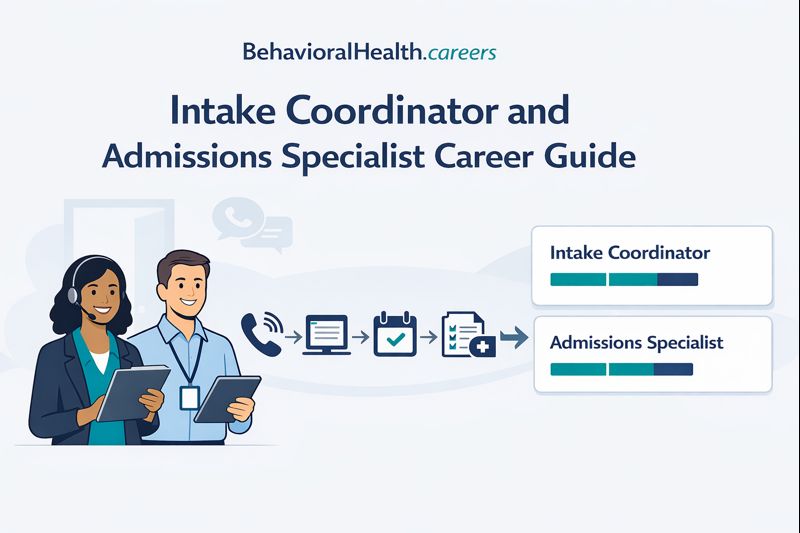
Intake coordinators and admissions specialists are often the first point of contact for clients or patients and are core members of the admissions team responsible for managing the intake process.
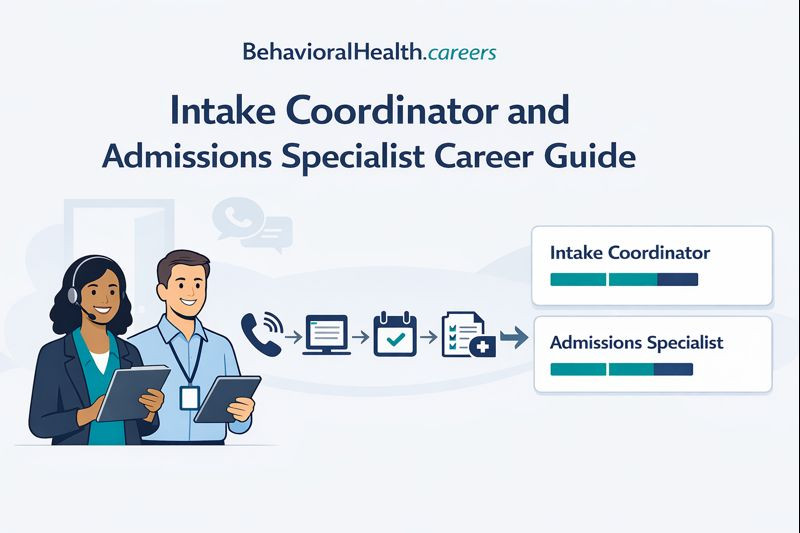
They help people start care by answering inquiries, gathering required information, scheduling next steps, documenting accurately, and handing off to clinical teams.
The ability to communicate effectively, organize information, and manage the intake process is essential for ensuring client satisfaction and seamless onboarding.
This guide from BehavioralHealth.careers explains what the job actually is across common behavioral health settings and how to get hired quickly.
Intake coordinators play a pivotal role in enhancing organizational efficiency and improving client satisfaction. Titles and duties vary widely by employer, so always confirm scope in the job posting.
An at-a-glance summary
- What the role is (plain English): The front door of care. You help people navigate next steps, keep information organized, and route the right details to the right staff.
- Where intake and admissions teams work: Treatment centers, outpatient clinics (IOP/PHP), hospitals/EDs, community mental health treatment, telehealth, and centralized call centers.
- Typical requirements (high level): Customer service or healthcare operations experience, strong phone skills, accurate documentation, confidentiality basics, and background checks (varies).
- Best-fit profiles: Calm communicator, strong communication skills, organizational skills, detail-oriented, consistent follow-through, comfortable with phones and schedules, respectful with sensitive topics.
- **Reality check:**Good day: You reach people fast, schedule smoothly, and hand off cleanly. Hard day: High call volume, complex logistics, and emotionally intense conversations.
What is an intake coordinator or admissions specialist?
An intake coordinator or admissions specialist supports the start of care by handling inquiries, interacting with applicants and prospective students, gathering relevant information (at a high level and guided by policy), scheduling and coordinating next steps, documenting in an EHR/CRM, and handing off to clinical and operational teams.
Proficient admissions specialists must balance traditional interpersonal skills with modern technological proficiency in 2026.
What are some of the core tasks of an admissions specialist?
Admissions specialists are typically required to have a strong understanding of the institution’s admission policies and procedures, and be empathic to callers (and loved ones) seeking support and information on behavioral health services.
In terms of tracking leads and opportunities for admissions or program enrollment, expertise in CRM platforms and tracking systems such as Salesforce and CallRail (or CTM) becomes essential for admissions specialists.
What this role is not
- Not diagnosing
- Not providing therapy
- Not making clinical decisions or doing clinical triage outside your organization’s scripts and escalation policies
Why it matters
- Access and speed to care
- Continuity and clean handoffs
- Patient experience and clear expectations
- Program fit and safer escalation to clinicians when needed
- Excellent communication skills are essential for gathering relevant information and ensuring a positive experience for applicants
Day-to-day responsibilities: real workflows
Handling inbound calls, web leads, and referrals
- Answer inbound calls and respond to web form leads within expected timeframes
- Use respectful, policy-guided language to understand what the caller is looking for
- Route urgent concerns to clinical staff per policy
Gathering information: high-level and policy-guided
- Confirm contact details and preferred communication method
- Collect relevant information, including medical history when applicable, needed to schedule or route appropriately (without diagnosing)
- Ask only what your scripts and workflows require, then escalate when needed
Scheduling and logistics
- Offer appointment options, explain what to expect, and confirm attendance requirements
- Coordinate time zones, transportation needs, interpreter services, or caregiver participation when applicable
- Manage waitlists, reschedules, and no-show recovery workflows
Documentation and data entry
- Enter accurate notes in an EHR/CRM, including call outcomes and next steps
- Create follow-up tasks, reminders, and handoff notes that are clear and complete
- Keep records consistent, timely, and audit-ready
Insurance verification and authorization touchpoints: high level
- Collect insurance information and document payer details
- Use payer portals, phone lines, or internal teams to confirm active coverage and benefit basics
- Route prior authorization or utilization tasks to the appropriate team per workflow
Coordination and handoffs to clinical staff
- “Warm transfer” when appropriate: brief, respectful summary and clean handoff
- Escalate safety or risk concerns to a clinician per policy, then document actions taken
- Coordinate with clinical, billing, utilization, and scheduling teams so nothing stalls
Follow-up and engagement
- Return missed calls quickly, attempt multiple outreach touches per policy, and document outcomes
- Send reminders, confirm paperwork completion, and reduce appointment drop-off
- Keep referral partners informed within privacy rules and organizational policy
Getting started: where these roles work and how the job changes
Entry-level behavioral health roles in admissions typically require 0–2 years of experience, focusing on responsibilities such as application processing and initial student outreach.
About 51%–54% of admissions positions require a bachelor’s degree; recommended majors include Education, Communications, Business, Psychology, or Marketing.
Some roles in admissions may accept an associate degree combined with three to four years of relevant experience in registrar or student services.
Entry-level positions in admissions include Admissions Assistant, Representative, and Coordinator, focusing on application processing and database management.
Requirements and training: what’s common, what varies
Education patterns
- Many roles commonly accept a high school diploma or GED, especially for entry-level intake, scheduling, and call center roles.
- Associate or bachelor’s degrees are often preferred in some settings (hospital systems, specialized programs), but requirements vary.
Background checks and compliance training
- Background checks, confidentiality training, and role-specific compliance training are common, especially in hospitals and regulated settings.
- Requirements vary by employer and setting, so confirm in the posting.
Common skills and expectations
- Phone and written communication: Clear, calm, professional, and consistent; strong communication skills are essential for gathering information and providing support
- Organizational skills: Ability to manage multiple tasks, maintain accurate records, and coordinate between departments to ensure smooth operations
- Scheduling and coordination: Managing calendars, constraints, and follow-through
- Documentation accuracy: Clean, timely notes in EHR/CRM
- Confidentiality basics: High-level HIPAA awareness and appropriate information sharing
- Calm under stress: De-escalation basics and escalation to clinical staff per policy
- Evaluation skills: Ability to evaluate application materials and data to assess fit and effectiveness
Key skills for an Admissions Specialist include strong interpersonal communication, CRM database management, and data analysis.
Helpful but not always required
- Medical office, front desk, or call center experience
- EHR/CRM familiarity
- Exposure to insurance terminology and benefit confirmation at a high level
- Gaining hands-on experience through internships or entry-level positions in healthcare settings is invaluable for aspiring intake coordinators.
- Familiarity with medical terminology is helpful for roles in healthcare settings.
If you have no direct experience, highlight
- Reliability and attendance
- Customer service and conflict resolution
- Attention to detail and documentation habits
- Handling high-volume tasks while staying accurate
Pay and job outlook: careful and useful
Intake and admissions titles do not map perfectly to a single national job code, so pay and outlook are best understood through related healthcare support and administrative roles and by reading postings in your region.
Pay drivers you will see in postings
- Setting and acuity: Hospitals and higher-acuity environments often pay differently than standard outpatient
- Shift coverage: Evenings, weekends, and holidays may come with differentials
- Call volume and performance expectations: Metric-heavy roles can influence total compensation through bonuses or incentives (varies)
- Insurance and VOB exposure: Comfort with payer portals, benefit basics, and documentation can increase competitiveness
- Bilingual skills: Often valued in patient access roles
- Remote vs onsite and region: Labor markets and cost of living influence offers
- Employer type: Health systems, nonprofit CMH, and private treatment programs often structure compensation differently
- Hourly pay rates: Many job postings specify compensation per hour, and hourly pay is common for admissions specialist roles.
Metrics and job posting language: what it really means
Common terms you may see, without judgment:
- Inbound call volume: How many calls or leads you handle per shift/day
- Time-to-contact: How quickly you respond to new leads or referrals
- Conversion rate: Percent of inquiries that schedule, complete an assessment, or progress to the next step (definition varies)
- Show rate: Percent of scheduled appointments that are kept
- Follow-up attempts: How many outreach touches are expected before closing a lead
- Documentation timeliness: How quickly notes and tasks must be completed after contact
- Client satisfaction: A key metric used to evaluate the effectiveness of intake coordinators, reflecting the quality of client interactions and overall service experience.
- Intake process efficiency: Another important metric to evaluate performance, focusing on how smoothly and quickly clients are onboarded and how well the intake process is managed.
Questions to ask before you accept
- How long is the training, and how much shadowing is included?
- What is the escalation process for safety or risk concerns?
- What are staffing levels and call coverage like during peak hours?
- What metrics are measured, how are they defined, and how are they used to evaluate performance, including client satisfaction and the efficiency of the intake process?
- What are the after-hours expectations, and how stable is the schedule?
How to get hired fast: step-by-step plan
- Choose your target setting
- Pick one: treatment admissions, outpatient intake, hospital patient access, or call center intake. Tailor your resume to that environment.
- Translate your experience into intake language
- Customer service, sales, scheduling, dispatch, hospitality, and front desk work all transfer if you emphasize calm communication, accuracy, and follow-through. Entry-level roles in admissions typically require 0–2 years of experience, focusing on responsibilities such as application processing and initial student outreach.
- Prepare a phone-friendly resume
- Use a clean format, short bullets, and keywords that match the posting. Show measurable workflow outcomes without clinical claims.
- Build interview stories about calm communication and follow-through
- Prepare examples of handling an upset caller, prioritizing accurately, and documenting consistently. Be ready for interviews by practicing your responses and expressing hope and optimism about being selected for the position.
- Apply strategically
- Target roles that match your availability. Evening/weekend coverage often hires faster. Hybrid and remote roles for intake specialists can be competitive, so be precise about phone and documentation skills.
- Follow up professionally
- Short email script:
Subject: Follow-up on Intake Coordinator application
Hello [Name], I applied for the Intake Coordinator role on [date]. I’m strong on phone-based support, scheduling, and accurate documentation, and I’m comfortable working in fast-paced workflows. If helpful, I can share availability for an interview this week. Thank you, [Your Name]
Resume guidance: keyword bank and bullet examples
Keyword bank
intake, admissions, patient access, referral coordination, scheduling, documentation, insurance verification (high level), CRM, EHR, warm transfer, follow-up, escalation to clinician per policy, confidentiality
Sample resume bullets: choose and tailor
- Managed high-volume inbound calls, captured accurate details, and routed requests to the appropriate team.
- Scheduled appointments across multiple provider calendars while reducing conflicts and reschedules.
- Documented call outcomes and next steps in a CRM/EHR with consistent formatting and timely completion.
- Coordinated handoffs between scheduling, clinical staff, and billing to prevent delays in service start.
- Used structured scripts and respectful language to support callers and set expectations for next steps.
- Maintained confidentiality and followed privacy practices when handling sensitive information.
- Completed benefit intake fields accurately and flagged authorization or coverage questions to the appropriate team.
- Followed up on missed calls and web leads using a structured outreach cadence and clear documentation.
- Resolved scheduling barriers by offering alternatives and confirming requirements before appointments.
- Maintained organized records, task lists, and reminders to ensure reliable follow-through.
- Collaborated with team members to improve intake workflow consistency and reduce dropped handoffs.
- Stayed calm during high-stress interactions and escalated concerns to supervisors or clinicians per policy.
What not to write
- Diagnosing language or clinical conclusions
- Claims that you conduct clinical assessments or determine level of care independently
- Any sensitive details about specific individuals or situations
Interview questions and strong answer frameworks
Common interview questions
- How do you handle an upset or anxious caller?
- What does strong documentation look like to you?
- How do you prioritize when the phones are nonstop?
- Describe your experience with scheduling and calendars.
- How do you ensure follow-through on call-backs and tasks?
- What tools have you used (CRM, EHR, call platforms)?
- How do you protect confidentiality in a busy environment?
- How do you handle a situation outside your scope?
- What metrics have you worked under, and how did you stay consistent?
- How do you avoid errors when moving fast?
- How do you communicate handoffs to other teams?
- Why this setting (treatment, outpatient, hospital, call center)?
STAR frameworks you can adapt
Handling an upset caller respectfully
- Situation: Caller frustrated and emotional about delays.
- Task: Support them, gather essentials, and route correctly.
- Action: Used calm tone, clarified next steps, confirmed contact info, set a callback time, escalated per policy if needed.
- Result: Caller understood the plan; handoff completed; documentation captured.
Managing high volume while staying accurate
- Situation: High call volume and multiple pending tasks.
- Task: Maintain speed without mistakes.
- Action: Used a structured note template, quick confirm-backs, and task flags; prioritized time-sensitive items first.
- Result: No dropped follow-ups; clean documentation; steady performance.
Coordinating a complicated schedule or referral
- Situation: Multi-party appointment constraints and paperwork deadlines.
- Task: Schedule efficiently and prevent delays.
- Action: Offered ranked options, confirmed requirements, sent reminders, and tracked completion.
- Result: Appointment kept; fewer reschedules; smooth handoff.
Escalating to a clinician per policy and documenting clearly
- Situation: Caller expressed a concern that required clinical support.
- Task: Follow policy and protect safety within your scope.
- Action: Kept the caller engaged, initiated warm transfer or escalation pathway, documented steps taken, and outcome.
- Result: Clinician took over; process followed; clear record maintained.
Career paths and advancement
Professional progression in admissions generally follows a structured hierarchy based on experience and leadership responsibilities. Realistic pathways vary by employer, but common next steps include:
- Admissions Counselor and Senior Admissions Specialist: These mid-level positions typically require 3–6 years of experience, involve increased responsibilities, and often focus on managing recruitment projects and overseeing specific territories.
- Lead Intake Coordinator, Admissions Supervisor
- Patient Access Lead, Patient Access Manager in hospital systems
- Care coordination support roles that build toward case management teams (role scope varies)
- Utilization management support, authorizations, and billing pathways for those who like payer workflows
- Clinical paths are only if you pursue additional education, supervised training, and licensure requirements
Senior roles in admissions may include Associate/Assistant Director or Director of Admissions, focusing on enrollment strategy, policy development, and cross-departmental leadership.
Senior leadership roles typically require 7+ years of experience, and a master’s degree in Higher Education Administration or College Counseling is often preferred for positions such as Admissions Manager or Dean.
Green flags and red flags in intake and admissions job postings
Green flags
- Clear training plan and shadowing schedule
- Defined metrics with reasonable expectations and clear definitions
- Transparent pay range and schedule details
- Strong supervision and clear escalation protocols
- Realistic scope and boundaries for non-clinical staff
Red flags
- Pressure to provide clinical advice or make clinical decisions
- Vague training and “figure it out” culture
- Unrealistic conversion targets without support
- Unclear schedule, frequent last-minute changes, or chronic understaffing
- Scope that mixes intake with clinical triage beyond policy-guided escalation
FAQs on Admissions Coordinator Careers
What does an intake coordinator do in behavioral health?
They handle inquiries, gather required information at a high level, schedule next steps, document accurately, and hand off to clinical or operational teams.
What is the difference between intake and admissions?
Intake often focuses on first contact and scheduling. Admissions often includes additional steps to confirm readiness and coordinate the start of services. Definitions vary by employer.
Do I need a degree for intake coordinator jobs?
Not always. Many entry-level roles accept a high school diploma or GED, while some employers prefer college or healthcare experience.
Is intake coordinator a clinical role?
No. It is typically an operations and coordination role. Clinical decisions are handled by licensed staff.
Are there remote intake coordinator jobs?
Yes, especially in centralized intake and telehealth call centers. Competition can be higher, so emphasize phone skills and documentation accuracy.
What is verification of benefits (VOB)?
A non-clinical process to confirm a person’s health insurance coverage status and basic benefit information, documented for the care team and billing workflow.
What should I ask about training and metrics?
Ask about training length, shadowing, escalation policies, staffing levels, how metrics are defined, and how performance is coached.
What shifts are most common?
It depends on setting. Hospitals and call centers often require broader coverage. Outpatient clinics tend to have more standard business hours.
What skills matter most for success?
Calm phone communication, organization, accurate documentation, follow-through, and comfort coordinating schedules and handoffs.
Is this a good path into case management or clinical roles later?
It can be a strong foundation for care coordination support or operations pathways. Clinical roles usually require additional education, supervised training, and licensure.
Related Resources
- Careers in Behavioral Health
- Behavioral Health Technician vs Mental Health Technician vs Psych Aide
- Behavioral Health Case Manager and Care Coordinator Career Guide
- Substance Abuse Counselor Career Guide
- LCSW Career Guide
- Peer Support Specialist Career Guide
- Mental Health Counselor Career Guide
- Therapist Onboarding Checklist
Sources
- O*NET OnLine, Patient Representatives (task and workflow context). (O*NET OnLine)
- O*NET OnLine, Medical Secretaries and Administrative Assistants (scheduling, documentation, billing-related context). (O*NET OnLine)
- U.S. Bureau of Labor Statistics, Secretaries and Administrative Assistants (broad administrative outlook context). (Bureau of Labor Statistics)
- U.S. Bureau of Labor Statistics, Medical Assistants (healthcare support outlook context and administrative task overlap). (Bureau of Labor Statistics)
- U.S. Bureau of Labor Statistics, Medical Records Specialists (documentation and EHR context). (Bureau of Labor Statistics)
- U.S. Department of Health and Human Services, Summary of the HIPAA Privacy Rule (confidentiality basics context). (hhs.gov)