Who this set of checklists is for and how to use them effectively
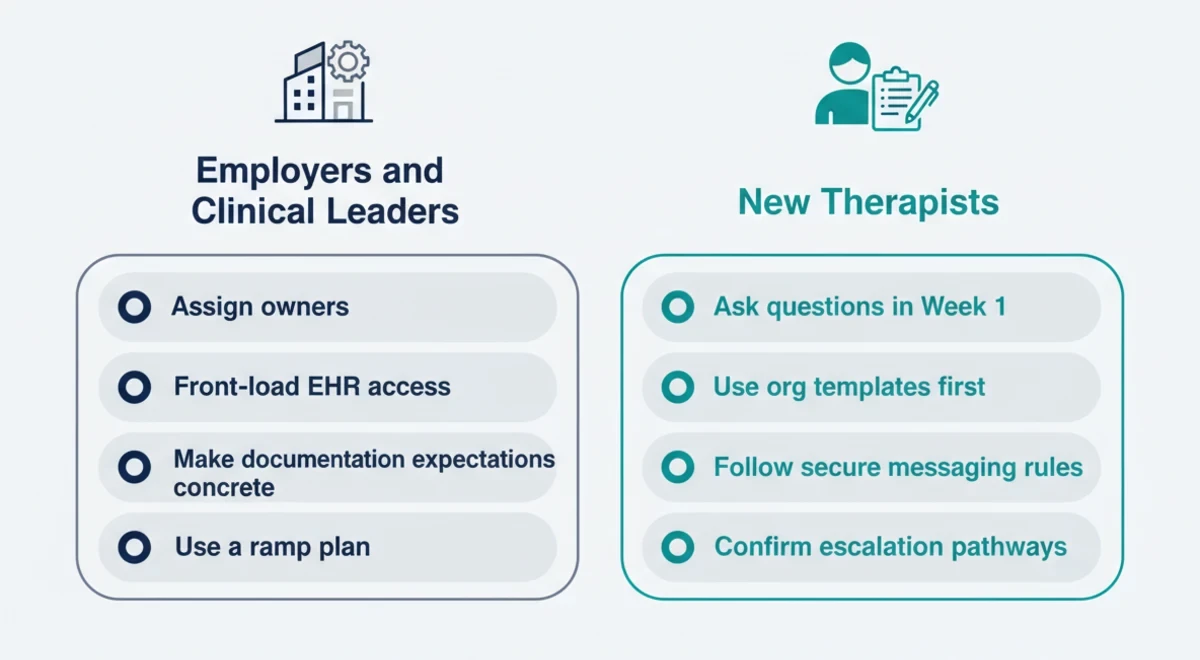
For employers and clinical leaders: Use this as an operational checklist to assign owners, track completion, and standardize the therapist experience across outpatient, inpatient/residential, community mental health, private practice groups, school-based programs, telehealth, and SUD/addiction treatment settings.
Before onboarding, determine the central factors and requirements for each therapist role, such as responsibilities and qualifications.
When hiring, a multi-step hiring process is essential to accurately assess each candidate and ensure they meet non-negotiable criteria.
Critical factors should be considered when evaluating candidates for therapist positions.
For therapists (licensed and pre-licensed): Use this to self-prepare, ask the right questions early, and confirm you have what you need to provide safe, consistent care within your organization’s policies.
Inclusive definition of “therapist” (US-only): This checklist applies to common roles such as LMFT, LPC/LMHC/LCMHC, LCSW/LICSW, psychologists, and associate or pre-licensed clinicians who practice under supervision where applicable.
How to copy/paste into an internal doc:
- Paste this checklist into a shared document (Google Doc, Word, Notion, Confluence) or your onboarding ticketing system.
- Add columns if you want (Status, Date completed, Notes), but you can also keep it as-is and check boxes.
- Keep one “Master” version, then clone per hire.
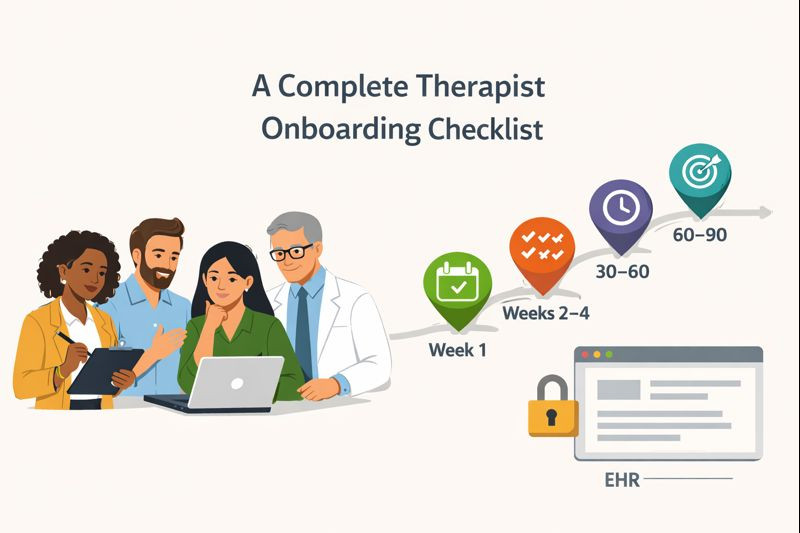
Timing phases used in this guide:
- Pre-start: from offer acceptance to Day 1
- Week 1: Days 1–5
- Weeks 2–4: Days 6–20
- Days 30–60: Month 2
- Days 60–90: Month 3
An Important note: This resource is operational guidance, not legal advice. Requirements vary by state, payer, setting, and license type. Follow your organization’s policies, payer contracts, and applicable state licensing board rules.
Related Resources for Employers and Clinicians
- The Behavioral Health Workforce Outlook for 2026
- Transferring your counseling license to another state
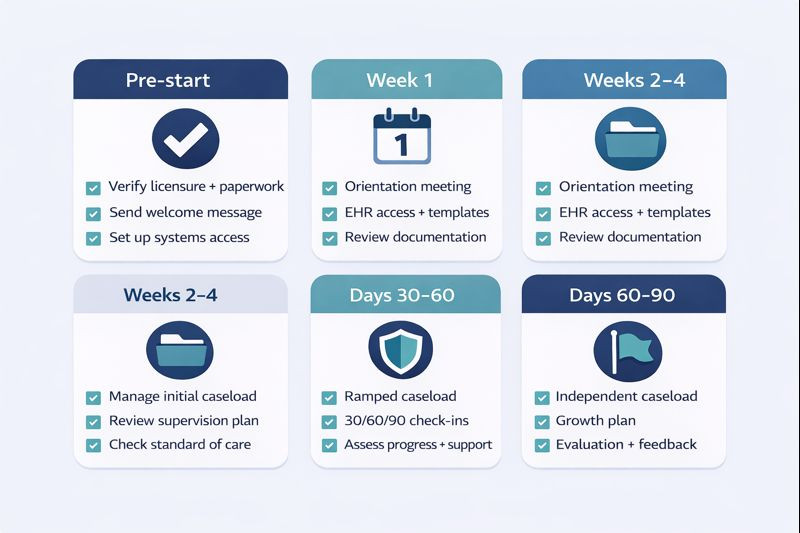
Your quick-start checklist:
Pre-start (offer accepted)
- Verify licensure, NPI (if applicable), background checks, and collect required paperwork
- Confirm the scope of the role, caseload expectations, schedule template, and start date plan
- Request EHR access, email, and required systems
- Assign supervisor, mentor, and supervision cadence (especially for associates)
- Schedule HIPAA/security training, documentation standards, and safety protocol training
- Build a Week 1 calendar with owners for each session
- Prepare workspace, equipment, and telehealth setup (if applicable)
- Create a training checklist for the new hire before their start date to reduce onboarding time and improve efficiency
Week 1 (Day 1–5)
- Complete HR onboarding and required acknowledgments
- EHR navigation essentials: scheduling, note templates, messaging rules
- Review documentation standards, informed consent workflow, and privacy practices
- Learn intake flow, triage, referrals, consult/escalation pathways
- Shadow 1–2 intakes or sessions (as appropriate to setting)
- Set 30/60/90 goals and a supervision plan
- As part of the orientation process, schedule introductions to colleagues, including fellow therapists and administrative staff, to support team integration and collaboration.
Weeks 2–4
- Begin ramped caseload with weekly documentation feedback
- Learn billing basics, prior auth touchpoints, and UR workflow (as applicable)
- Join case conference and interdisciplinary meetings
- Confirm measurement-based care tools and patient education materials (if used)
- As part of the various tasks and additional steps during this period, supervisors should evaluate the new hire's clinical skills to ensure competency and integration into the team.
Days 30–60
- Documentation audit and competency check-in
- Confirm caseload targets and workflow efficiency
- Review risk management procedures and secure communication habits
Days 60–90
- Performance review touchpoint and ongoing training plan
- Confirm CE expectations, specialty pathways, and next-quarter goals
- Validate long-term supervision cadence (especially for associates)
A Complete therapist onboarding checklist
How to use this section: Check off items as completed.
Each line includes Owner, When, and a short Why it matters.
A comprehensive therapist onboarding checklist ensures legal compliance, operational efficiency, and smooth integration into your practice culture.
Using practice management software can streamline the onboarding process for new therapists by providing tools for scheduling, billing, and client management.
Consider using a digital onboarding platform to reduce the time spent on administrative tasks and save valuable time, allowing therapists to focus more on client care.
Automated systems and practice management software can help automate administrative tasks, further streamlining your onboarding process.
- Create processes and systems to streamline the onboarding process:
Owner - Practice Manager
When - Before onboarding begins
Why it matters - Streamlining and creating efficient systems saves valuable time and ensures a smooth transition for new therapists.
- Use a digital onboarding platform or practice management software:
Owner - Practice Manager
When - During onboarding
Why it matters - Automates administrative tasks, reduces manual effort, and allows therapists to focus on client care.
- Ensure compliance with regulatory requirements and industry standards:
Owner - Compliance Officer;
When - Ongoing;
Why it matters - Meeting legal, professional, and industry standards, including data security measures for GDPR compliance, is essential for smooth operations and organizational success.
- Maintain detailed financial records:
Owner - Finance/Admin
When - Ongoing
Why it matters - Crucial for compliance and effective expense management in a private practice.
- Establish your private practice:
Owner - Practice Owner
When - Before onboarding
Why it matters - Secure the right credentials, officially register your business, and create a business plan to outline your target clients and specialisms.
- Establish clear payment policies:
Owner - Practice Owner/Finance;
When - Before seeing clients;
Why it matters - Manages client payments and ensures financial sustainability.
Phase 1: Pre-start from the offer accepted to Day 1
Hiring, credentialing, and readiness
- Confirm signed offer letter and start date (Owner: HR; When: Pre-start; Why it matters: Locks in timelines and next steps.)
- Provide final job description and core duties review (Owner: HR; When: Pre-start; Why it matters: Aligns expectations and scope. Note: Determine key factors for the role, such as essential responsibilities and required qualifications, to ensure the candidate is a good fit.)
- Review role scope within setting (outpatient, inpatient, school-based, telehealth, SUD) (Owner: Supervisor; When: Pre-start; Why it matters: Reduces role confusion and risk.)
- Verify license status and standing with the state board (Owner: HR; When: Pre-start; Why it matters: Confirms eligibility to practice. Note: Credential verification should include confirming active licensure, professional liability insurance, and, if applicable, NPI number.)
- Verify associate or pre-licensed status and allowable activities (Owner: Supervisor; When: Pre-start; Why it matters: Ensures work stays within supervision rules.)
- Confirm NPI status or plan to obtain if required for the role (Owner: Therapist; When: Pre-start; Why it matters: Supports billing, credentialing, and payer workflows [3].)
- Collect required IDs and employment eligibility documentation (Owner: Therapist; When: Pre-start; Why it matters: Prevents Day 1 delays.)
- Run background check(s) per policy and setting (Owner: HR; When: Pre-start; Why it matters: Meets organizational and facility requirements.)
- Complete reference checks per policy (Owner: HR; When: Pre-start; Why it matters: Confirms fit and professionalism. A multi-step hiring process helps ensure that each candidate is accurately assessed before making a hiring decision.)
- Confirm immunizations, screenings, or health clearance if required by setting (Owner: HR; When: Pre-start; Why it matters: Supports safety and facility policy.)
- Confirm malpractice coverage approach (org-provided or individual) as applicable (Owner: HR; When: Pre-start; Why it matters: Clarifies professional protection and expectations.)
- Initiate payer credentialing steps if applicable (CAQH, payer rosters, facility enrollment) (Owner: Billing; When: Pre-start; Why it matters: Avoids revenue and access delays.)
- Check exclusion databases if required by payer/program participation (Owner: HR; When: Pre-start; Why it matters: Helps meet federal program participation expectations [4].)
Supervision and clinical governance
- Assign clinical supervisor and backup supervisor (Owner: Supervisor; When: Pre-start; Why it matters: Ensures continuity for guidance and escalation. Note: Clinical supervision is essential for professional development, licensure, and preventing burnout. Providing clinical supervision supports therapists and social workers in building clinical skills and maintaining high standards of care.)
- Create a supervision plan (frequency, format, documentation) for associates (Owner: Supervisor; When: Pre-start; Why it matters: Supports compliant practice and skill growth.)
- Assign an onboarding mentor or peer buddy (Owner: Supervisor; When: Pre-start; Why it matters: Improves integration and reduces ramp time. Clinical consultation with a mentor or peer buddy offers ongoing support, guidance, and professional development opportunities.)
- Define documentation review process during ramp (Owner: Supervisor; When: Pre-start; Why it matters: Builds quality early and prevents rework.)
- Define escalation pathways for clinical questions and safety concerns (Owner: Supervisor; When: Pre-start; Why it matters: Ensures clear response routes.)
Policies, compliance, and training scheduling
- Send employee handbook and policy acknowledgment list (Owner: HR; When: Pre-start; Why it matters: Sets expectations before Day 1.)
- Schedule HIPAA privacy training (Owner: HR; When: Pre-start; Why it matters: Establishes privacy responsibilities for protected health information [1]. Note: This training is required to meet regulatory requirements and adhere to industry standards for privacy and data protection.)
- Schedule HIPAA security training for electronic systems (Owner: IT; When: Pre-start; Why it matters: Reinforces safeguards for ePHI [2]. Note: HIPAA compliance requires rigorous training on confidentiality, data storage, and breach protocols to ensure compliance with legal and industry standards.)
- Schedule documentation standards training (Owner: Supervisor; When: Pre-start; Why it matters: Aligns clinical notes with org requirements. Emphasize the importance of training standards and ensure compliance with industry standards and accreditation benchmarks.)
- Schedule mandated reporting and duty-to-warn policy review (Owner: Supervisor; When: Pre-start; Why it matters: Clarifies internal procedures without relying on informal guidance.)
- Schedule crisis/safety protocol orientation appropriate to the setting (Owner: Supervisor; When: Pre-start; Why it matters: Prepares for standardized responses and referrals.)
- Schedule training for informed consent workflow and privacy practices notice handling (Owner: Supervisor; When: Pre-start; Why it matters: Supports consistent client communication.)
Systems, access, and logistics
- Submit EHR access request with role-based permissions and ensure electronic health records are configured and accessible (Owner: IT; When: Pre-start; Why it matters: Prevents access delays and streamlines digital documentation.)
- Create email, chat, scheduling accounts, professional email, EHR system access, and virtual phone numbers (Owner: IT; When: Pre-start; Why it matters: Enables day-to-day communication and ensures all necessary IT access is established.)
- Provision MFA and password manager where required (Owner: IT; When: Pre-start; Why it matters: Reduces security risk.)
- Collect emergency contacts as part of required paperwork (Owner: Admin; When: Pre-start; Why it matters: Ensures safety and preparedness in case of emergencies.)
- Confirm templates: note types, treatment plan, discharge summary (as applicable) (Owner: Supervisor; When: Pre-start; Why it matters: Standardizes documentation.)
- Provide scheduling template and appointment types (Owner: Admin; When: Pre-start; Why it matters: Supports predictable availability.)
- Define expected caseload ramp plan (Owner: Supervisor; When: Pre-start; Why it matters: Prevents overload and supports quality.)
- Prepare workspace (office, badge, keys) or for a remote therapist role, the required hardware and software (Owner: Admin; When: Pre-start; Why it matters: Removes Day 1 friction.)
- Confirm equipment needs (laptop, headset, webcam) (Owner: IT; When: Pre-start; Why it matters: Ensures readiness for sessions and charting.)
- Build a Week 1 orientation calendar with owners (Owner: Supervisor; When: Pre-start; Why it matters: Makes onboarding consistent and trackable.)
Phase 2: Day 1 and Week 1 (Days 1–5)
Day 1 essentials
- Welcome, role overview, and success definition (Owner: Supervisor; When: Day 1; Why it matters: Aligns expectations and priorities.)
- HR onboarding completion: payroll, benefits, required forms, and collection of all required paperwork as part of the onboarding process (Owner: HR; When: Day 1; Why it matters: Ensures employment setup is complete and supports a smooth onboarding process.)
- Review confidentiality expectations and minimum necessary access (Owner: HR; When: Day 1; Why it matters: Reinforces privacy responsibilities [1].)
- Review secure communication rules (email, texting, portals) (Owner: IT; When: Day 1; Why it matters: Prevents privacy and security mistakes.)
- Confirm supervision cadence and first supervision meeting date (Owner: Supervisor; When: Day 1; Why it matters: Creates immediate support structure.)
- EHR login confirmed and basic navigation walkthrough (Owner: IT; When: Day 1; Why it matters: Enables documentation from the start.)
- Review note completion timelines and late note escalation (Owner: Supervisor; When: Day 1; Why it matters: Prevents downstream billing and compliance issues.)
- Review informed consent workflow and documentation location (Owner: Supervisor; When: Day 1; Why it matters: Supports consistent client onboarding.)
- Review boundaries, dual relationships, and professional conduct expectations (Owner: Supervisor; When: Day 1; Why it matters: Protects clients and clinicians.)
Week 1 clinical readiness
- Review documentation standards and “what good looks like” examples (Owner: Supervisor; When: Week 1; Why it matters: Sets quality baseline early.)
- Learn treatment planning templates and update cadence (Owner: Supervisor; When: Week 1; Why it matters: Supports continuity and measurement. Note: Comprehensive, accurate treatment plans are essential for client documentation and record-keeping.)
- EHR training: Learn how to complete intake forms, progress notes, and treatment plans in the system (Owner: Supervisor; When: Week 1; Why it matters: Ensures accurate and complete electronic health records.)
- Evaluate clinical skills, including assessment of equipment operation, safety, and emergency protocols (Owner: Supervisor; When: Week 1; Why it matters: Verifies competency and readiness for high-quality patient care.)
- Learn risk screening tools used by the organization (if any) (Owner: Supervisor; When: Week 1; Why it matters: Standardizes assessment workflow.)
- Review safety protocols and internal escalation steps (Owner: Supervisor; When: Week 1; Why it matters: Ensures consistent, timely response.)
- Review mandated reporting internal process and documentation steps (Owner: Supervisor; When: Week 1; Why it matters: Clarifies how to act within policy.)
- Review coordination of care expectations (PCP, psychiatry, case management) (Owner: Supervisor; When: Week 1; Why it matters: Supports team-based care.)
- Review referral pathways (internal, external, higher level of care) (Owner: Supervisor; When: Week 1; Why it matters: Improves appropriate routing.)
- Review cultural humility and accessibility expectations (Owner: Supervisor; When: Week 1; Why it matters: Promotes respectful, equitable care.)
- Review evidence-informed practice norms expected in the setting (Owner: Supervisor; When: Week 1; Why it matters: Aligns clinical approach without prescribing a single modality.)
- Learn how to document consults, handoffs, and care coordination (Owner: Supervisor; When: Week 1; Why it matters: Improves continuity and clarity.)
Week 1 workflow and operations
- EHR training: scheduling, templates, orders/tasks (as applicable) (Owner: IT; When: Week 1; Why it matters: Reduces charting time and errors. Note: Utilizing automated systems can streamline various administrative tasks, making it easier to manage scheduling, record-keeping, reminders, and credential verification efficiently.)
- EHR training: messaging etiquette and response time expectations (Owner: Supervisor; When: Week 1; Why it matters: Supports safe communication.)
- Learn appointment types, session length standards, and buffer time norms (Owner: Admin; When: Week 1; Why it matters: Prevents schedule instability.)
- Review cancellation and no-show policies (Owner: Admin; When: Week 1; Why it matters: Aligns client expectations and operations.)
- Learn intake flow: referral to scheduling to first session (Owner: Admin; When: Week 1; Why it matters: Reduces client drop-off.)
- Learn triage process and when to route to higher level of care (Owner: Supervisor; When: Week 1; Why it matters: Protects client safety and fit.)
- Review incident reporting expectations and how to file (Owner: Supervisor; When: Week 1; Why it matters: Supports safety culture and compliance.)
- Introduce billing basics relevant to role (what is captured, why it matters) (Owner: Billing; When: Week 1; Why it matters: Reduces claim delays without deep coding detail.)
- Review prior authorization touchpoints and therapist responsibilities (Owner: Billing; When: Week 1; Why it matters: Improves access and continuity.)
- Review utilization review basics (what it is, who does what) (Owner: Billing; When: Week 1; Why it matters: Prevents workflow surprises.)
- Review quality measures or documentation elements tracked by the org (Owner: Supervisor; When: Week 1; Why it matters: Aligns performance and reporting.)
Week 1 patient and client experience
- Review “first session” expectations and standard agenda (Owner: Supervisor; When: Week 1; Why it matters: Creates consistent experience.)
- Review patient education materials and where they live (Owner: Supervisor; When: Week 1; Why it matters: Supports consistent guidance. Note: Ensure all client data included in these materials is protected and handled according to GDPR compliance.)
- Confirm emergency contacts are collected and documented for each client (Owner: Admin; When: Week 1; Why it matters: Ensures safety and preparedness in case of emergencies.)
- Review accessibility workflow (accommodations, interpreters, language services) (Owner: Admin; When: Week 1; Why it matters: Improves access and compliance.)
- Learn measurement-based care tools if used (PHQ-9, GAD-7, other) (Owner: Supervisor; When: Week 1; Why it matters: Supports consistent outcomes tracking.)
- Review care team contact points for coordination (Owner: Supervisor; When: Week 1; Why it matters: Reduces client handoff gaps.)
Week 1 team integration
- Introductions to interdisciplinary team members and roles (Owner: Supervisor; When: Week 1; Why it matters: Improves collaboration speed. Note: Building strong relationships with colleagues is essential for effective communication, mentorship, and team integration.)
- Add clinician to meeting cadence: huddles, case conference, consult group (Owner: Admin; When: Week 1; Why it matters: Builds routine and support.)
- Identify who to contact for urgent operational issues (scheduling, IT, billing) (Owner: Supervisor; When: Week 1; Why it matters: Prevents delays.)
- Shadow intake and documentation workflow (Owner: Supervisor; When: Week 1; Why it matters: Converts training into practice.)
- Schedule first peer consult or case review session (Owner: Supervisor; When: Week 1; Why it matters: Reinforces standards and support.)
- Note: Onboarding in a group practice setting may involve additional steps for team-building, clear communication of non-negotiables, and structured processes to support organizational growth and effective management.
Phase 3: Weeks 2–4 (Days 6–20)
Caseload ramp and clinical quality
- Implement caseload ramp plan (Owner: Supervisor; When: Weeks 2–4; Why it matters: Balances access with quality.)
- Weekly documentation spot checks with feedback, including evaluation of clinical skills such as equipment operation, safety, and emergency protocols (Owner: Supervisor; When: Weeks 2–4; Why it matters: Catches issues early and ensures competency.)
- Add performance evaluation to review caseload, documentation compliance, and client retention at regular intervals (Owner: Supervisor; When: Weeks 2–4; Why it matters: Supports ongoing quality and therapist development.)
- Confirm treatment planning cadence is being met (Owner: Supervisor; When: Weeks 2–4; Why it matters: Supports continuity and payer alignment.)
- Review how to document care coordination and releases per policy (Owner: Supervisor; When: Weeks 2–4; Why it matters: Protects privacy and supports collaboration.)
- Confirm clinician understands referral and escalation pathways in practice (Owner: Supervisor; When: Weeks 2–4; Why it matters: Reduces bottlenecks and risk.)
- Identify common presenting needs in your setting and internal resources (Owner: Supervisor; When: Weeks 2–4; Why it matters: Improves navigation of the system.)
- Review boundaries in digital communication and after-hours expectations (Owner: Supervisor; When: Weeks 2–4; Why it matters: Prevents burnout and risk.)
Workflow proficiency
- EHR proficiency check: scheduling, documentation, tasks (Owner: Supervisor; When: Weeks 2–4; Why it matters: Improves efficiency. Note: Utilizing automated systems can streamline workflow and documentation, reducing manual effort and increasing accuracy.)
- Confirm note turnaround times are met (Owner: Supervisor; When: Weeks 2–4; Why it matters: Supports continuity and billing.)
- Confirm process for amendments/corrections is understood (Owner: Supervisor; When: Weeks 2–4; Why it matters: Protects record integrity.)
- Review consult process and documentation expectations (Owner: Supervisor; When: Weeks 2–4; Why it matters: Standardizes team input.)
- Review handoff workflows (coverage, transfers, discharges) (Owner: Supervisor; When: Weeks 2–4; Why it matters: Reduces client disruption.)
Billing and payer workflow basics (light touch)
- Confirm therapist knows what elements impact claim readiness (Owner: Billing; When: Weeks 2–4; Why it matters: Prevents avoidable denials.)
- Confirm therapist responsibilities in prior auth updates (if any) (Owner: Billing; When: Weeks 2–4; Why it matters: Maintains authorization continuity.)
- Review documentation expectations for medical necessity in your org’s terms, ensuring alignment with regulatory requirements and industry standards (Owner: Billing; When: Weeks 2–4; Why it matters: Aligns notes with payer review norms and supports compliance.)
- Review UR touchpoints and escalation route (Owner: Billing; When: Weeks 2–4; Why it matters: Prevents last-minute surprises.)
Team integration and culture
- Participate in case conference with at least one case presentation (Owner: Therapist; When: Weeks 2–4; Why it matters: Builds integration, fosters relationships with colleagues, and encourages feedback.)
- Confirm interdisciplinary collaboration norms are understood (Owner: Supervisor; When: Weeks 2–4; Why it matters: Reduces friction and delays.)
- Identify mentor check-in cadence (Owner: Therapist; When: Weeks 2–4; Why it matters: Creates ongoing support.)
- Collect feedback from new hires about their onboarding experience (Owner: Supervisor; When: Weeks 3–4; Why it matters: Ensures continuous improvement of the onboarding process.)
Phase 4: Days 30–60 (Month 2)
Competency and performance alignment
- 30-day review: progress on ramp, quality, fit; conduct a formal review as part of milestone check-ins at 30, 60, and 90 days to assess performance metrics (Owner: Supervisor; When: 30–60; Why it matters: Enables course correction.)
- Confirm caseload targets and sustainable scheduling plan (Owner: Supervisor; When: 30–60; Why it matters: Prevents overload and attrition.)
- Documentation audit (targeted sample) with action items (Owner: Supervisor; When: 30–60; Why it matters: Strengthens consistency and compliance.)
- Confirm therapist understands records requests workflow and who handles what (Owner: Supervisor; When: 30–60; Why it matters: Protects privacy and process integrity.)
- Review secure communication habits and any incidents/near misses (Owner: IT; When: 30–60; Why it matters: Improves security practices [2].)
Training and growth
- Identify 1–2 priority skill areas for targeted training (Owner: Supervisor; When: 30–60; Why it matters: Builds confidence and effectiveness.)
- Confirm CE expectations and internal training resources, ensuring adherence to training standards and compliance with industry benchmarks (Owner: Supervisor; When: 30–60; Why it matters: Supports professional development and regulatory compliance.)
- Create a training checklist to streamline the onboarding process and ensure new hires receive all necessary information (Owner: Supervisor; When: 30–60; Why it matters: Enhances consistency and efficiency in onboarding.)
- Confirm ongoing supervision cadence and documentation (Owner: Supervisor; When: 30–60; Why it matters: Maintains support and accountability.)
Phase 5: Days 60–90 (Month 3)
Stabilization and long-term success
- 60-day check-in: quality, productivity, collaboration (Owner: Supervisor; When: 60–90; Why it matters: Reinforces strengths and resolves gaps. Note: Schedule a formal review at 90 days to assess progress, identify growth areas, and address any concerns early.)
- Confirm therapist meets documentation timeliness and quality expectations (Owner: Supervisor; When: 60–90; Why it matters: Reduces downstream operational issues.)
- Confirm therapist understands escalation pathways and uses them appropriately (Owner: Supervisor; When: 60–90; Why it matters: Improves safety and consistency.)
- Confirm caseload and schedule are stable and aligned to role (Owner: Supervisor; When: 60–90; Why it matters: Improves retention and access.)
- Establish next-quarter goals and training plan (Owner: Supervisor; When: 60–90; Why it matters: Keeps development structured.)
- Confirm long-term supervision plan (especially associates) (Owner: Supervisor; When: 60–90; Why it matters: Supports ongoing compliant practice.)
Role-based and setting-based add-ons that may apply
Pre-licensed associates and supervision requirements: a mini checklist
- Confirm associate registration/permit documentation on file (Owner: HR; When: Pre-start; Why it matters: Confirms status for supervised practice, which is required for pre-licensed therapists and social workers.)
- Confirm supervisor meets qualification requirements per policy (Owner: Supervisor; When: Pre-start; Why it matters: Ensures supervision is valid and that clinical supervision is provided by a qualified professional, supporting licensure and ongoing development.)
- Define allowable clinical activities and co-sign requirements (Owner: Supervisor; When: Week 1; Why it matters: Prevents scope drift.)
- Define supervision documentation method and storage location (Owner: Supervisor; When: Week 1; Why it matters: Creates consistent records.)
- Set weekly supervision cadence for first 30 days (Owner: Supervisor; When: Week 1; Why it matters: Supports safe ramp-up.)
- Clarify how clinical escalations work after hours (Owner: Supervisor; When: Week 1; Why it matters: Ensures associates have support.)
- Confirm pathway for hours tracking and periodic review (Owner: Therapist; When: Weeks 2–4; Why it matters: Keeps licensure progress organized.)
SUD/addiction treatment documentation norms: mini checklist
- Confirm whether your program is subject to additional SUD confidentiality requirements and ensure all regulatory requirements are met (Owner: Supervisor; When: Week 1; Why it matters: Protects sensitive records handling and ensures compliance with legal and industry standards [5].)
- Review program expectations for group notes, attendance, and coordination documentation (Owner: Supervisor; When: Weeks 2–4; Why it matters: Aligns to program workflows.)
- Review release/consent workflows used in the program (Owner: Supervisor; When: Week 1; Why it matters: Supports compliant information sharing.)
- Confirm referral and step-up/step-down pathways within the continuum (Owner: Supervisor; When: Weeks 2–4; Why it matters: Improves transitions and retention.)
School-based clearance: mini checklist
- Confirm required school district clearance steps and timelines, and collect all required paperwork to ensure compliance (Owner: HR; When: Pre-start; Why it matters: Prevents delayed start and supports regulatory requirements.)
- Review school documentation expectations and communication channels (Owner: Supervisor; When: Week 1; Why it matters: Aligns to setting norms.)
- Review mandated reporting procedures as defined by the organization and school partner (Owner: Supervisor; When: Week 1; Why it matters: Clarifies process and contacts.)
- Review family communication boundaries and consent workflow (Owner: Supervisor; When: Weeks 2–4; Why it matters: Protects privacy and clarity.)
Telehealth module: separate sub-checklist
Note: Telehealth practice rules vary by state and license type. This is operational guidance, not legal advice. Follow your state board and organizational policy.
- Confirm telehealth platform access and role permissions, and ensure access to electronic health records as required (Owner: IT; When: Pre-start; Why it matters: Enables secure sessions, streamlines digital documentation, and supports compliance with regulatory requirements.)
- Confirm private space expectations and environmental safeguards (Owner: Therapist; When: Week 1; Why it matters: Protects privacy and professionalism.)
- Review identity verification workflow used by your org (Owner: Supervisor; When: Week 1; Why it matters: Supports accurate documentation and safety.)
- Review emergency location protocol used by your org (Owner: Supervisor; When: Week 1; Why it matters: Ensures consistent response planning.)
- Confirm informed consent includes telehealth elements where used by policy (Owner: Supervisor; When: Week 1; Why it matters: Sets expectations and documentation.)
- Confirm cross-state practice awareness expectations and escalation path for questions (Owner: Supervisor; When: Week 1; Why it matters: Routes uncertainty to the right owner.)
- Review tech troubleshooting steps and backup communication method per policy (Owner: IT; When: Week 1; Why it matters: Reduces session disruptions.)
- Confirm secure messaging rules for telehealth clients (Owner: IT; When: Week 1; Why it matters: Prevents privacy mistakes [2].)
- Test headset, camera, lighting, and connectivity baseline (Owner: Therapist; When: Pre-start; Why it matters: Improves client experience.)
- Review documentation expectations for telehealth visits (Owner: Supervisor; When: Weeks 2–4; Why it matters: Standardizes records across modalities.)
Optional setting modules: mini sub-checklists
Inpatient or residential programs
- Review unit routine, rounds cadence, and documentation expectations (Owner: Supervisor; When: Week 1; Why it matters: Aligns to facility workflow. Note: Organizing various tasks and identifying critical steps during this phase is essential to ensure a smooth and effective onboarding process.)
- Review interdisciplinary collaboration norms (nursing, psychiatry, case management) (Owner: Supervisor; When: Week 1; Why it matters: Prevents gaps and duplication.)
- Review observation, incident reporting, and safety protocols appropriate to the unit (Owner: Supervisor; When: Week 1; Why it matters: Standardizes response.)
- Review discharge planning workflow and handoffs (Owner: Supervisor; When: Weeks 2–4; Why it matters: Improves continuity post-discharge.)
- Confirm access and permissions for facility systems beyond EHR (Owner: IT; When: Pre-start; Why it matters: Prevents workflow delays.)
Community mental health
- Review referral sources and eligibility criteria used by your program (Owner: Supervisor; When: Week 1; Why it matters: Reduces intake mismatch.)
- Review care coordination expectations with external agencies, including any additional steps required to ensure compliance with program and regulatory standards (Owner: Supervisor; When: Week 1; Why it matters: Improves continuity and collaboration.)
- Review documentation expectations for care management touchpoints (Owner: Supervisor; When: Weeks 2–4; Why it matters: Captures full scope of work.)
- Review safety and outreach protocols used by the program (Owner: Supervisor; When: Week 1; Why it matters: Ensures consistent fieldwork procedures.)
- Review productivity expectations and supports available (Owner: Supervisor; When: 30–60; Why it matters: Improves retention and performance.)
Private practice group
- Review intake and matching process, and how referrals are assigned (Owner: Admin; When: Week 1; Why it matters: Sets expectations and flow. Note: For group practice owners, it's important to tailor this process to the unique needs of a group practice, ensuring clear guidelines for matching clients with clinicians and maintaining accountability across the team.)
- Review scheduling autonomy rules, cancellation policy, and waitlist practices (Owner: Admin; When: Week 1; Why it matters: Prevents client confusion.)
- Review billing model (insurance, self-pay, sliding scale) at a high level (Owner: Billing; When: Week 1; Why it matters: Aligns communication and documentation.)
- Confirm documentation expectations and audit cadence (Owner: Supervisor; When: Weeks 2–4; Why it matters: Maintains consistency across clinicians.)
- Review consultation norms and how to access supervision/peer support (Owner: Supervisor; When: Week 1; Why it matters: Reduces isolation and risk.)
Business considerations: Group practice owners should review business structure, legal registration, and strategic planning to ensure the group practice operates efficiently and supports long-term growth.
Common onboarding mistakes and how to avoid them
For employers and clinical leaders
- Mistake: No single owner for onboarding.
Fix: Assign an onboarding lead and name owners for every checklist block to ensure a smooth onboarding process.
- Mistake: EHR access arrives late.
Fix: Submit access requests immediately after offer acceptance with role permissions, and ensure compliance with regulatory requirements as part of the onboarding process.
- Mistake: Documentation expectations are vague.
Fix: Provide examples of acceptable notes and a short rubric in Week 1.
- Mistake: Caseload ramps too fast.
Fix: Use a written ramp plan with supervision checkpoints and documentation review.
- Mistake: Telehealth rules are assumed.
Fix: Provide a telehealth module and an escalation path for state practice questions.
- Mistake: Supervision is informal for associates.
Fix: Set cadence, document expectations, and backup coverage up front.
For new therapists
- Mistake: Waiting to ask questions until problems appear.
Fix: Ask in Week 1 about documentation timelines, escalation, and consult norms. Clearly communicating your needs, expectations, and any concerns early helps ensure a smoother onboarding process and better integration into the team.
- Mistake: Over-customizing documentation early.
Fix: Start with org templates and standards, then improve efficiency later.
- Mistake: Unclear boundaries and messaging habits.
Fix: Follow official channels and response expectations from Day 1.
- Mistake: Trying to learn everything at once.
Fix: Focus on workflow basics and quality notes first, then optimize.
- Mistake: Overlooking documentation standards training.
Fix: Pay close attention to training standards and use this time to develop your clinical skills, especially regarding compliance, safety, and emergency protocols.
30-60-90 day success plan with mini checklist and milestones
For employers: a mini checklist
- Set measurable 30/60/90 expectations (Owner: Supervisor; When: Pre-start; Why it matters: Creates a shared definition of success.)
- Provide a ramp plan with caseload targets by week (Owner: Supervisor; When: Pre-start; Why it matters: Prevents overload.)
- Schedule standing supervision and documentation review checkpoints (Owner: Supervisor; When: Week 1; Why it matters: Reinforces quality.)
- Run a 30-day documentation audit and coaching plan (Owner: Supervisor; When: 30–60; Why it matters: Corrects early patterns.)
- Confirm systems proficiency and remove admin blockers (Owner: IT; When: 30–60; Why it matters: Improves productivity.)
- Conduct 60-day performance check-in and training plan (Owner: Supervisor; When: 60–90; Why it matters: Supports retention.)
- Conduct 90-day review and set next-quarter goals (Owner: Supervisor; When: 60–90; Why it matters: Establishes ongoing development. Note: Use this milestone as a formal review to assess the new hire’s progress, address any concerns early, and identify growth areas for continued competency development.)
For therapists: a mini-checklist)
- Clarify documentation timelines, templates, and “done” definition (Owner: Therapist; When: Week 1; Why it matters: Prevents rework and late notes. Communicate your needs and expectations clearly during onboarding to ensure mutual understanding and smoother integration.)
- Learn intake flow, referrals, and escalation pathways (Owner: Therapist; When: Week 1; Why it matters: Improves continuity and safety.)
- Use supervision and peer consult early and consistently (Owner: Therapist; When: Weeks 2–4; Why it matters: Accelerates growth and alignment.)
- Track your own ramp: caseload, admin time, and friction points (Owner: Therapist; When: Weeks 2–4; Why it matters: Supports problem-solving with your supervisor.)
- Ask for documentation feedback using real note examples (Owner: Therapist; When: 30–60; Why it matters: Improves quality quickly. Establishing a feedback loop is essential for ongoing improvement and clear communication of expectations.)
- Confirm a sustainable weekly schedule and boundaries (Owner: Therapist; When: 30–60; Why it matters: Prevents burnout.)
- Set next-quarter clinical growth goals (Owner: Therapist; When: 60–90; Why it matters: Keeps development structured.)
Milestones to aim for
- By Day 30: Core workflows are stable (EHR, scheduling, note standards); supervision rhythm is established.
- By Day 60: Caseload is approaching target; documentation quality is consistent; collaboration feels routine.
- By Day 90: Full role ownership with a clear development plan for the next quarter.
Templates you can copy
1) 90-minute Day 1 agenda to copy and paste
0:00–0:10 Welcome, introductions, and role overview
0:10–0:25 HR essentials: forms, payroll, benefits, policies overview; collect all required paperwork as part of the orientation process
0:25–0:40 Compliance basics: privacy expectations, secure communication, required trainings scheduled
0:40–0:55 Clinical setup: supervision plan, escalation pathways, documentation standards overview
0:55–1:10 Systems: EHR login test, scheduling view, templates location, messaging norms
1:10–1:25 Week 1 calendar review, shadowing plan, ramp plan highlights
1:25–1:30 Questions, confirm next touchpoints
2) First-week schedule example
Day 1: HR onboarding + EHR access + role overview + supervision kickoff. Organize various tasks and include any additional steps needed for a smooth start.
Day 2: Documentation standards training + intake flow overview + shadowing. Continue to manage various tasks and add additional steps as required.
Day 3: Safety protocols + referral pathways + measurement tools (if used). Ensure all various tasks are tracked and complete any additional steps.
Day 4: Billing/UR basics (light touch) + scheduling/no-show policy + consult norms. Review various tasks and incorporate additional steps as necessary.
Day 5: First case review + documentation feedback on sample note + plan Weeks 2–4 ramp. Wrap up various tasks from the week and address any outstanding additional steps.
3) Supervision agreement starter outline
- Purpose: Support safe, effective practice and professional growth (not legal advice)
- Participants: Supervisor, supervisee (and backup supervisor if applicable). Clinical supervision is essential for ongoing professional development, licensure, and preventing burnout. Providing clinical supervision ensures therapists receive the oversight and mentorship needed for effective practice.
- Cadence: Frequency and duration (weekly, early on, then adjust). Regular clinical supervision sessions are important, especially at the start, to support skill development and professional growth.
- Format: Individual supervision, group supervision, live observation review (if used)
- Documentation: How supervision is logged and where stored
- Case consultation: How to bring cases and what materials to prepare
- Escalation: What qualifies as urgent, and how to reach the supervisor
- Feedback loop: How feedback is given, tracked, and revisited. Gathering and revisiting feedback is crucial to ensure continuous improvement and address any ongoing concerns.
- Goals: 30/60/90 goals and competency areas
- Boundaries: Professional conduct, communication expectations, and schedule reliability
Employer guidance: making onboarding faster without cutting corners
- Standardize the first two weeks. Use a repeatable schedule with named owners for each session. Incorporate automated systems to streamline onboarding tasks, which saves valuable time and reduces manual effort.
- Front-load access and templates. EHR access, note templates, and scheduling rules should be ready on Day 1.
- Make documentation expectations concrete. Provide a short rubric and examples of acceptable notes.
- Use a written ramp plan. Protect quality and retention by scaling caseload gradually.
- Schedule supervision before Day 1. Put recurring supervision on the calendar early, especially for associates.
- Create a single source of truth. Keep policies, workflows, and “how-to” guides in one easy location.
- Add mentorship that is not supervisory. A peer mentor reduces small operational questions landing on supervisors.
- Measure what matters. Track early indicators like note timeliness, no-show follow-up workflow, and client experience basics.
- Close the loop at 30/60/90. Short check-ins prevent small misalignments from becoming performance issues.
FAQs on Onboarding New Therapists
What documents should a new therapist provide?
Typically: proof of identity, license documentation, certifications (if applicable), and any items your employer requires for credentialing and onboarding. Be sure to complete all required paperwork, such as tax forms, background check authorizations, and digital onboarding documents, to ensure a smooth start.
How do we verify licensure and scope quickly?
Use your standard HR process plus your state board verification method and document the outcome. When unclear, route questions to compliance or clinical leadership. Always ensure that verification meets all regulatory requirements to maintain compliance with legal and professional standards.
What should be covered in HIPAA training for therapists?
Privacy basics (uses/disclosures, minimum necessary) and security basics (safe access, secure messaging, device safeguards) aligned to your systems and policies [1] [2].
How long should therapist onboarding take?
Most organizations benefit from a structured onboarding process, including a Week 1 orientation and a 30–90 day ramp with defined checkpoints. A structured approach helps set clear expectations and supports a smooth transition. Adjust based on setting complexity and caseload model.
What is different for telehealth therapist onboarding?
Platform access, privacy and environment standards, identity verification workflow, emergency location protocol, and clear guidance for where to send state practice questions.
Do associate or pre-licensed clinicians need different onboarding?
Yes. They need a documented supervision plan, clear scope limits, and more frequent early feedback.
What should we include in documentation standards training?
Templates, required elements, note timelines, how to handle corrections, and examples of acceptable documentation in your setting.
How do we onboard therapists into billing and prior authorization without overwhelming them?
Teach the “why” and the therapist touchpoints only. Provide a one-page workflow map and who to contact for billing questions.
What should a new therapist do if they are unsure about a policy or scope question?
Pause and escalate through your organization’s defined pathway (supervisor, compliance, clinical leadership). Avoid relying on informal hallway guidance.
What if our program handles SUD records with additional confidentiality rules?
Confirm whether additional federal confidentiality requirements apply and train clinicians on your program’s consent and disclosure workflows [5].
References
- HHS Office for Civil Rights, HIPAA Privacy Rule overview and regulations.
- HHS Office for Civil Rights, HIPAA Security Rule summary (administrative, physical, technical safeguards).
- CMS NPI Registry (NPPES) information and lookup.
- HHS OIG, List of Excluded Individuals/Entities (LEIE) and exclusions information.
- SAMHSA, Substance Use Confidentiality Regulations (42 CFR Part 2) overview and resources.