Disclaimer: This guide is for informational purposes for medical professionals. Regulatory requirements for telepsychiatry and controlled substance prescribing vary by state and federal jurisdiction. Always verify current DEA and state board mandates.

Telepsychiatry is no longer a “remote alternative.” In 2026, it is the primary delivery model for psychiatric care. Telepsychiatry is shaping the future of behavioral health care and the practice of medicine, driving innovation and expanding access to quality mental health services.
If you are a Psychiatrist (MD/DO) or a Psychiatric Mental Health Nurse Practitioner (PMHNP), the market has shifted in your favor.
Most telepsychiatry jobs are fully remote, allowing clinicians to practice medicine from any location with flexible schedules and reduced administrative burden.
However, the complexity of the landscape, ranging from new DEA prescribing mandates to the rise of AI-driven documentation, requires a tactical approach to career selection.
As of March 2026, the telepsychiatry job market is highly active, with strong demand for remote psychiatrists, PMHNPs, licensed therapists, and psychiatric aides across the United States.
At-a-Glance: The 2026 Telepsychiatry Landscape
- Market Share: Over 60% of all psychiatric consultations are now conducted via telehealth.
- Prescribing Shift: APRNs and PAs now handle 40% of all psychiatric prescriptions nationwide.
- Top Tech: AI scribes have moved from luxury to necessity for hitting productivity targets.
- Regulatory Focus: The “Return of the In-Person Visit” (6/12-month rules) is the dominant compliance hurdle.
The telepsychiatry workforce now includes not only psychiatrists and nurse practitioners, but also physician assistants and licensed therapists, reflecting the multidisciplinary nature of modern telepsychiatry.
Telepsychiatry Settings: Where You’ll Practice in 2026
In 2026, telepsychiatry offers mental health providers an unprecedented range of practice settings, thanks to advances in telemedicine technology and the growing demand for virtual care.
As a remote psychiatrist or psychiatric nurse practitioner, you can choose to work within large health systems, community hospitals, outpatient clinics, or private practices – all from the comfort of your home office.
Many clinicians are now embedded in intensive outpatient programs (IOP) and partial hospitalization programs (PHP), delivering high-quality care to patients with complex mental health disorders and behavioral health needs.
Telepsychiatry also enables providers to participate in multidisciplinary teams, collaborating with other healthcare professionals to ensure comprehensive patient care.
Whether you prefer the structure of a hospital-based team or the autonomy of independent practice, there are opportunities to match your preferred work style.
What are the Differences Between W-2 and 1099 Telehealth Psychiatry Roles?
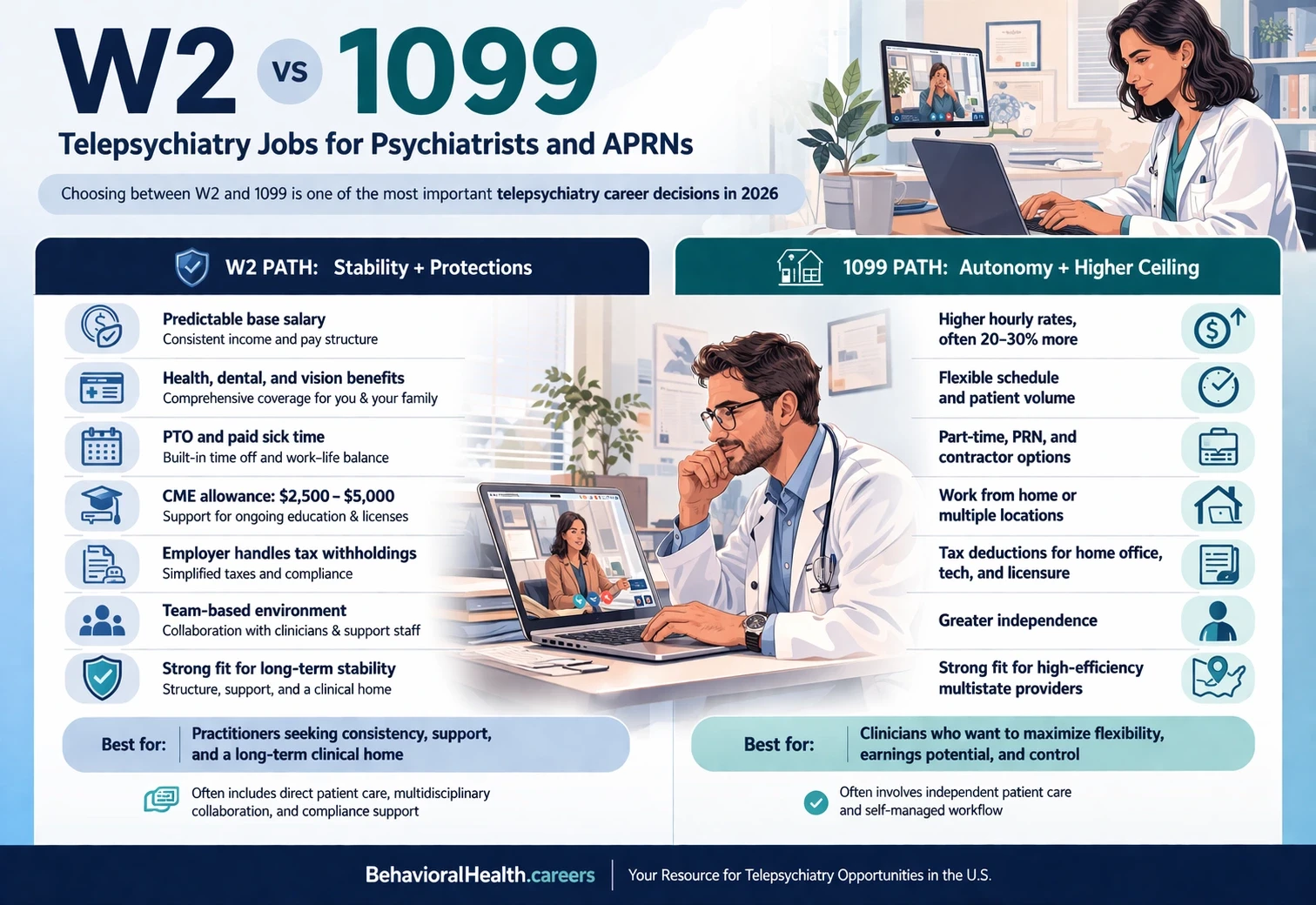
Choosing between a full-time W2 role and a 1099 contract position is the most consequential decision you will make this year. The 2026 market offers clear distinctions between the two.
The W2 Path Offers More Stability and Protections
- Core responsibilities: W2 telepsychiatry roles typically involve providing direct patient care, collaborating with multidisciplinary teams, and maintaining documentation in compliance with organizational standards.
- Benefits: W2 positions often offer predictable W-2 compensation and benefits, including a guaranteed base salary as part of the compensation package. Comprehensive health, dental, and vision insurance, as well as paid time off (PTO) and paid sick time, are commonly included.
- CME Allowance: Typically $2,500–$5,000 annually.
- Tax Simplicity: The employer handles withholdings, reducing your administrative burden.
- Best For: Practitioners seeking a long-term home and those who value a consistent mental health treatment team environment.
The 1099 Path Offers Autonomy and Often a Higher Ceiling
- Core responsibilities: 1099 telepsychiatry roles focus on independent patient care, managing your own caseload, and ensuring compliance with telemedicine regulations.
- Rate Premium: Usually 20-30% higher hourly rates than W2 equivalents to account for self-employment taxes.
- Flexibility: Many remote psychiatry roles allow for flexible hours, part-time, PRN, or 1099 contractor options, and telepsychiatry practices often operate in a fully remote model, allowing you to work from home or any location of your choice. You control your schedule and patient volume.
- Deductions: Ability to write off home office expenses, tech, and licensure fees.
- Best For: High-efficiency providers who want to maximize earnings or work across multiple states simultaneously.
What this means for you: If you value predictable income and administrative support for prior authorizations, go W2. If you want to optimize your hourly “take-home” and are comfortable managing your own quarterly taxes, the 1099 route is superior in 2026.
Clinicians in telepsychiatry typically have flexible scheduling, allowing them to control their availability and session structure.
Telepsychiatry Salary Transparency: The 2026 Deep Dive
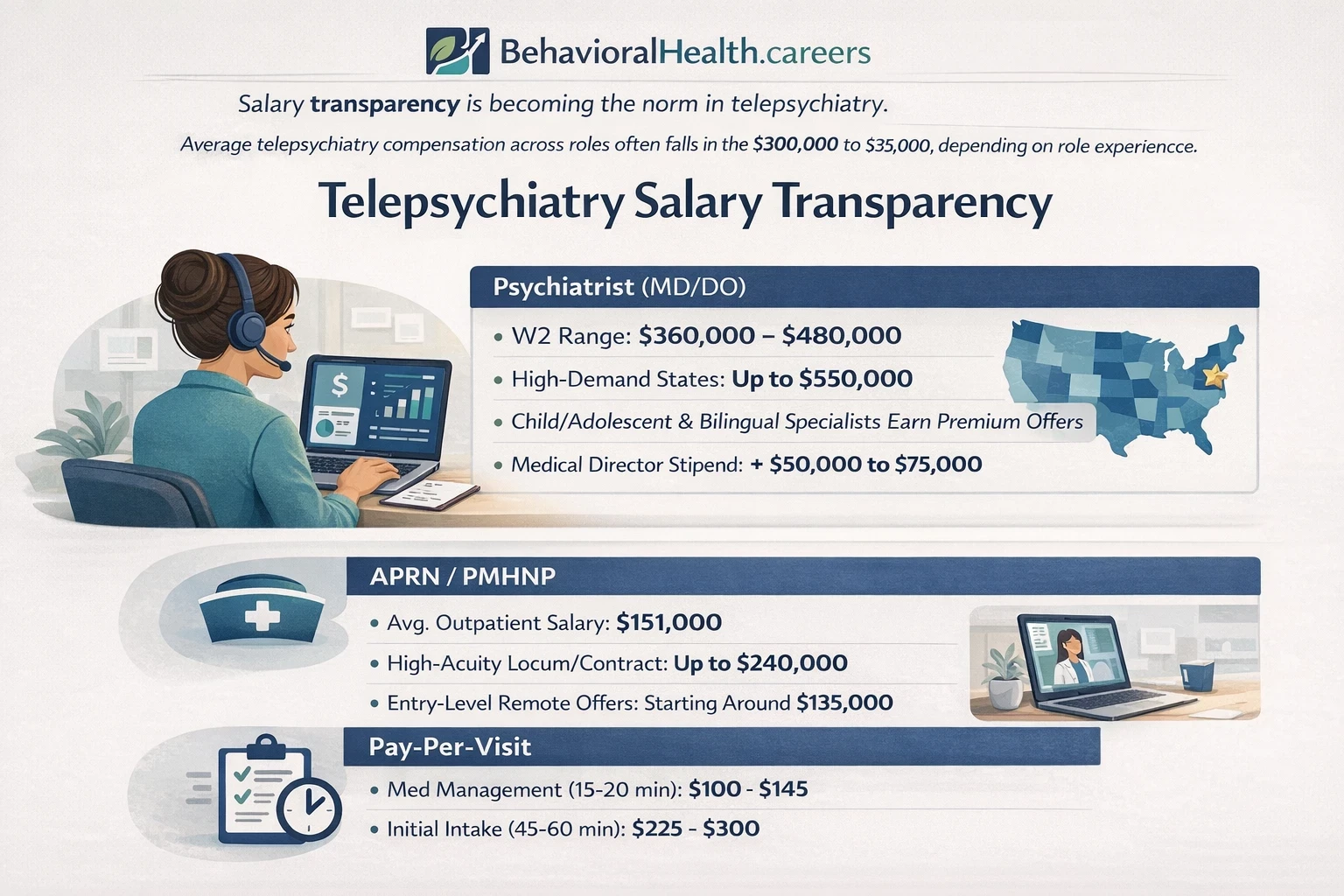
The era of “salary negotiable” is ending. In 2026, transparency is the baseline, especially for telepsychiatry physicians. Compensation packages for telepsychiatry physicians are increasingly transparent, with clear distinctions between base salary and additional incentives.
We are tracking the following verified ranges for telepsychiatry roles.
The average salary for telepsychiatry positions can range from $300,000 to $350,000 annually, depending on experience and role.
Psychiatrist (MD/DO) Compensation
- W2 Range: $360,000 – $480,000 (National Average).
- High-Demand States: California, New York, and Florida see packages reaching $550,000 for bilingual or specialized (Child/Adolescent) providers.
- Medical Director Roles: Add $50,000 – $75,000 in stipend for administrative oversight.
Psychiatric Nurse Practitioners: APRN and PMHNP Compensation
For the federal benchmark and state tables, review our psychiatric nurse practitioner (PMHNP) salary by state guide.
- Average Salary: $151,000 for standard outpatient roles.
- Locum/Contract Potential: High-acuity telepsychiatry (ER/Crisis) can pay up to $240,000 for full-time equivalents.
- Entry Level: New grads are seeing offers starting at $135,000 in most remote-first companies.
Pay-Per-Visit Structures
Many platforms have moved away from hourly rates to productivity-based models.
- Med Management (15-20 min): $100 – $145 per visit.
- Initial Intake (45-60 min): $225 – $300 per session.
A Brief Tele-psychiatry Salary Audit Checklist:
- Does the rate include “no-show” protection?
- Is malpractice insurance (with tail) included or a separate expense?
- Are there bonuses for state licensure in high-need areas?
- Is the pay-per-visit rate higher for after-hours or weekend shifts?
What Companies Offer Telepsychiatry Jobs? Who’s Hiring in 2026
The telepsychiatry job market in 2026 is robust, with leading companies actively seeking talented clinicians to join their teams. Organizations such as Iris Telehealth, Talkiatry, and Included Health are at the forefront, offering a range of telepsychiatry services to patients nationwide.
The hiring process typically begins with an interview designed to assess your clinical skills, experience, and alignment with the company’s mission to deliver high-quality care. Benefits packages often include competitive base salaries, vision insurance, paid time off, and opportunities for ongoing education and professional development.
If you are committed to advancing mental health care and want to join a team that values your expertise, the telepsychiatry field in 2026 offers a wealth of opportunities but with some caveats.
Red Flags: How to Spot a “Digital Telehealth Mill”
Not all tele-psychiatry jobs are created equal. In 2026, several high-profile platforms have come under fire for prioritizing throughput over patient safety.
Avoid companies that exhibit these traits:
- High-Volume Quotas: If a recruiter mentions a caseload of 30+ patients per day, walk away. This volume leads to clinical errors and rapid burnout.
- Rigid 15-Minute Windows: While common, a company that mandates 15-minute follow-ups without allowing for clinical complexity is a liability risk.
- Lack of Admin Support: Ask specifically who handles prior authorizations and billing disputes. If the answer is “the provider,” your actual hourly rate will plummet as you spend hours on paperwork.
- Ghost Leadership: Ensure you have direct access to a Medical Director. In “digital mills,” you are often managed by tech-focused product managers rather than clinicians.
2026 Regulatory Compliance: Prescribing and the “In-Person” Rule
The most significant legislative development this year is the finalization of the DEA’s rules on controlled substances. After years of extensions, the “Special Registration for Telemedicine” has finally crystallized.
- The 6/12-Month Rule: Most states now require an initial in-person visit within the first 6 months of treatment for Schedule II-V substances, with a follow-up every 12 months.
- State-Specific Compacts: The Interstate Medical Licensure Compact (IMLC) and the APRN Compact are essential. If you are not part of these, your geographic reach is limited.
- DEA Extensions: Check for local DEA “waivers” in rural areas that may still allow for 100% remote prescribing of buprenorphine and other addiction treatment medications.
Psychiatrists must hold a valid medical license in at least one U.S. state to practice telepsychiatry, and additional licenses are required for practice in multiple states.
A bachelor’s degree followed by a medical degree (MD or DO) is necessary, and starting a career in telepsychiatry requires completion of medical school, residency, state licensure, and proficiency in digital platforms.
Board-certified or board-eligible psychiatrists (MD/DO) are required for telepsychiatry positions, and an active, unrestricted medical license is necessary.
What this means for you: Ensure any potential employer has a “Hybrid” strategy. Some telepsychiatry providers maintain on-site clinics or collaborate with local clinics, such as the Cleveland Clinic, to meet regulatory requirements and support community involvement.
A company with no physical offices may struggle to comply with 2026 prescribing laws, putting your DEA registration at risk. Reputable employers are also committed to providing reasonable accommodations for candidates with disabilities during the application and interview process, ensuring an inclusive and accessible hiring experience.
The 2026 Tech Stack for Telepsychiatric Professionals: Efficiency via AI
To hit your productivity bonuses without burning out, you must utilize modern tools and have telemedicine experience.
In 2026, the most successful telepsychiatrists use an “AI-First” workflow, and telemedicine experience is highly valued in telepsychiatry roles, as it ensures providers are comfortable with digital platforms and virtual care delivery.
Telepsychiatry providers are also expected to document all services in the patient’s electronic medical record (EMR), leveraging technology to ensure accurate and compliant records.
- Medwriter.ai: Specifically built for psychiatry, this tool automates E/M scoring (99213/99214) to ensure you are billing accurately for your time.
- PMHScribe: An ambient AI tool that listens to the session and generates a full psychiatric SOAP note, focusing on mental status exams and risk assessments.
- Twofold Health: Provides clinical decision support by flagging potential drug-to-drug interactions in real-time as you type a script.
What this means for you: If an employer provides these tools, it is a sign of a high-quality clinical environment. If they don’t, ask if you can integrate your own HIPAA-compliant software into their EMR.
Secure Your Next Tele-Psychiatry Role Today
The telepsychiatry market of 2026 rewards providers who are specialized, tech-savvy, and vigilant about compliance.
Telepsychiatry roles often involve collaboration with a multidisciplinary team to develop and implement individualized treatment plans, and a family-oriented approach is valued in holistic mental health care.
Whether you are looking for a part-time gig to supplement your private practice or a high-level executive role in a digital health startup, the options are plentiful.
Next Steps:
- Review your licensure: Ensure you are credentialed in at least 3 high-volume states (CA, TX, FL, NY).
- Audit your tech: Test an AI scribe to see how much time it can shave off your daily documentation.
- Search with precision: Use the dedicated filters on BehavioralHealth.careers to find roles that match your specific requirements for compensation and support.
References
AMN Healthcare. (2025). 2025 review of physician and advanced practitioner recruiting incentives. https://www.amnhealthcare.com/blog/physician/perm/psychiatrist-salary-guide-2025/
Decker, S. L., Encinosa, W. E., & Zuvekas, S. H. (2024). Use of telehealth among medical visits in the United States: Results from the 2021 Medical Expenditure Panel Survey. Annals of Internal Medicine. https://doi.org/10.7326/M24-0137
Drug Enforcement Administration & U.S. Department of Health and Human Services. (2025a, January 17). Special registrations for telemedicine and limited state telemedicine registrations [Notice of proposed rulemaking]. Federal Register, 90(11), 5993–6051. https://www.federalregister.gov/documents/2025/01/17/2025-01099/special-registrations-for-telemedicine-and-limited-state-telemedicine-registrations
Drug Enforcement Administration & U.S. Department of Health and Human Services. (2025b, December 31). Fourth temporary extension of COVID-19 telemedicine flexibilities for prescription of controlled medications [Temporary rule]. Federal Register. https://www.federalregister.gov/documents/2025/12/31/2025-24123/fourth-temporary-extension-of-covid-19-telemedicine-flexibilities-for-prescription-of-controlled
Health Resources and Services Administration. (2024). State of the behavioral health workforce 2024. U.S. Department of Health and Human Services. https://bhw.hrsa.gov/sites/default/files/bureau-health-workforce/data-research/state-of-behavioral-health-workforce-2024.pdf
Interstate Medical Licensure Compact Commission. (n.d.). Physician license. https://imlcc.com/
Mulvaney-Day, N., Gibbons, B. J., Vital, J. M., Mauch, D., & Azrin, S. (2022). Trends in use of telehealth for behavioral health care during the COVID-19 pandemic: Considerations for payers and employers. Psychiatric Services, 73(9), 1001–1008. https://doi.org/10.1176/appi.ps.202100016
National Council of State Boards of Nursing. (2020). APRN Compact. https://www.aprncompact.com/
National Institute of Mental Health. (2024). Mental illness. U.S. Department of Health and Human Services. https://www.nimh.nih.gov/health/statistics/mental-illness
Nightingale College. (2025). PMHNP salary by state & work setting [2025]. https://nightingale.edu/blog/pmhnp-salary.html
Substance Abuse and Mental Health Services Administration. (2024). DEA and HHS extend telemedicine flexibilities through 2025 [Press statement]. U.S. Department of Health and Human Services. https://www.samhsa.gov/about/news-announcements/statements/2024/dea-hhs-extend-telemedicine-flexiblities-through-2025
U.S. Bureau of Labor Statistics. (2024a). Occupational employment and wages, May 2024: 29-1223 Psychiatrists. U.S. Department of Labor. https://www.bls.gov/oes/current/oes291223.htm
U.S. Bureau of Labor Statistics. (2024b). Occupational outlook handbook: Nurse practitioners, nurse anesthetists, and nurse midwives. U.S. Department of Labor. https://www.bls.gov/ooh/healthcare/nurse-anesthetists-nurse-midwives-and-nurse-practitioners.htm
Worthen, A., Torous, J., Khan, S., Hammes, N., & Rabinowitz, T. (2024). Telepsychiatry current practice and implications for future trends: A 2023 American Psychiatric Association member survey. Telemedicine and e-Health. https://doi.org/10.1089/tmj.2024.0042