

Behavioral
Health Program Director Salary: What the Data Shows
Behavioral health program directors sit at the top of the
non-physician career ladder, and their pay reflects it. The closest
federal wage category, Social and Community Service Managers, shows a
median of $80,390 a year (BLS, May 2025 estimates, released May 2026),
with the middle 80 percent running from $53,150 to $132,260. State
medians range from $56,100 in Arkansas to $106,700 in the District of
Columbia.
Read that federal median as a floor. It is a broad management
category, and dedicated behavioral health program and clinical
directors, especially those running licensed treatment programs with
clinical and budget responsibility, typically sit at or above these
figures. This page gives the state-by-state federal proxy, then the
credentials and market forces that push director pay toward the high
end. Everything federal is sourced to the Bureau of Labor Statistics and
refreshed each spring.
National snapshot (Social and Community Service Managers proxy)
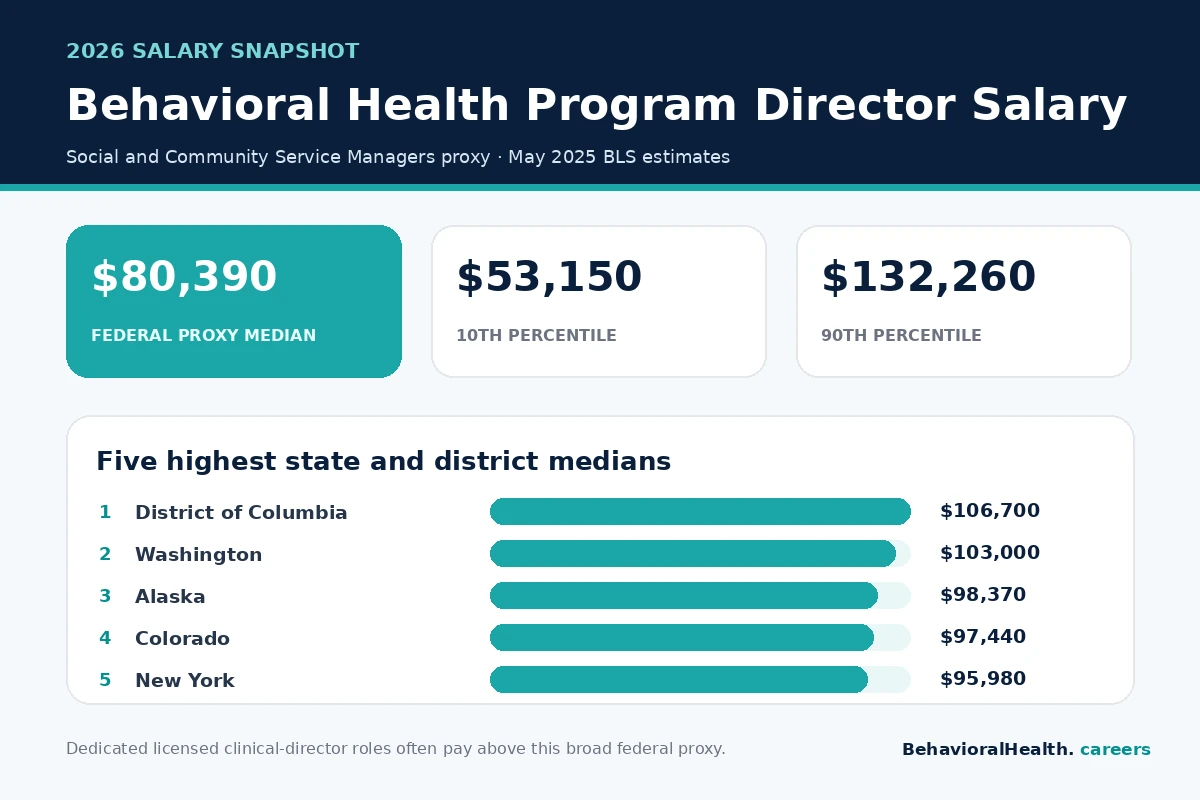
Highest-paying states
| Rank | State | Median annual wage |
|---|---|---|
| 1 | District of Columbia | $106,700 |
| 2 | Washington | $103,000 |
| 3 | Alaska | $98,370 |
| 4 | Colorado | $97,440 |
| 5 | New York | $95,980 |
This list reads differently from the frontline-role tables on this
site. Director pay follows organizational budgets and the cost of the
market a program operates in, so high-cost, high-funding states (plus
DC, dense with headquarters and government-adjacent nonprofits) top the
list. It is a management pay curve, not a clinical-shortage curve.
Behavioral health program director salary by state (proxy)
| State | Employment | 10th pctile | Median | 90th pctile | Mean |
|---|---|---|---|---|---|
| Alabama | 2,350 | $46,010 | $72,310 | $121,090 | $77,910 |
| Alaska | 830 | $64,540 | $98,370 | $137,260 | $101,050 |
| Arizona | 3,010 | $49,950 | $77,550 | $121,560 | $81,440 |
| Arkansas | 2,850 | $36,530 | $56,100 | $91,920 | $61,330 |
| California | 33,510 | $56,510 | $83,210 | $149,280 | $95,910 |
| Colorado | 2,800 | $64,870 | $97,440 | $163,400 | $105,880 |
| Connecticut | 4,350 | $51,110 | $75,520 | $119,990 | $80,910 |
| Delaware | 930 | $56,870 | $75,950 | $113,700 | $80,910 |
| District of Columbia | 640 | $67,380 | $106,700 | $162,000 | $114,420 |
| Florida | 8,600 | $48,080 | $76,050 | $132,510 | $83,870 |
| Georgia | 4,460 | $51,880 | $73,290 | $132,990 | $83,950 |
| Hawaii | 980 | $55,750 | $76,370 | $117,640 | $81,090 |
| Idaho | 820 | $52,000 | $79,120 | $111,550 | $81,080 |
| Illinois | 7,520 | $50,840 | $78,380 | $118,170 | $82,480 |
| Indiana | 2,950 | $47,900 | $73,940 | $116,110 | $78,610 |
| Iowa | 2,790 | $46,000 | $65,940 | $102,740 | $71,470 |
| Kansas | 1,570 | $55,690 | $79,260 | $129,070 | $86,540 |
| Kentucky | 2,280 | $47,390 | $76,960 | $119,210 | $79,460 |
| Louisiana | 2,680 | $56,010 | $82,090 | $126,320 | $87,430 |
| Maine | 1,620 | $51,840 | $76,160 | $100,410 | $77,270 |
| Maryland | 4,300 | $58,050 | $87,450 | $151,610 | $97,210 |
| Massachusetts | 8,800 | $60,520 | $81,380 | $130,060 | $90,020 |
| Michigan | 6,320 | $53,100 | $85,500 | $127,910 | $87,900 |
| Minnesota | 5,430 | $61,130 | $84,220 | $136,140 | $94,520 |
| Mississippi | 1,120 | $40,570 | $67,330 | $108,900 | $73,530 |
| Missouri | 3,060 | $48,410 | $71,970 | $108,020 | $75,650 |
| Montana | 820 | $47,590 | $73,640 | $104,010 | $74,740 |
| Nebraska | 1,320 | $50,740 | $73,790 | $111,840 | $78,660 |
| Nevada | 1,200 | $43,260 | $65,570 | $123,230 | $76,270 |
| New Hampshire | 1,180 | $59,250 | $82,290 | $122,680 | $87,820 |
| New Jersey | 5,530 | $62,510 | $95,290 | $154,370 | $101,660 |
| New Mexico | 1,150 | $61,810 | $81,290 | $124,460 | $88,700 |
| New York | 19,340 | $64,120 | $95,980 | $149,550 | $102,500 |
| North Carolina | 4,970 | $52,390 | $79,590 | $126,640 | $85,690 |
| North Dakota | 510 | $62,380 | $86,630 | $116,030 | $87,990 |
| Ohio | n/a | $47,970 | $73,890 | $108,830 | $77,630 |
| Oklahoma | 1,640 | $38,310 | $73,720 | $99,730 | $71,490 |
| Oregon | 3,390 | $61,610 | $87,010 | $136,990 | $96,090 |
| Pennsylvania | 10,220 | $49,470 | $75,280 | $116,990 | $80,870 |
| Puerto Rico | 840 | $37,490 | $60,280 | $107,730 | $65,640 |
| Rhode Island | 1,370 | $56,190 | $77,570 | $129,230 | $87,660 |
| South Carolina | 1,990 | $50,390 | $73,410 | $126,270 | $82,160 |
| South Dakota | 450 | $65,660 | $86,870 | $117,590 | $90,180 |
| Tennessee | 2,770 | $58,990 | $88,240 | $137,510 | $93,430 |
| Texas | 13,460 | $49,300 | $76,520 | $123,580 | $82,030 |
| Utah | 2,140 | $49,760 | $83,200 | $126,010 | $87,870 |
| Vermont | 1,200 | $61,450 | $80,760 | $117,460 | $85,650 |
| Virgin Islands | 60 | $49,750 | $64,990 | $84,990 | $68,740 |
| Virginia | 3,300 | $59,810 | $94,970 | $142,420 | $99,690 |
| Washington | 3,650 | $71,270 | $103,000 | $156,990 | $110,330 |
| West Virginia | 820 | $46,400 | $62,060 | $108,170 | $70,320 |
| Wisconsin | 3,580 | $61,090 | $82,130 | $115,520 | $85,950 |
| Wyoming | 350 | $37,130 | $66,330 | $107,020 | $70,320 |
The 90th-percentile column is the one to read for director roles,
because it is where the licensed clinical directors and multi-site
executives actually sit. Colorado (163, 400), Washington(156,990),
and New Jersey ($154,370) show six-figure ceilings well above their
medians, which is the proxy quietly revealing the dedicated behavioral
health leadership tier hiding inside the broader manager category.
What sets a director’s pay: license first
Unlike the frontline roles on this site, director pay is gated by
clinical credentials as much as by management experience.
Clinical licensure is usually the entry ticket
Program and clinical director roles at licensed treatment programs
typically require an independent clinical license: an LCSW, an LPC or
LMHC, a licensed psychologist, or in some settings an RN or PMHNP. State
licensing rules for behavioral health facilities frequently require a
licensed clinical director on staff, which makes the credential a hard
gate, not a nice-to-have. A director who holds one of these licenses
commands materially more than an administratively-strong but unlicensed
manager, because the license is what lets the program operate and bill.
Ourtherapist,
counselor, and social worker comparison guide covers the most common
licensure path into these seats. covers the most common
licensure path into these seats.
The executive credential adds a premium
The
Certified Behavioral Health Executive (CBHE), administered through the
National Association of Long Term Care Administrator Boards, signals
leadership competency on top of a clinical background, and industry
compensation surveys point to a pay premium for directors who hold it.
Treat the exact figure as directional (these are aggregator and
association estimates, not federal data), but the direction is
consistent: licensure plus a recognized executive credential moves a
director toward the top of the range.
Scope and setting do the rest
A director’s pay
scales with what they are responsible for: headcount, number of sites,
census, and whether they carry P&L. Hospital systems and for-profit
treatment operators generally pay above community non-profits for the
same title, and multi-site or regional roles clear six figures in most
states.
What the hiring market looks like
The director market is a replacement market more than a growth one.
BLS projects 6 percent employment growth for social and community
service managers from 2024 to 2034, faster than the all-occupation
average, with roughly 18,600 openings a year over the decade, most
driven by managers retiring or moving on. The bottleneck for behavioral
health employers is narrower than that number suggests, because the pool
that can legally fill a clinical director seat is limited to
experienced, independently-licensed clinicians who also want to manage,
and that is a small slice of an already-short workforce.
That scarcity is why leadership retention is a budget line, not an
afterthought. A licensed clinical director who leaves takes program
compliance and billing capacity out the door with them. For employers,
the workable levers are internal (building a supervisor-to-director
pipeline so you are not always hiring from outside) and, at the offer
stage, competitive and transparent pay, since the candidates who can
fill these roles have the least patience for a vague or below-market
range. The 2026 behavioral
health workforce outlook that runs through this salary library
applies to leadership hiring too: at this level, a hidden range mostly
signals that the number is not competitive.
How director pay compares
A behavioral health program director’s median on the federal proxy
($80,390) runs roughly 21, 000abovethementalhealthcounselormedian(59,350)
and sits below the psychologist median ($100,580) and well below
prescribers. The dedicated-role reality is higher than the proxy:
licensed clinical directors frequently clear six figures, closing much
of the gap to psychologists. For the roles a director rises from and
manages, see the therapist,
counselor, and social worker comparison guide and psychologist salary page.
Frequently asked questions
How much does a behavioral health program director
make?
The closest federal category, Social and Community
Service Managers, shows a median of $80,390 a year (BLS, May 2025
estimates), with the middle 80 percent from $53,150 to $132,260.
Dedicated behavioral health directors typically sit at or above the
proxy, and market surveys for “behavioral health director” specifically
average around $140,000.
Which states pay the most?
On the federal proxy, by
median wage: the District of Columbia (106, 700), Washington(103,000),
Alaska (103,000),
Alaska (98, 370), Colorado(97,440),
and New York ($95,980). Organizational budgets and market cost, not
clinical shortage, drive this list.97,440),
and New York ($95,980). Organizational budgets and market cost, not
clinical shortage, drive this list.
What credentials do you need to be a clinical or program
director?
Most licensed treatment programs require an
independent clinical license (LCSW, LPC/LMHC, licensed psychologist, or
RN/PMHNP), often because state facility rules mandate a licensed
clinical director. An executive credential like the CBHE adds a further
pay premium on top of the license.
Is the pay proxy accurate for behavioral health directors
specifically?
It is a conservative floor. The Social and
Community Service Managers category blends behavioral health directors
with managers of many other social programs, so dedicated behavioral
health program and clinical directors, particularly licensed ones with
budget responsibility, generally earn at or above these figures.
Where these numbers come from
Federal wage figures are from the U.S. Bureau of Labor Statistics
Occupational Employment and Wage Statistics program, May 2025 estimates
(occupation code 11-9151, Social and Community Service Managers, used as
the nearest proxy for behavioral health program and clinical directors),
released May 2026. Growth and openings projections are from the BLS
Employment Projections program (2024 to 2034). This is a broad
management category; dedicated behavioral health director figures cited
from aggregator and association surveys are directional and clearly
labeled as non-federal. OEWS reports wages for employees; independent
contractor rates are not included. Figures marked n/a are suppressed in
the source data. All figures are estimates and marked as such. We
refresh this page when BLS publishes new estimates each spring.
Hiring or advancing into leadership? Find current roles from employers hiring this month.
Browse live behavioral health
director and management listings from employers hiring this
month.