

Social
and Human Service Assistant Salary: What the Federal Data Shows
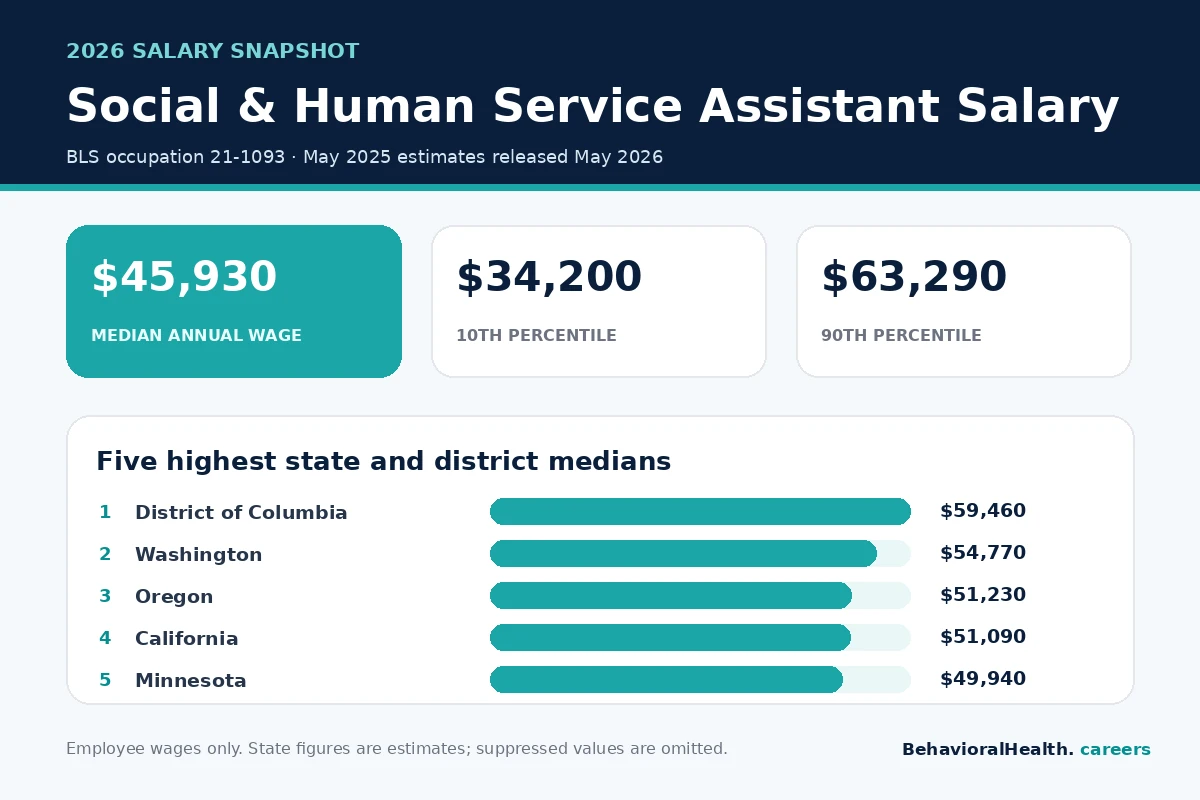
Social and human service assistants earn a median of $45,930 a year,
according to the most recent federal wage data (BLS, May 2025 estimates,
released May 2026). Most earn between $34,200 and $63,290, and state
medians run from $31,200 in Mississippi to $59,460 in the District of
Columbia.
If you work in behavioral health as a case aide, a behavioral health
associate, a residential counselor’s assistant, or a community support
worker, this is very likely your federal wage category. This page covers
the state numbers, what actually raises pay in a role built on a high
school diploma, and where the job leads. Everything is sourced to the
Bureau of Labor Statistics and refreshed each spring.
National snapshot
Highest-paying states
| Rank | State | Median annual wage |
|---|---|---|
| 1 | District of Columbia | $59,460 |
| 2 | Washington | $54,770 |
| 3 | Oregon | $51,230 |
| 4 | California | $51,090 |
| 5 | Minnesota | $49,940 |
The high end is a cost-of-living and public-funding story more than a
shortage one. These are states with larger public human-services budgets
and higher wage floors, which lift entry-level pay across the board. The
West Coast and the upper Midwest showing up here, with the Deep South at
the other end of the table, is the same pattern that runs through most
support-tier behavioral health roles.
Social and human service assistant salary by state
| State | Employment | 10th pctile | Median | 90th pctile | Mean |
|---|---|---|---|---|---|
| Alabama | 3,370 | $24,170 | $35,830 | $52,100 | $37,240 |
| Alaska | 1,370 | $37,440 | $47,360 | $78,850 | $52,420 |
| Arizona | 7,290 | $35,630 | $40,730 | $49,950 | $42,360 |
| Arkansas | 3,530 | $25,880 | $36,770 | $49,660 | $37,560 |
| California | 58,730 | $39,040 | $51,090 | $74,250 | $55,100 |
| Colorado | 5,410 | $38,440 | $47,690 | $65,450 | $50,370 |
| Connecticut | 9,930 | $36,890 | $44,730 | $60,980 | $46,540 |
| Delaware | 1,050 | $33,080 | $40,710 | $49,420 | $41,760 |
| District of Columbia | 2,080 | $40,930 | $59,460 | $86,090 | $60,770 |
| Florida | 22,670 | $34,180 | $44,410 | $59,460 | $45,380 |
| Georgia | 7,410 | $29,030 | $39,480 | $58,050 | $41,370 |
| Guam | 160 | $25,730 | $38,920 | $55,430 | $40,650 |
| Hawaii | 2,230 | $36,530 | $42,400 | $58,030 | $44,580 |
| Idaho | 3,810 | $37,450 | $47,540 | $60,470 | $49,020 |
| Illinois | 22,220 | $35,030 | $46,950 | $72,780 | $50,460 |
| Indiana | 11,740 | $31,200 | $44,550 | $58,640 | $44,570 |
| Iowa | 5,230 | $33,060 | $42,480 | $60,780 | $44,430 |
| Kansas | 6,070 | $34,330 | $42,570 | $55,580 | $43,490 |
| Kentucky | 4,670 | $27,540 | $37,440 | $55,530 | $40,190 |
| Louisiana | 3,440 | $27,060 | $35,780 | $49,810 | $37,300 |
| Maine | 4,580 | $39,770 | $47,710 | $60,050 | $49,470 |
| Maryland | 7,280 | $36,990 | $47,210 | $68,890 | $51,200 |
| Massachusetts | 9,180 | $39,440 | $47,130 | $63,670 | $50,430 |
| Michigan | 12,450 | $30,780 | $39,160 | $57,100 | $42,940 |
| Minnesota | 11,110 | $38,490 | $49,940 | $64,560 | $52,370 |
| Mississippi | n/a | $22,990 | $31,200 | $45,710 | $32,850 |
| Missouri | 6,200 | $31,730 | $41,780 | $50,710 | $42,270 |
| Montana | 1,200 | $29,840 | $38,570 | $50,620 | $40,350 |
| Nebraska | 1,460 | $31,010 | $38,940 | $46,640 | $39,570 |
| Nevada | 2,420 | $30,940 | $38,570 | $56,470 | $42,740 |
| New Hampshire | 1,860 | $37,700 | $46,950 | $58,210 | $47,540 |
| New Jersey | 17,270 | $34,340 | $48,420 | $72,800 | $51,770 |
| New Mexico | 3,050 | $32,820 | $46,340 | $63,650 | $47,670 |
| New York | 40,970 | $35,980 | $47,190 | $64,430 | $49,080 |
| North Carolina | 9,020 | $30,620 | $42,850 | $59,570 | $43,880 |
| North Dakota | 1,530 | $37,270 | $46,260 | $66,170 | $48,940 |
| Ohio | 10,970 | $30,250 | $38,390 | $52,570 | $41,150 |
| Oklahoma | 3,340 | $27,490 | $36,740 | $54,320 | $38,910 |
| Oregon | 11,260 | $39,860 | $51,230 | $67,170 | $52,980 |
| Pennsylvania | 24,340 | $34,520 | $44,050 | $58,700 | $45,060 |
| Puerto Rico | 5,560 | $23,960 | $31,570 | $41,220 | $32,870 |
| Rhode Island | 2,290 | $36,580 | $47,720 | $71,270 | $50,870 |
| South Carolina | 5,220 | $30,270 | $38,550 | $58,120 | $42,180 |
| South Dakota | 830 | $29,850 | $38,350 | $48,120 | $39,110 |
| Tennessee | 4,380 | $30,280 | $40,310 | $52,190 | $41,300 |
| Texas | 21,620 | $31,350 | $45,860 | $60,460 | $46,210 |
| Utah | 6,540 | $33,790 | $39,930 | $55,840 | $42,860 |
| Vermont | 1,920 | $38,760 | $46,640 | $55,380 | $47,320 |
| Virgin Islands | 60 | $29,560 | $37,150 | $42,430 | $38,980 |
| Virginia | 10,670 | $32,840 | $43,450 | $60,500 | $45,060 |
| Washington | 7,590 | $43,180 | $54,770 | $72,770 | $55,900 |
| West Virginia | 3,320 | $29,690 | $39,290 | $52,510 | $41,200 |
| Wisconsin | 7,750 | $34,990 | $47,500 | $71,390 | $50,360 |
| Wyoming | 610 | $34,280 | $45,290 | $61,080 | $45,630 |
A reading tip for this role: the 10th-percentile column is the one to
watch, because it marks the true entry wage, and the spread between
states is brutal. An entry-level assistant in Washington ($43,180)
starts above the median in a dozen states. The low-median cluster
(Mississippi, Louisiana, Arkansas, Oklahoma) reflects both regional wage
floors and a human-services funding base that runs lean.
What raises pay in a high-school-diploma job
This is one of the most accessible roles in behavioral health, which
is exactly why the credential moves matter: small additions to your
qualifications separate you from a large entry pool.
The biggest raise, though, is usually the move out of the assistant
category entirely. This role is a recognized on-ramp, and the two most
common next steps both pay meaningfully more: behavioral health case
manager work (our Case Manager
Career Guide covers it) and, with a degree, licensed counseling,
where the median rises to $59,350. The Intake
Coordinator and Admissions Specialist guide covers another common
lateral move with a higher ceiling.
Certificates and an associate degree
The role
typically asks for a high school diploma, but candidates with a human
services certificate, an associate degree in a related field, or CPR and
crisis-intervention training move up the pay band faster and qualify for
the settings that pay in the upper half of the table.
An addiction or case-management credential
For
assistants working in SUD or case-support settings, an entry addiction
credential (a CADC track in most states) or a case-management
certification is the clearest step up, because it makes you eligible for
roles that carry more responsibility and higher pay bands.
Setting and funder
Government and
hospital-affiliated programs generally pay assistants more than small
non-profits, and public human-services agencies in higher-wage states
sit at the top of the table for a reason.
What the hiring market looks like
The headline for employers is churn, not scarcity. BLS projects 6
percent employment growth from 2024 to 2034, faster than the
all-occupation average, but the number that matters more is openings:
roughly 50,600 openings for social and human service assistants are
projected each year over the decade, and most come from workers leaving
the role, either moving up or leaving the field. That is a workforce
that turns over constantly.
For a behavioral health employer, that reframes the problem. The
challenge in these roles is rarely finding a warm body; it is keeping
one long enough to be worth the training. The levers that work are the
ones that reduce turnover: a visible path up (into case management,
intake, or counseling), realistic caseloads, and pay that is stated
plainly in the posting. In a high-turnover, high-volume hiring category,
a listed pay range does double duty, filtering for candidates who will
accept the wage and signaling that the employer is not hiding a lowball.
That is the same 2026 behavioral
health workforce outlook that runs through this whole salary
library, and it applies most bluntly at the entry tier.
Frequently asked questions
How much does a social and human service assistant
make?
The national median is $45,930 a year (BLS, May 2025
estimates), with most earning between $34,200 and $63,290. State medians
range from $31,200 to $59,460.
Which states pay the most?
By median wage: the
District of Columbia (59, 460), Washington(54,770),
Oregon (54,770),
Oregon (51, 230), California(51,090),
and Minnesota ($49,940). Public human-services funding and higher state
wage floors, not clinical shortages, drive this list.51,090),
and Minnesota ($49,940). Public human-services funding and higher state
wage floors, not clinical shortages, drive this list.
What credentials raise pay in this role?
The job
usually asks only for a high school diploma, so a human services
certificate, an associate degree, crisis-intervention training, or an
entry addiction credential (CADC track) each help. The largest raise is
usually the move up to case management or, with a degree, into licensed
counseling.
Is this a good entry point into behavioral health?
Yes. It is among the most accessible behavioral health roles and a
recognized on-ramp: it leads into case management, intake and
admissions, and, with further education, licensed counseling, each
paying more than the assistant baseline.
Where these numbers come from
Wage figures are from the U.S. Bureau of Labor Statistics
Occupational Employment and Wage Statistics program, May 2025 estimates
(occupation code 21-1093, Social and Human Service Assistants), released
May 2026 and the most recent federal data available. Growth and openings
projections are from the BLS Employment Projections program (2024 to
2034). This is a broad category that includes case aides and many
entry-level behavioral health support roles. OEWS reports wages for
employees; independent contractor rates are not included. Figures marked
n/a are suppressed in the source data. All figures are estimates and
marked as such. We refresh this page when BLS publishes new estimates
each spring.
Starting out in behavioral health? Find current roles from employers hiring this month.
Browse live case aide and behavioral
health support listings from employers hiring this month.