Disclaimer: This guide provides career trajectory estimates and national salary benchmarks as of March 2026. Individual compensation and requirements vary by state agencies, organization size, and specific clinical licensure.
The transition from clinical practitioner to corporate executive is not a promotion: it is a career pivot. Most clinicians spend the first decade mastering the 50-minute hour.
To move into behavioral health executive jobs, you must master the fiscal quarter and the complexities of behavioral health operations.
This guide from BehavioralHealth.careers outlines the logistical requirements, necessary mindset shift, and financial realities of moving into leadership roles that ensure regulatory compliance and deliver high quality care within behavioral health services.
The benefits of executive leadership in behavioral health include creating meaningful impact for the communities served, improving care delivery, and fostering lasting positive change for both patients and the workforce.
At a Glance: The Executive Pivot
- Target Roles: Clinical Director, Chief Operating Officer (COO), Executive Director, Medical Director, Chief of Behavioral Health.
- Core Credentials: Clinical license (LCSW, LPC, PhD, MD) plus optional MBA/MHA for large-scale organizations.
- The Big Shift: Transitioning from individual patient advocacy to systemic health, strategic planning, and organizational sustainability.
- 2026 Market Outlook: High demand for innovative "hybrid leaders" who understand both clinical burnout and P&L (Profit and Loss) management, shaping the future of behavioral health workforce development.
The Logistical "How-To" of the Executive Move
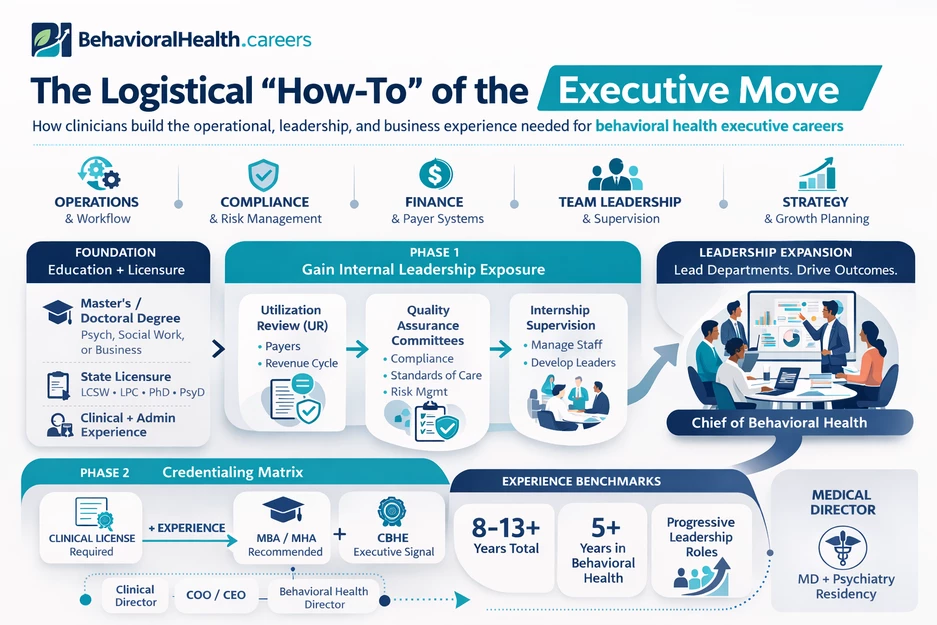
Moving into behavioral health executive careers requires deliberate accumulation of non-clinical data points and leadership experience.
Training and resources are essential in preparing individuals for executive roles, supporting the development of necessary competencies and providing tools for effective leadership.
Clinical intuition alone is insufficient to oversee daily operations and ensure delivery of positive behavioral health outcomes. The implementation of leadership skills, combined with a personalized approach to developing individuals for these roles, is critical.
Executive positions in behavioral health typically require a Master’s or Doctoral degree in psychology, social work, or business, alongside extensive clinical and administrative experience.
Additionally, state-issued licensure; such as LCSW, LPC, or licensed psychiatrist credentials, are usually required for these roles.
Phase 1: Internal Leadership Exposure
Before applying for C-suite roles, demonstrate “functional oversight” by volunteering for or leading:
- Utilization Review (UR): Understand payer communications and revenue cycle management is the basis of utilization review jobs.
- Quality Assurance (QA) Committees: Gain exposure to regulatory compliance, risk management, and highest standards of care by coordinating teams and collaborating with multidisciplinary staff.
- Internship Supervision: Managing employees and teams requires different skills than managing patients; this is your first test of clinical-administrative leadership.
The Chief of Behavioral Health directs and coordinates all aspects of the behavioral health department, emphasizing the importance of collaboration and teamwork to achieve effective and comprehensive care.
Phase 2: The Credentialing Matrix
Your clinical license (LCSW, LPC, PhD, PsyD) forms your foundation. For executive roles, especially in organizations with $10M+ annual revenue, business-specific education is highly recommended.
- License + Experience: Sufficient for the Clinical Director position at mid-sized agencies or residential centers, where the position involves overseeing clinical operations and staff.
- MBA or MHA (Master of Healthcare Administration): Recommended for COO, CEO, or Behavioral Health Director positions to excel in strategic planning and operational excellence, as these positions require broad organizational leadership.
- Specialized Certifications: Consider the Certified Behavioral Health Executive (CBHE) credential to signal commitment to behavioral health operations and leadership excellence for executive positions.
Executive positions typically require 8–13+ years of experience in acute or outpatient settings, with at least 5 years in behavioral health services and progressive supervisory or administrative experience.
Medical Director positions usually require a Medical Degree (MD) with a Psychiatry residency.
The Mindset Shift: From Patient Advocacy to P&L
The most significant barrier to success in behavioral health careers at the executive level is the “guilt gap” - the friction when clinical needs clash with budget constraints.
To succeed, adopt a dual-perspective framework balancing clinical care with financial sustainability. It is essential to be committed to supporting your teams and building strong relationships with staff, clients, and stakeholders to foster trust and effective communication.
The Director of Behavioral Health leads and strategizes the development and implementation of comprehensive behavioral health programs, ensuring both quality care and organizational success.
Caring for the P&L Alongside the Patient
In the chair, your focus is the individual patient. In the boardroom, your focus is on census, throughput, and sustainable workforce models.
- Clinical perspective: “We need more staff to reduce caseloads.”
- Executive perspective: “We need to optimize billing workflows to fund two additional FTE positions.”
Efficient operations in behavioral health organizations are essential for optimizing patient access to care and minimizing administrative bottlenecks. Employers in the behavioral health sector highly value executives who can drive operational efficiency and improve the quality of life for patients through effective leadership.
This balance ensures your organization can continue providing behavioral health services that positively impact adults, seniors, and families.
The "Interplay" Factor
Successful executives bridge the gap between clinicians and leadership by translating business needs into improved clinical outcomes and operational efficiency. Innovation is essential, as leaders must inspire their teams to drive positive change and continuously improve behavioral health programs.
Partnering with other organizations or professionals is also crucial to achieve organizational goals and deliver comprehensive behavioral health services.
Utilizing reports and embracing data-driven decision making helps analyze treatment effectiveness, manage costs, and monitor staff performance, ensuring transparency and informed strategies.
Additionally, organizations are encouraged to design sustainable and innovative staffing models to effectively address workforce challenges.
For a deeper dive into market shifts toward integrated leadership, read our 2026 Behavioral Health Workforce Outlook.
Tactical Checklist: Your 12-Month C-Suite Roadmap
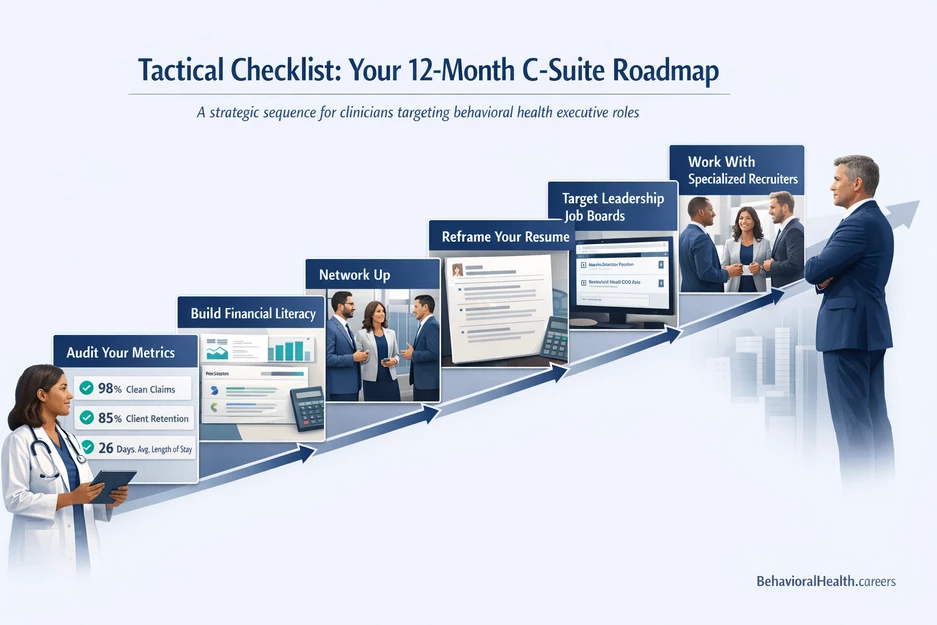
If you are a clinician aiming for medical director or executive leadership roles, follow this sequence:
- Audit Your Metrics: Track clean claim rates, client retention, and average length of stay (ALOS) - metrics critical to behavioral health executive roles.
- Seek Financial Literacy: Enroll in “Healthcare Finance for Non-Financial Managers” courses to understand balance sheets and budgeting.
- Network Up: Attend conferences focused on behavioral health operations and leadership, such as NatCon or executive retreats.
- Update Your Resume: Shift focus from “Patient Care” to “Operational Impact.” For example, “Managed a caseload generating $15k monthly revenue with 95% compliance.”
- Explore Specialized Job Boards: Target leadership-specific categories, including psychiatry and prescribing leadership or addiction treatment management.
- Leverage Specialized Recruiters: Some recruitment services, such as UHC Solutions, specialize in recruiting top-tier talent for the behavioral health sector and can place candidates in executive roles within two weeks.
Is the C-Suite Right for You?
The C-suite offers higher pay, greater influence, and the ability to shape behavioral health services and workforce development.
On the flip side, it also means less direct patient interaction and more responsibility for organizational success.
The path to executive behavioral health jobs is open to clinicians across disciplines - LCSWs, BCBAs, LPCs, and MDs. The industry urgently needs leaders who balance clinical insight with strategic planning and operational excellence.
For leadership roles in the space, both exclusive and sourced from top employers across the country, turn to BehavioralHealth.careers and stay informed by setting an alert for daily or weekly reminders today.
References
Center for Behavioral Health Statistics and Quality, Substance Abuse and Mental Health Services Administration. (2025). Key substance use and mental health indicators in the United States: Results from the 2024 National Survey on Drug Use and Health (HHS Publication No. PEP25-07-007, NSDUH Series H-60). U.S. Department of Health and Human Services. https://www.samhsa.gov/data/report/2024-nsduh-annual-national-report
National Council for Mental Wellbeing. (n.d.). About us. https://www.thenationalcouncil.org/about-us/
Substance Abuse and Mental Health Services Administration. (n.d.). About SAMHSA. U.S. Department of Health and Human Services. https://www.samhsa.gov/about-us
Texas Behavioral Health Executive Council. (n.d.). About the council. https://bhec.texas.gov/
Texas Legislature, 86th Regular Session. (2019). H.B. 1501: Relating to the creation of the Texas Behavioral Health Executive Council (Acts 2019, 86th R.S., ch. 768). Texas Legislative Reference Library. https://lrl.texas.gov/legis/billsearch/billdetails.cfm?billFileID=295952