Disclaimer: This guide provides market analysis and career information based on 2026 projections and industry standards. It does not constitute legal or financial advice regarding specific employment contracts or state-specific insurance regulations.
2026 At-A-Glance: The UR Market Summary
If you are looking to move away from direct patient care or trying to staff a high-efficiency clinical team, behavioral health utilization review jobs are likely on your radar.
Utilization review is the process through which insurance companies determine if they will continue to pay for a patient's mental health or addiction treatment.
UR professionals evaluate the medical necessity, appropriateness, and efficiency of mental health and substance abuse treatments to promote streamlined, high quality care.
By 2026, the role has shifted from a "paper-pusher" stereotype to a high-level clinical strategy position, with an array of clinical jobs industry-wide.
Behavioral health utilization review (UR) roles include Behavioral Health Utilization Review Clinicians, Specialists, Nurses (RNs), and Coordinators.
- Primary Seekers: Licensed clinicians (LCSWs, LPC, RN) seeking remote work or predictable 9-to-5 schedules.
- Primary Employers: Insurance carriers (Payers), residential treatment centers (Facilities), and third-party managed care organizations.
- 2026 Salary Range: $75,000 – $110,000+ (varies by license type and seniority).
- Market Disruptor: "Gold Card" legislation is streamlining routine approvals, shifting UR focus toward high-acuity, complex case management.
The Pivot: Why Clinicians are Moving to Utilization Review
The transition from clinical work to UR is a practical response to the high-stress environment of direct practice.
Many licensed clinical social worker jobs and counseling roles involve heavy emotional labor and unpredictable "after-hours" crises.
Utilization Review (UR) offers a way to utilize clinical expertise without the burnout of a full caseload, typically by acting as part of a utilization review team.
What this means for you:
You are not "leaving the field." You are applying your diagnostic and treatment planning knowledge to ensure patients receive the correct level of care based on medical necessity. The role requires a mindset shift: you are no longer the provider, but the auditor of the provider's logic.
There are numerous benefits for both clients and employers.
Regular reviews by UR professionals help to prevent relapses or crises by allowing for adjustments in care levels.
Effective UR reduces claim denials, ensuring facilities receive timely payment, vital for their operations, and personalizing each utilization review report to the patient is essential for effective communication with insurers.
Insurance companies want to see evidence of aftercare planning as early as possible in the treatment process, and sharing the patient's progress toward treatment goals is crucial for justifying continued funding for their behavioral health treatment.
The 2026 Market Reality: "Gold Card" Legislation
One of the most significant shifts in the behavioral health careers landscape in 2026 is the widespread adoption of "Gold Card" laws.
These state-level mandates (pioneered in states like Texas and West Virginia) allow providers with high prior authorization approval rates to bypass the standard UR process for certain services.
The Impact on the UR Job Market:
- Reduced Volume, Increased Complexity: UR clinicians spend less time on routine, high-volume approvals (like standard outpatient therapy) and more time on high-risk, high-cost cases (like residential treatment or intensive outpatient programs).
- Demand for Expertise: Employers now prioritize candidates who can handle complex peer-to-peer reviews and defend clinical decisions with data.
- Efficiency Requirements: Tech-enabled "Gold Carding" means UR staff must be highly proficient in automated authorization systems.
Essential Credentials and Qualifications
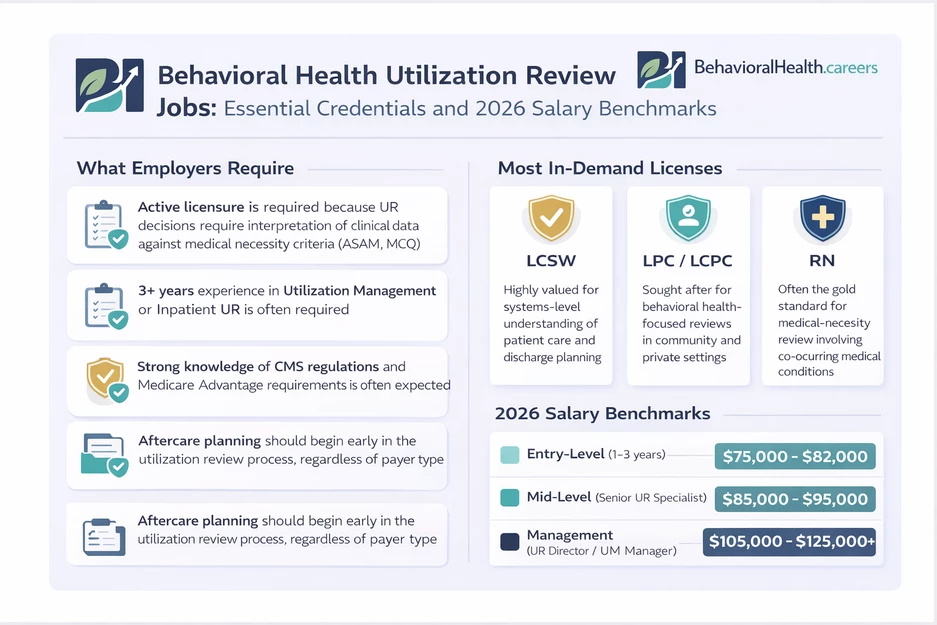
Credentials are non-negotiable for job seekers in this sector. Because UR decisions involve the interpretation of clinical data against medical necessity criteria (like ASAM or MCQ), employers require active licensure.
Utilization Review jobs in behavioral health often require a minimum of 3 years of experience in Utilization Management or Inpatient UR.
Employers in the behavioral health field often seek candidates with strong knowledge of CMS regulations and Medicare Advantage requirements for Utilization Review roles.
No matter the carrier, whether private or commercial, insurance companies want to see evidence of aftercare planning as early as possible in the utilization review process.
Most In-Demand Licenses:
- LCSW (Licensed Clinical Social Worker): Highly valued for their systemic view of patient care and discharge planning.
- LPC / LCPC (Licensed Professional Counselor): Sought after for behavioral health-specific reviews in community and private settings.
- RN (Registered Nurse): Often the gold standard for medical-necessity reviews involving co-occurring medical conditions.
2026 Salary Benchmarks:
- Entry-Level (1-3 years experience): $75,000 - $82,000
- Mid-Level (Senior UR Specialist): $85,000 - $95,000
- Management (UR Director / UM Manager): $105,000 - $125,000+
For more details on the broader landscape, see the Behavioral Health Workforce Outlook 2026.
Remote vs Facility-Based: Choosing Your Setting
While the appeal of remote work is a primary driver for mental health jobs in the UR space, both settings offer distinct advantages and challenges.
The Remote Appeal (Payer-Side)
Most remote UR roles are found with major insurance carriers.
- Pros: Flexible location, lower overhead costs, and often better benefits packages.
- Cons: High production quotas and "screen fatigue."
- Hiring Tip: Multi-state licensure is your greatest asset here. If you are licensed in three or more states, you are a priority candidate for national payers.
The Facility-Based Reality on the Provider-Side
Facilities, particularly residential treatment centers, hire internal UR staff to advocate for patient coverage.
- Pros: Closer collaboration with the clinical team and a direct impact on patient stay length.
- Cons: Often requires on-site presence and carries the pressure of securing facility revenue.
- Hiring Tip: Experience with specific EMRs (Electronic Medical Records) like Kipu or Sunwave is often a prerequisite.
The Employer’s Corner: Reducing Turnover and Addressing Tech Gaps
Hiring for behavioral health utilization review jobs presents unique challenges in 2026.
High turnover remains a risk if the role is treated as purely administrative.
Strategies for Better Retention:
- Prioritize Tech Literacy: During the interview, move beyond "How do you handle a denial?" and ask "How do you navigate multiple EMR tabs while on a peer-to-peer call?" If a candidate struggles with basic screen-sharing or digital documentation, they will likely burn out during high-volume periods.
- Define the "Clinical Value": Clinicians stay in UR when they feel their clinical judgment matters. Involve UR staff in clinical team meetings so they understand the "why" behind the cases they represent.
- Standardize Onboarding: Use a clear therapist onboarding checklist adapted for UR workflows to ensure new hires understand the specific payer portals and criteria sets used by your organization.
The Tech Literacy Audit:
- Can the candidate use logic-based filtering in spreadsheets?
- Do they have experience with Integrated Care Management (ICM) software?
- Can they articulate medical necessity using specific data points rather than general clinical "feelings"?
- Do they know that personalizing each utilization review report to the patient is essential for effective advocacy with insurance providers?
What This Means for Your Career
The demand for behavioral health careers in utilization management is projected to grow through the end of the decade.
As healthcare moves toward a "Value-Based" model, the person who can prove the value of a specific treatment, using data, becomes the most important person in the room.
Whether you are an employer looking to stabilize your revenue cycle management or a clinician looking for a sustainable career path, UR is the bridge between clinical excellence and fiscal responsibility.
Next Steps:
- Employers: Review your tech requirements and clinical training protocols to reduce turnover. See the Behavioral Health Hiring Toolkit here.
- Job Seekers: Update your resume to focus on authorizations, medical necessity, and EMR proficiency.
Explore current openings and start your transition at BehavioralHealth.careers.