Becoming a certified peer support specialist takes a high school diploma, documented lived experience of recovery, a state-approved training course, and, in most states, a block of supervised work hours.
What varies is the size of that block, and it varies enormously.
Ohio asks for a 16-hour online course, a 40-hour training, and an exam. Illinois asks for 100 classroom hours plus 2,000 documented work hours plus 100 hours of supervision. Michigan will not let you into training at all until an employer has already hired you.
That spread is the whole story. Almost every guide to this career tells you the national version of the path, then sends you off to “check your state.” The national version is close to useless for planning, because your state decides whether this takes four months or two years.
This guide covers what holds true everywhere, then gives you verified requirements for ten states that, between them, show every model in use.
One thing to settle first: this is a real job with a real credential, not a volunteer role with a certificate attached.
As of a 2024 national count, 48 states and the District of Columbia certify peer support specialists for both mental health and substance use. Hawaii certifies for mental health only. South Dakota does not certify at all.
What a peer support specialist actually does
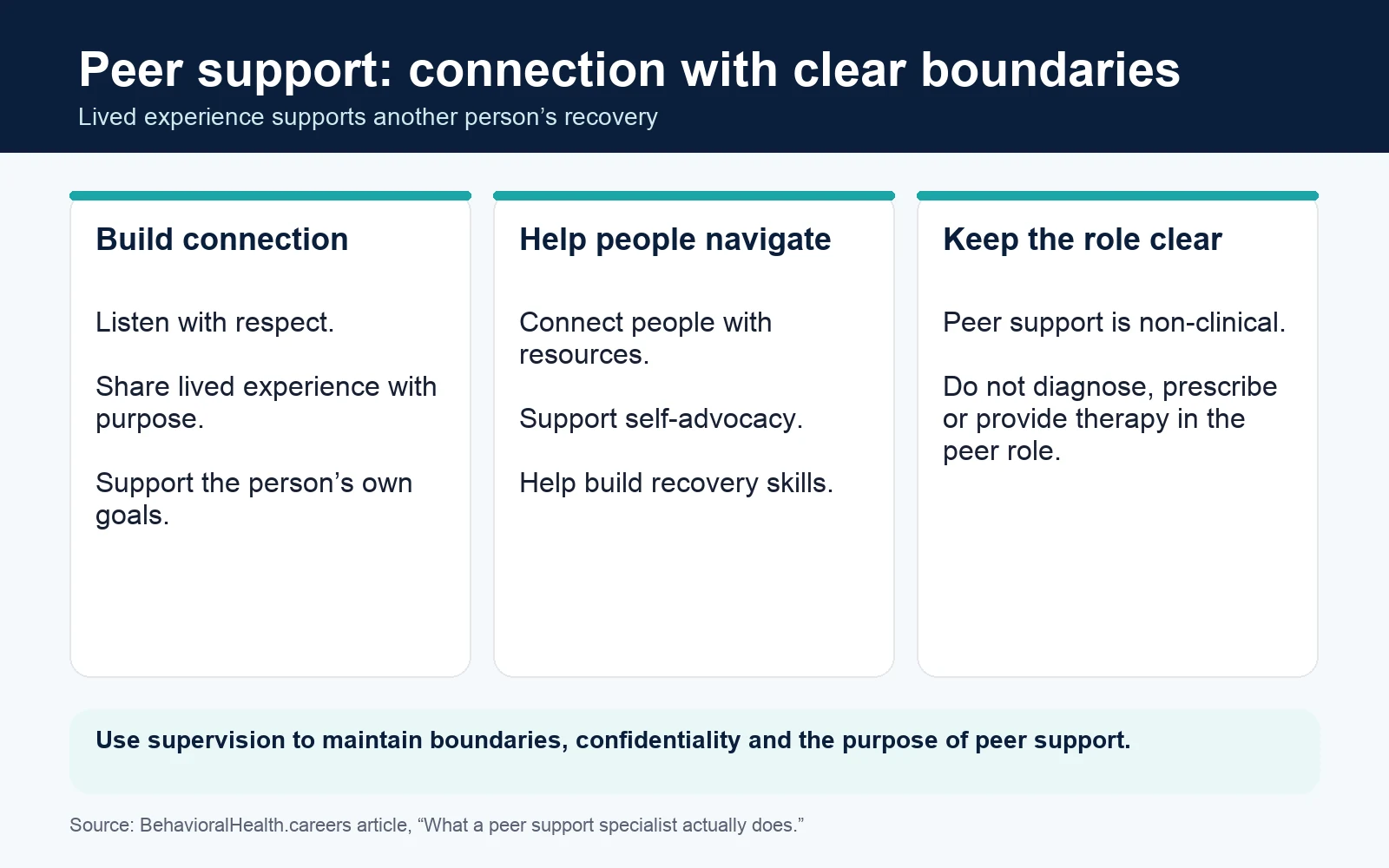
A peer support specialist uses personal experience of a mental health condition, a substance use disorder, or both to support other people working on their own recovery. The role is non-clinical by design. You do not diagnose, and you do not treat.
Writing the care plan is someone else’s job. You offer something a clinician cannot: the credibility of having been there, along with the ability to build trust through lived experience and strong communication as a role model who brings hope.
In practice,
the work looks like connecting people to housing, benefits, and treatment; sitting with someone through a hard week; running a group; advocating for clients inside a treatment team that is talking over them; and modeling that recovery holds. To provide recovery support well in those day-to-day moments, peers need strong interpersonal skills, positive communication skills, and the practical skills to meet people where they are.
Peers work in community mental health centers, recovery community organizations, hospitals, mobile crisis teams, outpatient substance use programs, supportive housing, warm lines, and reentry programs.
The line you cannot cross is the one that gets peers into trouble. Peer support is not therapy delivered by someone cheaper. State codes of ethics for the role cover boundaries, dual relationships, confidentiality, and the duty not to give clinical advice.
Employers that blur that line are the employers to avoid, and you will be able to spot them by the job posting.
The honest readiness question
Wanting to help people is where everyone starts, but before you decide to pursue peer work, take an honest look at your ability, readiness, and current stability. It is not what makes this sustainable.
Most states set a minimum time in recovery before you can certify, and they set it for a reason. North Carolina wants 18 months before you begin training. Georgia wants at least a year working toward wellness and recovery. Washington wants a year. Michigan wants a year of having received mental health services. Texas asks you to demonstrate current self-directed recovery without putting a number on it.
Those numbers are the state’s estimate of when the work stops being a risk to you. Your own estimate matters more.
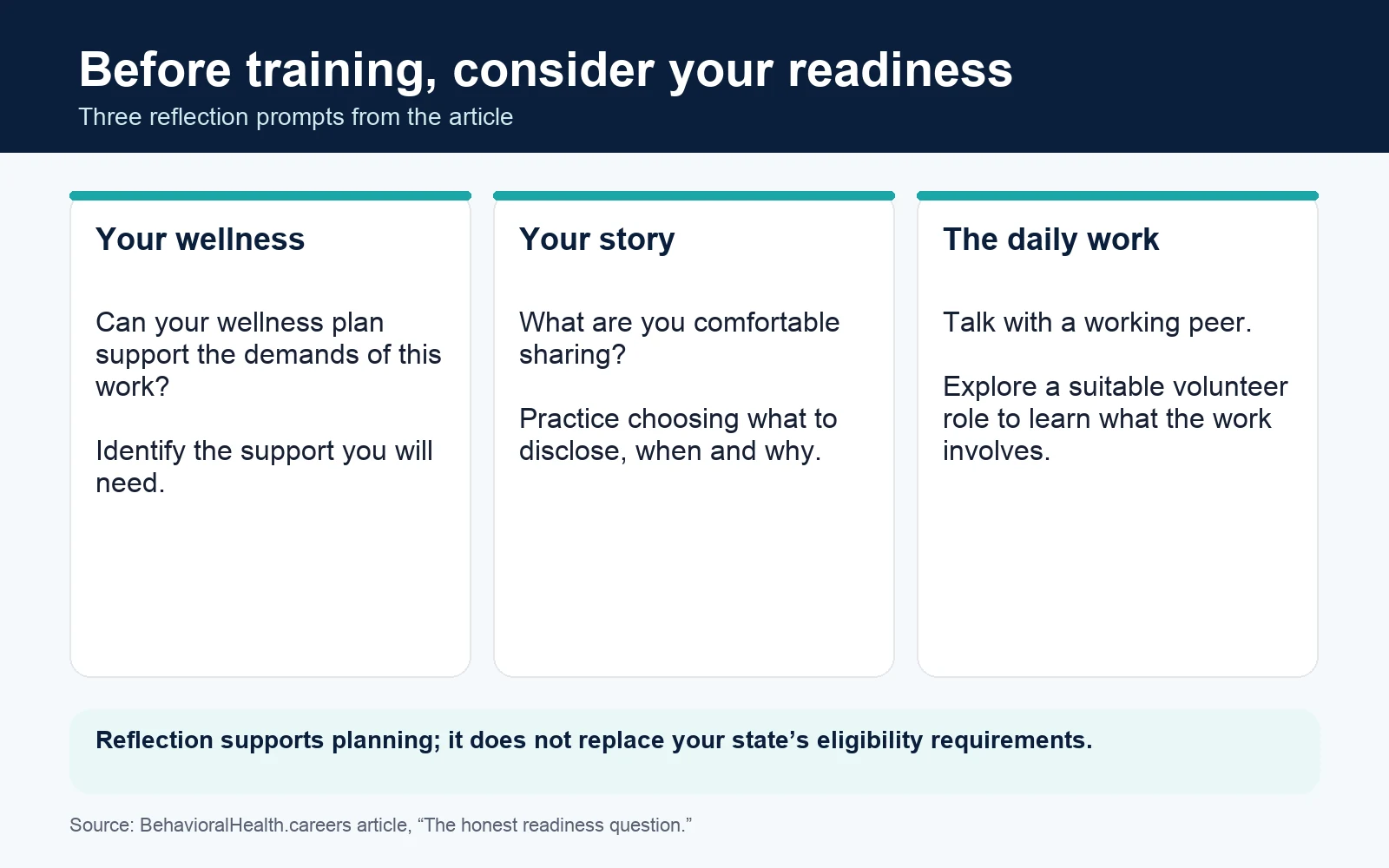
Ask yourself whether your wellness plan can absorb a job where other people’s crises are the job and whether you can support people on a regular basis without disrupting your own recovery journey.
You will encounter suicidality, grief, overdose, homelessness, and the family courts, often in the same week, often from people whose story sounds like yours.
Two useful tests before you commit to anything. Volunteer somewhere that touches the work: a warmline, a clubhouse, a peer-run respite, a crisis text line.
And talk to a working peer specialist about what the training and the first year were actually like. Both take a few hours. Both tell you more than any self-assessment form.
Sharing your story professionally is a skill you build, and before you receive training, it helps to be realistic about the skills needed and the understanding the role requires.
Certification training will ask you to do it in a room of strangers, repeatedly, and to get deliberate about what you disclose, when, and why. Some people find that clarifying. Some find it costs more than they expected.
What SAMHSA recommends, and why your state may ignore it
The Substance Abuse and Mental Health Services Administration’s National Model Standards for Peer Support Certification, first published in 2023 and revised since, cover 11 areas including lived experience, training, examinations, supervised work experience, background checks, and fees.
They are guidance rather than law, and they are especially helpful for understanding what the federal agency sees as reasonable certification standards across the mental health field. SAMHSA’s guidance also reflects research on effective peer support and recovery-oriented practice.
Three recommendations stand out against what states actually do.
On training, SAMHSA puts the range at 40 to 60 hours for mental health, substance use, and family peer certifications. California requires 80. Pennsylvania requires 75. Illinois requires 100 clock hours.
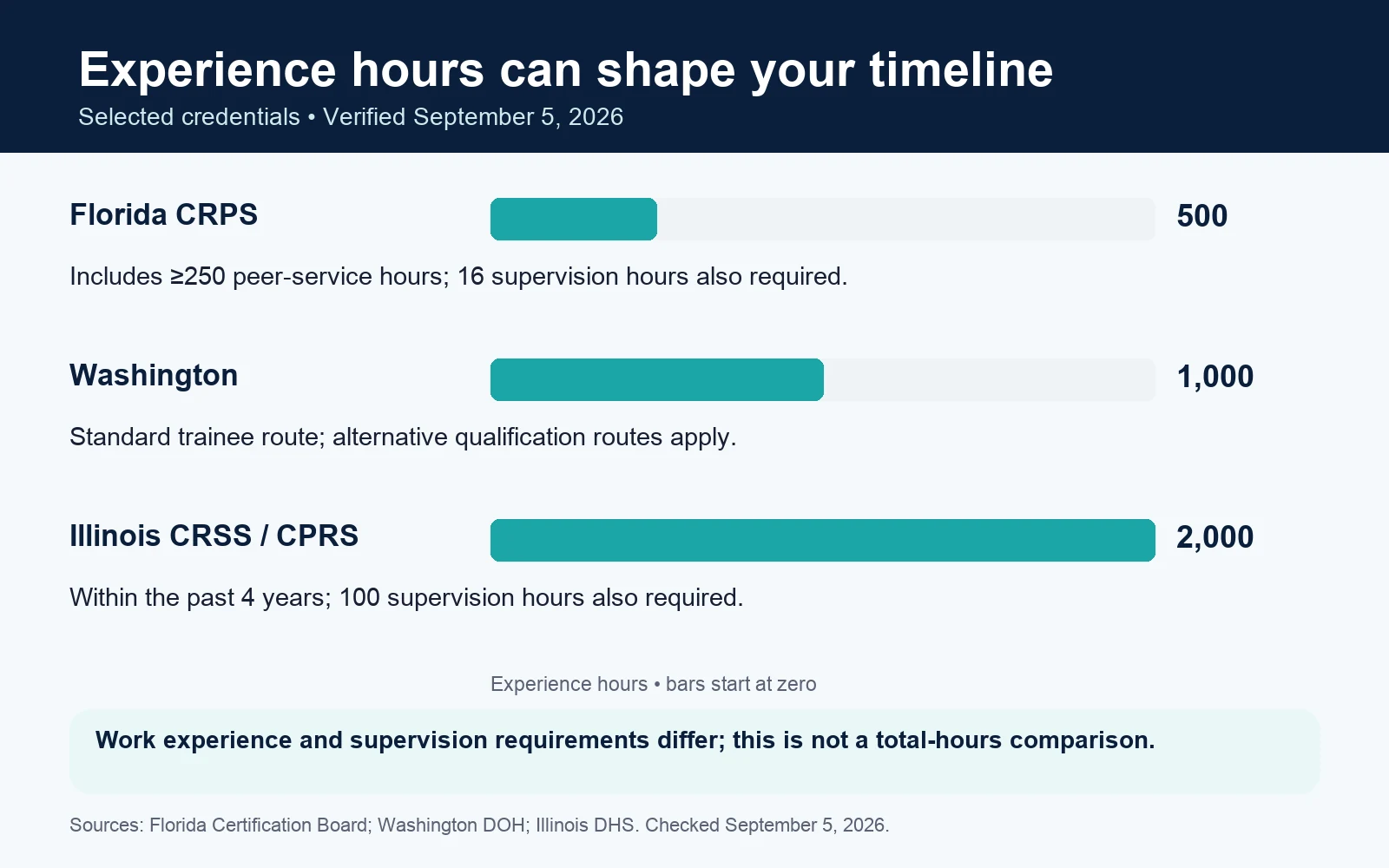
On supervised work experience, SAMHSA says that where states require it at all, a maximum of 120 hours should be enough. New York requires 2,000. Illinois requires 2,000. Florida requires 500. Washington requires 1,000. Ohio and Georgia require none.
On background checks, SAMHSA recommends leaving them to hiring organizations rather than building them into certification, and where states do run them, limiting disqualifying offenses to those that pose a risk to the people being served, while avoiding required disclosure of misdemeanors, drug- and alcohol-related crimes, and nonviolent felonies. Several states run checks as part of certification anyway.
One clarification, because the distinction matters: SAMHSA is advising states on what they should ask, not telling applicants what they may leave off a form. Answer every question a board actually asks you, truthfully and in full. A false or incomplete disclosure is its own disqualifying problem, separate from whatever the underlying record is.
SAMHSA also discourages abstinence-based pathway requirements and recommends expedited routes for peers certified in another state. If you are moving, ask the receiving board about reciprocity before you assume you are starting over.
The five things every state asks about
Strip away the local detail and every certification process is testing the same five things.
Lived experience. Personal experience with a mental health condition, a substance use disorder, or both, and a willingness to identify publicly as a person in recovery. Some states extend this to parents and family members supporting a loved one, usually under a separate credential.
Education. A high school diploma or GED. That is the ceiling as well as the floor in most states. California is explicit that life or work experience cannot substitute; Ohio says there is no waiver or exception. None of the ten states in this guide requires a college degree, and it is not the advantage people assume.
Approved training. Only state-approved curricula count, and these programs usually cover ethics, advocacy, and recovery principles. A well-reviewed course from an out-of-state provider will not get you certified, and it will not make your services Medicaid-billable.
Assessment. Most states use written exams as part of certification. A few use an interview, a supervisor recommendation, or the coursework itself.
Time in the role. Supervised work or volunteer hours, ranging from zero to 2,000 depending on where you live.
Ten states, side by side
These ten cover large populations and, more usefully, every model in current use: exam-first states, hours-first states, cohort-selection states, and one state where employment comes before everything.
| State | Credential | Approved training | Supervised or work hours | Exam | Notable |
|---|---|---|---|---|---|
| California | Medi-Cal Peer Support Specialist | 80 hours | None for initial certification | 120-item multiple choice, 2.5 hours | County opt-in; 20 CE hours every 2 years including 6 in law and ethics |
| Texas | MHPS or RSPS | 19.5-hour core plus 40 to 46-hour supplemental | 250 hours under a certified peer specialist supervisor | Knowledge assessment inside the supplemental training; no separate board exam | Criminal history and registry checks; separate mental health and recovery tracks |
| Florida | Certified Recovery Peer Specialist | 40 hours | 500 work hours, at least 250 peer-specific, plus 16 hours documented supervision | 100 items, 70% to pass | Provisional pathway if you do not yet have the 500 hours |
| New York | NY Certified Peer Specialist | 13 Academy of Peer Services core courses plus 5 more (minimum 15 hours) | 2,000 hours supervised peer specialist experience | None | Initial fees currently funded by the state Office of Mental Health |
| Pennsylvania | Certified Peer Specialist | 75 hours from an authorized vendor | 12 months work or volunteer experience in the last 3 years, or 24 college credits | 50 questions, 90 minutes | $150 application and exam fee; 36 CEUs every 2 years |
| Illinois | CRSS or CPRS | 100 clock hours | 2,000 work hours within 4 years plus 100 hours of supervision | IC&RC exam, 75 items, 500 to pass | Heaviest total requirement of the ten |
| Ohio | Certified Peer Recovery Supporter | 16-hour online curriculum then 40-hour training, online or in person | None on the training route | Online exam, 70% to pass | Three routes: the state training, an approved alternate training, or existing work experience |
| Georgia | CPS-MH, CPS-AD, CPS-P or CPS-Y | 5-day training | None | Written exam by appointment | Competitive: scored application plus group interview, 35 selected per cohort |
| North Carolina | NC Certified Peer Support Specialist | 20 prerequisite hours plus Foundations of Peer Support Parts I and II | Not stated in the program’s published requirements | Written exam, $50 per attempt, 3 attempts before restarting | 18 months in recovery required before training begins |
| Michigan | Certified Peer Support Specialist | 5-day training | Not stated; employment comes first instead | Certification exam at the end of training | You must already be employed by a community mental health services program or contract provider |
Ranges are current as of publication and change often. Verify with the certifying body before you pay for anything.
The state notes that matter
California. CalMHSA is the sole certifying body for the Medi-Cal Peer Support Specialist credential. Eighty hours of training, then a 120-item multiple-choice exam over two and a half hours, offered in ten languages including Spanish, Arabic, Simplified Chinese, Farsi, Hindi, Japanese, Korean, Russian, and Vietnamese.
You get three attempts inside a 12-month approval window. Renewal runs on a two-year cycle with 20 continuing education hours, six of them in law and ethics. The catch is county opt-in: whether the credential opens Medi-Cal billable work near you depends on your county. Source: CalMHSA and California DHCS.
Texas. The Texas Certification Board runs two parallel credentials, Mental Health Peer Specialist and Recovery Support Peer Specialist. Both share a 19.5-hour core workshop, then split into a 40 to 46-hour supplemental track. The supplemental training ends in a knowledge assessment; there is no separate board exam.
Texas rule requires at least 250 hours of supervised work experience as a peer specialist during an initial six-month certification, after which the certifying entity grants a two-year certification. Independent study does not count toward the 250, and neither does supervision time that does not involve observing you deliver services. Criminal history and registry checks are required. Renewal needs 20 CE hours, including three in ethics. Sources: 26 Texas Administrative Code 354.3205, and the Texas Certification Board.
Florida. Forty training hours is among the lightest classroom loads of the ten, but the Florida Certification Board pairs it with 500 hours of work experience, at least 250 of which must be direct peer specialist services to people with similar lived experience, plus 16 hours of documented on-the-job supervision and three recommendation forms. The exam is 100 items at 70%. If you do not have the 500 hours yet, the provisional pathway lets you certify and accumulate them. Source: Florida Certification Board.
New York. No exam, and initial fees are currently covered by the Office of Mental Health, which makes New York one of the cheapest states to enter. The trade is time. Standard certification requires all 13 Academy of Peer Services core courses, at least five more APS courses totaling a minimum of 15 hours, and 2,000 hours of supervised peer specialist experience, plus three references and a letter from your current or most recent supervisor.
There is a provisional tier for people not yet at 2,000 hours. The published schedule is $150 to apply and $60 a year to renew, with the initial fee currently funded. That funding is not permanent, and the board’s application document is several years old, so confirm the current position with NYPSCB before you budget. Source: New York Peer Specialist Certification Board.
Pennsylvania. Seventy-five hours from one of three authorized vendors, a written statement of lived experience of at least a page, and then a choice: 12 months of work or volunteer experience in the last three years, or 24 college credit hours in the same window. The exam is short, 50 multiple-choice questions in 90 minutes. Application and exam together cost $150. Certification lasts two years and renewal needs 36 CEUs plus a $50 fee. Source: Pennsylvania Certification Board.
Illinois. The heaviest lift of the ten. Plan around it rather than discovering it. Both the CRSS and the CPRS require 100 clock hours of education, 2,000 hours of work experience completed within the past four years with most of that time spent supporting people through recovery support duties, and 100 hours of supervision across the performance domains.
The exam is IC&RC’s, 75 multiple-choice items, passing score 500 on a 200 to 800 scale, $200, with unlimited retakes. The two credentials differ mainly in ethics load: CRSS requires six hours, CPRS requires 16 plus five hours each on family and youth content. Work experience can be paid or volunteer, which is the detail that makes the 2,000 hours reachable. Source: Illinois Department of Human Services.
Ohio. Three routes to the same credential, which most guides miss. You can complete the state training, complete an approved alternate peer supporter training, or certify on the strength of existing work experience. On the state-training route the free 16-hour Ohio Learn Peer Recovery Supporter curriculum comes first and is the prerequisite for registering for the 40-hour training, which runs online or in person.
Then the certification exam, passed at 70% or higher. BCI and FBI criminal records checks must be within one year of your application, and the high school diploma or GED requirement has no waiver. If you already have peer work behind you, ask about the experience route before you book a course. Source: Ohio Department of Behavioral Health.
Georgia. The only state on this list where the bottleneck is getting a seat. DBHDD is the sole certifying body, and the Georgia Mental Health Consumer Network runs the project. You need to be 18, have a high school diploma or GED, and have at least a year working toward wellness and recovery. Then you submit a written application that gets scored, sit a one to two-hour group interview with about five other applicants, and compete for roughly 35 places per cohort.
Training runs five consecutive days. Application is $20 and training is $125. Four credential types exist: mental health, addictive disease, parent, and youth, the last restricted to applicants aged 18 to 30. Cohort sizes change, so treat 35 as current rather than fixed. Source: Georgia DBHDD and the Georgia Mental Health Consumer Network.
North Carolina. Eighteen months in recovery before you start training, which is the longest pre-training recovery requirement of the ten. Twenty hours of prerequisite training splits into three hours of ethics and 17 hours of related behavioral training, then Foundations of Peer Support Part I online and Part II instructor-led.
The application fee is $20, the exam is $50 per attempt, and three failed attempts mean starting the process over. Recertification comes at two years. The program’s published requirements do not state a supervised-hour minimum, which is not the same as there being none, so ask the program before you plan around it. Source: UNC Behavioral Health Springboard.
Michigan. Read this one before you spend a dollar. Michigan requires you to be employed by a community mental health services program or a contract provider at the beginning of training. You cannot certify your way into the job; you get the job first, and your employer sponsors you and pays the $300 application fee.
You also need a primary mental health diagnosis with substantial life disruption and at least a year of having received mental health treatment or services. Training is five days and ends in a certification exam. If you are in Michigan, your first move is applying to CMHSPs rather than looking for a course. Source: Michigan MDHHS.
Washington. Washington moved from the older 40-hour training into a newer training structure, and people who completed the older version have to take a gap course. The newer training began in March 2025. Source: Washington State Health Care Authority.
One more state to look at
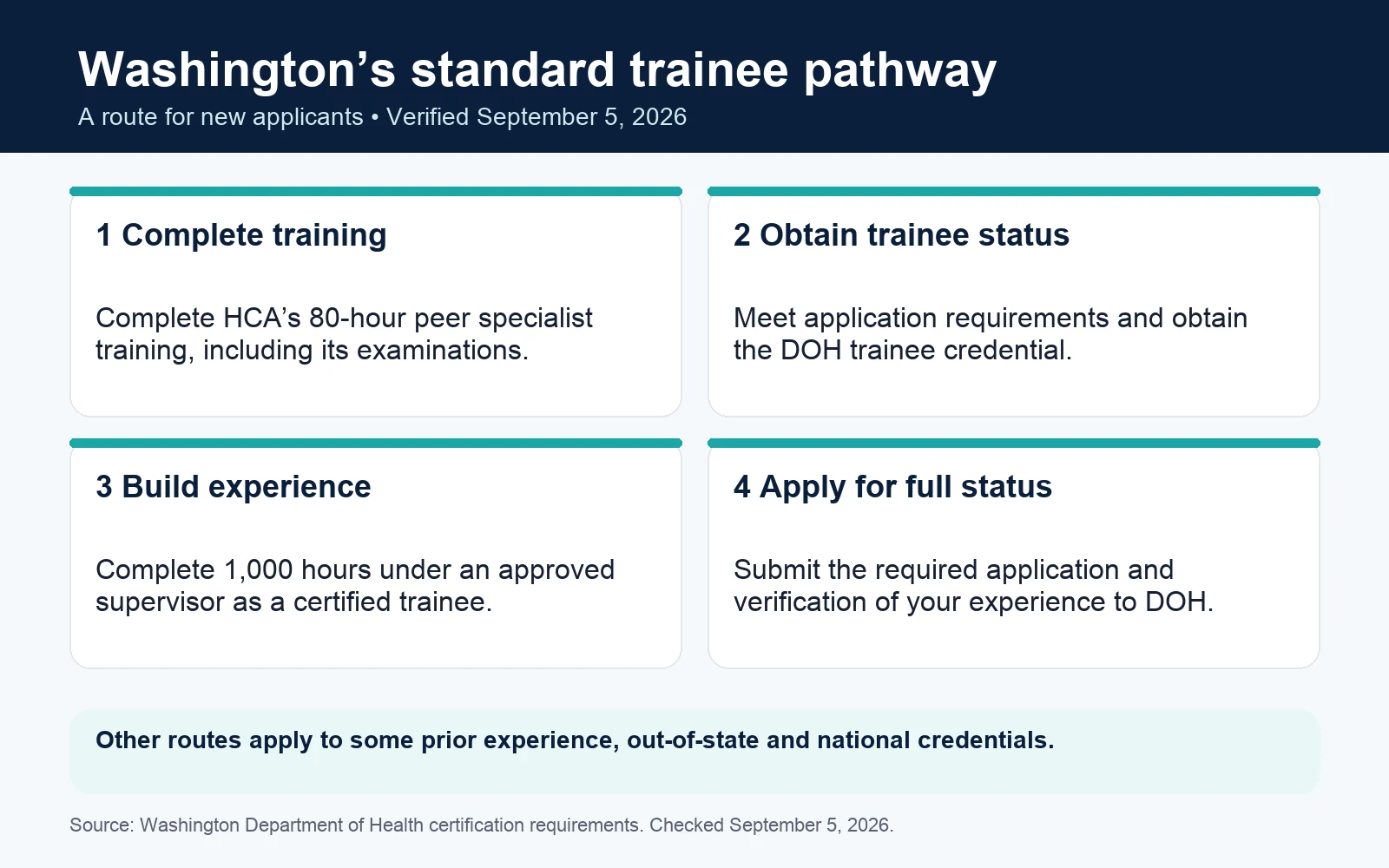
Washington is not on the list above, but its answer to the hours problem is the one to watch. The credential now sits with the Department of Health and requires 80 hours of Health Care Authority peer specialist training with the exams built into the training itself, plus 1,000 hours of supervised experience completed as a Certified Peer Support Specialist Trainee.
You attest to one or more years in recovery, or to being the parent or legal guardian of a youth receiving behavioral health services. People who took the older 40-hour training complete a gap course.
The trainee tier is the interesting part. It gives you access to a recognized status while you build the 1,000 hours, instead of leaving you to find 1,000 hours of experience before anyone will call you certified. Source: Washington State Department of Health.
Traps that cost people months
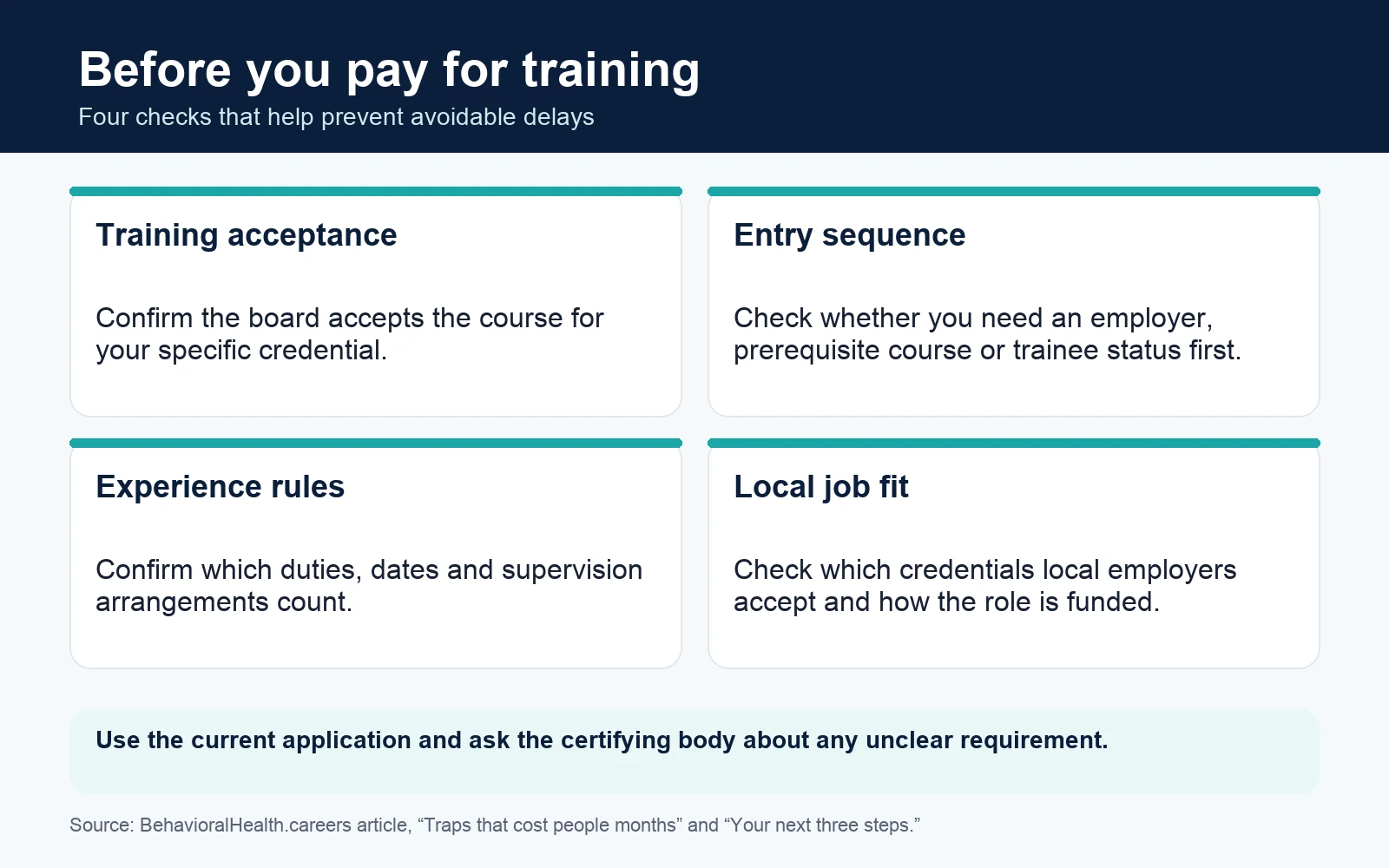
Paying for the wrong training. Peer support courses are sold widely online, and most of them do not satisfy any state’s certification requirement. Confirm the provider appears on your state’s approved list before you enroll.
Assuming a national credential substitutes for a state one. In the states here it does not, and Medicaid billing runs on the state credential.
Missing the county or plan layer. California’s credential opens Medi-Cal work only in counties that have opted in. Several state Medicaid programs cover peer support on one side of the mental health and substance use line and not the other, and which side changes.
A credential that does not open billable work in your area is a credential without local jobs behind it. Check your state Medicaid agency’s current rule, and which community resources and local services the credential actually connects you to in your area, rather than a summary of it.
Not banking your hours from day one. States that require 500, 1,000 or 2,000 hours want documentation with supervisor sign-off. People who start logging in month nine end up recreating a year of timesheets from memory. Start a log the week you start working, paid or volunteer.
Letting a background check surprise you. SAMHSA recommends narrowing disqualifying offenses and leaving checks to employers. Several states run them at certification anyway. If you have a record, ask the certifying board directly what disqualifies before you invest time and fees.
National credentials, and what they are actually for
The National Certified Peer Recovery Support Specialist credential, issued through NAADAC’s National Certification Commission for Addiction Professionals, is the one you will see referenced most.
It requires a high school diploma or GED, a minimum of two years of lived experience and recovery from substance abuse or co-occurring disorders, 60 continuing education contact hours including six in ethics and six in HIV and other pathogens, 1,000 hours of paid work experience or 2,000 hours of volunteer experience in a peer recovery support role, and 75 hours of direct supervision. The application fee is $150.
Treat a national credential as a supplement. It is not a shortcut. It travels well, it signals seriousness to employers operating in several states, and it may benefit applicants seeking employers in more than one state if you move often. It does not replace state certification, and state certification is what determines whether an agency can bill Medicaid for your time.
Who supervises you, and the 2024 change that matters
Medicaid is what turned peer support from a volunteer tradition into a paid profession, and its rules shape every job you will apply for.
The founding document is a CMS State Medicaid Director letter dated August 15, 2007, which made peer support reimbursable and set three conditions: supervision by a competent mental health professional as defined by the state, care coordination inside a person-centered plan, and state-defined training and credentialing with ongoing continuing education.
That supervision line was widely read as requiring a licensed clinician to supervise every peer. On June 5, 2024, CMS issued an FAQ correcting the reading. Supervisors may include licensed practitioners, unlicensed practitioners, and experienced peer support providers, with states defining who qualifies. The agency pointed states toward SAMHSA’s core competencies and the National Model Standards when building those definitions.
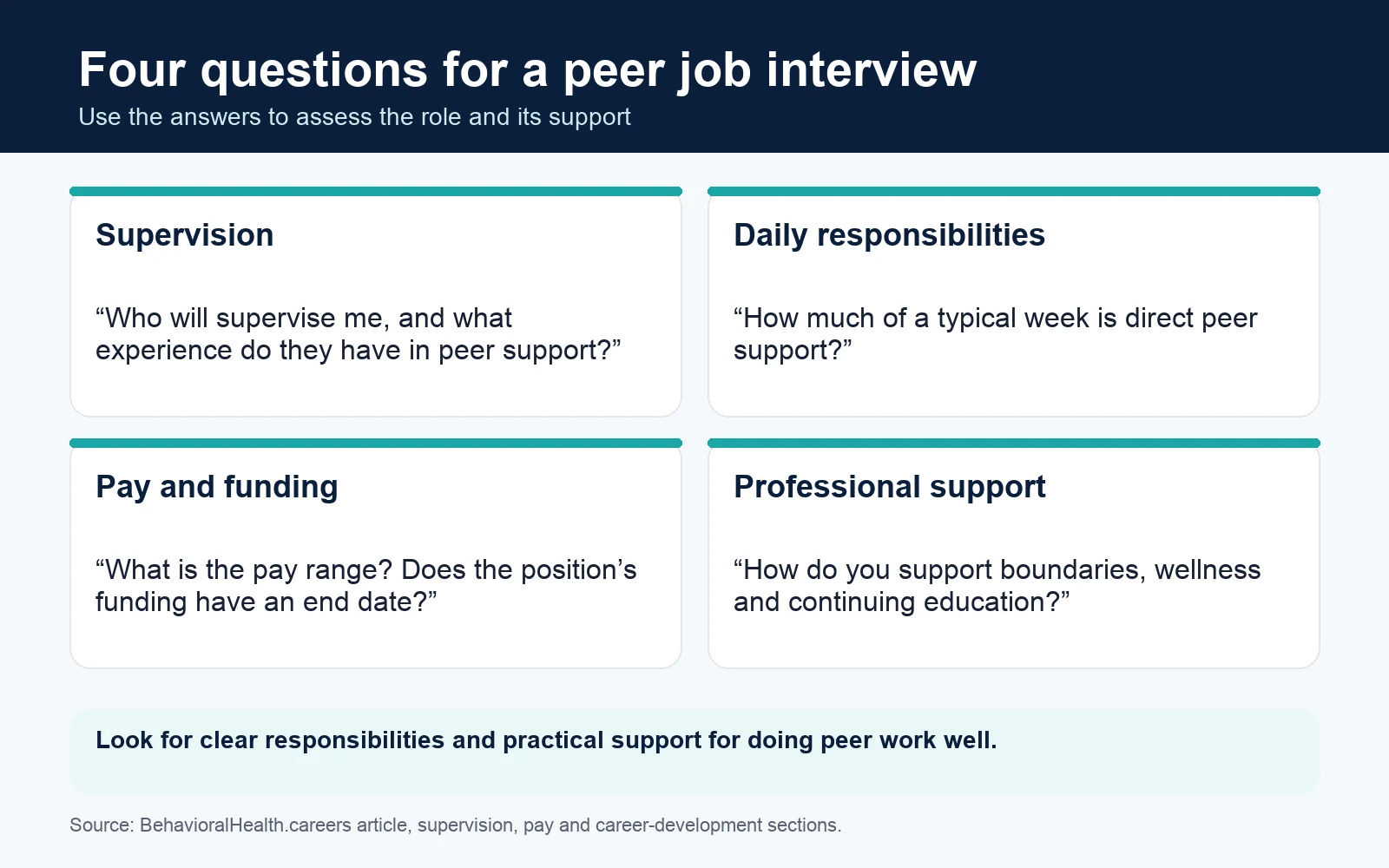
This matters to you for two reasons. It opens a supervisory career ladder that stays inside the peer role rather than requiring you to become a clinician. And it gives you a specific question for interviews: who will supervise me, and are they a peer? An employer that has thought about that answer has usually thought about the rest of the program too.
On the coverage side, a 2024 national analysis found 48 states and DC reimbursing peer support through Medicaid, with 41 covering both mental health and substance use and the rest covering one side or neither. Vermont and South Dakota reimbursed neither.
Treat any list of which states cover which side as perishable. Ohio is the example: that analysis has Ohio covering substance use only, and Ohio’s own Medicaid rule, effective September 1, 2024, covers peer support delivered for needs “relating to a mental health or substance use disorder”. The list was right when it was published and Ohio moved. Before you build a plan around your state’s coverage, read the current rule on your state Medicaid agency’s own site.
What the work pays
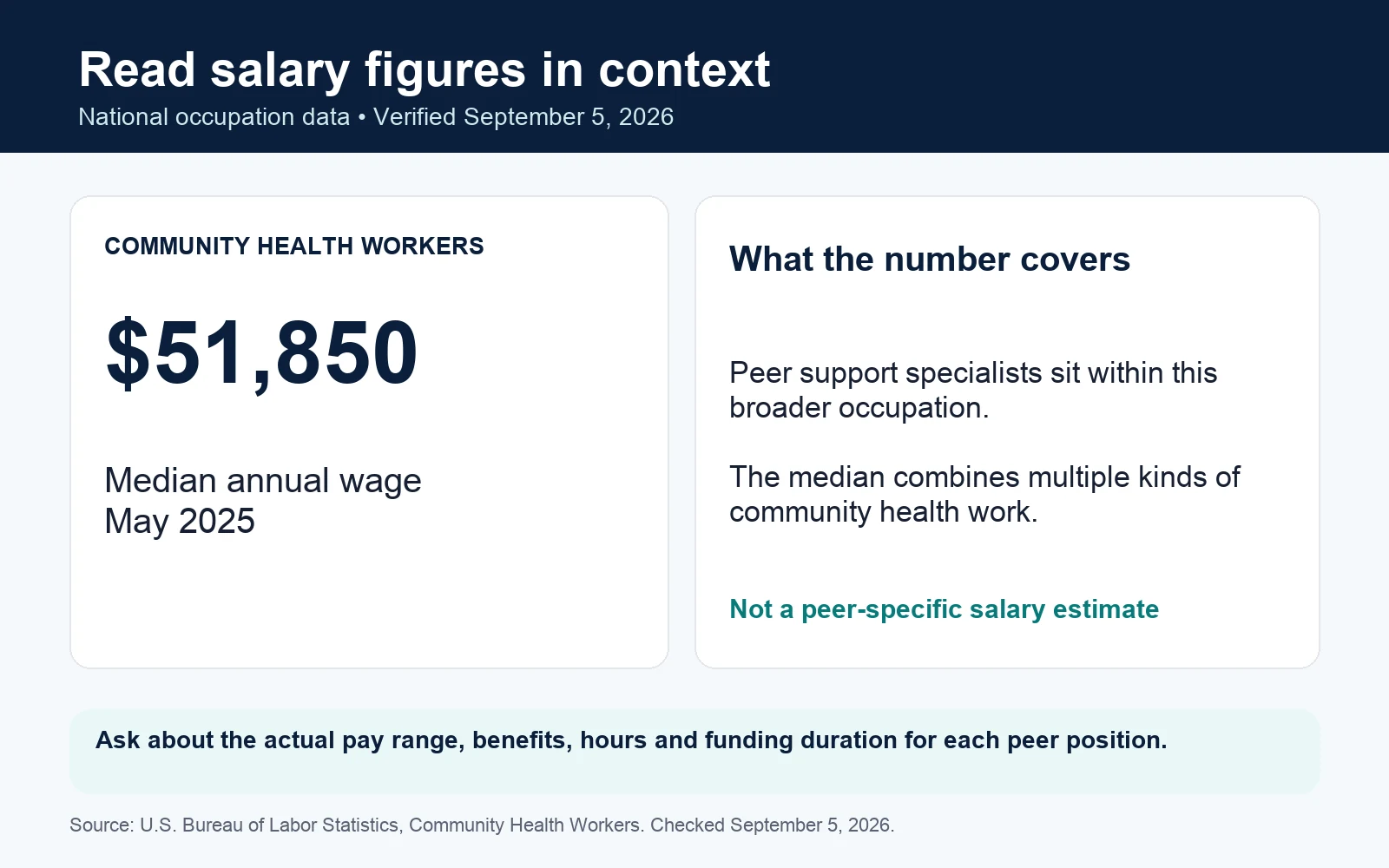
There is no clean national salary figure for peer support specialists, and anyone quoting one to the dollar is quoting a job-ad aggregator rather than a wage survey. The occupation has no dedicated federal code.
The Bureau of Labor Statistics folds peer support specialists into Community Health Workers, code 21-1094, which BLS describes as including workers who “have experienced a mental health or substance use disorder and are in recovery while providing support to others experiencing similar challenges.”
For that broader group, BLS puts the median wage at $51,850 a year as of May 2025 and projects 13% employment growth from 2025 to 2035, roughly 7,000 openings a year. Typical entry-level education is a high school diploma.
Peer-specific roles generally sit below that median, because the category also contains better-paid outreach and program roles, even as peer roles continue to develop across the behavioral health workforce.
One observation from our own listings says more about this market than any average. Across every job we pulled from employer feeds through August 2026, 19 carried a peer, recovery coach or recovery support specialist title, and three of them posted pay.
Nineteen is too small a sample to build a salary figure on, and we are not going to pretend otherwise. The ratio is what matters: our board overall runs between 66% and 76% posted pay, and peer roles came in well under that.
Read that as a negotiating condition rather than a salary estimate. When most employers in a role are not posting pay, the candidate who asks a direct question about the range is not the one at a disadvantage. Ask for the range, and ask whether the position is funded by a grant with an end date and what the workplace conditions are before you accept an offer, because a lot of peer roles are.
Specialized peer roles
The general credential is not the only door.
Family peer specialists have supported a child, partner or other loved one through mental health or substance use challenges, and work with families rather than with the person in treatment. Several states, Georgia among them, certify this separately.
Youth and young adult peer specialists are usually younger adults with recent lived experience, working in schools, early psychosis programs and youth drop-in centers. Georgia’s CPS-Y is restricted to applicants aged 18 to 30.
Forensic and justice-involved peers have lived experience of incarceration or court involvement and work in reentry, probation, diversion and drug court programs.
Recovery-focused peers work primarily with substance use and co-occurring conditions, and this is where the NCPRSS and state credentials like Texas’s RSPS and Florida’s CRPS sit.
Each track has its own eligibility rules and, often, its own training. Choose the one that matches the experience you actually have rather than the one with the most job postings, because the eligibility attestation is not something you can work around.
Staying certified, and where the role goes next
States renew on a cycle, typically one to three years, and attach continuing education to renewal. Pennsylvania wants 36 CEUs over two years. California wants 20 hours over two years including six in law and ethics. Texas wants 20 hours including three in ethics. SAMHSA recommends annual ethics training regardless.
State behavioral health agencies and peer academies often run these courses free or close to it, so budget the time rather than the money; that ongoing learning also provides helpful information for keeping your certification active and your practice current.
The career ladder in peer services is shorter than in clinical roles, and pretending otherwise does no one a favor. The realistic moves are senior peer roles, peer supervision (now clearly viable under the 2024 CMS guidance), program coordination, training and technical assistance, and state or regional peer advocacy work, with senior peers and supervisors often taking on more responsibility while staying grounded in peer ethics.
Some peers use the credential as an entry point and go on to case management or a counseling license while keeping a peer lens. Others build a career inside peer services and are good at it for twenty years.
The failure mode to watch for in employers is role drift: a peer position that gradually absorbs case management, transportation, and documentation until there is no peer support left in it. Ask in the interview what a typical week looks like hour by hour, and listen for how much of it is peer support.
Your next three steps
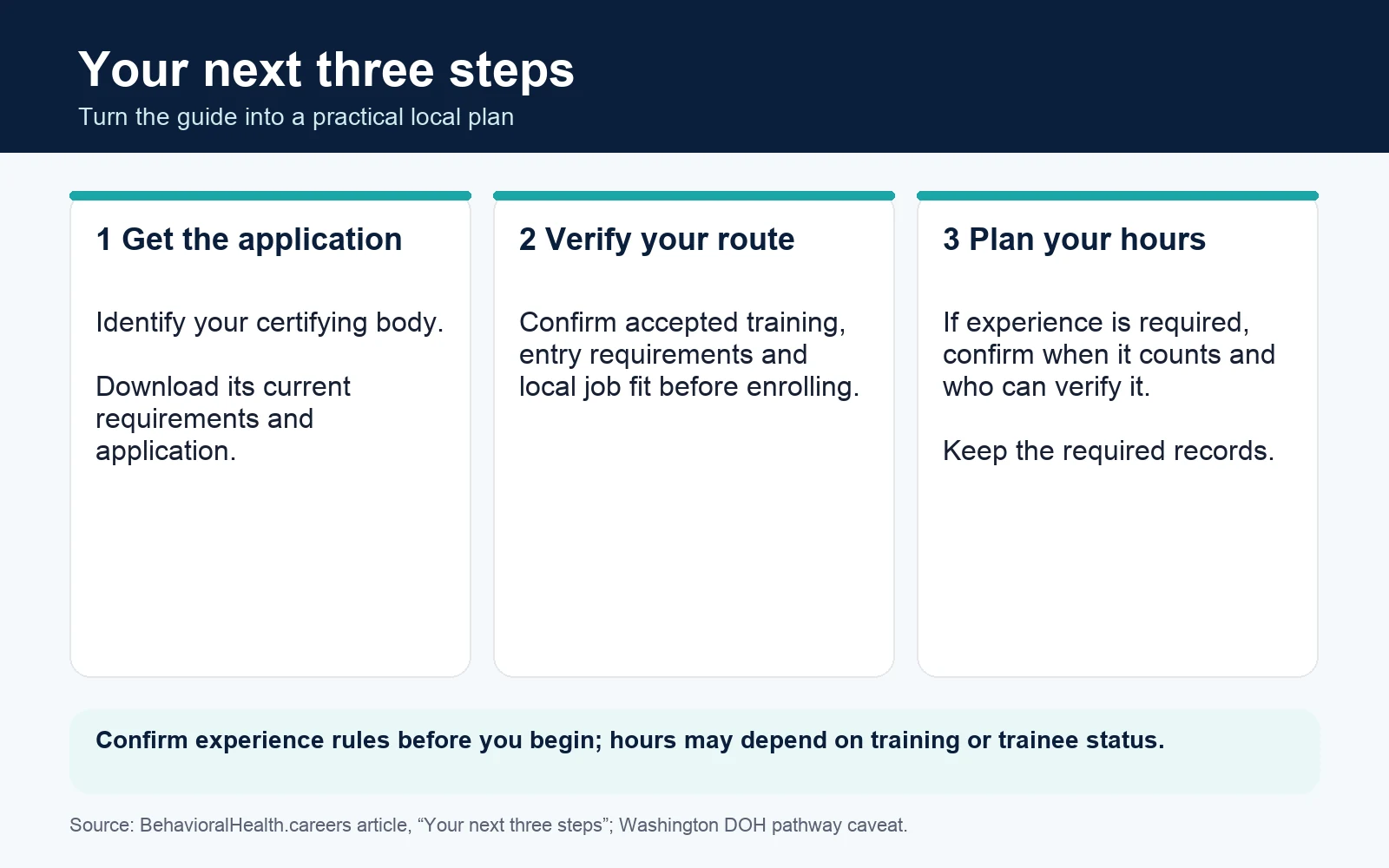
Identify your state’s certifying body and download its current application as the first step. The application itself rather than a summary of it, because that is where the hour requirements and fees actually live.
Check two things before enrolling in anything: whether the training provider is on your state’s approved list, and whether your county or region bills Medicaid for the peer services your credential would cover, which also helps you identify the recovery goals and services a credentialed peer role in your area is expected to support.
Start logging hours now, with a supervisor who will sign for them, even if you are volunteering. In the states that require 500 to 2,000 hours, this is the constraint that determines your timeline.
Search current peer support openings on BehavioralHealth.careers (/jobs/?search_keywords=peer) to see what employers in your state are asking for, and what they are paying when they say.
Frequently asked questions
How long does it take to become a certified peer support specialist?
Three to twelve months in states with no supervised-hour requirement, and one to two years in states that require substantial hours. Ohio and Georgia can be done in months once you have a training seat. Illinois and New York require 2,000 hours of work experience, which at full time is roughly a year of employment and considerably longer part time. The training itself is rarely the constraint. The hours are.
Do I need a college degree to work as a peer specialist?
No. Every state covered in this guide requires a high school diploma or GED and nothing above it, and California and Ohio both say explicitly that no substitution or waiver is available. A degree may help for supervisory or program coordination roles later, but it is not a hiring advantage for entry-level peer positions and it does not shorten any certification pathway.
Can I be a peer support specialist if I still take psychiatric medication or attend treatment?
In every state covered here, yes. None of them treats ongoing medication or continuing therapy as disqualifying, and Michigan actively requires that you have received mental health services. Several states ask for evidence that you are engaged in your own recovery rather than finished with it.
What boards screen for is stability, self-awareness, and your ability to make progress in your own recovery process. If your state is not one of the ten here, confirm it with the certifying board, because this is a question worth a direct answer rather than an assumption.
What if I have a criminal record?
It depends on the state and on the offense. SAMHSA recommends limiting disqualifying offenses to those posing a risk to the people being served, and specifically recommends against requiring disclosure of misdemeanors, drug and alcohol-related crimes, and nonviolent felonies.
Not every state follows that. Texas and Ohio run checks as part of certification. Ask the certifying board directly, in writing, before you pay any fees.
Can peer specialists bill Medicaid directly?
In almost all cases, no. Peer services are billed by the approved agency that employs you, because peers provide recovery support within those programs. This is why the employer’s Medicaid status matters more than your credential when you are job hunting, and why a certification that is not billable in your county has limited local value.
Does certification transfer if I move to another state?
Sometimes, and it is worth asking rather than assuming. SAMHSA recommends states offer expedited processes, including letting peers certified elsewhere sit the exam immediately instead of repeating every requirement. Some boards honor that; others do not. Contact the receiving board before you move, and keep every certificate, transcript, and supervisor verification you have ever been issued.
Sources
SAMHSA, National Model Standards for Peer Support Certification (2023) : https://library.samhsa.gov/sites/default/files/pep23-10-01-001.pdf
CMS, State Medicaid Director Letter #07-011, August 15, 2007 : https://downloads.cms.gov/cmsgov/archived-downloads/smdl/downloads/smd081507a.pdf
CMS, Frequently Asked Questions on Medicaid and CHIP Coverage of Peer Support Services, June 5, 2024 : https://www.medicaid.gov/federal-policy-guidance/downloads/faq06052024.pdf
Policy Center for Maternal Mental Health, Gaps in Peer Support Reimbursement and Certification in the United States (updated December 2024) : https://policycentermmh.org/gaps-in-peer-support-reimbursement-and-certification-in-the-united-states/
U.S. Bureau of Labor Statistics, Occupational Outlook Handbook, Community Health Workers : https://www.bls.gov/ooh/community-and-social-service/community-health-workers.htm
CalMHSA, Medi-Cal Peer Support Specialist certification and exam : https://www.capeercertification.org/certification-exam/
California DHCS, Medi-Cal Peer Support Services Specialist Program FAQ : https://www.dhcs.ca.gov/medi-cal-peer-support-services-specialist-program-frequently-asked-questions/
Texas Certification Board via PeerHub TX, MHPS and RSPS certification : https://centralizedtraining.com/peerhubtx/mhps-certification/
Florida Certification Board, CRPS Requirements and Application Pathways : https://flcertificationboard.org/certifications/crps-requirements-and-application-pathways/
New York Peer Specialist Certification Board, NYCPS application : https://nypscb.org/wp-content/themes/nypscb/files/PDFs/NYCPS%20Application%20Feb%2002-14-2020.pdf
Pennsylvania Certification Board, Certified Peer Specialist : https://www.pacertboard.org/cps
Illinois DHS, CRSS and CPRS FAQs : https://www.dhs.state.il.us/page.aspx?item=155382
Ohio Department of Behavioral Health, Paths to CPRS Certification : https://dbh.ohio.gov/wps/portal/gov/dbh/community-partners/peer-supporters/certified-peer-recovery-supporter-cprs-adult/paths-to-certification
Georgia DBHDD, Certified Peer Specialist : https://dbhdd.georgia.gov/recovery-transformation/cps
Georgia Mental Health Consumer Network, CPS training schedule and application process : https://www.gmhcn.org/cps-training-schedule
UNC Behavioral Health Springboard, NC Certified Peer Support Specialist certification : https://pss.unc.edu/certification
Michigan MDHHS, Peer Support Specialist Certification Training Application : https://www.michigan.gov/-/media/Project/Websites/mdhhs/Folder2/Folder1/Peer_Support_Specialist_Certification_Training_Application.pdf
Washington State Department of Health, Peer Support Specialist certification requirements : https://doh.wa.gov/licenses-permits-and-certificates/professions-new-renew-or-update/peer-support-specialist/certification-requirements
NAADAC / NCC AP, NCPRSS initial credential application : https://www.naadac.org/assets/2416/intitial_ncrs_application_-_final_pdf_fillable_-_42623.pdf