
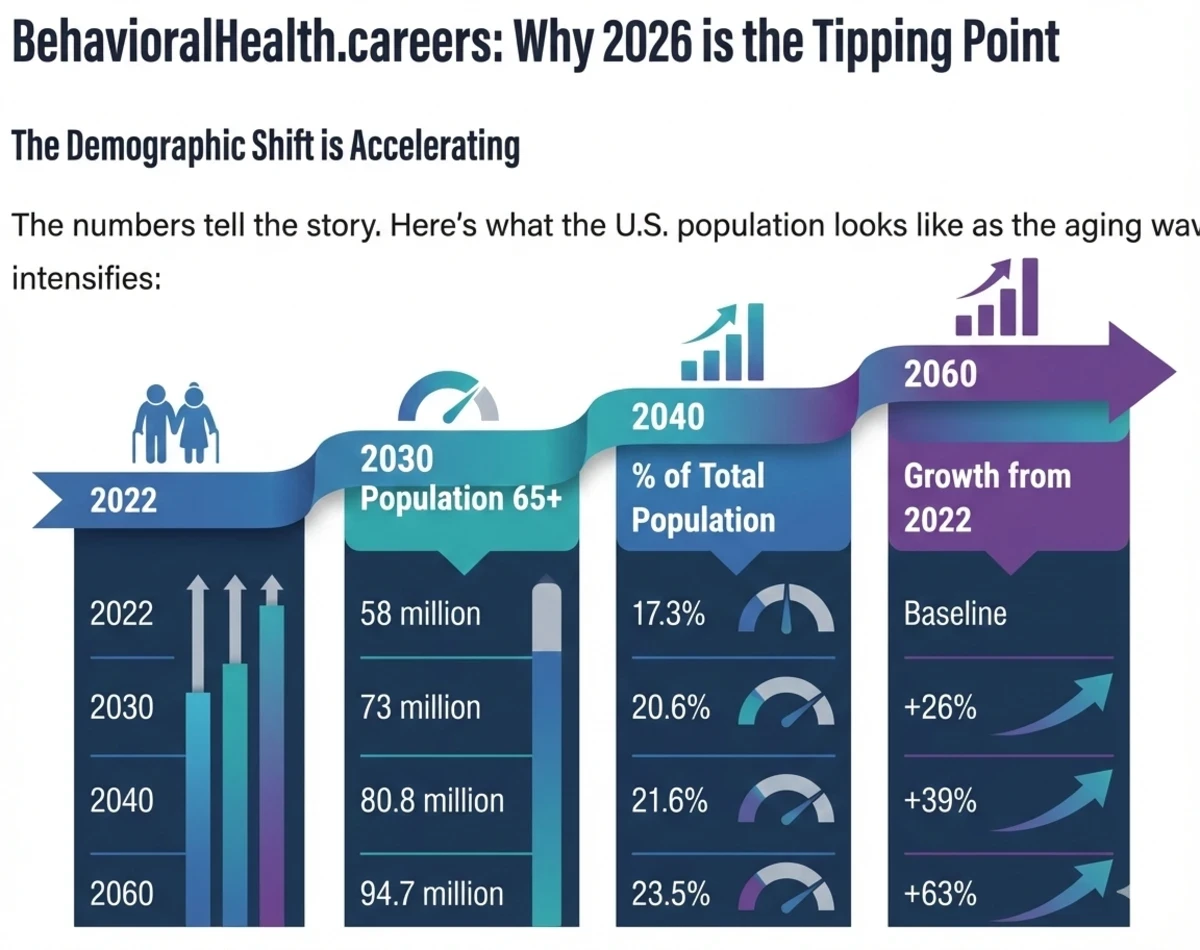
By 2030, all Baby Boomers will be 65 or older: approximately 73 million Americans. That’s one in five people. And by 2060?
The 65+ population hits 94.7 million, representing nearly one in four U.S. residents. This isn’t speculation. It’s demographic math.
Within this growing population, there is a wide diversity and diversity among older adults, reflecting varied backgrounds, experiences, and needs that must be recognized to provide effective care.
The problem: America currently has around 4,000 trained geropsychologists. The need by 2030: 18,000 to 30,000 specialists.
That’s a workforce gap requiring triple the current capacity in just four years.
If you’re exploring behavioral health careers or looking to specialize, geropsychology represents the rare intersection of urgent need, competitive pay, and long-term job security.
This guide breaks down why 2026 is the inflection point and what it means for your career trajectory.
A Concise Introduction to Geropsychology
You’ve probably heard of geropsychology, or maybe you know it as geriatric psychology – either way, it’s a specialized branch of professional psychology that’s all about understanding and addressing the mental health needs of older adults.
And as the U.S. population ages, the demand for professionals with expertise in this field is rapidly increasing. But what does a geropsychologist actually do?
They work closely with older adults, their families, and caregivers to help manage mental health disorders, support cognitive functioning, and enhance everyday living abilities.
The American Psychological Association (APA) officially recognizes geropsychology as a specialty, and there’s even a Council of Professional Geropsychology Training Programs (CoPGTP) that sets the standards for professional geropsychology training programs nationwide.
You might wonder what kind of training these practitioners go through – well, it’s rigorous gero-psychology training that gives them the skills they need to assess, diagnose, and treat issues like cognitive decline, depression, and anxiety. The goal?
Making sure that older adults receive the highest quality of care. This field improves the lives of older persons and also supports families and communities as they navigate the challenges of aging.
Why 2026 is the Tipping Point
The Demographic Shift is Accelerating
The numbers tell the story. Elderly adults face emotional challenges due to loss of lifelong relationships and declining health.
Here’s what the U.S. population looks like as the aging wave intensifies:
By 2030, just four years from now, one in five Americans will be over 65.
This age cohort carries the highest rates of depression, anxiety, dementia, and chronic illness-related psychological distress.
Translation: demand for geropsychologist jobs will outpace nearly every other specialty in behavioral health.
The Senior Behavioral Health Provider Gap is Widening
Mental health counselors specializing in geriatric populations are projected to grow 17% from 2024 to 2034: more than four times the national average of 4% across all occupations.
Clinical psychologists focusing on older adults are growing at 6%, which matches the average but masks the reality: within geropsychology specifically, the shortage creates disproportionate opportunity.
The American Geriatrics Society’s estimate is stark: to meet 2030 demand, the geropsychology workforce would need to increase by 350% to 650%. That’s not happening. Which means if you’re entering the field now, you’re positioning yourself in a seller’s market that will last decades.
Perhaps even more importantly, geropsychologists report high job satisfaction due to the meaningful impact they have on their patients’ lives.
Understanding Mental Disorders in Aging
If you’re an older adult dealing with mental health challenges like anxiety, depression, or dementia, you’re not alone – these conditions are incredibly common and can really impact how you experience life day to day.
That’s where geropsychologists come in, and they’re uniquely trained to understand exactly what you’re going through.
They get that your mental health doesn’t exist in a bubble – they look at how your physical health, any cognitive changes, and your social and cultural background all work together to affect how you’re feeling.
When you work with one of these professionals, they’ll take time to really observe your daily life and environment, figuring out what your strengths are, where you might be struggling, and what coping strategies are already working for you.
From there, they’ll create a treatment plan that’s designed specifically for your unique situation.
Geropsychology Job Growth for Older Adults vs The National Job Market
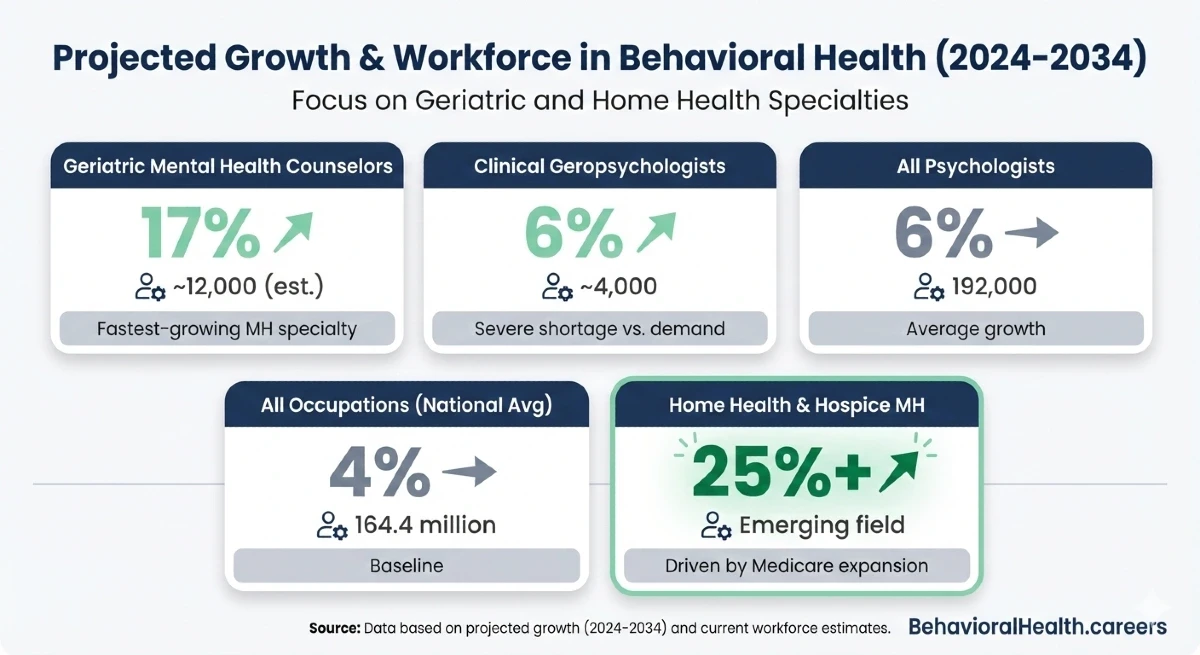
Here’s how senior mental health roles compare to the broader employment landscape:
According to the U.S. Bureau of Labor Statistics, the median annual salary for geropsychologists is approximately $82,180, with variations depending on geographic location and experience.
Geropsychologists are essential in addressing the complex mental health needs of older adults, who often experience comorbid medical and mental health conditions.
The takeaway: geropsychology jobs are growing 2x to 4x faster than the general labor market, with home health roles leading the surge.
Salary & Benefits: What You’ll Actually Earn
Let’s get specific. Geropsychology compensation varies by credential, setting, and experience, but the floor is competitive, and the ceiling is high.
Salary Ranges by Credential
- Clinical Geropsychologists (Doctoral-level): Median $90,130; experienced practitioners at 90th percentile earn $98,210+
- Top-Tier Specialists (Private Practice, VA Leadership): $100,000 to $180,000+
- Master’s-Level Mental Health Counselors (Geriatric Focus): $53,710 to $98,210 depending on licensure and setting
- Geriatric Social Workers (LCSW with specialty training): $60,000 to $85,000
Career Earnings Outlook
Median lifetime earnings over a 30-year career exceed $3.5 million for doctoral-level geropsychologists. There is a strong demand for practicing psychologists specializing in geropsychology, as the aging population increases the need for mental health services tailored to older adults.
The field of geropsychology is recognized as a specialty by the American Psychological Association and the American Board of Professional Psychology.
Educational investment (typically $80,000 to $150,000 for a PsyD or PhD) recovers within 7 to 10 years of full-time practice: faster if you enter high-demand settings like the VA or telehealth-based private practice.
Medicare-Reimbursable Mental Health Services Are Expanding
A game-changer for 2026 and beyond: Medicare is increasing reimbursement rates for mental health services, particularly for chronic disease management and dementia care.
Geropsychologists often work in long-term care facilities, outpatient settings, and private practices, providing essential mental health support for older adults.
This shift makes geropsychology more financially viable in private practices and encourages health systems, including long-term care environments, to hire specialists.
Top 3 Settings for Geropsychologist Jobs in 2026
Where you practice shapes your daily work, pay structure, and advancement path.
Here are the three settings hiring aggressively right now.
1. VA Hospitals and Federal Health Systems
What you’ll do: Provide individual and group therapy for aging veterans; conduct cognitive assessments for dementia and PTSD; collaborate with interdisciplinary teams on geriatric care plans.
Why it’s growing: The veteran population is aging rapidly. Veterans Affairs plays a key role in mental health services for older adults. The Department of Veterans Affairs provides training to over 100,000 health profession students each year, including psychologists, with a focus on geropsychology and related fields.
The VA employs the largest number of psychologists in the country and offers competitive salaries ($90,000 to $120,000+), loan forgiveness programs, and federal benefits.
Who should apply: Doctoral-level psychologists (PhD or PsyD) with supervised experience in geriatric assessment. Veterans’ preference applies but is not required for clinical roles.
Job security: Exceptional. The VA is federally funded and faces consistent demand. Search psychologist jobs with federal health system filters to see current openings.
2. Home Health and Hospice Care
What you’ll do: Deliver in-home therapy for older adults with mobility limitations, chronic illness, or end-of-life psychological needs; provide palliative care and end-of-life counseling, which can lower stress and improve quality of life for dying patients and their families; train caregivers; coordinate with medical teams, whether in remote roles or in-person.
Why it’s exploding: Telehealth expansion and Medicare’s shift toward home-based care models have unlocked access for homebound seniors. Growth in home health mental health roles is projected at 25%+ through 2034: the fastest expansion in the field.
Who should apply: Master’s-level counselors (LPC, LMFT, LCSW) comfortable with autonomous practice and technology platforms. Doctoral-level psychologists are also in demand for complex cases involving neuropsychological assessment.
Flexibility: High. Many home health roles offer hybrid schedules with telehealth integration, making this setting ideal for work-life balance.
3. : Both Solo and Group Private Practices
What you’ll do: Build a specialized caseload focused on aging-related issues: depression, anxiety, grief, caregiver stress, dementia support, and chronic illness adaptation.
You will work directly with older patients, gaining valuable insight into their lives and experiences. Geropsychologists also assist families in managing caregiving strain and resolving family conflicts related to care decisions. You control your schedule, rates, and clinical focus.
Why it’s viable now: Medicare reimbursement improvements and the growth of sliding-scale senior care networks make geriatric-focused private practice sustainable. Many practitioners report $100,000 to $150,000 annual earnings once established.
Our psychologist salaries by state resource offers data based on the most current BLS reporting available.
Who should apply: Licensed clinicians (LCSW, LPC, PsyD, PhD) with 2+ years of post-licensure experience and business development skills. Consider joining an established group practice first to learn administrative systems before going solo.
Reality check: Private practice requires strong billing knowledge and self-motivation. But for geropsychologists, the demand is high enough that building a full caseload takes months, not years.
When you think about advancing care for older adults, what comes to mind? Research is really at the heart of moving clinical geropsychology forward and making life better for seniors.
You’ll find that geropsychologists are right there contributing to studies on cognitive decline, mental health conditions, and health promotion, exploring how the aging process affects your everyday living abilities and overall well-being.
What are the Skills and Tools of Modern Geropsychologists?
If you want to provide effective care for older adults as a geropsychologist, you’re going to need a pretty broad set of skills and tools. It’s essential that you have a solid understanding of adult development, later life transitions, and all those diverse challenges that aging adults face every day.
You’ll need expertise in assessment, diagnosis, and treatment of mental health disorders, but that’s just the start.
You’ve also got to be able to work within interdisciplinary models, which means collaborating with other professionals like physicians, nurses, and social workers.
Don’t forget that you’ll be navigating some really complex ethical issues too – things like autonomy, confidentiality, and end-of-life decision-making that are particularly relevant when you’re working in geriatric practice.
And you can’t just learn this stuff once and call it good. Staying current with developments in aging services and maintaining your commitment to professional development is what ensures you can actually meet the evolving needs of older persons and their families.
The 2026 Geropsychology Outlook: Four Stats That Matter
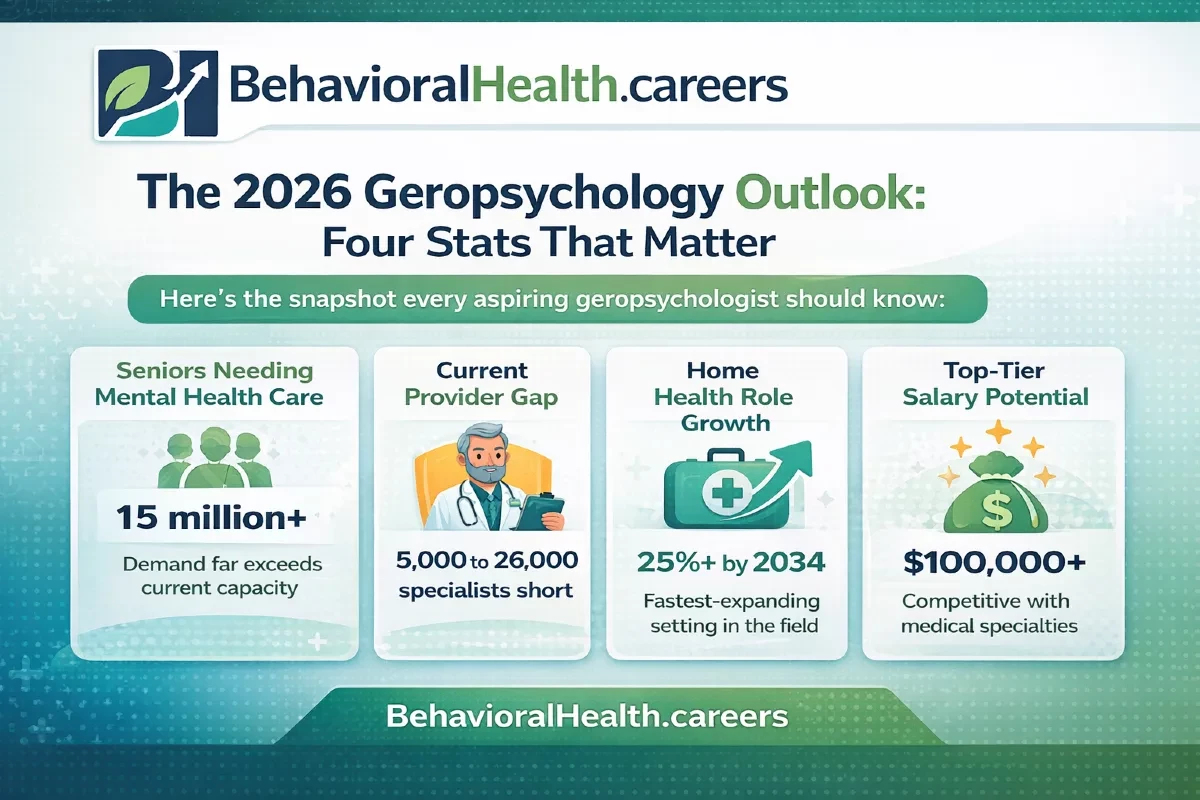
Here’s the snapshot every aspiring geropsychologist should know:
The American Board of Geropsychology and the American Board of Professional Psychology offer national board certification for geropsychologists, indicating advanced expertise beyond the minimum requirements.
The American Psychological Association has highlighted the urgency of expanding the geropsychology workforce to meet the needs of an aging population.
This is the landscape. If you’re pursuing psychologist jobs or considering specialization, geropsychology offers rare alignment: societal need, financial sustainability, and meaningful work.
What You Need to Enter the Field
Educational Pathways and Professional Geropsychology Training Programs
- Doctoral Route (PhD or PsyD): Required for independent practice as a psychologist. Programs typically include geropsychology electives or specialization tracks. Expect 5-7 years post-bachelor’s.
- Master’s Route (LPC, LMFT, LCSW): Faster entry. Many master’s programs now offer geriatric mental health certificates. Expect 2-3 years post-bachelor’s plus supervised hours for licensure.
- Postdoctoral Fellowships: Not required but highly valued. Geropsychology fellowships (often through VA or academic medical centers) provide specialized training and make you competitive for leadership roles.
Licensure and Credentials
State licensure is mandatory. For psychologists, that’s typically 2,000 to 4,000 supervised hours post-doctorate. Master’s-level clinicians follow state-specific requirements: usually 2,000 to 3,000 hours. Track your hours carefully using systems like the one in our therapist onboarding checklist.
Specialty certifications (e.g., Geropsychology Certificate from APA) aren’t required but strengthen your resume and signal expertise to employers.
A Rewarding Role With Surging Demand
The convergence is clear: an aging population, a massive workforce shortage, expanding reimbursement models, and competitive salaries. Geropsychology is no longer a niche specialty: it’s a mainstream growth sector with decades of sustained demand ahead.
If you’re deciding where to focus your clinical training or considering a career pivot, senior mental health offers something rare: the chance to build expertise in a field that will need you more, not less, as your career progresses.
Ready to explore geropsychologist jobs? Search opportunities now or check out our behavioral health workforce outlook for 2026 to see how geropsychology fits into the broader hiring landscape.