

Peer
Support Specialist Salary: What the Data Shows, and What It Can’t
Peer support specialist pay is one of the harder numbers to pin down
in behavioral health, because the federal government has no dedicated
wage code for the role. The closest official match, Community Health
Workers, shows a median of $51,850 a year (BLS, May 2025 estimates,
released May 2026).
Read that as a ceiling-leaning proxy, not a
bullseye: it includes better-paid community health roles alongside
certified peer specialists, so dedicated peer-support pay generally sits
below it, closer to the $35,000 to $50,000 band that job-posting data
consistently shows.
This page gives you the federal proxy table by state, then the two
things that actually determine a peer specialist’s paycheck:
certification and your state’s Medicaid rate. Everything federal is
sourced to the Bureau of Labor Statistics and refreshed each spring.
National snapshot (Community Health Workers proxy)
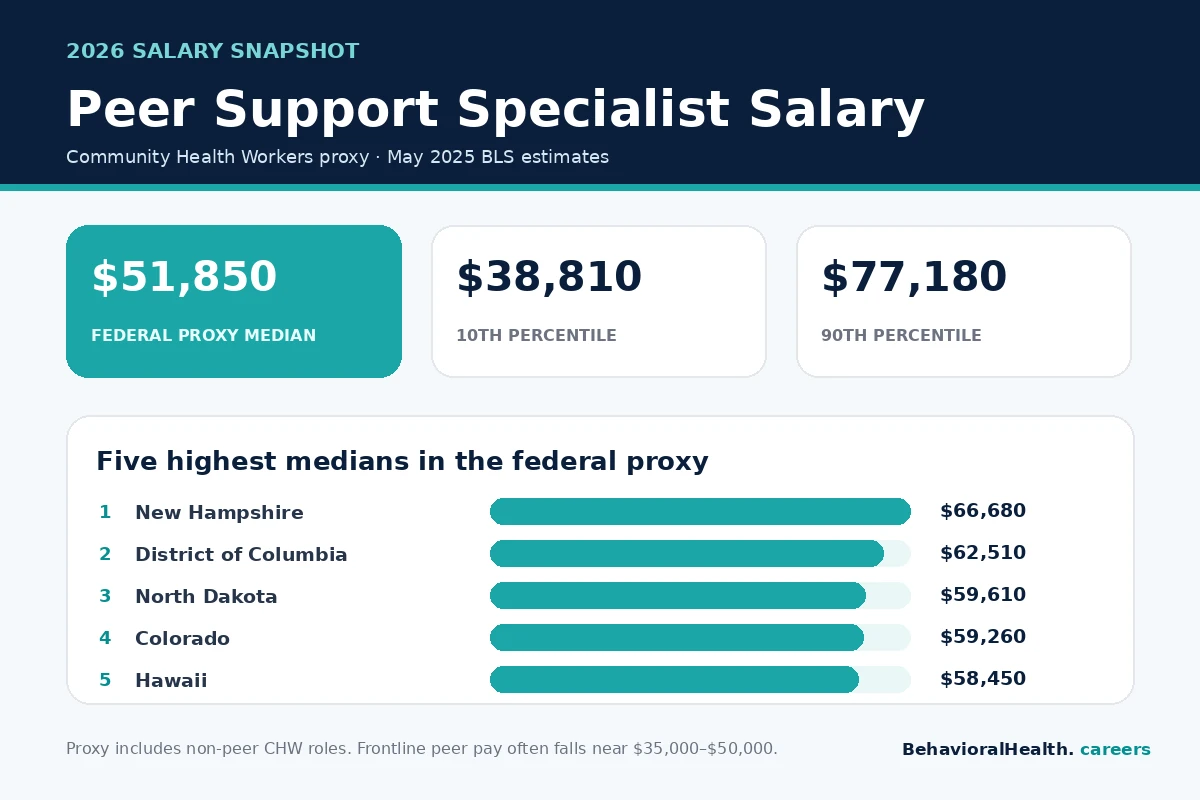
Highest-paying states
| Rank | State | Median annual wage |
|---|---|---|
| 1 | New Hampshire | $66,680 |
| 2 | District of Columbia | $62,510 |
| 3 | North Dakota | $59,610 |
| 4 | Colorado | $59,260 |
| 5 | Hawaii | $58,450 |
Colorado on this list is worth a flag, because it is also a state
actively reforming peer-service Medicaid billing, and states that fund
peer work through Medicaid rather than short-term grants tend to support
steadier, better-paid positions. That link between how a role is funded
and what it pays is the real story under this table.
Peer support specialist salary by state (CHW proxy)
| State | Employment | 10th pctile | Median | 90th pctile | Mean |
|---|---|---|---|---|---|
| Alabama | 270 | $33,470 | $43,340 | $62,790 | $45,050 |
| Alaska | 400 | $38,780 | $52,000 | $77,210 | $54,460 |
| Arizona | 1,140 | $39,310 | $48,950 | $75,010 | $53,650 |
| Arkansas | n/a | $38,680 | $44,890 | $69,720 | $50,140 |
| California | 9,500 | $46,320 | $58,050 | $88,590 | $63,740 |
| Colorado | n/a | $45,450 | $59,260 | $76,790 | $59,540 |
| Connecticut | 290 | $43,120 | $53,560 | $74,120 | $56,790 |
| Delaware | 280 | $35,810 | $55,850 | $74,530 | $53,920 |
| District of Columbia | 280 | $51,010 | $62,510 | $93,070 | $68,810 |
| Florida | 1,220 | $31,350 | $45,420 | $69,630 | $47,830 |
| Georgia | 490 | $34,100 | $50,680 | $73,130 | $52,940 |
| Hawaii | 240 | $37,700 | $58,450 | $84,750 | $59,940 |
| Idaho | 270 | $39,500 | $52,050 | $94,280 | $57,780 |
| Illinois | 2,040 | $39,040 | $49,240 | $65,540 | $51,690 |
| Indiana | 1,310 | $38,400 | $47,960 | $68,620 | $50,920 |
| Iowa | 390 | $37,690 | $47,780 | $71,360 | $50,290 |
| Kansas | 240 | $37,940 | $47,300 | $63,650 | $49,550 |
| Kentucky | 980 | $33,310 | $48,230 | $71,980 | $51,300 |
| Louisiana | 210 | $35,360 | $46,450 | $59,440 | $47,320 |
| Maine | 360 | $41,770 | $48,670 | $61,360 | $50,330 |
| Maryland | 3,030 | $36,190 | $50,550 | $79,290 | $55,120 |
| Massachusetts | 2,970 | $42,910 | $55,560 | $74,840 | $56,940 |
| Michigan | 1,890 | $37,720 | $49,380 | $74,610 | $54,160 |
| Minnesota | 1,260 | $42,610 | $47,560 | $69,160 | $52,050 |
| Mississippi | 410 | $30,930 | $39,520 | $70,890 | $44,250 |
| Missouri | 1,820 | $36,990 | $48,770 | $64,330 | $50,640 |
| Montana | 330 | $38,470 | $49,780 | $79,580 | $53,890 |
| Nebraska | 160 | $38,550 | $51,780 | $72,970 | $55,020 |
| Nevada | 670 | $41,980 | $57,730 | $95,200 | $63,550 |
| New Hampshire | 200 | $43,430 | $66,680 | $77,010 | $62,320 |
| New Jersey | 1,330 | $39,640 | $55,790 | $83,600 | $59,500 |
| New Mexico | 610 | $38,210 | $54,830 | $73,110 | $56,180 |
| New York | 5,800 | $44,310 | $58,130 | $87,980 | $62,140 |
| North Carolina | 1,680 | $36,160 | $47,560 | $68,380 | $50,160 |
| North Dakota | 90 | $44,800 | $59,610 | $76,210 | $60,120 |
| Ohio | 1,910 | $35,950 | $50,650 | $75,380 | $54,580 |
| Oklahoma | 600 | $34,520 | $45,790 | $67,630 | $48,730 |
| Oregon | 1,980 | $45,000 | $53,350 | $73,760 | $56,250 |
| Pennsylvania | 1,970 | $38,960 | $50,710 | $80,830 | $56,480 |
| Puerto Rico | 670 | $22,650 | $36,900 | $49,620 | $36,300 |
| Rhode Island | 520 | $45,370 | $53,100 | $76,310 | $57,350 |
| South Carolina | 540 | $38,110 | $47,970 | $70,230 | $52,540 |
| South Dakota | 270 | $39,230 | $45,700 | $60,630 | $49,030 |
| Tennessee | 520 | $34,180 | $42,310 | $58,960 | $43,430 |
| Texas | 4,210 | $36,250 | $48,720 | $64,290 | $50,350 |
| Utah | 580 | $35,480 | $55,700 | $74,880 | $55,990 |
| Vermont | 170 | $44,010 | $51,500 | $62,320 | $53,190 |
| Virginia | 620 | $34,440 | $48,910 | $79,990 | $54,280 |
| Washington | 2,640 | $43,820 | $57,070 | $80,680 | $59,800 |
| West Virginia | 310 | $29,480 | $37,950 | $56,840 | $40,090 |
| Wisconsin | 630 | $39,010 | $51,210 | $71,450 | $54,140 |
| Wyoming | 140 | $39,520 | $54,020 | $79,600 | $58,310 |
Excluding Puerto Rico, state medians on the proxy run from $37,950 in
West Virginia to $66,680 in New Hampshire. Treat single-state precision
loosely where employment is small (New Hampshire and North Dakota each
sample a few hundred workers or fewer), and remember the proxy caveat:
for frontline certified peer specialists specifically, the honest
expectation in most states is a band below these medians.
Certification and the Medicaid rate: the two real levers
For peer specialists, pay is set less by tenure than by whether the
work is billable, and that comes down to certification and your state’s
Medicaid rate.
Certification is the gate to billable work
A state
peer-specialist certification (titles vary: CPS, CPRS, PRSS) is
increasingly required before an agency can bill Medicaid or insurance
for the hours you work. Several states are formalizing this now.
Colorado, for example, requires peer support professionals to be
certified or in the certification process for their services to be
reimbursable as of 2026, and broader “must be certified to bill” rules
take effect in additional states through 2027. Uncertified peer roles
still exist, but they cluster in the lowest-paid, grant-dependent tier.
Certification is the cheapest raise available in this role.
Your state’s Medicaid rate sets the ceiling
Because
most peer services are Medicaid-funded, the reimbursement rate your
state sets for a unit of peer support effectively caps what agencies can
pay. Those rates vary enormously, from roughly $6 per unit in the lowest
states to over $36 per unit in the highest. That range is most of why
the state table above looks the way it does, and it is why a certified
peer specialist in a well-reimbursing state can out-earn a colleague
doing identical work across a state line.
Where the funding is stable, so is the pay
Certified Community Behavioral Health Clinics (CCBHCs) reimburse through
a cost-based prospective payment system that is designed to pay for peer
support, care coordination, and crisis work that fee-for-service
Medicaid covers poorly. As CCBHCs expand, they are creating more of the
salaried, benefited peer positions that sit at the top of the realistic
range.
What the hiring market looks like
Demand for the work is climbing even where the pay lags. BLS projects
Community Health Worker employment to grow about 11 percent from 2024 to
2034, well above the 3 percent average across all occupations, driven by
health systems and payers leaning on peer and community roles to reach
people that clinical staff alone cannot. Layer on the behavioral health
access gap (roughly 137 million Americans live in a federally designated
Mental Health Professional Shortage Area, with about a quarter of the
need met) and peer specialists are increasingly the workforce filling
it.
For employers, the tension is real: the demand signal says hire
peers, but the pay these roles can offer is capped by Medicaid rates
outside any single agency’s control. The two things an employer can
control are the path up (certification support, supervision, a real
ladder into case management or counseling) and pay transparency, since a
posted range on a peer role signals the seriousness that recruits in a
field where too many peer jobs read as underfunded afterthoughts. Our complete guide to
careers in behavioral health maps where peer roles lead next.
How peer pay compares, and where it leads
Against the other support-tier roles on this site, the realistic peer
band ($35,000 to $50,000 for frontline certified work) sits just below
psychiatric aides (median $44,910) and behavioral health technicians
(median $45,130), though the proxy table above reads higher because of
the non-peer roles it includes. See the behavioral health
technician salary page and psychiatric aide salary page for
those comparisons. The strongest pay move for a peer specialist is
usually vertical: lived-experience roles are a recognized on-ramp to
case management and, with a degree, to counseling, where the median
jumps to $59,350.
Frequently asked questions
How much does a peer support specialist make?
There
is no dedicated federal wage code for the role. The closest proxy,
Community Health Workers, shows a median of $51,850 (BLS, May 2025
estimates), but that overstates frontline peer pay because it includes
better-paid community health roles. For certified peer specialists
specifically, job-posting data points to a realistic band of about
$35,000 to $50,000, heavily dependent on state Medicaid rates.
Which states pay the most?
On the federal proxy, by
median wage: New Hampshire (66, 680), DistrictofColumbia(62,510),
North Dakota (62,510),
North Dakota (59, 610), Colorado(59,260),
and Hawaii ($58,450). States that fund peer work through Medicaid rather
than short-term grants tend to support better-paid positions.59,260),
and Hawaii ($58,450). States that fund peer work through Medicaid rather
than short-term grants tend to support better-paid positions.
Does certification raise a peer specialist’s pay?
Yes, mainly by making the work billable. A state peer-specialist
certification is increasingly required before an agency can bill
Medicaid for your hours, and several states are phasing in “must be
certified to bill” rules in 2026 and 2027. Uncertified roles cluster in
the lowest-paid, grant-funded tier.
Why does peer pay vary so much by state?
Because
most peer services are Medicaid-funded, and state Medicaid reimbursement
rates for a unit of peer support range from roughly $6 to over $36. That
rate effectively caps what agencies in a state can pay.
Where these numbers come from
Federal wage figures are from the U.S. Bureau of Labor Statistics
Occupational Employment and Wage Statistics program, May 2025 estimates
(occupation code 21-1094, Community Health Workers, used as the nearest
proxy for peer support specialists), released May 2026. Growth
projections are from the BLS Employment Projections program (2024 to
2034). BLS has no dedicated peer support specialist code, and certified
peer specialist pay varies by state Medicaid rate; both facts are noted
throughout. OEWS reports wages for employees; independent contractor
rates are not included. Figures marked n/a are suppressed in the source
data. All figures are estimates and marked as such. We refresh this page
when BLS publishes new estimates each spring.
Looking for peer support work now? Find current roles from employers hiring this month.
Need detailed guidance on the path to becoming a peer support specialist?
Browse live peer support specialist
listings from employers hiring this month.