
Registered Behavior Technicians typically earn about $20 to $22 an hour, or roughly $42,000 to $45,000 a year, according to three national salary sources checked in August 2026. Entry-level pay can begin in the high teens, while experienced RBTs and some lead roles reach the mid-$20s per hour or the low-to-mid $50,000s.
Those figures are useful benchmarks, not a promise of take-home pay. RBT schedules, paid hours, cancellation policies, mileage, benefits, and local demand can make two jobs with the same advertised rate feel very different.
What RBTs actually earn
No single source provides an official national RBT wage. The clearest picture comes from comparing several sources that use different methods:
| Source | Current national figure | Data basis | Updated |
|---|---|---|---|
| ZipRecruiter | $42,702/year; $20.53/hour | Job postings and third-party data; 25th percentile $36,500, 75th percentile $47,500, 90th percentile $52,000 | Aug. 24, 2026 |
| Indeed | $44,785/year | About 2,000 salary observations from job postings over the previous 36 months | Aug. 16, 2026 |
| PayScale | $20.66/hour | 1,653 salary profiles; 10th–90th percentile $16.60–$26.42/hour and total pay $34,000–$55,000 | July 11, 2026 |
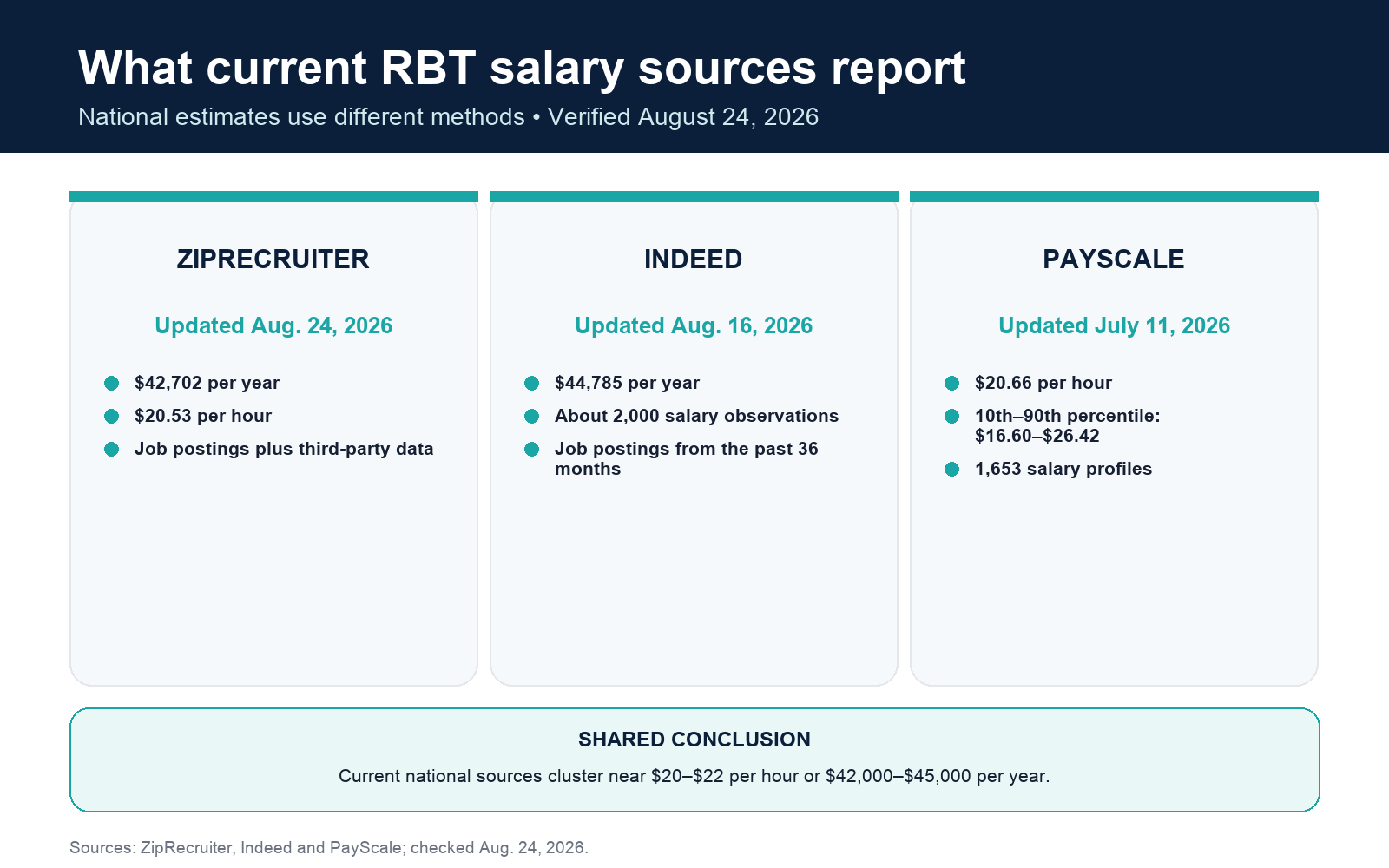
The shared conclusion is narrower than some salary guides suggest: about $20 to $22 an hour or $42,000 to $45,000 a year is the most defensible national benchmark right now. A wider range can still be useful for job seekers, but it should be labeled as the spread between lower-paid and higher-paid roles—not as typical pay.
Annual salary estimates also assume a consistent work schedule. Before comparing offers, ask how many hours are guaranteed and which parts of the workday are paid.
Why BLS does not publish an RBT-specific salary
The U.S. Bureau of Labor Statistics does not publish an RBT-specific wage series. RBT pay may be represented within broader occupational categories, but those categories do not isolate the BACB credential.
That is why this guide uses current salary aggregators instead of presenting a federal median. Because those sources rely on different datasets and methods, a range is more honest than a single “official” number.
What affects an RBT’s real take-home pay
The hourly rate is only the beginning. When comparing RBT jobs, ask employers about:
- Guaranteed hours: Is a full weekly schedule guaranteed, or does pay depend on completed client sessions?
- Client cancellations: Are late cancellations paid, partially paid, or unpaid?
- Travel: Is drive time between clients paid, and is mileage reimbursed?
- Training and documentation: Are required meetings, notes, training, and supervision paid?
- Benefits: Does the position include health coverage, paid time off, retirement contributions, or tuition assistance?
- Schedule stability: How often do assigned hours change, and are make-up sessions expected?
A slightly lower hourly rate with stable paid hours and benefits can be worth more than a higher rate attached to an unpredictable schedule.
What can raise RBT pay
Experience and added responsibility. Employers may pay more for experienced RBTs, lead technicians, trainers, or staff who can support complex schedules. Ask what responsibilities come with the higher rate and whether the role remains within the RBT scope of practice.
Local labor demand. Pay varies by state and metro area. Compare several current listings near you rather than relying only on a national average.
A stronger compensation package. Guaranteed hours, paid cancellations, mileage reimbursement, benefits, and paid training can improve total compensation even when the posted hourly rate is similar.
Further education and certification. Some RBTs later pursue the BCaBA or BCBA credential, but becoming a BCBA is not a one-step promotion. It requires graduate-level education, qualifying behavior-analytic coursework, supervised fieldwork, and passing the BCBA examination. Current national estimates place average BCBA pay near $89,000 to $91,000 a year: ZipRecruiter reports $89,075, while Indeed reports $91,426.
What it takes to become and remain an RBT
The RBT is an entry-level paraprofessional credential administered by the Behavior Analyst Certification Board. Applicants must meet age and education requirements, complete required background and abuse-registry checks, finish a 40-hour training, pass an initial competency assessment, apply to the BACB, and pass the RBT examination. RBTs then work under ongoing supervision.
Maintenance requirements changed in 2026. RBTs who are newly certified or recertified in 2026 move to a two-year certification cycle and must complete 12 professional development units during that cycle. Always confirm the current rules in the BACB RBT Handbook and the BACB’s professional-development guidance.
For a step-by-step explanation, see our guide to becoming a Registered Behavior Technician. You can also compare this credential with other entry-level roles in our behavioral health technician vs. mental health technician vs. psychiatric aide guide.
What the hiring market looks like
Demand for ABA services is supported by a large population of children and families seeking care. The CDC’s latest ADDM Network report estimated autism prevalence at 1 in 31 among 8-year-old children across 16 U.S. sites, using 2022 surveillance data. That finding should not be generalized to every child in the United States, but it helps explain sustained demand for autism services.
All states have enacted some form of autism-related insurance requirement, according to the National Conference of State Legislatures. Coverage is not uniform: eligible plans, required services, age limits, dollar limits, and exceptions vary, and self-funded employer plans are generally governed by federal law.
For job seekers, the practical signal is the local market. Compare current openings by employer, setting, schedule, and total compensation. For employers, clearly stating the hourly range, paid-hours policy, travel terms, and benefits makes an RBT listing easier to evaluate.
Frequently asked questions
How much does an RBT make?
Current national sources cluster near $20 to $22 an hour or $42,000 to $45,000 a year. PayScale reports a broader 10th-to-90th-percentile hourly range of $16.60 to $26.42, while ZipRecruiter places its 90th-percentile annual estimate at $52,000. Actual earnings depend on location, experience, paid hours, and benefits.
Is there an official BLS salary for RBTs?
No RBT-specific BLS wage series is published. RBT pay may be included within broader occupational categories, so current RBT estimates come from salary aggregators that use different data and methods.
What should I ask before accepting an RBT job?
Ask about guaranteed weekly hours, cancellation pay, drive-time pay, mileage reimbursement, paid documentation and training, schedule stability, and benefits. These terms can matter as much as the advertised hourly rate.
How can an RBT earn more?
Experienced, lead, and training roles may pay more, and local demand affects rates. Some RBTs pursue BCaBA or BCBA certification for a larger long-term pay increase, but those credentials require additional education, supervised fieldwork, and examination.
What do you need to become an RBT?
Applicants must meet BACB age and education requirements, complete background and abuse-registry checks, finish a 40-hour training, pass an initial competency assessment, apply, and pass the RBT exam. RBTs work under ongoing supervision. Those newly certified or recertified in 2026 move to a two-year cycle with 12 required professional development units.
Sources and methodology
Salary figures were checked on August 24, 2026, against ZipRecruiter, Indeed, and PayScale. These services use different inputs—including job postings, third-party data, and salary profiles—so this guide compares their overlap instead of treating any one figure as official.
Credentialing information comes from the BACB. Autism prevalence comes from the CDC’s 2022 ADDM Network surveillance report, published in 2025. Insurance-law context comes from NCSL. Salary data changes frequently, so check the linked sources and current local job postings before making a decision.
Looking for RBT roles now? Browse Registered Behavior Technician jobs from employers currently hiring.