

You can go from no experience to a certified Registered Behavior Technician in about one to three months, and the two fees you cannot avoid total $110.
It is one of the shortest credentialed routes into behavioral health, and many applied behavior analysis employers require it before you work with clients.
This guide covers how to become a Registered Behavior Technician or RBT, what the Behavior Analyst Certification Board requires in 2026, what each step costs, how long it takes, and what the credential is worth once you hold it.
The essential takeaways
- You need to be at least 18 and hold a high school-level education or the equivalent. No college degree and no prior clinical experience are required (Behavior Analyst Certification Board [BACB], 2026a).
- Four steps stand between you and the credential: a 40-hour training course, an initial competency assessment, a BACB application, and the RBT exam at a Pearson VUE test center.
- Two of those steps need other people. The competency assessment requires a qualified assessor and, for part of it, an actual client. The application requires a BACB certificant to sign an attestation for you. Your employer’s BCBA can do both, which is why certifying on the job is the smoother route.
- Fixed costs are $65 to the BACB and $45 to Pearson VUE. Training is the variable, and many ABA employers pay for it.
- One to three months is a realistic timeline. The training has a hard floor of five days and a ceiling of 180.
- If you certify in 2026, your first renewal is two years later, and it needs 12 hours of professional development instead of another competency assessment. Guides that still say RBT renews every year are out of date.
- 260,174 people held active RBT certification as of July 1, 2026 (BACB, n.d.-c).
What an RBT does
An RBT delivers behavior-analytic services under the close supervision of an RBT Supervisor, usually a Board Certified Behavior Analyst. You carry out treatment plans. You do not write them, and you do not practice independently.
The work is direct and hands-on. You run skill-acquisition programs, collect data on how often a behavior occurs and how long it lasts, use reinforcement and prompting, and graph progress for your supervisor to review. A session might mean implementing behavior intervention plans under supervision, such as teaching a five-year-old with autism to ask for help out loud instead of hitting, or using preference assessments to find out which rewards a client actually responds to.
Most RBTs work in autism clinics, in-home ABA programs, public and private schools, early intervention, and residential treatment. The role also opens up career opportunities across healthcare and school settings and can be a rewarding career because of the positive impact on clients. Some telehealth work exists, though the majority of the job is face to face.
RBT is the BACB’s Registered Behavior Technician credential rather than a job title. Plenty of agencies hire technicians pursuing RBT certification as behavior technicians and put them through certification during onboarding.
That is a different thing from a behavioral health technician, which is a broader frontline role across mental health and substance use settings with no single national credential attached.
Our Behavioral Health Technician vs Mental Health Technician vs Psych Aide guide sorts out those titles, and our guide on how to become a Behavioral Health Technician covers that route.
Who qualifies: age, education, and background checks
Meeting eligibility requirements starts with three basics, and all three are checkable before you spend a dollar.
- You must be at least 18 years old when you submit your application.
- You must have at least a high school education or the equivalent.
- You must have a criminal background check and an abuse registry check, each completed no more than 180 days before you pay for your application.
The BACB does not run those checks. You arrange them and keep the documentation. Employers and states layer on their own conditions, commonly a TB test, CPR certification, or a driving record check for in-home roles.
Ask your employer what they require before you enroll in training, because their list is usually longer than the BACB’s.
Step 1: Complete the 40-hour training
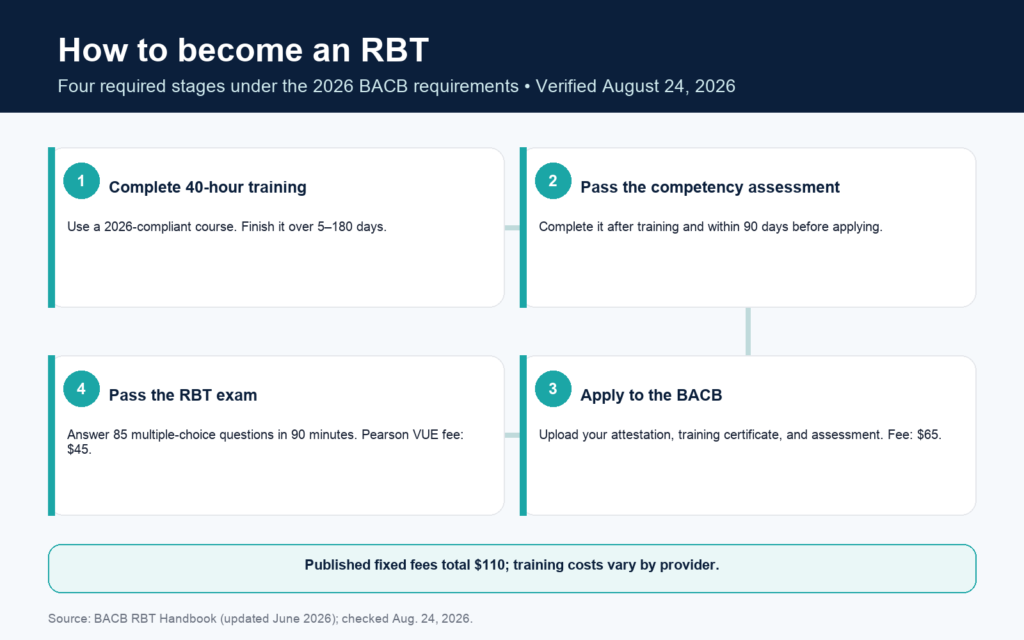
Your RBT training has to follow the BACB’s 2026 40-hour RBT training requirements and curriculum outline under BACB guidelines, and it must run no fewer than five days and no more than 180. The five-day floor is enforced. Many providers offer the RBT course at your own pace within that window. A self-paced course you binge over a weekend will not count toward certification, whatever the provider’s marketing says.
The BACB allocates 38 of the 40 hours and leaves trainers two to distribute (BACB, 2026b):
- Behavior-change interventions, 20 hours
- Ethics and professionalism, 5 hours
- Data collection and graphing, 3 hours
- Assisting with behavior assessments, 3 hours
- Service delivery documentation and reporting, 3 hours
- Introduction to applied behavior analysis, 2 hours
- Preparing for service delivery, 1 hour
- Next steps in the certification process, 1 hour
The training is designed to build skills and support exam preparation before the competency assessment.
The Responsible Trainer must be an active BCaBA, BCBA, or BCBA-D who has completed the BACB’s 8-hour supervision training, and a BCBA instructor or BCaBA-led provider is responsible for the course content. Assistant Trainers need RBT certification or higher.
Before you pay, confirm what the completion certificate will say.
It has to carry your name and BACB ID, the training dates, total time in training, the Responsible Trainer’s name and certification number, that trainer’s signature or company branding, the names and certification numbers of any Assistant Trainers, and this statement:
“This training program is designed to meet the 2026 training eligibility requirement for RBT certification. The training is offered independent of the BACB.”
A certificate missing that language can hold up your application.
Because the certificate has to carry your BACB ID, create your BACB account early enough to hand your provider the number.
Ask your employer before you buy anything. Many ABA agencies run the training in-house or reimburse it for new hires, and paying out of pocket for something your employer would have covered is the most common avoidable cost in this process.
RBT training programs are available in all 50 states and Canada.
Step 2: Pass the initial competency assessment
The RBT competency assessment is the hands-on step in the process. It must be completed after the 40-hour training course. An assessor watches you perform tasks from the RBT curriculum to check your practical skills and the practical application of training concepts, marking each one pass or fail. It can be done in person, live over the internet, or through recorded videos made specifically for the assessment.
Read this part carefully, because it is where independent candidates get stuck (BACB, 2025a). Three of tasks 6 through 14, the skill-acquisition and behavior-reduction items, have to be demonstrated with an actual client. Role-play does not satisfy those three. If you have no employer and no clinical placement, you do not just need to hire an assessor; you need access to a client, and that is the real barrier to certifying entirely on your own.
The Responsible Assessor must be a BCaBA or BCBA who has completed the BACB’s 8-hour supervision training. Assistant Assessors need active RBT certification or higher plus demonstrated proficiency in the material, and both must follow ethical standards in how they oversee and conduct the evaluation.
The restriction on who can assess you runs one way: your assessor cannot be related to you, be employed by you, or report to you. Your employer’s BCBA is fine, and so is an assessor you pay, because the BACB does not count assessment fees as employment.
The assessment must be completed no more than 90 days before you submit your certification application. Let that window close, and you repeat the whole thing.
Most candidates go through their employer or training provider, which solves the assessor and the client access in one move. That is the strongest practical argument for getting hired as a behavior technician first and certifying on the job.
Step 3: Apply to the BACB and schedule the exam
The RBT application process requires you to upload three documents through the BACB website using your BACB account: the RBT Certification Application Attestation form, your 40-hour training certificate, and your completed initial competency assessment (BACB, 2026a). The application processing fee is $65, and it is not refundable.
The attestation form is one of the certification requirements after you meet eligibility requirements and complete training. You do not upload your diploma, your background check, or your abuse registry results.
Instead, a BACB certificant signs a form confirming your age, your high school-level education, and that you passed both checks within the previous 180 days. Same relationship rule as the assessor: they cannot be related to you, be employed by you, or report to you, so your supervising BCBA qualifies.
The form has to be signed no more than 90 days before you pay for the application. Keep your own documentation, because the BACB can audit the attestation.
Once your application is approved, scheduling the exam is the final step before testing. You get an email with instructions for scheduling the exam with Pearson VUE. You book it yourself, through your Pearson account or Pearson customer service. The BACB cannot book, cancel, or move an appointment on your behalf. The exam appointment fee is $45.
If you need disability-related testing accommodations, request them through the BACB and Pearson VUE with documentation before you choose a date.
Step 4: Pass the RBT exam
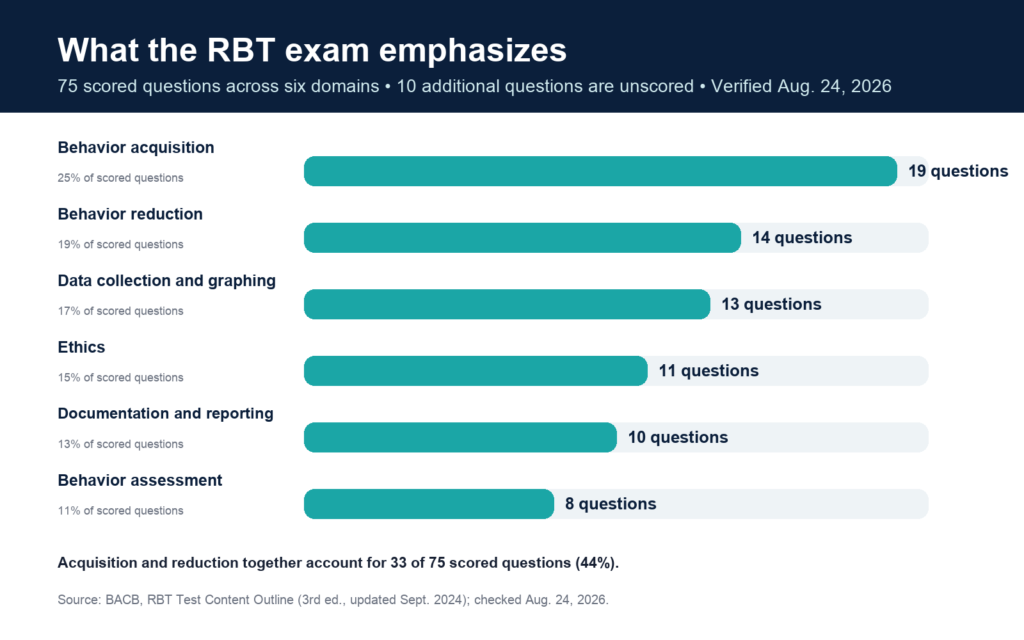
The RBT certification exam is 85 multiple-choice questions, 75 scored and 10 unscored pilot items, in 90 minutes at a Pearson VUE test center. Questions come from the RBT Test Content Outline, 3rd edition, which has governed the exam since 2026.
The 75 scored questions break down by domain (BACB, 2024):
- Behavior acquisition, 19 questions
- Behavior reduction, 14 questions
- Data collection and graphing, 13 questions
- Ethics, 11 questions
- Documentation and reporting, 10 questions
- Behavior assessment, 8 questions
Focused exam preparation helps candidates successfully pass on the first attempt.
Let that distribution drive your studying. Acquisition and reduction together are 33 of the 75 scored questions, so that is where the exam lives. Ethics carries more weight than behavior assessment, and it is the domain candidates most often treat as an afterthought.
You get eight attempts in the 12 months after your application is approved, with at least seven days between them. There is currently no BACB retake application fee, but the $45 Pearson appointment fee applies to every sitting. Burn through all eight without passing and you wait out the rest of your 12-month authorization period, then start the application over. That is not just another $65. The BACB reviews nothing you submitted before, so you need a fresh competency assessment, a fresh attestation, and new background and abuse-registry checks. Only the 40-hour training certificate carries over. Slow down rather than stacking attempts.
What it costs and how long it takes
Two costs are fixed and published: $65 to the BACB for application processing and $45 to Pearson VUE for the exam appointment. That is $110 regardless of where you train. Training itself is the variable, prices differ widely between providers, and a large share of ABA employers cover it; some even offer paid training, so treat any quoted total as a ceiling until you have asked your employer.
On timing, the training runs one to four weeks in practice against that five-day minimum. The competency assessment usually takes days once you can get on an assessor’s calendar. BACB review has been running quickly of late, though it moves with application volume, and exam scheduling depends on test center availability where you live. One to three months start to finish is realistic for someone moving steadily, and the learning experience is usually fastest when one employer organizes the training, assessment, and supervision.
What slips is never the parts you control. It is the competency assessment, which needs an assessor and a client, and the attestation form, which needs a BACB certificant willing to sign for you. Both depend on other people’s calendars and both have 90-day clocks attached. Sort out who those two people are before you start the 40 hours, not after.
Pay, demand, and where the credential leads
RBTs earn about $20 to $23 an hour, triangulated across ZipRecruiter, Indeed, and PayScale (2026), or about $39,981 a year on average. No federal wage code exists for the role, so there is no Bureau of Labor Statistics median to quote.
Our RBT salary page carries the sourcing, the annual equivalents, the entry-level and lead-technician ends of the range, and what actually raises the number. For employer-posted pay at each step from RBT to BCBA, see our guide to ABA therapy jobs.
Two things pull real take-home below whatever annual figure you see quoted. Many RBT roles are part-time, and in-home ABA involves drive time between clients that is often unpaid or only partly paid. Ask about guaranteed hours and mileage terms in the interview. They move earnings more than a dollar on the hourly rate does.
To compare RBT work with other starting roles, our entry-level behavioral health jobs guide groups options by education level and reports pay where enough employers disclose it.
Demand is steady, and it is structural. The CDC’s most recent surveillance identified autism in 1 in 31 eight-year-old children (Centers for Disease Control and Prevention [CDC], 2025; 2022 surveillance year), and 260,174 people held active RBT certification as of July 1, 2026. More than 32,880 RBTs are currently employed in the U.S. This is a high-volume hiring category, so agencies recruit year-round.
The credential is also a rung. RBT experience is the background BCaBA and BCBA programs and employers look for, and it supports professional growth. It also creates pathways into advanced roles, while giving many people a base for personal and professional growth. When you are ready for that step, our guide on how to become a BCBA covers the 2027 BACB requirements and fieldwork hours.
Our Complete Guide to Careers in Behavioral Health maps how the wider field connects.
Ready to start looking? Browse RBT jobs on our board.
Keeping your certification: supervision and the 2026 renewal change
Renewal changed in 2026, and most of the guidance still online has not caught up. RBT certification used to renew every year. It now runs on a two-year cycle, starting with anyone who certifies or recertifies in 2026.
If you certify in 2026, your first recertification falls two years later. It requires 12 professional development units and a recertification application, and no competency assessment. Maintaining certification also means RBTs must submit ongoing documentation every two years. You can start earning those PDUs as soon as you certify, so there is no reason to leave them until the last few months.
What counts toward the 12 (BACB, n.d.-b): in-service training delivered by a qualified trainer, ACE provider events, and behavior-analytic university coursework. What does not count: reading articles or listening to podcasts on your own time, and supervision meetings.
Ask your employer whether their in-service training is set up to issue PDUs, because plenty of workplace training is not.
If you are already certified, one exception applies. RBTs recertifying during 2026 itself still need the RBT Recertification Competency Assessment, completed no more than 45 days before their expiration date, plus the recertification application processing fee. That is the last cycle the assessment applies to.
Supervision did not change, and meeting ongoing supervision requirements is still part of keeping the credential active (BACB, 2026a). At least 5% of the hours you spend delivering behavior-analytic services each calendar month must be supervised, with a minimum of two face-to-face, real-time contacts per month. Your supervisor must observe you working with a client in at least one of them, and at least one of the two has to be individual, with no other RBTs or trainees in the room. An employer who only runs group supervision is leaving you out of compliance. That ongoing supervision also supports continuous learning in behavior analysis practice.
Frequently asked questions
How long does it take to become an RBT?
To become a registered behavior technician, most people need one to three months. The 40-hour training takes one to four weeks against a five-day minimum, the competency assessment usually follows within days, BACB application review is usually fast, and then you schedule the exam—the final step after application approval—around test center availability. The bottleneck is normally other people’s calendars.
Can I become an RBT with no experience in behavioral health?
Yes, and no college degree is required either. You need to be 18 or older, have a high school education or the equivalent, and clear a background check and abuse registry check. There is a practical catch: part of the competency assessment has to be demonstrated with a real client, which is hard to arrange without an employer. Many agencies hire behavior technicians as trainees who are pursuing behavioral analysis work and complete certification on the job, so for most people the first job and the credential happen together.
How much does RBT certification cost?
The published fees are $65 for the BACB application and $45 for the Pearson VUE exam appointment, so $110 in fixed costs. Training is separate and varies by provider. A large share of ABA employers pay for the training and sometimes the fees, which is worth confirming before you enroll anywhere. Failing the exam eight times in your authorization period forces a fresh application, which means redoing the competency assessment and the attestation as well as paying the $65 again.
Does RBT certification still renew every year?
No, and this is the most common outdated claim about the credential. Anyone certifying or recertifying in 2026 and after is on a two-year cycle. RBT supervisors still must meet supervision obligations throughout that two-year cycle. If you certify in 2026, your first recertification comes two years later and needs 12 professional development units plus an application, with no competency assessment. Only RBTs recertifying during 2026 itself still need the recertification competency assessment, completed no more than 45 days before their expiration date.
Is RBT certification valid in every U.S. state?
The RBT credential is issued by the Behavior Analyst Certification Board and its standards are the same everywhere it is recognized. Some states add their own licensure or registration for behavior analysis on top of it, and employers add their own conditions. Check your state’s behavioral health licensing board alongside the BACB requirements.
What happens if my RBT certification lapses?
You lose the ability to practice as an RBT. The cheapest way out is the BACB’s reinstatement period, which lets you submit late for a $50 late fee on top of the usual application. Miss that and you are reapplying from scratch. Note what triggers the 2026 rules: it is the date you submit your application, not the date you lapsed. Any application submitted on or after January 1, 2026 requires the 2026 40-hour training and the updated competency assessment, even if your certification lapsed before then. Check the current RBT Handbook or contact the BACB before you assume a shortcut exists.
References
Behavior Analyst Certification Board. (2026a). Registered behavior technician handbook. Retrieved August 24, 2026, from https://www.bacb.com/rbt-handbook
Behavior Analyst Certification Board. (2026b). RBT 2026 40-hour training requirements and curriculum outline. https://www.bacb.com/wp-content/uploads/2023/12/2026-RBT-40-Hour-Training-Curriculum-260313-a.pdf
Behavior Analyst Certification Board. (2025a). RBT initial competency assessment packet. https://www.bacb.com/wp-content/uploads/2025/09/2026-RBT_Initial_Competency_Assessment-251106-a.pdf
Behavior Analyst Certification Board. (2024). RBT test content outline (3rd ed.). https://www.bacb.com/wp-content/rbt-outline-3rdEd/
Behavior Analyst Certification Board. (2025b). RBT 2026 requirements. https://www.bacb.com/wp-content/uploads/2025/07/RBT-2026-Requirements_250723-a.pdf
Behavior Analyst Certification Board. (n.d.-a). Guidance for meeting RBT requirements during the 2026 transition. Retrieved August 24, 2026, from https://www.bacb.com/wp-content/Guidance-RBT-Requirements-2026-Transition
Behavior Analyst Certification Board. (n.d.-b). RBT professional development: In-service training requirements. Retrieved August 24, 2026, from https://www.bacb.com/wp-content/RBT-Professional-Development-In-Service-Training
Behavior Analyst Certification Board. (n.d.-c). BACB certificant data. Retrieved August 24, 2026, from https://www.bacb.com/bacb-certificant-data/
Behavior Analyst Certification Board. (n.d.-d). Registered behavior technician (RBT). Retrieved August 24, 2026, from https://www.bacb.com/rbt/
Centers for Disease Control and Prevention. (2025, May 27). Data and statistics on autism spectrum disorder. Retrieved August 24, 2026, from https://www.cdc.gov/autism/data-research/index.html
Pearson VUE. (n.d.). Behavior Analyst Certification Board. Retrieved August 24, 2026, from https://www.pearsonvue.com/us/en/bacb.html


Pingback: Behavioral Health Technician vs Mental Health Technician vs Psych Aide: Comparison and Role Guide | BehavioralHealth.careers
Pingback: How to Become a BCBA: Requirements and State Licensing
Pingback: ABA Jobs Explained: RBT, BCaBA and BCBA Pay and Requirements