
PSYPACT lets a licensed psychologist practice telepsychology with clients in other participating states, but many remote psychologist jobs still name the state they hire for.
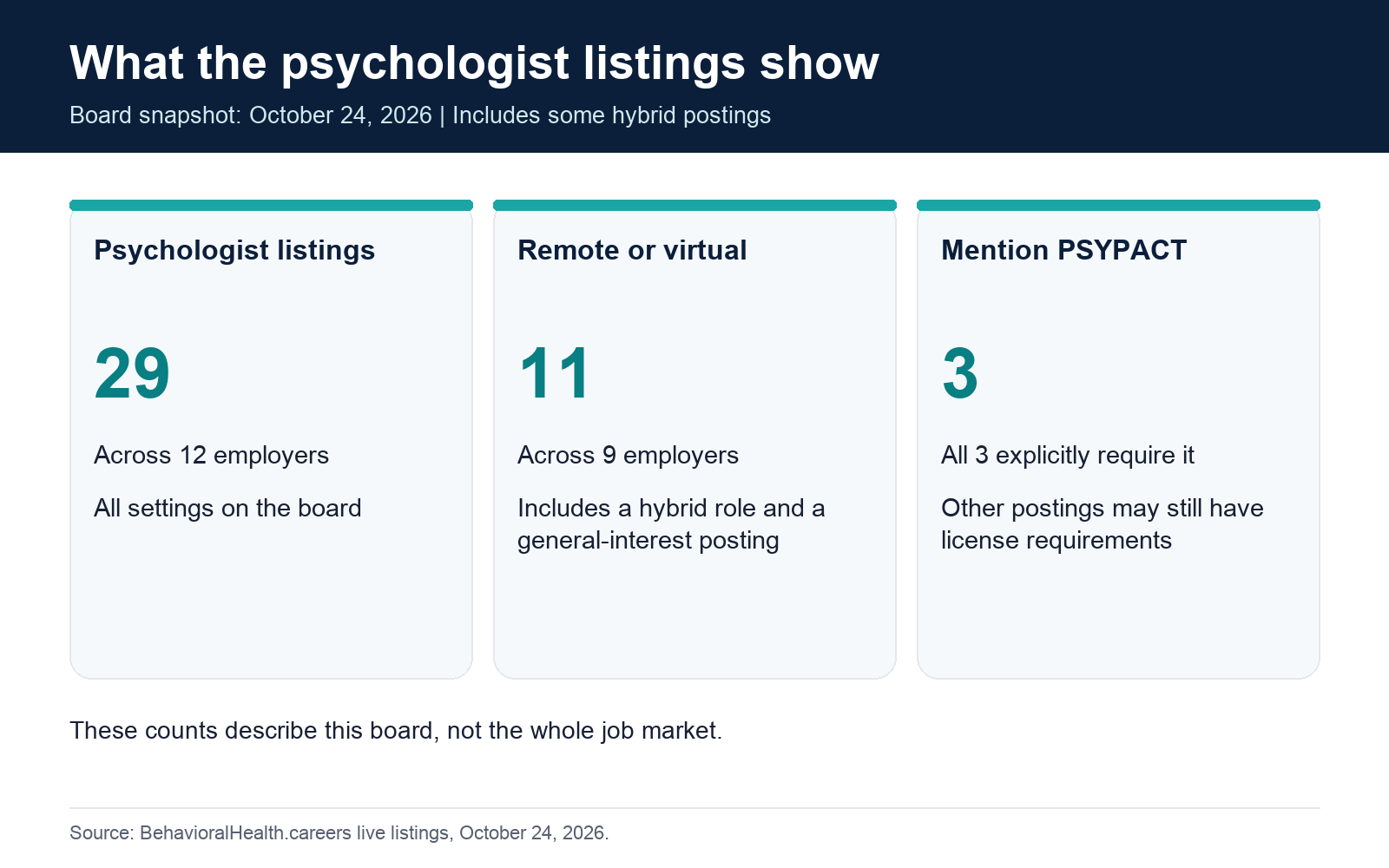
On October 24, 2026, BehavioralHealth.careers listed 29 psychologist jobs from 12 employers. Of those, 11 were remote or virtual, from 9 employers, and only 3 mentioned PSYPACT at all. All 3 required it.
So treat PSYPACT as one way to widen your options. Plenty of remote jobs still come down to a license in a single state.
This guide shows who is hiring, which states their postings name, what the PSYPACT credential involves, and what employers on the board post for pay. For the full rules of the compact, read our PSYPACT states guide.
How we counted
We counted listings with a clinical psychologist role tag or “psychologist” or “psychology” in the title, and left out psychology technician roles, which don’t require a license.
A listing counts as remote if the employer marks it remote, or if its title says remote, virtual, telehealth, telemedicine, or telepsychiatry, which includes a few hybrid titles. We searched the full text of each listing for “PSYPACT.”
Pay figures come only from listings with a posted range: the median of the posted minimums to the median of the posted maximums. When fewer than 10 listings or fewer than three employers stand behind a figure, we leave it out.
Our content and salary data methods page explains how we collect pay.
Who is hiring telehealth psychologists?
Remote and virtual psychologist listings on October 24, 2026:
| Employer | Remote listings | What the postings describe |
|---|---|---|
| Headlight | 2 | Outpatient psychologist, remote within California; one part-time |
| Eating Recovery Center | 2 | “Virtual Psychologist” for eating disorder treatment; PSYPACT required |
| Blackbird Health | 1 | Pediatric neuropsychologist, contract (1099) |
| LifeStance Health | 1 | Pediatric integrated behavioral health clinician (LICSW or psychologist), Massachusetts |
| aptihealth | 1 | Licensed clinical psychologist, intake specialist, New York |
| Marvin Behavioral Health | 1 | Remote therapist for couples work; PSYPACT required |
| Brightline | 1 | Evaluation and testing psychologist, hybrid, Albany, New York |
| Included Health | 1 | General-interest posting for psychologists and master’s-level therapists |
| Headway | 1 | Remote licensed clinical psychologist |
Source: BehavioralHealth.careers live listings, October 24, 2026.
Four of the 11 are contract, part-time, hybrid testing or intake roles rather than a full-time telehealth caseload. If you want a W-2 job with benefits, check each posting’s employment type before you apply.
The largest psychologist employer on the board, LifeStance Health, posted 14 psychologist jobs, 13 of them not marked remote.
Amae Health, which runs psychiatry-led clinics for people with serious mental illness, had an on-site psychologist opening in Boston.
What employers ask for when they mention PSYPACT
All three psychologist postings that mention PSYPACT require it. Eating Recovery Center’s two “Virtual Psychologist” postings require a PsyD or PhD from an APA-accredited program, a psychology license, residence in a PSYPACT state, the PSYPACT credential, and a passing score on the Examination for Professional Practice in Psychology (EPPP), plus two to four years of psychotherapy experience.
Marvin Behavioral Health requires independent licensure in a PSYPACT state, active PSYPACT credentials, training in couples therapy, and at least two years of post-licensure experience with adults and couples.
Outside the psychologist listings, two Headspace therapist postings say it prefers licensed psychologists who hold PSYPACT or are willing to apply.
Which states these jobs name
Remote doesn’t mean any state. Of the 11 remote psychologist listings, 6 named a state: California (2), New York (2), Massachusetts (1), and Illinois (1). The other 5 named no state in the title or location.
When a remote job names one state, ask whether you need a license there. Often you will. PSYPACT helps only when both your home state and your client’s state participate. Before you count on it, check both states on PSYPACT’s legislative map page.
Membership changes as states pass and implement legislation, so we don’t repeat a state count here.
Psychologist jobs not marked remote were spread more widely. Wisconsin had 3, Maryland had 2, and thirteen more states had 1 each.
What practicing under PSYPACT requires
Our PSYPACT guide covers the rules in full. Here is what matters for a telehealth job.
Telepsychology (APIT). To practice telepsychology under the compact, you need the Authority to Practice Interjurisdictional Telepsychology (APIT).
The ASPPB E.Passport is a prerequisite for it (ASPPB E.Passport Quick Guide). To qualify for the E.Passport, you need (ASPPB E.Passport Quick Guide):
- a current, active psychology license, based on a doctoral degree, in at least one PSYPACT state
- no disciplinary action on any license
- a passing score on the EPPP at or above ASPPB’s recommended passing score
- a doctoral degree in psychology that meets one of ASPPB’s accepted pathways, such as APA or CPA accreditation (ASPPB E.Passport FAQs)
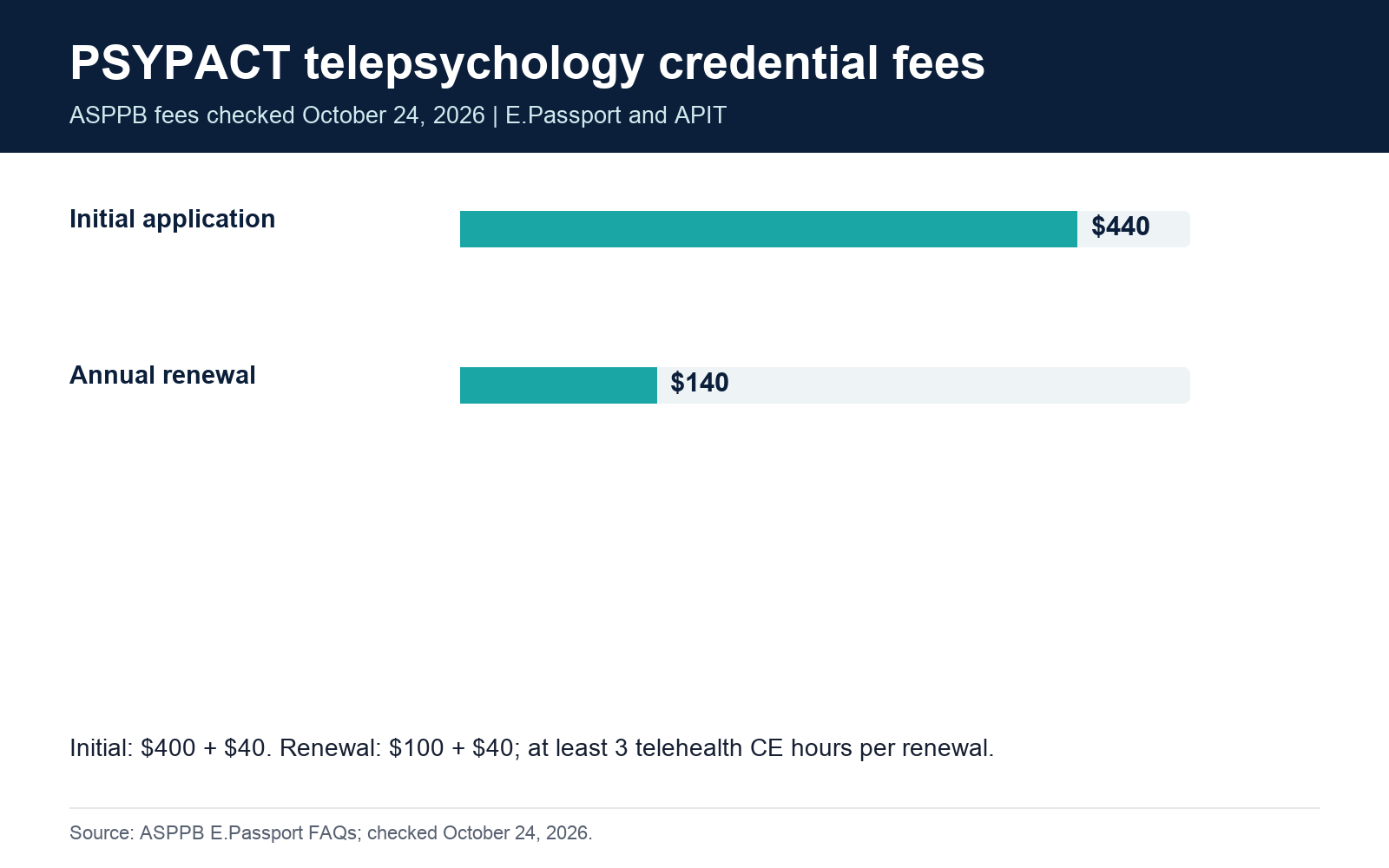
The E.Passport application costs $400, plus a $40 APIT fee. Renewal costs $100 plus $40 each year, and each renewal period requires at least three hours of coursework related to telehealth (ASPPB E.Passport FAQs).
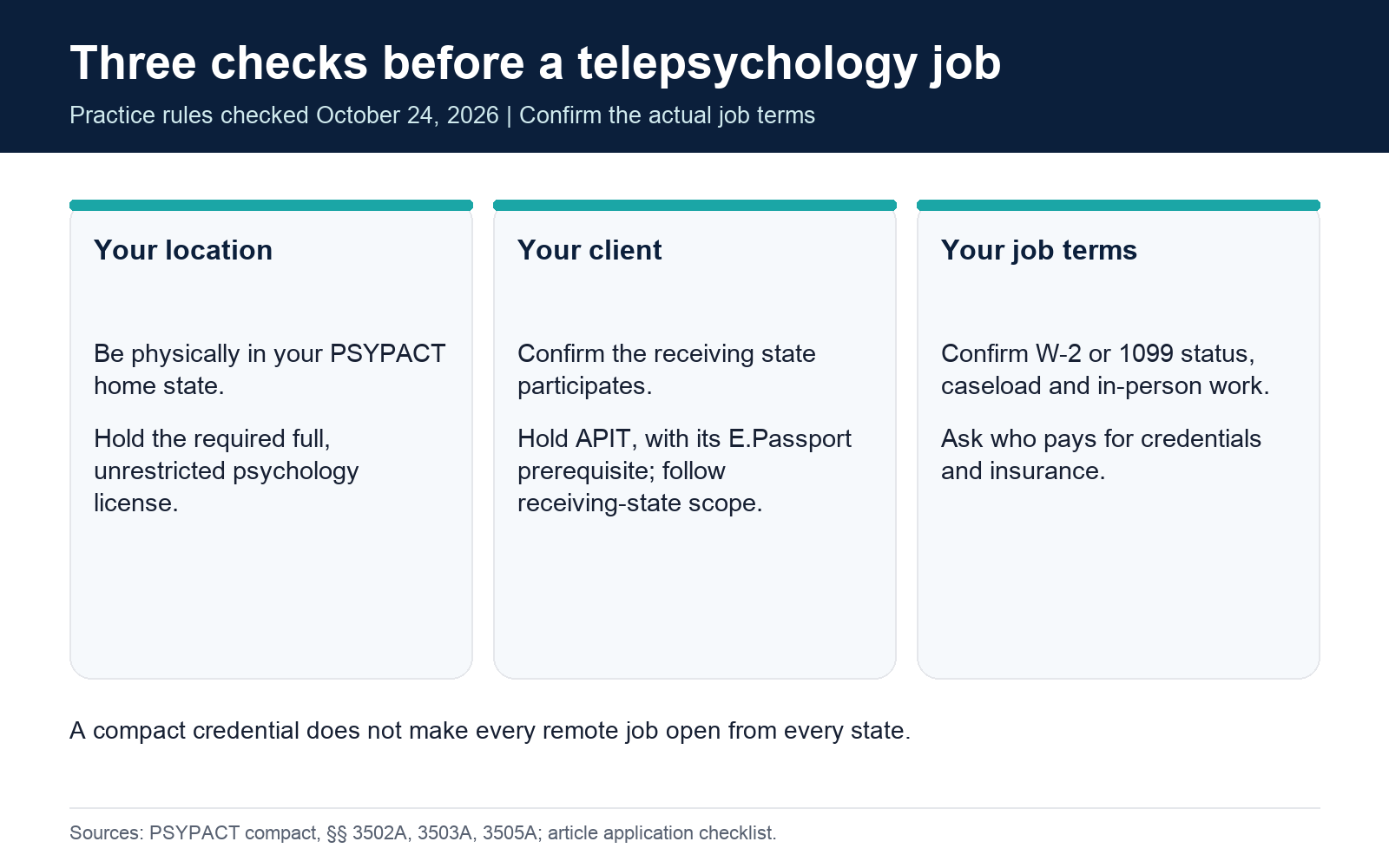
Two practice rules matter for remote jobs. Under the compact, you initiate client contact from your home state, and your practice is subject to the scope of practice of the receiving state, meaning the compact state where the client is physically located during the session (Psychology Interjurisdictional Compact, as enacted in Delaware).
DC Health’s summary of the compact states the first rule plainly: hold a full, unrestricted license and be physically located in your PSYPACT home state (DC Health). If you move to a state that isn’t in PSYPACT, the remote job may no longer work under the compact.
PSYPACT also covers temporary in-person practice of up to 30 days within a calendar year, under a separate credential (Psychology Interjurisdictional Compact).
And if you’re already fully licensed in both your state and your client’s state, you don’t need PSYPACT for that client (Ohio Psychological Association).
Psychologist pay: what employers post
Among licensed psychologist listings with a posted salary on October 24, 2026, the median range was $103,000 to $142,080 a year, across 19 listings from 5 employers.
LifeStance Health posted 13 of those 19 ranges, so the figure leans heavily on one employer’s outpatient pay.
| Group | Median posted pay | Listings (n) | Employers |
|---|---|---|---|
| Licensed psychologists, salaried | $103,000 to $142,080 a year | 19 | 5 |
| Hourly listings | Too few posted ranges to report | 5 | 4 |
| Remote listings | Too few posted ranges to report | 5 salaried, 3 hourly | 4 and 3 |
Source: BehavioralHealth.careers live listings, October 24, 2026. Postdoctoral fellowships are excluded from the salaried figure.
The board also listed one postdoctoral fellowship at LifeStance Health.
Our psychologist salary guide has federal pay data by state, and our ranking of mental health careers by posted pay shows where psychologists fall against other roles.
Finding psychologist openings on the board
BehavioralHealth.careers shows pay on psychologist jobs wherever the employer posts it. Three employers named in this guide have their own pages on our site: LifeStance Health, Headlight, and Amae Health.
Our psychologist salary guide covers pay by state, so you can benchmark any offer you get.
Before you apply for a remote psychologist job
- Which states will my clients be in, and do I need a license in each one, or does PSYPACT cover them?
- Is this W-2 employment, or a 1099 contract, and who pays for licenses, the E.Passport, and malpractice insurance?
- Is the work therapy, testing, intake, or a mix, and how are testing hours paid?
- What caseload, or weekly hours, does the employer expect?
- What happens to the job if I move to a state outside PSYPACT?
- Is any in-person time expected, and in which state?
Frequently asked questions
Do telehealth psychologist jobs require PSYPACT?
Requirements vary by employer. On October 24, 2026, 3 of 29 psychologist listings on our board explicitly required PSYPACT, and none of the others mentioned it. Silence in a posting does not establish that PSYPACT is unnecessary.
Many remote listings name a single state instead, so confirm the employer’s license and compact requirements before you apply.
How do I get PSYPACT authorization for telepsychology?
Apply to ASPPB for the E.Passport, which requires a doctoral-based license in a PSYPACT state, no disciplinary action, a passing EPPP score and a qualifying doctoral degree.
The E.Passport is a prerequisite for the Authority to Practice Interjurisdictional Telepsychology (APIT). The application costs $400 plus a $40 APIT fee.
Can I practice under PSYPACT from a state that isn’t in the compact?
No. Under the compact you initiate telehealth sessions from your PSYPACT home state, where you must hold a full, unrestricted license, and the client must be in another compact state.
How much do psychologists make on BehavioralHealth.careers?
Salaried licensed psychologist listings had a median posted range of $103,000 to $142,080 a year on October 24, 2026, across 19 listings. One employer posted most of those ranges, so compare individual offers.
Sources
- BehavioralHealth.careers live listings and listing text, read October 24, 2026 (1,051 published listings).
- Association of State and Provincial Psychology Boards, E.Passport Quick Guide 2025 and E.Passport FAQs.
- Psychology Interjurisdictional Compact, as enacted in Delaware, Title 24, Chapter 35A.
- DC Health, Psychology Interjurisdictional Compact (PSYPACT).
- Ohio Psychological Association, Using PSYPACT as an Ohio psychologist, July 29, 2021.
- PSYPACT Commission, legislative map page.