


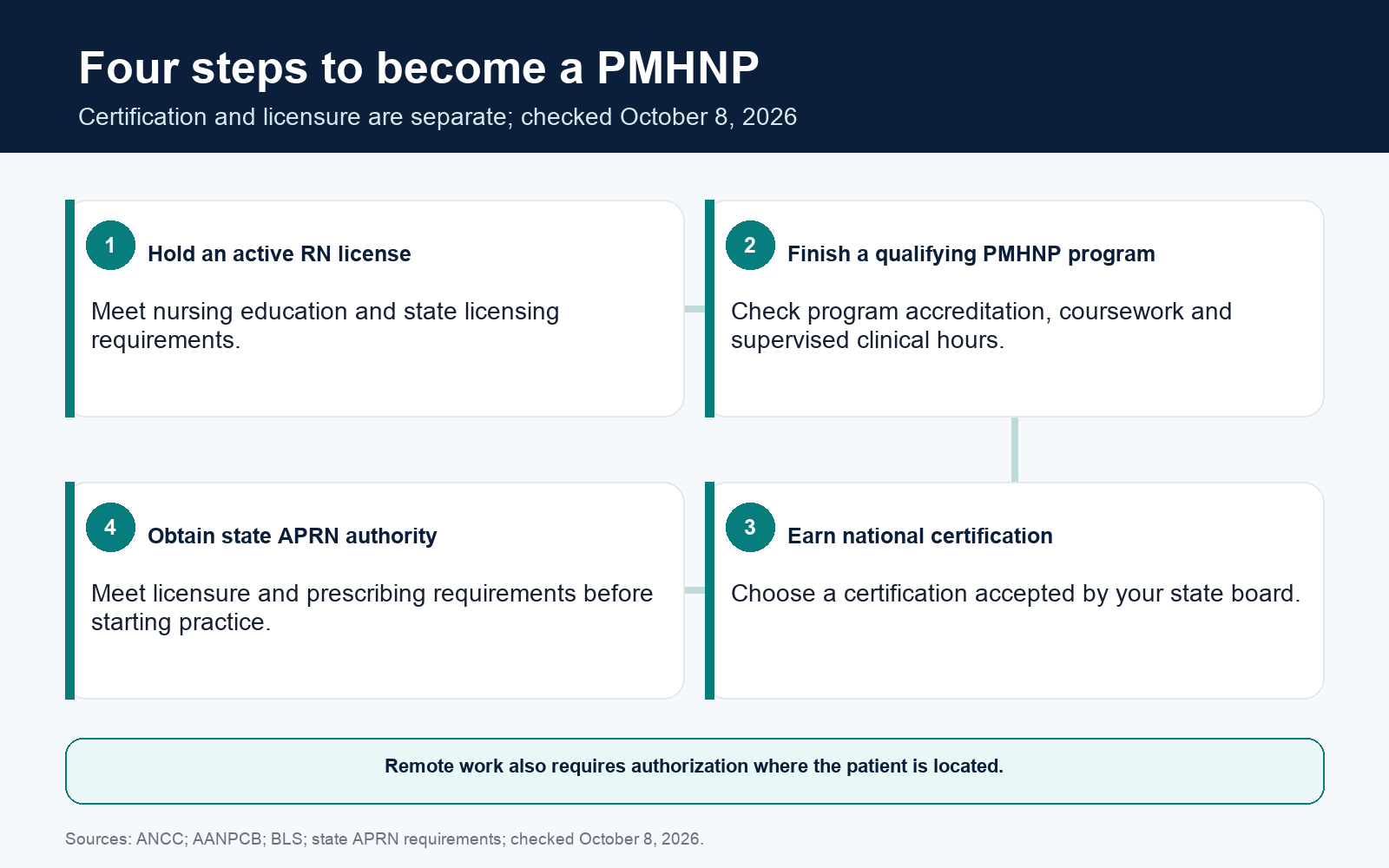
Becoming a psychiatric mental health nurse practitioner takes four steps: hold an active registered nurse (RN) license, finish a graduate PMHNP program, pass a national PMHNP certification exam, and get licensed as an advanced practice registered nurse (APRN) in your state.
The route through school depends on where you start. A BSN-prepared nurse earns an MSN or DNP. A nurse practitioner in another specialty usually adds a post-graduate certificate.
Employers are hiring.
On October 7, 2026, BehavioralHealth.careers listed 109 PMHNP jobs from 23 employers, and 62 of them were remote or virtual.
Among listings with a posted salary, the median range was $145,000 to $175,000 a year across 66 listings from 11 employers.
What a PMHNP does
PMHNPs assess and diagnose mental health conditions, order and interpret tests, prescribe medication, and in many settings provide psychotherapy. How much of that a PMHNP can do alone depends on the state.
In states with full practice, nurse practitioners can evaluate patients, diagnose, order and interpret tests, and start and manage treatment, including prescribing controlled substances, under the licensing authority of the state board of nursing (AANP).
On our board, PMHNP jobs cluster in outpatient psychiatry groups, telehealth companies, and eating disorder and addiction treatment programs.
More than half of the October 9th listings were remote or virtual, which our telepsychiatry jobs guide covers in depth.
Step 1. Hold an active RN license
Every route starts with an RN license. RNs must hold a state nursing license, which requires graduating from an approved nursing program and passing a licensing exam.
The three usual education paths are a bachelor’s degree in nursing (BSN), an associate degree in nursing, or a diploma from an approved program (BLS Occupational Outlook Handbook, Registered Nurses).
ANCC’s PMHNP board certification also requires a current, active RN license (ANCC). If you hold an associate degree, look for an RN-to-MSN track, which bridges to the graduate degree.
Psychiatric nursing experience is not a national requirement for entering a PMHNP program, but it is a practical way to find out whether the specialty fits you before you commit to graduate school. Our guide to behavioral health nurse jobs covers RN roles in psychiatric settings.
Step 2. Complete a graduate PMHNP program
ANCC accepts three graduate routes for PMHNP certification: a master’s degree, a doctor of nursing practice (DNP), or a post-graduate certificate from a PMHNP program with qualifying program accreditation (ANCC).
- BSN to MSN or BSN to DNP. The standard route for RNs who are not yet nurse practitioners. The DNP adds doctoral coursework and a project; both lead to the same certification exam.
- Post-graduate certificate. For nurses who already hold a graduate nursing degree, including family nurse practitioners who want to move into psychiatry. Time to finish depends on how much of your earlier coursework counts.
For ANCC, program accreditation must be through CCNE, ACEN or NLN CNEA; post-graduate certificate applicants need accreditation of the certificate APRN program itself. ANCC also specifies graduate core courses and training in at least two psychotherapy modalities.
Clinical hours are the part to check closely. The national standards for nurse practitioner education, updated in 2022, call for at least 750 hours of direct patient care in every NP program, up from 500, and simulation does not count toward that total (2022 NTF Standards, criterion III.H).
ANCC’s own exam eligibility rule sets a lower floor of 500 faculty-supervised clinical hours (ANCC), so a program with fewer than 750 hours may still qualify you to test.
For post-graduate certificates, the NTF standards call for a formal gap analysis of prior APRN education and at least 750 direct care hours across prior APRN education and the certificate program to meet the new population’s outcomes.
Ask each program how many new direct hours it requires and how prior coursework and hours are assessed.
Realize that program length varies by route and pace.
As one example, the University of Massachusetts Amherst says nurse practitioners can complete its PMHNP certificate in five semesters, while master’s-prepared RNs who are not nurse practitioners need about three years, with 750 clinical hours either way (UMass Amherst). Ask every program for its own figures.
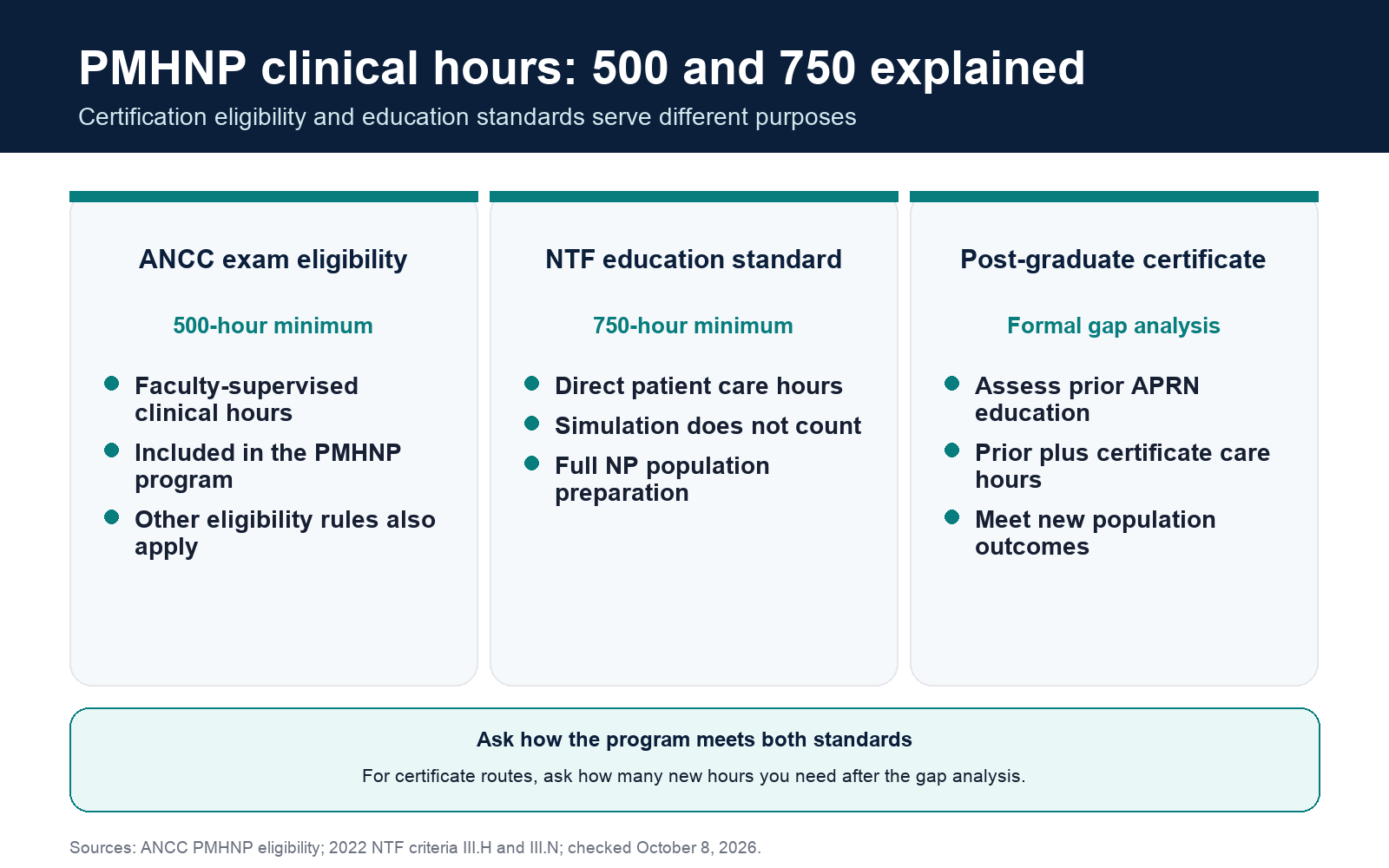
For post-graduate certificates, NTF gap analysis considers prior APRN education and certificate hours together toward the new population’s outcomes. Sources checked October 8, 2026.
Step 3. Pass a national PMHNP certification exam
Two national boards certify PMHNPs. The American Nurses Credentialing Center (ANCC) has long offered the PMHNP-BC, and the American Academy of Nurse Practitioners Certification Board (AANPCB) began giving its own PMHNP exam in spring 2024 (APEA; AANPCB). Confirm that your state board of nursing accepts the certification you choose, and check each board’s eligibility rules against your program.
ANCC awards the PMHNP-BC (Psychiatric-Mental Health Nurse Practitioner, Board Certified) credential to candidates who meet its eligibility rules and pass its competency-based exam.
You can sit for the ANCC exam once all coursework and faculty-supervised clinical hours are complete, before your degree is formally conferred. ANCC issues the certification after it receives your final transcript (ANCC).
The ANCC credential is valid for five years. You renew it by meeting ANCC’s continuing education and professional development requirements, and you must keep your license to practice (ANCC renewal requirements). Check each board’s site for current fees before you apply.
Step 4. Get APRN licensure and prescriptive authority in your state
State boards of nursing license APRNs. Nurse practitioners need an RN license, an accredited graduate program, a passing score on a national certification exam and an APRN license (BLS Occupational Outlook Handbook, Nurse Practitioners).
What you can do after licensure depends on the state. AANP sorts states into three groups (AANP):
- Full practice: NPs evaluate, diagnose, treat and prescribe, including controlled substances, under the state board of nursing alone.
- Reduced practice: state law requires a career-long collaborative agreement with another provider, or limits the setting of at least one part of NP practice.
- Restricted practice: state law requires career-long supervision, delegation or team management by another health provider for at least one part of NP practice.
Counts of full practice states differ between sources and change with each legislative session, so use AANP’s interactive map for your state rather than a number in an article. Your state board of nursing has the final word, including on any transition period it requires before a new NP practices independently.
Prescribing controlled medications takes one more step: a DEA registration, alongside the state’s own prescribing authority. For a multistate telehealth role, confirm the applicable DEA registration requirements for each practice arrangement; a pending rule does not establish an exemption (see the next section).
Working across state lines and by telehealth
Licensure follows the patient. Clinicians must be licensed or otherwise legally permitted to practice in the state where the patient is located during the visit (HHS). There is no multistate license for nurse practitioners yet. As of October 2026, the APRN Compact is not in effect; NCSBN’s model compact takes effect only after seven states enact it (NCSBN). A remote PMHNP who sees patients in several states needs authorization to practice as an APRN in each of them.
Telehealth prescribing of controlled medications has a deadline. A temporary DEA and HHS rule lets DEA-registered practitioners prescribe Schedule II to V controlled medications by qualifying audio-video telemedicine without a prior in-person visit through December 31, 2026 (Federal Register, December 31, 2025).
OIRA lists DEA’s special-registration rule as pending review, received August 25, 2026 (OIRA regulatory review record). Final-rule review does not establish a published rule or an effective date. Recheck the Federal Register before relying on a post-2026 prescribing plan.
If you are considering a remote role, ask the employer how its prescribers will work after December 31, 2026, and which states it will register you in.
We will update this section when DEA publishes its final rule, or by December 1, 2026, whichever comes first.
PMHNP pay: what employers post
Among PMHNP listings on our board with a posted salary on October 7, 2026:
| Group | Median posted salary range | Listings (n) | Employers |
|---|---|---|---|
| All PMHNP listings | $145,000 to $175,000 | 66 | 11 |
| Remote or virtual | $125,000 to $140,000 | 32 | 7 |
| Not marked remote (includes hybrid titles) | $152,000 to $210,800 | 34 | 6 |
Source: BehavioralHealth.careers live listings, October 7, 2026. Median of employer-posted minimums to median of employer-posted maximums among PMHNP listings with a posted salary. Hourly listings were too few to report.
Across those 66 salaried listings, the middle half of posted salary midpoints ran from $132,500 to $181,400.
Don’t read the remote and on-site gap as a rule. Three employers (Ascend Healthcare, Brave Health and Boulder Care) posted 27 of the 32 remote salary ranges. Two (LifeStance Health and Headlight) posted 25 of the 34 ranges for jobs not marked remote. The split mostly reflects which employers hire for which setting, so compare individual offers instead.
For a federal benchmark, BLS reports a median of $132,300 a year for all nurse practitioners in May 2025 (BLS). BLS does not report PMHNPs separately, so that figure blends every NP specialty.
Our PMHNP salary guide has the state-by-state federal tables, and our ranking of mental health careers by posted pay shows where PMHNPs fall against other roles.
Who is hiring PMHNPs on the board
On October 7, 2026, the employers with the most PMHNP listings were:
| Employer | PMHNP listings |
|---|---|
| Talkspace | 22 |
| LifeStance Health | 15 |
| Headlight | 11 |
| Ascend Healthcare | 10 |
| Brave Health | 9 |
| Boulder Care | 8 |
| Compass Health Center | 5 |
Amae Health, which runs psychiatry-led clinics for people with serious mental illness, had 3. Eating disorder and addiction treatment programs, including Eating Recovery Center (3), The Emily Program (2) and Boca Recovery Center (1), also listed PMHNP roles.
How to choose a PMHNP program
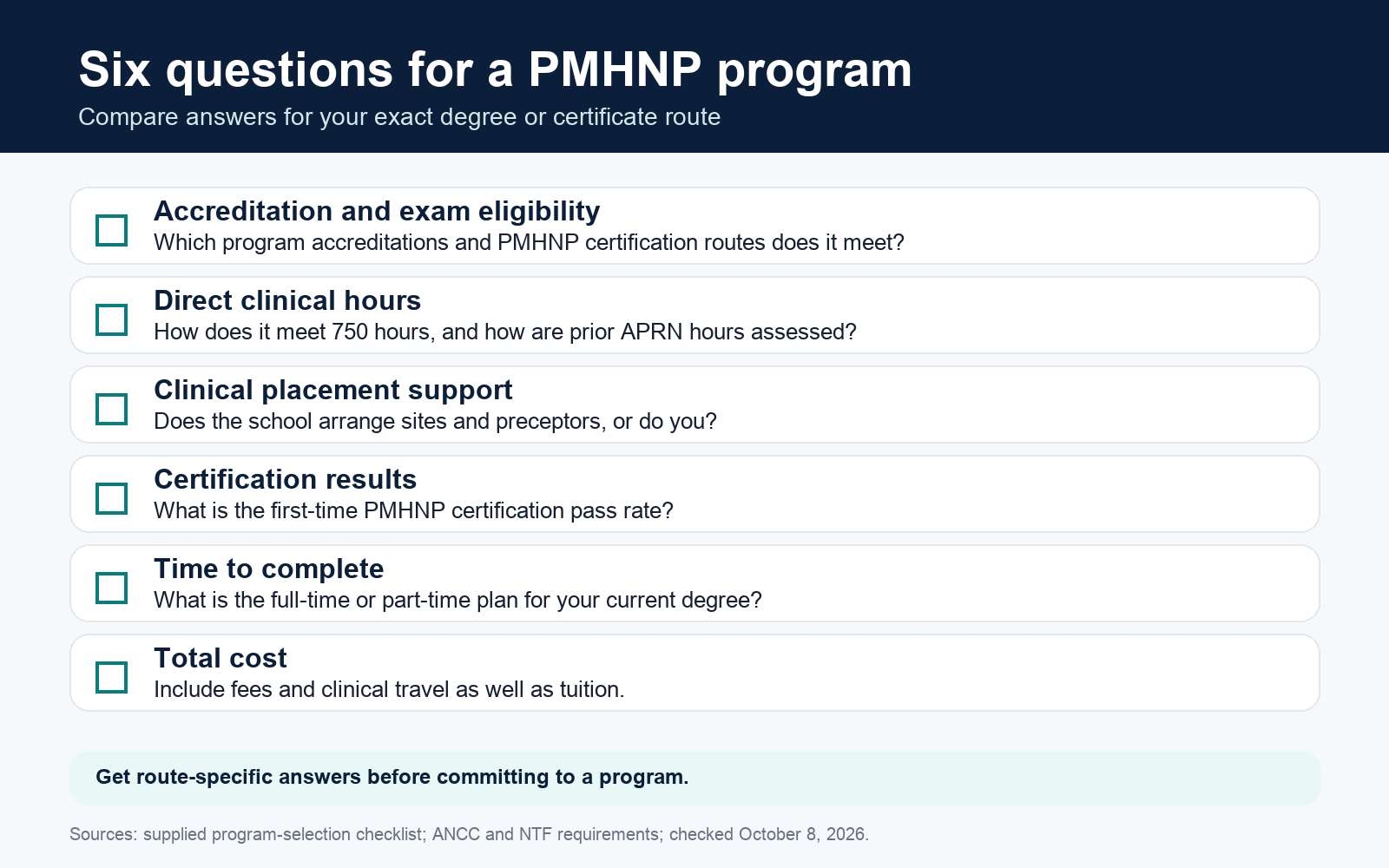
Most programs look alike on a website. Ask each one these questions:
- Is the program accredited, and does it meet the eligibility rules for the ANCC and AANPCB PMHNP exams?
- How many direct patient care clinical hours does it require, and does it meet the 750-hour standard?
- Does the school find and arrange clinical placements and preceptors, or do you?
- What is its first-time pass rate on the PMHNP certification exams?
- How long will it take you, full-time and part-time, given your current degree?
- What is the total cost, including fees and clinical travel?
Frequently asked questions
Can a family nurse practitioner become a PMHNP?
Yes. ANCC accepts a post-graduate certificate from an accredited PMHNP program, which is the usual route for an FNP. You then sit for a PMHNP certification exam and update your APRN licensure as your state board of nursing requires.
Do you need a DNP to become a PMHNP?
No. ANCC accepts a master’s degree, a DNP or a post-graduate certificate from an accredited PMHNP program.
Can PMHNPs practice without a physician?
It depends on the state. In full practice states, NPs diagnose, treat and prescribe under the state board of nursing alone. Reduced practice states require a career-long collaborative agreement or limit where NPs can practice.
Restricted practice states require career-long supervision, delegation or team management by another provider. Check AANP’s state map and your state board of nursing.
Can PMHNPs prescribe controlled medications by telehealth?
Through December 31, 2026, a temporary DEA rule lets DEA-registered practitioners prescribe Schedule II to V controlled medications by qualifying audio-video telemedicine without a prior in-person visit.
OIRA lists DEA’s special-registration rule as pending review. State law, DEA registration rules and the applicable telemedicine conditions still apply.
How much do PMHNPs make?
On our board, PMHNP listings with a posted salary had a median range of $145,000 to $175,000 a year (66 listings, October 7, 2026). BLS reports $132,300 for all nurse practitioners in May 2025.
Sources
- BehavioralHealth.careers live listings, read October 7, 2026 (1,150 published listings; 109 PMHNP).
- American Nurses Credentialing Center, Psychiatric-Mental Health Nurse Practitioner (Across the Lifespan) Certification.
- CareerOneStop, My Next Move: PMHNP-BC certification profile.
- American Psychiatric Nurses Association, National Task Force releases new criteria for quality nurse practitioner education (6th edition).
- APEA, An overview of the 2022 NTF Standards.
- University of Massachusetts Amherst, PMHNP certificate FAQs.
- American Association of Nurse Practitioners, State Practice Environment, updated May 2026.
- APEA, Psychiatric-mental health NPs have a new certification exam, February 9, 2024.
- American Academy of Nurse Practitioners Certification Board, aanpcert.org.
- U.S. Bureau of Labor Statistics, Occupational Outlook Handbook: Registered Nurses and Nurse Anesthetists, Nurse Midwives, and Nurse Practitioners.
- U.S. Department of Health and Human Services, Licensure for behavioral health.
- National Council of State Boards of Nursing, South Dakota enacts APRN Compact.
- Drug Enforcement Administration and HHS, Fourth Temporary Extension of COVID-19 Telemedicine Flexibilities for Prescription of Controlled Medications, Federal Register, December 31, 2025.
- telehealth.org, DEA telemedicine special registration rule enters final review, September 9, 2026.


Pingback: Telepsychiatry Jobs: A Useful Guide for Psychiatrists and PMHNPs | BehavioralHealth.careers