The usual route to becoming a licensed mental health counselor starts with a bachelor's degree, followed by a qualifying counseling master's or higher degree, supervised clinical experience, an accepted exam, and approval from your state licensing board. What changes is the license title, the education and supervised-hour requirements, and which exam the board accepts. The order can change, too: some states require you to pass an exam before you begin post-degree supervised practice.
This guide covers the national steps, a license title for all 50 states, and detailed licensure requirements for Florida, New York, Texas, California, Pennsylvania, and Alabama. Requirements come from state boards, the National Board for Certified Counselors (NBCC), and CACREP, and we link to each source. Timelines are our estimates, and we label them that way.
What it takes to become a licensed mental health counselor
- Degree: a qualifying master's or higher degree in counseling or a board-accepted related field, usually 60 semester credit hours. CACREP-accredited clinical mental health counseling programs require at least 60.
- Supervised clinical experience: plan on roughly 1.5 to 3 years after graduation, though your pace and state rules may require longer. On the standard master's-level routes covered here, New York, Texas, California, Pennsylvania, and Alabama require 3,000 hours; Alabama allows reductions for qualifying additional graduate coursework. Florida requires two years that include 1,500 hours of face-to-face psychotherapy.
- National exam: the National Counselor Examination (NCE) or the National Clinical Mental Health Counseling Examination (NCMHCE), both run by NBCC. Some states add a law, ethics, or jurisprudence exam.
- State application: official transcripts, verified supervision hours, exam scores, a background check, and fees.
- Renewal: most states require continuing education to keep the license active.
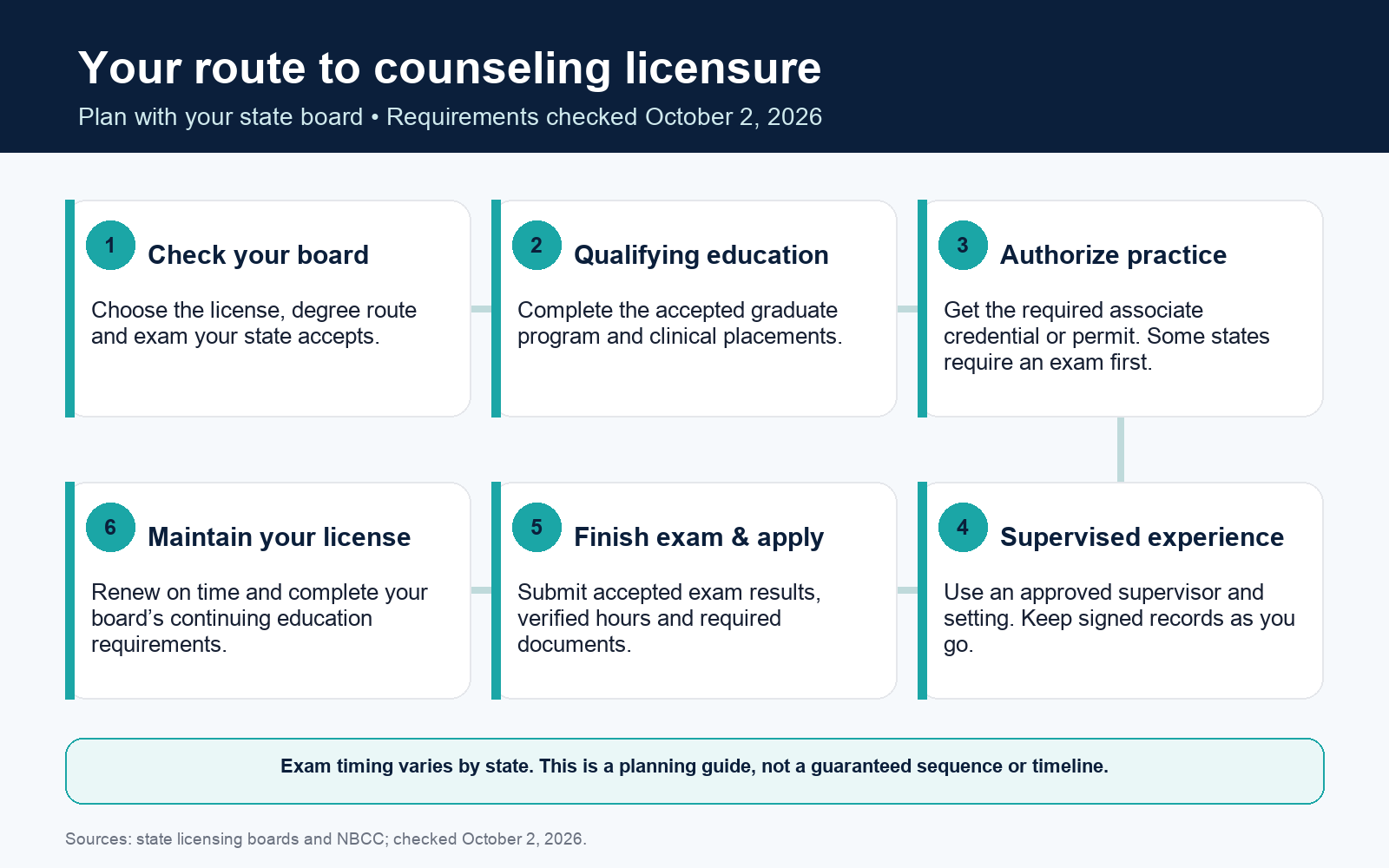
Counseling licensure stages. Exam timing and supervised-practice authorization vary by state; checked October 2, 2026.
What is a licensed mental health counselor?
A licensed mental health counselor is a clinician with graduate training who assesses and treats mental health conditions through counseling. Many counseling licenses also authorize diagnosis, but that authority depends on the state and credential. New York, for example, has a separate diagnostic privilege. Licensed mental health counselors provide mental health services in community mental health centers, hospitals, addiction treatment programs, schools, telehealth companies, and private practice.
Licensure for mental health counselors is regulated at the state level, which is why the title varies. New York and Florida use Licensed Mental Health Counselor (LMHC). Texas and Pennsylvania use Licensed Professional Counselor (LPC). California uses Licensed Professional Clinical Counselor (LPCC). The core expectations are the same: graduate education in counseling, supervised clinical experience, a national exam, and a code of professional ethics.
Counselors work alongside clinical social workers, marriage and family therapists, psychologists, and other mental health professionals, and the lines between those roles can blur in practice. For a side-by-side comparison, see our guide to therapists, counselors, social workers, psychologists, and psychiatrists.
LPC vs LMHC: counseling license titles by state
In states with one full counseling license, LPC and LMHC generally describe comparable credentials, though their legal scope still depends on state law. Other states use two tiers: a base license and a clinical or independent license. In two-tier states, the base license usually has a narrower scope or requires ongoing supervision. An LPC in Illinois or Ohio, for example, is not the same as an LMHC in New York or Florida. The clinical tier (LCPC in Illinois, LPCC in Ohio) is the closer match.
The table is a quick guide to counseling license titles and separate clinical or independent tiers. It does not list every associate, provisional, or specialty credential. Use NBCC's state board directory to find your board and confirm the credential you need before you apply. A title alone does not establish independent practice authority.
| State | Counseling license | Separate clinical or independent tier |
|---|---|---|
| Alabama | LPC | |
| Alaska | LPC | |
| Arizona | LPC | |
| Arkansas | LPC | |
| California | LPCC | |
| Colorado | LPC | |
| Connecticut | LPC | |
| Delaware | LPCMH | |
| Florida | LMHC | |
| Georgia | LPC | |
| Hawaii | LMHC | |
| Idaho | LPC | LCPC |
| Illinois | LPC | LCPC |
| Indiana | LMHC | |
| Iowa | LMHC | |
| Kansas | LPC | LCPC |
| Kentucky | LPCC | |
| Louisiana | LPC | |
| Maine | LPC | LCPC |
| Maryland | LCPC | |
| Massachusetts | LMHC | |
| Michigan | LPC | |
| Minnesota | LPC | LPCC |
| Mississippi | LPC | |
| Missouri | LPC | |
| Montana | LCPC | |
| Nebraska | LMHP | LIMHP |
| Nevada | CPC | |
| New Hampshire | LCMHC | |
| New Jersey | LPC | |
| New Mexico | LMHC | LPCC |
| New York | LMHC | |
| North Carolina | LCMHC | |
| North Dakota | LPC | LPCC |
| Ohio | LPC | LPCC |
| Oklahoma | LPC | |
| Oregon | LPC | |
| Pennsylvania | LPC | |
| Rhode Island | LCMHC | |
| South Carolina | LPC | |
| South Dakota | LPC | LPC-MH |
| Tennessee | LPC | LPC-MHSP |
| Texas | LPC | |
| Utah | CMHC | |
| Vermont | LCMHC | |
| Virginia | LPC | |
| Washington | LMHC | |
| West Virginia | LPC | |
| Wisconsin | LPC | |
| Wyoming | LPC |
Two rows need extra context. In New Mexico, the LMHC is a supervised transition credential toward independent LPCC licensure. In Nebraska, professional counselor certification (CPC) can accompany the LMHP or LIMHP license; it is not a stand-alone practice license.
Most states also issue an associate, intern, or resident license for the supervised period after graduation. Texas calls it LPC Associate, California calls it APCC, and Florida registers candidates as mental health counselor interns.
Step 1: Meet the education requirements
Graduate counseling programs generally require a bachelor's degree for admission, but it does not have to be in psychology. Many graduate programs accept bachelor's degrees from various fields as long as prerequisites are met.
The graduate degree is where the education requirements get specific. Most states require a master's degree in counseling with about 60 semester credit hours of graduate coursework covering the content areas your state lists: counseling theory, human growth and development, assessment, psychopathology, group counseling and group dynamics, career development, multicultural counseling, research and program evaluation, professional orientation, and professional ethics.
A clinical mental health counseling program accredited by CACREP (the Council for Accreditation of Counseling and Related Educational Programs) is a useful starting point. Still, match the specific program to your state's requirements before you enroll. Under the 2024 CACREP Standards, entry-level programs require at least 60 semester credit hours, plus:
- a practicum of at least 100 hours, including 40 hours of direct service with clients
- an internship of 600 hours, including 240 hours of direct service with clients
Many boards accept non-CACREP programs that are substantially equivalent, but that usually means a course-by-course review. A school counseling or general psychology degree may need additional graduate coursework, or may not qualify for your state's mental health counseling license. If you are considering an online program or a school in another state, ask your state board in writing whether the degree program will qualify before you enroll.
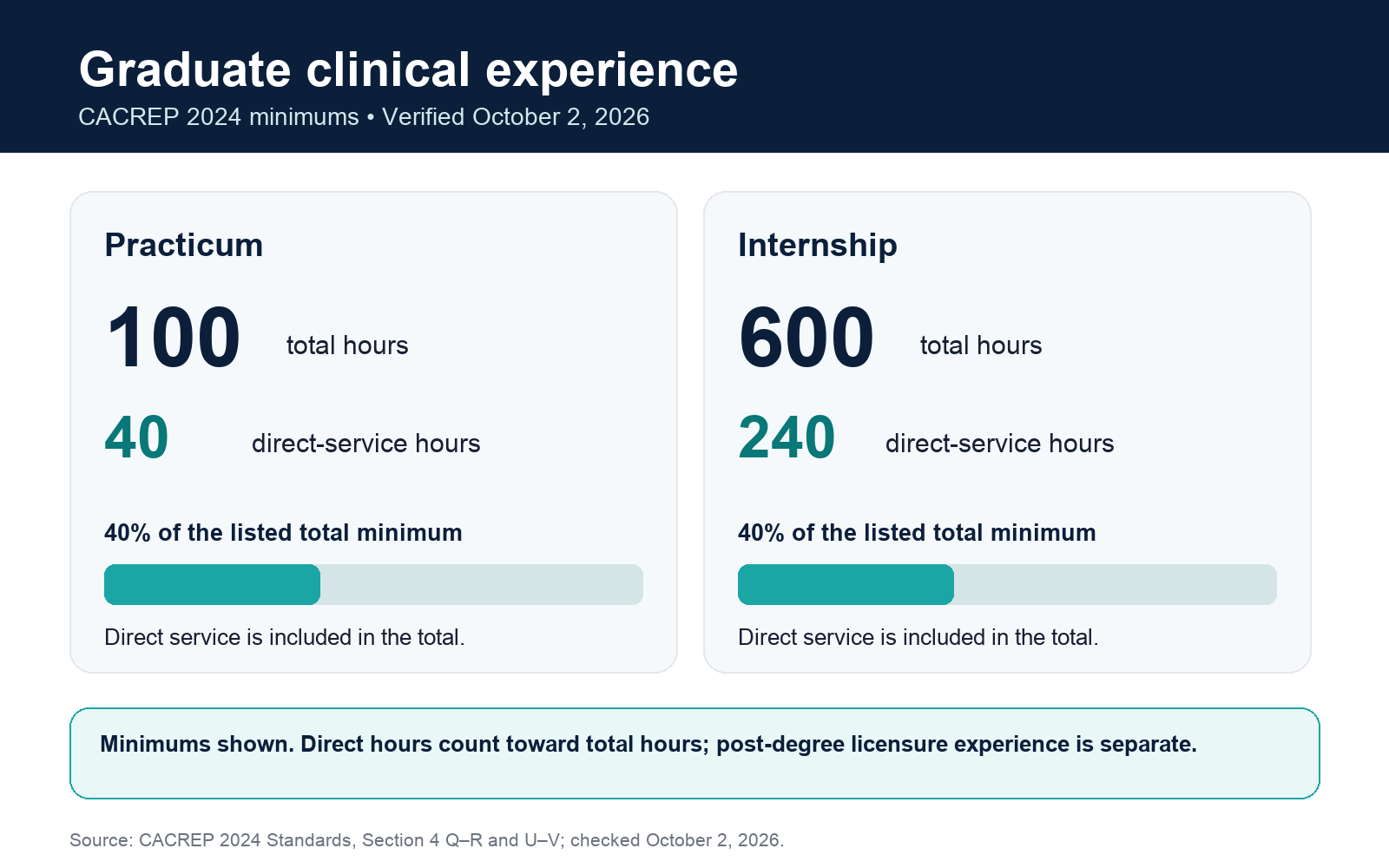
CACREP 2024 minimum practicum and internship hours. These are graduate-program experiences, distinct from post-degree licensure experience; checked October 2, 2026.
Step 2: Complete supervised clinical experience after graduation
The post-degree supervised period is a substantial part of the process. You work as a counselor under a qualified supervisor, usually while holding an associate, intern, or resident license, and log hours of direct client contact and supervision. Many candidates complete this stage at community agencies, where they see diverse populations and a wide range of diagnoses.
Every board sets its own rules for total hours, direct client hours, minimum time, supervision frequency, and which licenses a supervisor must hold. The state sections below show how much those rules vary.
Practical habits that prevent delays:
- Register with your board as an associate, intern, or permit holder before you start counting hours, if your state requires it. California's exception is conditional: apply for APCC registration within 90 days of graduation, meet the agency fingerprinting requirements, and use an eligible setting outside private practice or a professional corporation.
- Log individual counseling, group counseling, and supervision hours as you go.
- Use the board's own forms, and get supervisor signatures regularly instead of at the end.
- Confirm that your supervisor's license type is one your board accepts.
Step 3: Meet the examination requirements (NCE or NCMHCE)
Most states require a national exam from the National Board for Certified Counselors. The two main options:
| Exam | Format | Time |
|---|---|---|
| National Counselor Examination (NCE) | 200 multiple-choice questions, 160 scored and 40 unscored field-test items | 255-minute session, including 225 minutes of testing |
| National Clinical Mental Health Counseling Examination (NCMHCE) | 11 clinical case studies, one of them unscored, with 100 scored questions | 255-minute session, including 225 minutes of testing |
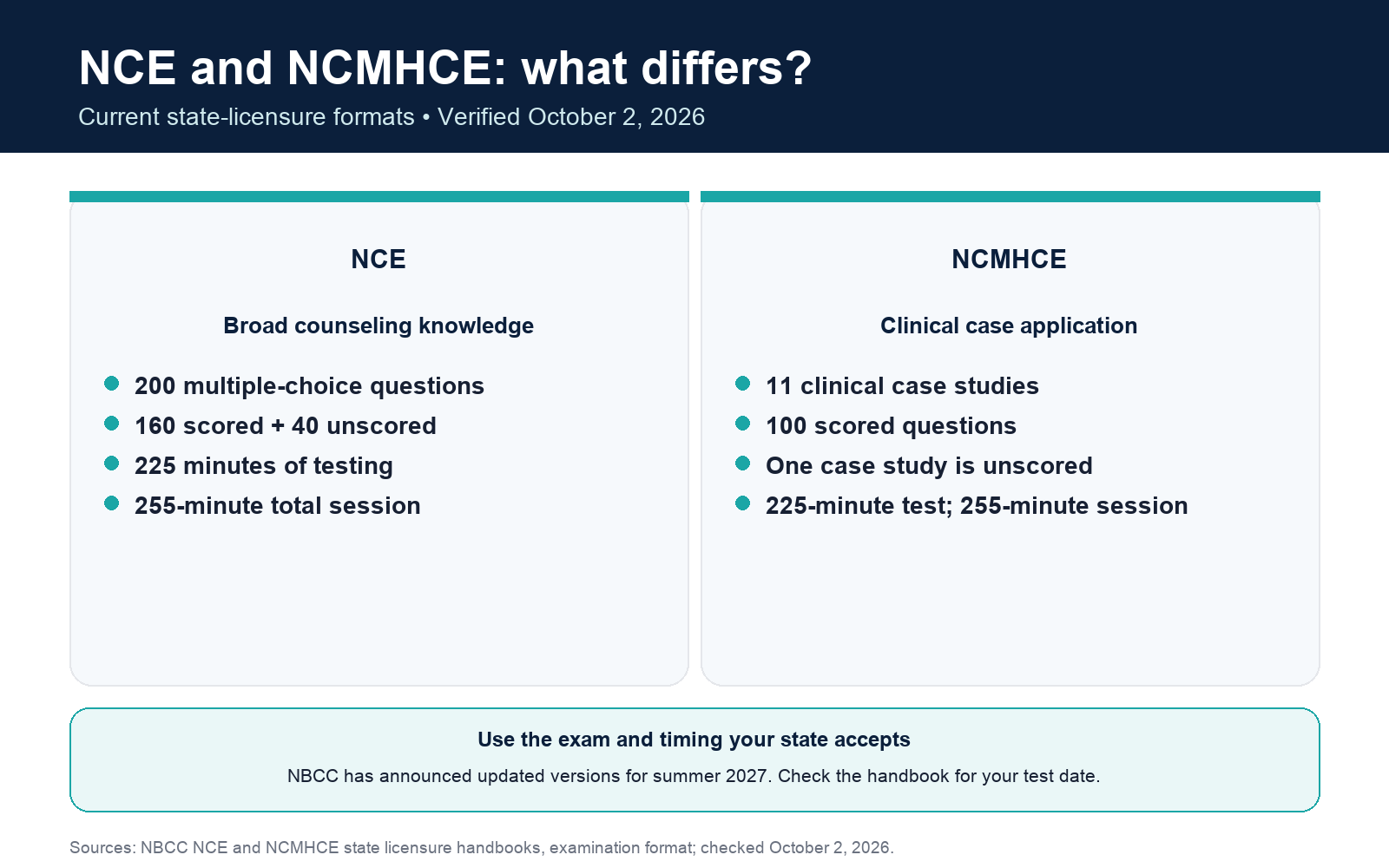
Current NBCC exam formats, checked October 2, 2026. Announced summer 2027 updates are separate; consult the handbook for your test date.
Sources: NBCC's NCE state licensure handbook (revised September 2024) and NCMHCE state licensure handbook (revised November 2025), checked October 2, 2026. NBCC has announced updated versions of both exams for summer 2027. Check the handbook and content outline that apply to your test date before you schedule. The current NCMHCE handbook also gives a 130–150 total-question range in its scoring section; the table follows its examination-format section's case-study description.
The NCE tests broad counseling knowledge. The NCMHCE is built around clinical cases and focuses on assessment, diagnosis, and treatment planning. Florida, New York, and California require the NCMHCE. Texas accepts either. Some states also require a state law and ethics or jurisprudence exam. Both exams are also used by NBCC for its national certified counselors credential. Exam fees change, so use NBCC's current fee schedule.
Step 4: Complete the licensing process for initial licensure
Submit the application materials when your board requires them. Some states review your education and experience before authorizing the clinical exam; others require exam results with the application. Most boards ask for:
- Official transcripts from your graduate program
- Verified supervision logs and supervisor forms
- National exam scores sent directly by NBCC
- Proof of any state-required courses or exams
- A background check or fingerprints
- The application fee
Incomplete application materials are a common reason for delays in the licensing process. Download current application forms from the board's site rather than reusing old versions. Before the board issues your full license, follow your state's rules for supervised practice, including any required associate license, intern registration, or limited permit. A lawful exemption in a particular setting does not automatically make the hours eligible for licensure.
How to become a licensed mental health counselor in Florida
Florida licenses LMHCs through the Board of Clinical Social Work, Marriage & Family Therapy and Mental Health Counseling. Florida's licensure requirements:
- Education: a qualifying master's degree with at least 60 semester hours or 80 quarter hours. Since July 1, 2025, Florida requires CACREP, MPCAC, or equivalent programmatic accreditation. A CACREP degree must be in mental health counseling; other CACREP counseling specialties do not satisfy that degree requirement. The program must include required coursework and 700 hours of university-sponsored clinical field experience, with at least 280 hours of direct client services.
- Supervised experience: two years of post-master's supervised experience, including 1,500 hours of face-to-face psychotherapy with clients and at least 100 hours of supervision over no less than 100 weeks.
- Intern registration: candidates register as mental health counselor interns during the supervised period.
- Exam: the NCMHCE.
- Required courses: an 8-hour Florida laws and rules course and a 3-hour HIV/AIDS course or the board's HIV/AIDS affidavit. The 2-hour domestic violence course is due within six months after licensure. Initial applicants must also complete the required fingerprint-based background screening.
How to become a licensed mental health counselor in New York State
New York licenses LMHCs through the New York State Education Department's Office of the Professions. New York State's licensure requirements:
- Education: a qualifying master's or doctoral degree in counseling with at least 60 semester hours, including a supervised internship or practicum of at least one year, defined by NYSED as at least 600 clock hours.
- Supervised experience: at least 3,000 clock hours of post-degree mental health counseling experience, with at least 1,500 hours of direct client contact.
- Supervision: supervisors must be licensed and registered in New York State in mental health counseling or another qualifying profession, such as psychology or clinical social work. Supervision averages one hour a week or two hours every other week, and no supervisor can oversee more than five limited permit holders at one time.
- Exam: the NCMHCE.
- Other requirements: coursework or training in identifying and reporting child abuse.
- Diagnostic authority: New York has a separate diagnostic privilege for diagnosis and assessment-based treatment planning. New applicants should review its clinical coursework, supervised direct-contact experience, and permit requirements separately from the LMHC license requirements.
- Limited permit: available to candidates who meet every requirement except the exam and experience. It lasts two years and can be extended for up to two more one-year periods.
How to become a licensed professional counselor in Texas
Texas licenses LPCs through the Texas Behavioral Health Executive Council (BHEC). Texas licensure requirements:
- Education: a qualifying graduate degree in counseling or a counseling-related field, with at least 60 semester hours for programs begun on or after August 1, 2017. Earlier qualifying programs may use the 48-hour rule. The practicum must include at least 300 clock hours, including 100 hours of direct client counseling. See 22 TAC 681.81–681.83 for content and documentation requirements.
- Supervised experience: candidates first hold an LPC Associate license. They complete at least 3,000 hours of supervised experience, including 1,500 hours of direct counseling, over at least 18 months, with at least 4 hours of supervision a month.
- Exams: the NCE or the NCMHCE and the Texas LPC jurisprudence exam are required for the LPC Associate application, before you begin counting post-degree experience. The jurisprudence exam is also required for the upgrade to full LPC licensure; use the board's current application timing rules.
How to become an LPCC in California
California licenses LPCCs through the Board of Behavioral Sciences (BBS). The details below come from the BBS Handbook for Future LPCCs.
- Education: a degree with at least 60 semester units or 90 quarter units, including a practicum with at least 280 hours of face-to-face counseling.
- Registration: candidates register as an Associate Professional Clinical Counselor (APCC). A registration number has a six-year limit and requires annual renewal. Hours before registration count only if you meet all conditions of the 90-day rule described above.
- Supervised experience: 3,000 hours over at least 104 weeks, with at least 1,750 hours of direct counseling.
- Exams: the California Law and Ethics Exam and the NCMHCE. Until you pass Law and Ethics, you must attempt it during each annual APCC renewal period; passing is required for a subsequent registration number and for licensure. APCC renewal also requires 3 hours of California law and ethics continuing education each year.
- Additional training: 6 hours of suicide risk assessment and intervention and 3 hours on providing mental health services via telehealth, documented through the routes the board accepts.
- Renewal: 36 hours of continuing education every two years, including 6 hours in law and ethics.
How to become a licensed professional counselor in Pennsylvania
Pennsylvania licenses LPCs through the State Board of Social Workers, Marriage and Family Therapists and Professional Counselors. The details below come from the board's licensure snapshot and 49 Pa. Code § 49.13.
- Education: 60 semester hours of graduate coursework, including a master's degree in counseling or a closely related field, or a doctoral degree.
- Supervised experience: 3,000 hours for master's degree holders, completed in no less than 2 years and no more than 6. Doctoral degree holders need 2,400 hours, 1,200 of them after the doctoral degree. At least half the experience must involve the services listed in §49.13, such as assessment, counseling, therapy, or consultation. Supervision must meet §49.14, including at least 2 hours for every 40 hours of experience.
- Exam: Pennsylvania requires one examination from its approved list, which includes the NCE.
- Initial licensure training: 3 hours of board-approved training in child abuse recognition and reporting.
- Renewal: 30 hours of continuing education each two-year renewal period, including at least 3 hours in ethics, 2 hours of Act 31 child abuse reporter training, and 1 hour in suicide prevention.
How to become a licensed professional counselor in Alabama
Alabama licenses LPCs through the Alabama Board of Examiners in Counseling. Under Alabama Administrative Code 255-X-3-.01:
- Education: a master's degree in counseling with at least 60 graduate semester hours or 90 quarter hours from a qualifying CACREP- or CORE-accredited program, or a regionally accredited program with equivalent content accepted by the board.
- Supervised experience: the standard route requires 3,000 hours of board-approved supervised experience: 2,250 direct counseling hours and 750 indirect-service hours. Hours begin only after the Associate Licensed Counselor (ALC) license is issued. The board may reduce the requirement for qualifying graduate coursework beyond the master's degree, but not below 1,000 hours.
- Exam: a board-approved examination.
The Counseling Compact and license portability
A license in one state does not let you practice in another. The Counseling Compact changes that for member states: an eligible counselor who lives in a participating home state and holds its unencumbered license for independent assessment, diagnosis, and treatment can apply for a privilege in another participating state once both states are operational. Membership alone does not open the application route. That matters most for telehealth services and for counselors who relocate.
As of October 2, 2026, ten states are issuing Compact privileges: Arizona, Arkansas, Georgia, Indiana, Louisiana, Minnesota, Ohio, Oklahoma, Tennessee, and Wyoming. Oklahoma began issuing privileges on October 1. Other member states are still completing implementation, so check the Compact's current rollout information before you plan cross-state or telehealth work. Enacted is not the same as operational.
Outside the Compact, moving usually means licensure by endorsement: the new state reviews your education, supervised hours, and exam history and issues a local license. Our Counseling Compact states guide covers the details. Social workers face a separate compact, covered in our social work licensure compact guide.
Continuing education and license renewal
Most states require you to complete continuing education to keep a counseling license active. The renewal period, total hours, and required topics differ by state. California LPCCs complete 36 hours every two years. Pennsylvania LPCs complete 30 hours every two years, with required hours in ethics, child abuse reporting, and suicide prevention.
Keep certificates in one place, confirm your board approves the provider before you take a course, and set reminders well before your renewal period ends. Boards can audit continuing education records, and restoring a lapsed license takes time. Choosing courses that match the work you want next, such as trauma treatment or supervision, turns a requirement into professional development.
Common mistakes that delay licensure
Most delays come from paperwork and planning, not clinical skill.
- Choosing a program that doesn't match your state. Check credit hours and required coursework against your board's education requirements before you enroll.
- Counting hours too early. Hours earned before you register as an associate or intern often don't count.
- Using a supervisor your board doesn't accept. Confirm the supervisor's license type and qualifications first.
- Waiting to collect signatures. Supervisors change jobs. Get forms signed as you go.
- Sending an incomplete application. Missing official transcripts, or exam scores sent by the applicant instead of by NBCC, are common reasons boards send applications back.
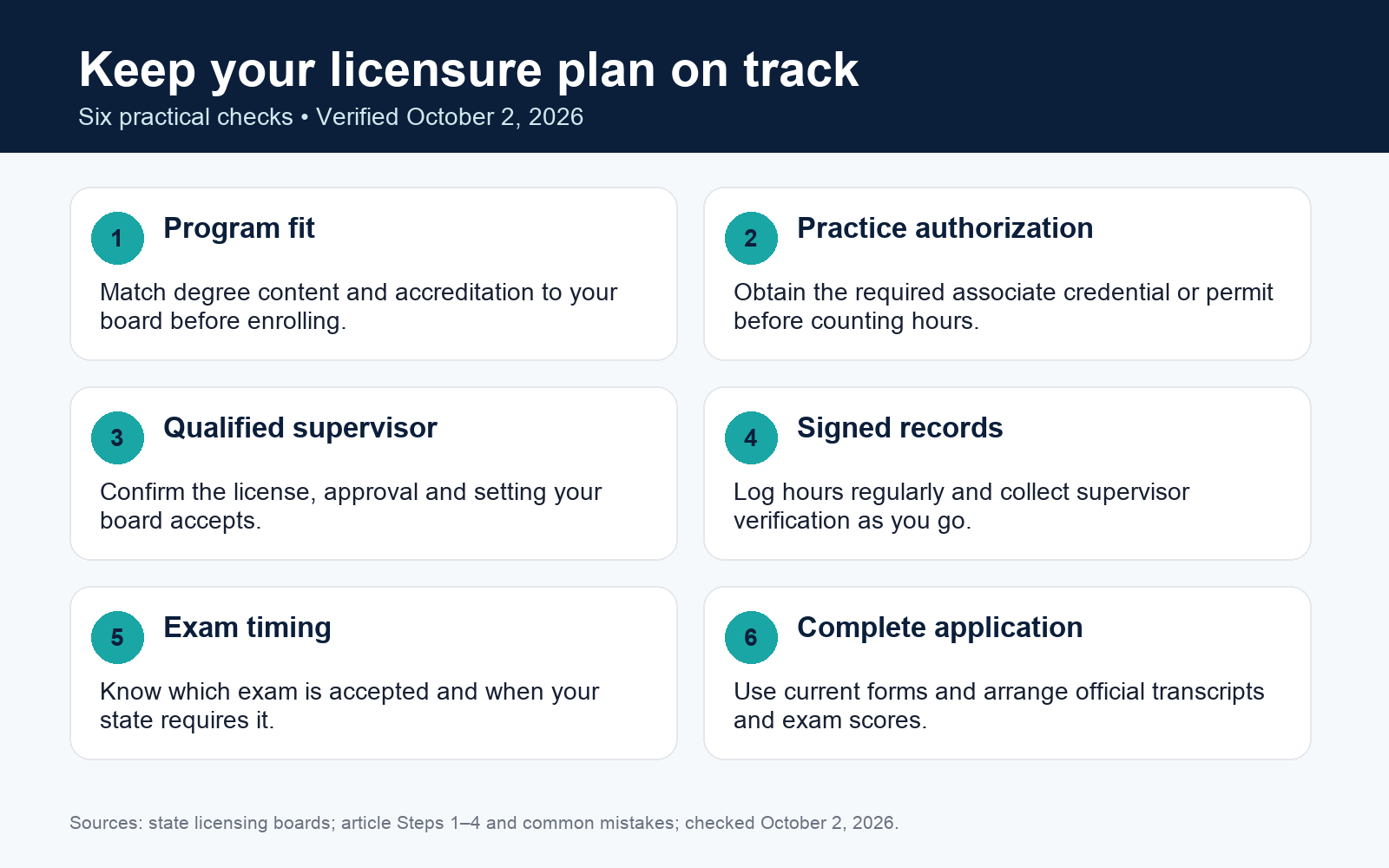
Planning checks that help prevent lost hours and application delays. Your board determines the documents and timing it accepts; checked October 2, 2026.
How long does it take to become a licensed mental health counselor?
Our estimate: about 7.5 to 10 years from the start of college. That breaks down to about 4 years for a bachelor's degree, 2 to 3 years for a counseling master's program, and 1.5 to 3 years for post-degree supervised experience. Texas sets an 18-month minimum for supervised experience, Florida sets two years, Pennsylvania sets two years, and California requires at least 104 weeks.
If you already hold a bachelor's degree, plan on roughly 3.5 to 6 years. Part-time study, a slow pace of client hours, or a change of supervisor will stretch the timeline.
Pay, career paths, and job search after licensure
Licensed mental health counselors work in community mental health centers, hospitals, integrated primary care, addiction treatment, college counseling centers, crisis response teams, telehealth companies, and private practice. Organizations hiring in behavioral health include health systems and telehealth providers. Many counselors specialize in trauma, substance use, children and adolescents, or couples work, and some move into supervision or independent practice as their license allows. Counselors interested in addiction treatment can also pursue state addiction credentials, covered in our substance abuse counselor licensing guide.
Annual salary varies by state, setting, and license level. Our mental health counselor salary page reports a median of $59,350 a year, with the middle 80 percent earning between $38,940 and $97,590, based on Bureau of Labor Statistics May 2025 estimates. Among listings on our board with posted pay, 81 salaried counselor and therapist roles had a median range of $65,000 to $90,000, and 79 hourly roles had a median of $40 to $50 an hour (September 28, 2026 data pull). See where counselors land in our pay ranking. The BLS occupational category also includes substance use and behavioral disorder counselors with different credential requirements, so these figures are not specific to independently licensed mental health counselors.
For a wider view of the mental health workforce and hiring demand, see our behavioral health workforce outlook for 2026. If you want to work remotely after licensure, our remote therapist jobs guide covers what employers expect.
Find counselor and therapist jobs
BehavioralHealth.careers lists behavioral health jobs with posted pay wherever employers disclose it. Browse open counselor jobs and therapist jobs to compare pay, supervision support, and license requirements. If you are still in the supervised period, look for postings that name your associate license and offer clinical supervision. Our content and salary data methods page explains where our numbers come from.
Frequently asked questions
Can I work as a counselor before I'm fully licensed?
Yes, where your state authorizes supervised practice under an associate, intern, resident, or limited-permit credential, or a specific lawful exemption. Use the title attached to your actual credential, and do not represent yourself as independently licensed. Titles, settings, and billing rules for the supervised stage vary, so check with your board and employer.
Is an LPC the same as an LMHC?
They are generally comparable counseling credentials, but the acronym does not guarantee the same legal scope. New York, Florida, and Washington use LMHC, while Texas, Pennsylvania, and many others use LPC. In two-tier states such as Illinois and Ohio, the clinical tier is the closer comparison. New York's separate diagnostic privilege is another reason to check practice authority as well as the title.
Will my license transfer to another state?
Not automatically. You may apply for licensure by endorsement in the new state or, if you meet the Compact's eligibility rules and both states are operational, apply for a privilege to practice. A move that changes your home state also requires you to follow the Compact's home-state change rules.
What if my graduate degree is in psychology instead of counseling?
Some boards accept related degrees if the coursework matches their required content areas. Others require a counseling degree. People with non-counseling degrees often need additional graduate coursework or a post-master's certificate in clinical mental health counseling. Ask your board for a written evaluation before you enroll in anything.
How do telehealth rules apply to licensed mental health counselors?
In general, you need a license, or a Compact privilege, in the state where the client is located at the time of the session. Check your board's telehealth guidance and your malpractice coverage before you see clients across state lines.