

If you are a social worker hoping to practice across state lines, start with the most important fact: the Social Work Licensure Compact is not operational for licensees yet. States have enacted the compact, its governing Commission is working, and the shared data system is under development—but no multistate social work licenses are available as of August 2, 2026.
That makes preparation useful and premature claims risky. This guide explains the compact’s verified status, who may qualify, how the multistate license is designed to work, what social workers and employers should do now, and how it differs from the Counseling Compact and PSYPACT.
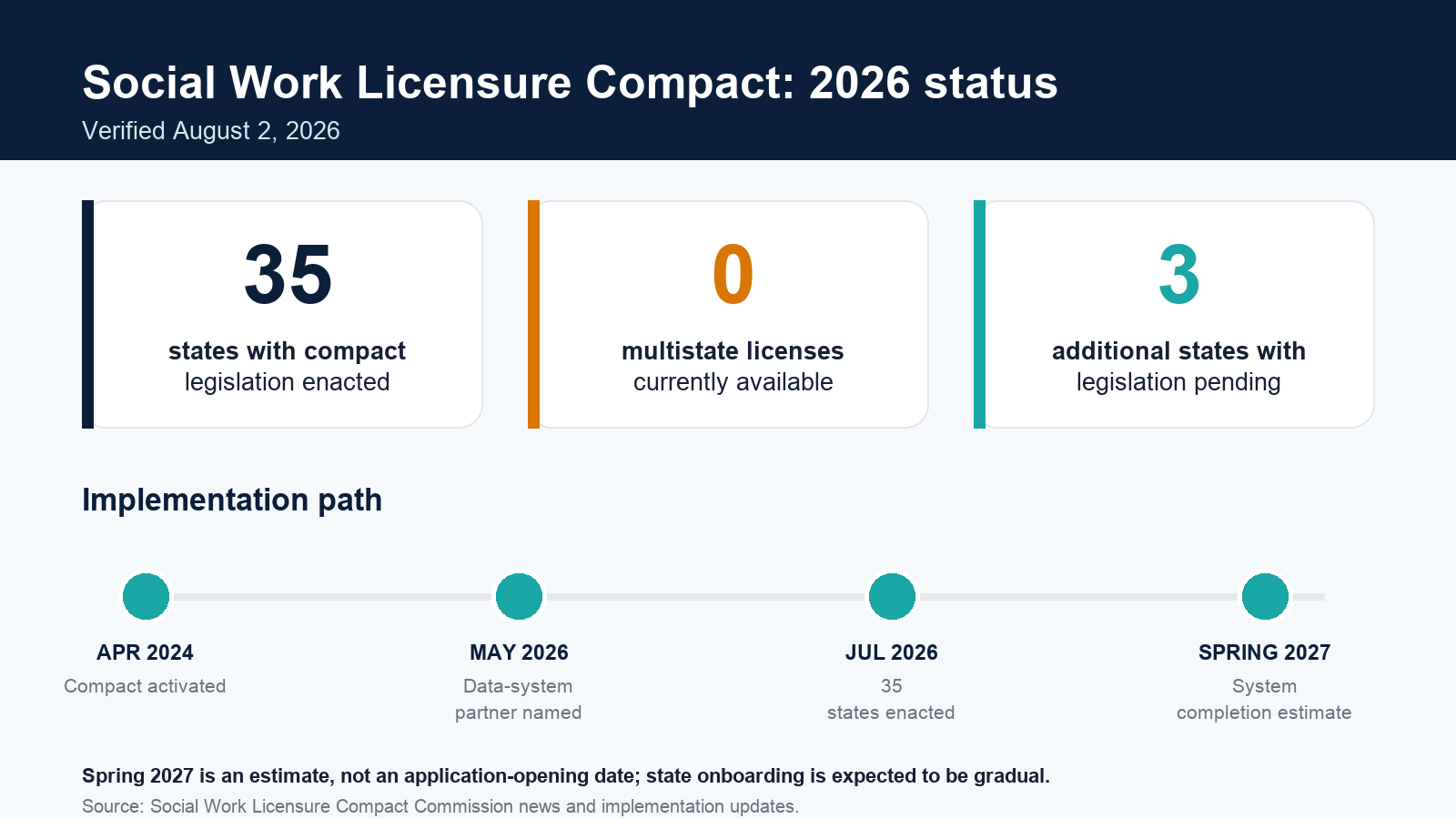
Last verified August 2, 2026: The Social Work Licensure Compact Commission reports 35 states with enacted compact legislation, three additional states with legislation pending, and zero multistate licenses available. Data-system development is estimated for completion in spring 2027, after which states will still need to onboard and applications must open.
This article is informational and is not legal advice. Compact implementation, state participation, and licensing rules can change. Confirm your status with the Social Work Licensure Compact Commission and the relevant state licensing board before providing services.
Who this guide is for
This is the social worker’s compact. It is designed for regulated social workers in bachelor’s, master’s, and clinical categories—credentials commonly styled as LBSW, LMSW, LCSW, LICSW, and state-specific equivalents. The precise category a state activates will depend on that state’s licensing framework.
Psychologists use PSYPACT, covered in our PSYPACT guide for psychologists. Professional counselors use the separate Counseling Compact. Each compact covers a different profession, uses a different authorization model, and follows its own implementation schedule.
What the Social Work Licensure Compact is
The Social Work Licensure Compact is an interstate occupational licensure compact among participating jurisdictions. The compact creates an additional licensing pathway for eligible social workers, improving license portability for multistate practice.
Once operational, that credential is intended to authorize practice in other participating states without requiring a separate license application in every state.
The compact was developed through the Council of State Governments’ National Center for Interstate Compacts with the Association of Social Work Boards and social-work organizations. Its goals include improving professional mobility and continuity of care while giving regulators a shared system for license status, investigations, and adverse actions.
Participating states mutually recognize the multistate credential through legally binding agreements that are constitutionally authorized.
The compact does not erase state regulation or create a national social work license; states retain regulatory authority. A social worker practicing in a remote state must follow that state’s scope-of-practice laws and rules. It also supports telehealth services across state lines, subject to the client-location state’s laws.
For telehealth, the relevant remote state is generally where the client is physically located when services are delivered.
The honest status: activated, not operational
The compact reached activation status in April 2024 after the required seventh enactment. The implementation process began after that milestone, and multistate licenses will be issued in 12 to 24 months once implementation is complete.
The Commission first convened in September 2024 and has since been adopting rules, developing procedures, and building the shared data infrastructure that member states need.
The Commission’s July 2026 update reports 35 states with enacted compact legislation. Virginia enacted the Compact on April 12, 2024, and later enactments included Wisconsin on April 9, West Virginia on June 9, and Alaska on July 3, bringing the reported total to 35. The Commission also reported legislation pending in three other states.
| Verified measure | Status on Aug. 2, 2026 | What it means |
|---|---|---|
| States with enacted legislation | 35 | Legislative adoption has expanded, but enactment alone does not authorize practice. |
| Multistate licenses available | 0 | Applications are not open and no social worker can practice under compact authority yet. |
| Additional states with legislation pending | 3 | The enacted-state count may continue changing. |
| Data-system completion estimate | Spring 2027 | An implementation estimate—not a guaranteed application-opening date. |
| State onboarding | Expected to be rolling | States may connect on different schedules after the system is ready. |
The Commission announced its data-system development partner in May 2026 and estimated completion in spring 2027. Even if that estimate holds, applications depend on final rulemaking and state onboarding. The Commission has said states will likely connect on different schedules because their licensing systems differ.
There is another legal nuance: passing a compact bill is not always the same as becoming a fully recognized compact member state.
The Commission’s May 2026 FAQ warned that material language changes can keep a state from being counted in the current status or able to officially join until the law matches the model text, and it specifically identified South Carolina and New Mexico at that time. In other words, material language in an enacted law still matters, so use the official compact map and Commission updates rather than relying on an undated state list.
How it differs from the Counseling Compact and PSYPACT
Behavioral health employers often discuss all three compacts together, but their credentials are not interchangeable.
| Feature | Social Work Compact | Counseling Compact | PSYPACT |
|---|---|---|---|
| Profession | Regulated social workers | Professional counselors | Psychologists |
| License levels | Bachelor’s, master’s, and clinical categories, subject to state activation | Independent counselors only | Licensed psychologists only |
| Authorization | One multistate license | Separate privilege for each remote state | E.Passport/APIT for telepsychology; TAP/IPC for temporary in-person practice |
| Status on Aug. 2, 2026 | Activated; not issuing | Issuing privileges in seven states | Operational in participating jurisdictions |
| Local law | Follow the client-location state’s rules | Follow the remote state’s rules | Follow the receiving state’s rules |
The practical takeaway is simple: social workers cannot use the Social Work Licensure Compact today, even if another clinician on the same team can already use PSYPACT or a Counseling Compact privilege.
Who may be eligible for a multistate license
The compact establishes common baseline criteria, although Commission rules and each home state’s implementation will control actual applications. An applicant will generally need to:
- Primarily reside in a participating home state that is connected and issuing multistate licenses.
- Hold or be eligible for an active, unencumbered license in that home state.
- Meet the education and qualifying-national-exam requirements for the requested category.
- Complete the required criminal background check, including FBI-records requirements implemented by the home state.
- Have no disqualifying discipline and pay applicable fees once those fees are finalized.
Primary residence matters. The Commission’s FAQ says a social worker cannot choose a different home state merely because an office or another license is located there. The home state is the person’s primary state of residence or domicile.
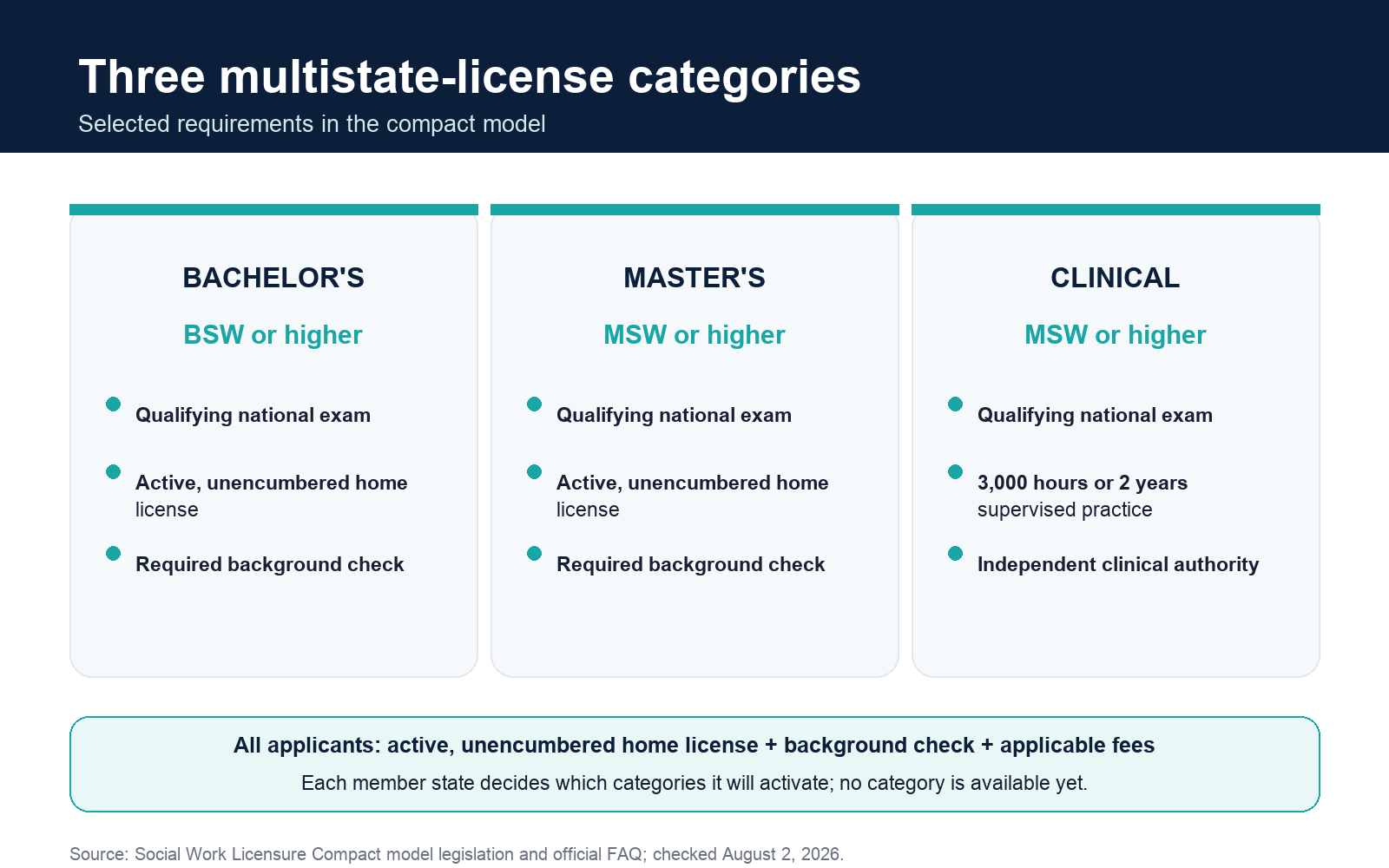
| Category | Education | Exam | Additional compact requirement |
|---|---|---|---|
| Bachelor’s | Accredited BSW or higher | Qualifying national exam for the category | Home-state license, background check, and applicable fees |
| Master’s | Accredited MSW or higher | Qualifying national exam for the category | Home-state license, background check, and applicable fees |
| Clinical | Accredited MSW or higher | Qualifying national exam for the category | 3,000 hours or two years of postgraduate supervised clinical practice, plus independent clinical authority |
The Commission has adopted a rule defining qualifying national examinations. The ASWB examinations are currently the available national social-work licensing examinations. The compact also gives the Commission authority to address certain previously licensed practitioners and future substantially equivalent assessments, so older exam histories should be reviewed under the final rules rather than assumed eligible or ineligible.
How the multistate license is designed to work
Once applications open, an eligible social worker will apply through the licensing board in the home state. After the home state verifies eligibility, completes the required checks, and collects applicable fees, it may issue a multistate license in an activated category.
That one credential is designed to authorize practice in other compact states without an additional application in each remote state. The social worker must still practice within the remote state’s authorized scope and follow its laws. Continuing education remains tied to the home-state license rather than creating a separate CE obligation in every remote state.
Two implementation conditions matter: the home state must be capable of issuing the multistate license, and the client-location state must participate in the compact for that category. Until the infrastructure and state connections exist, neither in-person nor telehealth practice is authorized by the compact.
What is known about fees
No reliable dollar estimate is available yet. The Commission’s May 2026 FAQ says each state will set its license fee and that the amount will include an administrative portion supporting Commission operations and the data system. It also states that all fees remain to be determined.
A proposed Chapter 5 fee rule posted in 2026 still showed the Commission administrative-fee amount as blank. Social workers and employers should avoid budgeting from rumors or fees charged by other professional compacts; the final social-work structure may differ.
What social workers should do now
- Verify your state’s status. Check the official map, then confirm any membership or category questions with your state board.
- Keep your home-state license active and unencumbered. Resolve renewal, continuing-education, or disciplinary issues before applications open.
- Organize exam and education records. Know which ASWB exam you passed and retain documentation of your accredited degree.
- Document clinical supervision. Clinical-category applicants should be able to substantiate the required postgraduate supervised practice.
- Watch Commission rulemaking. Fees, application procedures, data requirements, and category activation remain implementation-sensitive.
- Describe your status accurately. Do not claim compact authority or a multistate license before one has actually been issued.
A careful resume statement today might read: “LCSW in [home state]; monitoring Social Work Licensure Compact implementation and maintaining records for future eligibility.” Avoid language suggesting that enactment alone permits cross-state practice.
What behavioral health employers should know
Current staffing plans must still rely on individual state licenses. A job labeled “compact eligible” can mislead candidates if it implies that an LCSW may already serve clients across participating states.
- Continue verifying an individual license in every state where the social worker will practice or where a telehealth client will be located.
- Map your hiring footprint against official compact legislation and later against the states and categories actually connected to the data system.
- Track the social-work compact separately from PSYPACT and the Counseling Compact; current authority differs by profession.
- Prepare credentialing workflows to verify the home state, multistate-license category, current standing, and any remote-state scope restrictions.
- Expect adverse-action information to move through the compact data system once operational and update compliance procedures accordingly.
- Do not promise a launch date, fee, or state coverage until those details appear in official Commission or state-board materials.
Common misunderstandings
Myth: Thirty-five states enacted the compact, so I can practice in those states now. Reality: no multistate licenses are available, and enactment alone does not authorize practice.
Myth: Spring 2027 is the launch date. Reality: it is the Commission’s estimate for completing the data system. Final rules, state onboarding, and application availability are separate milestones.
Myth: The compact is only for LCSWs. Reality: the model includes bachelor’s, master’s, and clinical categories, but each state decides which categories it can activate.
Myth: A multistate license overrides local law. Reality: the social worker must follow the scope and practice rules of the state where the client is located.
Myth: Fees should resemble the Counseling Compact. Reality: social-work compact fees are not yet determined and the authorization model is different.
Frequently asked questions
Is the Social Work Licensure Compact operational in 2026?
No. The compact is activated and implementation work is underway, but no multistate licenses are available as of August 2, 2026.
When will multistate social-work licenses be available?
The Commission estimates data-system completion in spring 2027. That is not a guaranteed application date. States must still onboard, activate categories, and complete the required implementation work.
How many states have enacted the compact?
The Commission reported 35 states with enacted compact legislation in July 2026, plus legislation pending in three additional states. Confirm the latest status through the official map and news page.
Does the compact cover LBSWs and LMSWs as well as LCSWs?
The compact model includes bachelor’s, master’s, and clinical categories. A member state decides which categories it will activate, so availability may not be identical across states.
Will I need another licensing exam?
Applicants must satisfy the qualifying-national-exam requirement for the requested category. The ASWB examinations are currently the available national exams, but older or unusual licensing histories should be reviewed under Commission rules and home-state guidance.
Does it cover telehealth?
The multistate license is designed to support both in-person and remote practice in participating states. It provides no authority until issued, and the social worker must follow the laws of the state where the client is located.
How much will a multistate license cost?
The amount is not yet determined. The state-set fee is expected to include a Commission administrative component, but official dollar amounts were not final as of August 2, 2026.
Can employers rely on the compact for staffing now?
No. Employers should continue requiring and verifying individual state licenses until multistate licenses are available and the relevant states and categories are operational.
For current compensation benchmarks, see our behavioral health social worker salary by state guide.
Related BehavioralHealth.careers coverage
- PSYPACT guide for psychologists
- how social workers compare to counselors and psychologists
- Remote Therapist Jobs in 2026
- Counseling Compact states guide
References and official resources
- Social Work Licensure Compact Commission — compact overview, eligibility, and status.
- Social Work Compact enacted in 35 states — July 2026 status update.
- Official compact map — current legislative status.
- Commission news and implementation updates — data-system, fee, and launch information.
- Governance documents — adopted rules and model legislation.
- Proposed Chapter 5 fee rule — fee framework with amounts still undetermined.

Pingback: Our Guide to Remote Therapist Jobs in 2026 | BehavioralHealth.careers