

If you want a hands-on career helping people through some of the hardest moments of their lives, becoming a behavioral health technician is one of the fastest paths into healthcare.
This guide from BehavioralHealth.careers walks you through what you need to know: education and certification, pay, job outlook, and long-term career growth.
If you are still choosing a starting role, compare entry-level behavioral health jobs by education level to see how technician, peer, intake and case management options differ.

The essential takeaways
- A behavioral health technician supports people with mental health conditions, developmental disabilities, or substance use challenges, under the supervision of licensed clinicians such as psychiatrists, psychologists, nurses, or board certified behavior analysts.
- Most employers require at least a high school diploma or GED, basic computer skills, and a clean background check. Some prefer prior experience or training in a related field.
- Certification such as the Registered Behavior Technician (RBT) or Certified Behavioral Health Technician (CBHT) can improve your job prospects and pay.
- The field is projected to grow 13 percent from 2023 to 2033 (Bureau of Labor Statistics), faster than average, driven by rising demand for behavioral health services.
- You can usually move from first interest to your first job in about 6 to 18 months, depending on how quickly you complete training and certification.
What does a behavioral health technician do?
A behavioral health technician (BHT) is a frontline worker who helps people manage mental health conditions, developmental disabilities, or substance use disorders. BHTs do not diagnose conditions or prescribe medications.
They work under the supervision of mental health professionals, including psychiatrists, psychologists, counselors, nurses, and board-certified behavior analysts, to carry out treatment plans those clinicians develop. Day to day, a BHT observes patients, checks vital signs, assists with therapeutic activities, and supports people with daily living tasks.
Common job titles include Behavioral Health Technician, Mental Health Technician, Psychiatric Technician, Residential Aide, Recovery Specialist, and Behavioral Health Aide.
You may also encounter “mental health specialist”; our mental health specialist role guide explains why that title needs a closer look at the setting and job description.
Our Behavioral Health Technician vs Mental Health Technician vs Psych Aide Guide breaks down how these titles differ. On a typical day, a BHT helps with meals and hygiene, leads or assists group sessions, records behavior data, supports therapeutic activities, and helps during crisis stabilization.
The work matters because BHTs provide the consistent, compassionate support that keeps people safe, engaged in treatment, and moving toward recovery. It bridges the gap between formal therapy and real life.
Step by step: how to become a behavioral health technician
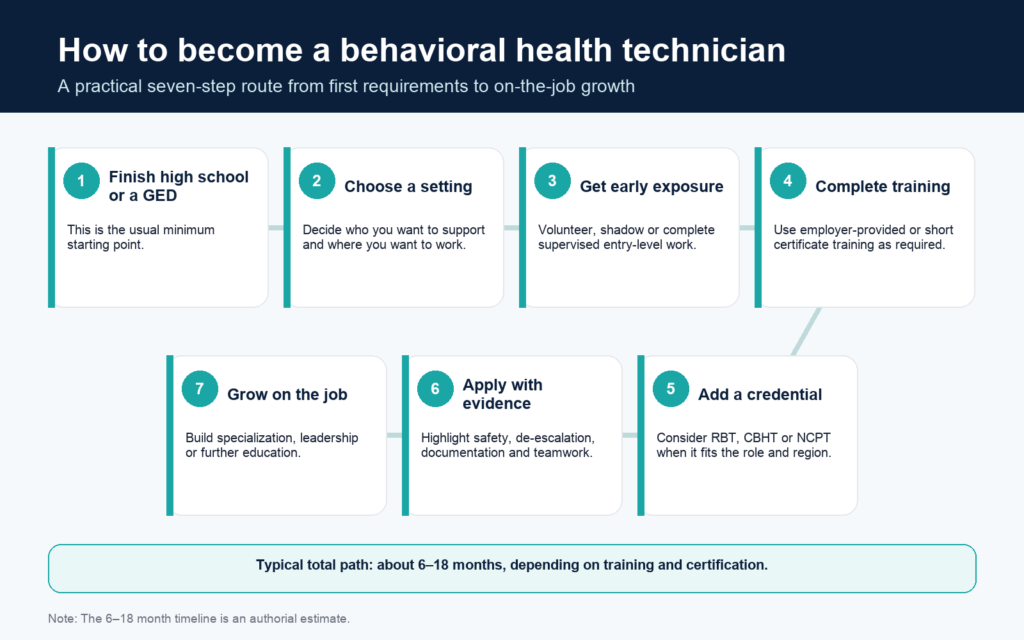
Here is a clear roadmap from first interest to your first behavioral health technician job.
- Finish high school or earn a GED. Many employers require a diploma or GED as the minimum for entry-level positions.
- Choose your population and setting. Decide whether you want to work with children or adults, and whether you prefer hospitals, schools, clinics, or residential programs. This guides your training path.
- Gain basic exposure. Volunteer at a group home, crisis line, or community mental health center. Even non-clinical tasks build transferable skills and show employers you understand the field.
- Complete a training program. Enroll in a behavioral health technician program, online or in person, covering behavior management, safety, documentation, ethics, and medical terminology. Training often includes CPR and first aid. Many employers also provide on-the-job training.
- Earn certification. Apply for the certification that fits your goals and state rules. Employers require criminal background checks for these positions because of the sensitive nature of patient care.
- Build your resume and apply. Highlight relevant training, credentials, and references. Target entry-level roles that offer strong supervision and ongoing learning.
- Grow on the job. Focus on continuing education, supervisor feedback, and building expertise in areas like crisis intervention or data collection to prepare for advancement.
Education, training, and certification
A college degree isn’t always required, but structured training plus certification makes you a much stronger candidate. Most employers accept a high school diploma or GED, though some prefer coursework in psychology, social work, special education, or human services.
Training generally covers mental health basics and crisis intervention, common conditions like anxiety, depression, and addiction, behavior support strategies, cultural competence, documentation in electronic health records, and patient confidentiality. Added training in suicide prevention and trauma-informed care can improve your employability.
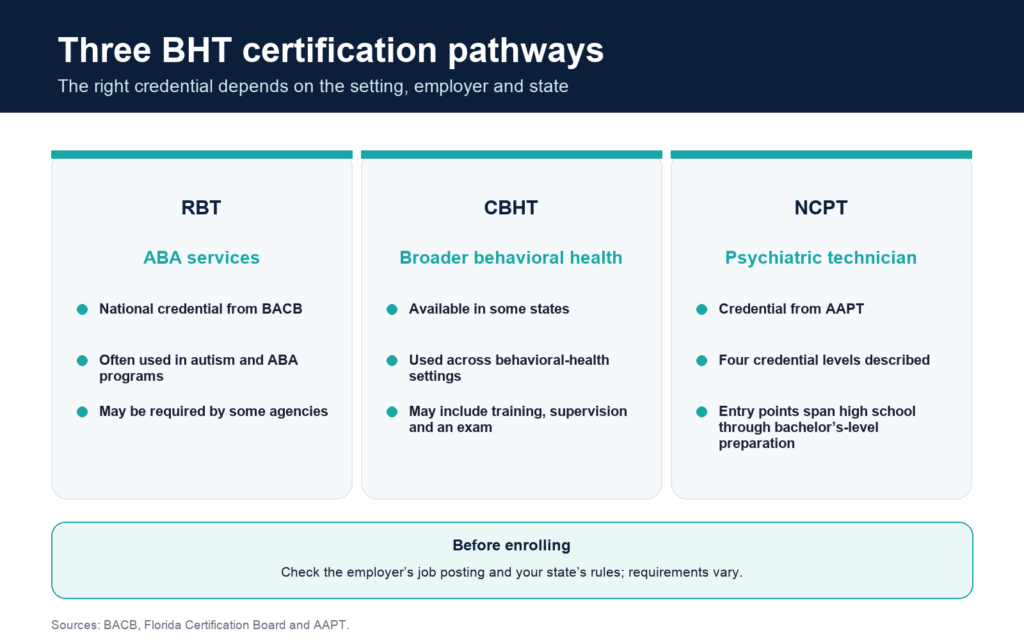
Primary certification pathways in the US:
- Registered Behavior Technician (RBT). A nationally recognized credential from the Behavior Analyst Certification Board, especially for autism and ABA services. Many ABA agencies require it, and most employers cover the training.
- Certified Behavioral Health Technician (CBHT). Available in some states, such as Florida, through the Florida Certification Board, requiring training hours, supervised experience, and a written exam.
- Nationally Certified Psychiatric Technician (NCPT). Offered by the American Association of Psychiatric Technicians at four levels, from an entry-level open to high school graduates up to a bachelor’s-level credential.
Certification typically involves completing set training hours, passing a competency assessment, clearing background checks, and following an ethics code. Requirements vary by state, so check your state licensing agency for current rules before you enroll.
Skills, qualities, and day-to-day work
This section helps you decide whether the role fits your strengths and your tolerance for stress. The personal qualities that matter most are patience, empathy, emotional stability, clear boundaries, and respect for people from different backgrounds. The practical skills include:
- Communication and active listening with clients and clinical teams
- Accurate observation, behavior data collection, and written documentation
- Basic computer and electronic health records proficiency
- Crisis prevention and de-escalation
A typical day might include a pre-shift briefing and patient status review, monitoring clients and assisting with meals and daily tasks, leading or assisting group sessions, helping carry out behavior plans, tracking progress through data and charting, and reporting concerns to supervisors.
The challenges are real: exposure to agitation or self-harm, shift work covering evenings, nights, and weekends, and the emotional weight of seeing people in crisis. So are the rewards: watching clients make progress, building genuine trust, and knowing your work helps lives get better.
Where behavioral health technicians work, pay, and job outlook
Behavioral health technicians are in demand across many settings: residential treatment centers, community health programs, inpatient psychiatric units, hospitals, detox and rehab facilities, school-based programs, outpatient clinics, and in-home services.
On pay, behavioral health technicians earn a median of about $45,130 a year, according to the latest federal wage data (BLS, May 2025 estimates), with most earning between $35,090 and $60,750. Pay varies widely by state and setting.
Our Behavioral Health Technician Salary by State guide breaks down the full numbers, the highest-paying states, and what actually raises technician pay.
The outlook is strong. Employment is projected to grow 13 percent from 2023 to 2033 (BLS), much faster than average, driven by rising attention to mental health, expanded insurance coverage for behavioral health, and shortages of trained frontline workers.
Ready to start? Browse current Behavioral Health Technician jobs on our board.
Advancement and long-term pathways
Many people begin as BHTs to test the behavioral health field before committing to a degree in counseling, psychology, social work, nursing, or occupational therapy.
Common advancement options include lead technician or shift supervisor, case management or care coordinator roles, specialization in substance use, autism services, or crisis response, and further education toward licensed therapist, nurse, or BCBA credentials.
Our Complete Guide to Careers in Behavioral Health maps those paths. And our resource on how to become a Registered Behavior Technician shows the path to that certification and more details on RBT roles.
When choosing a job, look for structured supervision from licensed clinicians, paid continuing education, tuition assistance or school partnerships, and clear internal promotion paths.
Keep a record of your training, certifications, and supervision hours as you go. This role can be both a fulfilling long-term career and a strong stepping stone into the wider field.
FAQs on the Path to Becoming a BHT
Do I need a college degree to work as a behavioral health technician?
Many employers accept candidates with a high school diploma or GED plus appropriate training and certification. Some hospitals and specialized programs prefer an associate or bachelor’s degree in psychology, social work, or a related area. Starting as a BHT is a practical way to gain experience while taking college classes part-time.
How long does it usually take to become a behavioral health technician?
Expect about 6 to 18 months from your first training course to your first job, depending on whether you already have a diploma, how fast you finish a training program, and how quickly you pass any certification exam. Short certificate programs finish in a few months; degree programs take longer but can open more advanced roles.
Is behavioral health technician work safe?
BHTs may work with people who are upset, confused, or occasionally physically aggressive, but employers are expected to provide safety training, appropriate staffing, and clear procedures. Good programs train staff in nonviolent crisis intervention, personal safety, and teamwork. Ask about safety policies, staffing ratios, and training during interviews.
Can I work part time or evenings as a behavioral health technician?
Many facilities run around the clock, so part-time, evening, overnight, and weekend shifts are common. Some employers pay a shift differential for nights or weekends, which raises total pay. That flexibility can make these roles a good fit around school or family commitments.
What is the difference between a behavioral health technician and a therapist?
Therapists, such as licensed professional counselors, social workers, or psychologists, hold graduate degrees, carry state licenses, and provide formal psychotherapy and treatment planning. Behavioral health technicians support those plans by observing, coaching, and assisting clients, but do not independently diagnose or choose therapies. Many technicians become therapists later, after gaining experience and completing further education and licensing.
References
American Association of Psychiatric Technicians. (n.d.). The certification process. Retrieved August 23, 2026, from https://psychtechs.org/the-certification-process/
Behavior Analyst Certification Board. (n.d.). RBT requirements. Retrieved August 23, 2026, from https://www.bacb.com/rbt/
Florida Certification Board. (n.d.). Certified Behavioral Health Technician (CBHT): Requirements and application pathway. Retrieved August 23, 2026, from https://flcertificationboard.org/certifications/cbht-requirements-application-pathway/
U.S. Bureau of Labor Statistics. (n.d.). Occupational employment and wages, May 2025: 29-2053 Psychiatric technicians. Occupational Employment and Wage Statistics. Retrieved August 23, 2026, from https://www.bls.gov/oes/current/oes292053.htm
U.S. Bureau of Labor Statistics. (n.d.). Psychiatric technicians and aides. Occupational Outlook Handbook. Retrieved August 23, 2026, from https://www.bls.gov/ooh/healthcare/psychiatric-technicians-and-aides.htm


Pingback: How to Become a Registered Behavior Technician | RBT Hiring
Pingback: Writing a Behavioral Health Technician Job Description That Brings Qualified Candidates | BehavioralHealth.careers