![[HERO] Student Loan Repayment for Behavioral Health Professionals: 10 Things You Should Know!](https://cdn.marblism.com/l-yAPjyLYhn.webp)
Disclaimer: This guide provides general information on loan repayment programs as of March 2026. Program requirements, funding levels, and deadlines change frequently. Confirm all details with the specific program administrator before making career or financial decisions.
Let’s get down to it: You didn’t enter the behavioral health field to get rich, but you also didn't sign up to be buried under six figures of debt for the next thirty years.
Whether you are hunting for licensed clinical social worker jobs or starting your journey in substance abuse counselor jobs, your student loan balance is likely the biggest line item on your monthly budget.
In 2026, the landscape for loan forgiveness has shifted.
Between new federal legislation and massive state-level grants in the "Big Five" behavioral health states, there is more money on the table than ever before: if you know where to look.
At a Glance: The 2026 Loan Repayment Cheat Sheet
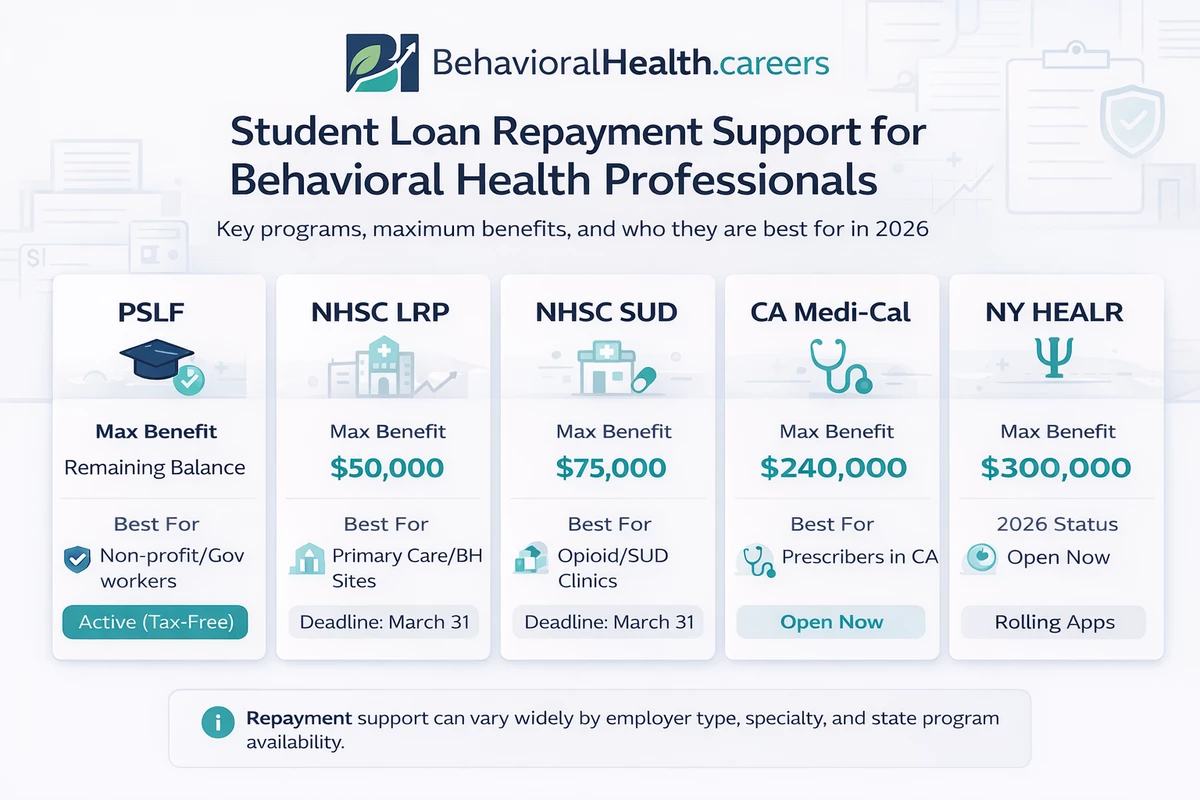
1. PSLF: The "One Big Beautiful Bill Act" Update
Public Service Loan Forgiveness (PSLF) remains the primary path for most clinicians. The deal is simple: work for a 501(c)(3) nonprofit or government agency, make 120 qualifying payments, and the rest is gone.
However, 2026 has brought two major shifts to this "gold standard":
- The OBBA Impact: The One Big Beautiful Bill Act (OBBA) has streamlined the consolidation process, preventing the "reset" of payment counts that used to plague borrowers.
- The NASW Lawsuits: We are tracking ongoing litigation from groups like the National Association of Social Workers (NASW) regarding restrictive employer definitions. This could potentially open PSLF eligibility to clinicians working in private practices that contract primarily with Medicaid.
What this means for you: If you are looking at behavioral health careers in the public sector, verify your employer’s tax status on day one.
Use the PSLF Help Tool to certify your employment annually: don't wait until year ten.
2. NHSC 2026 Deadlines: The March 31 Rush
The National Health Service Corps (NHSC) is the heavy hitter for federal repayment.
If you work in a Health Professional Shortage Area (HPSA), you can trade years of service for massive chunks of debt relief.
Mark your calendar for March 31, 2026. This is the deadline for the three primary tracks:
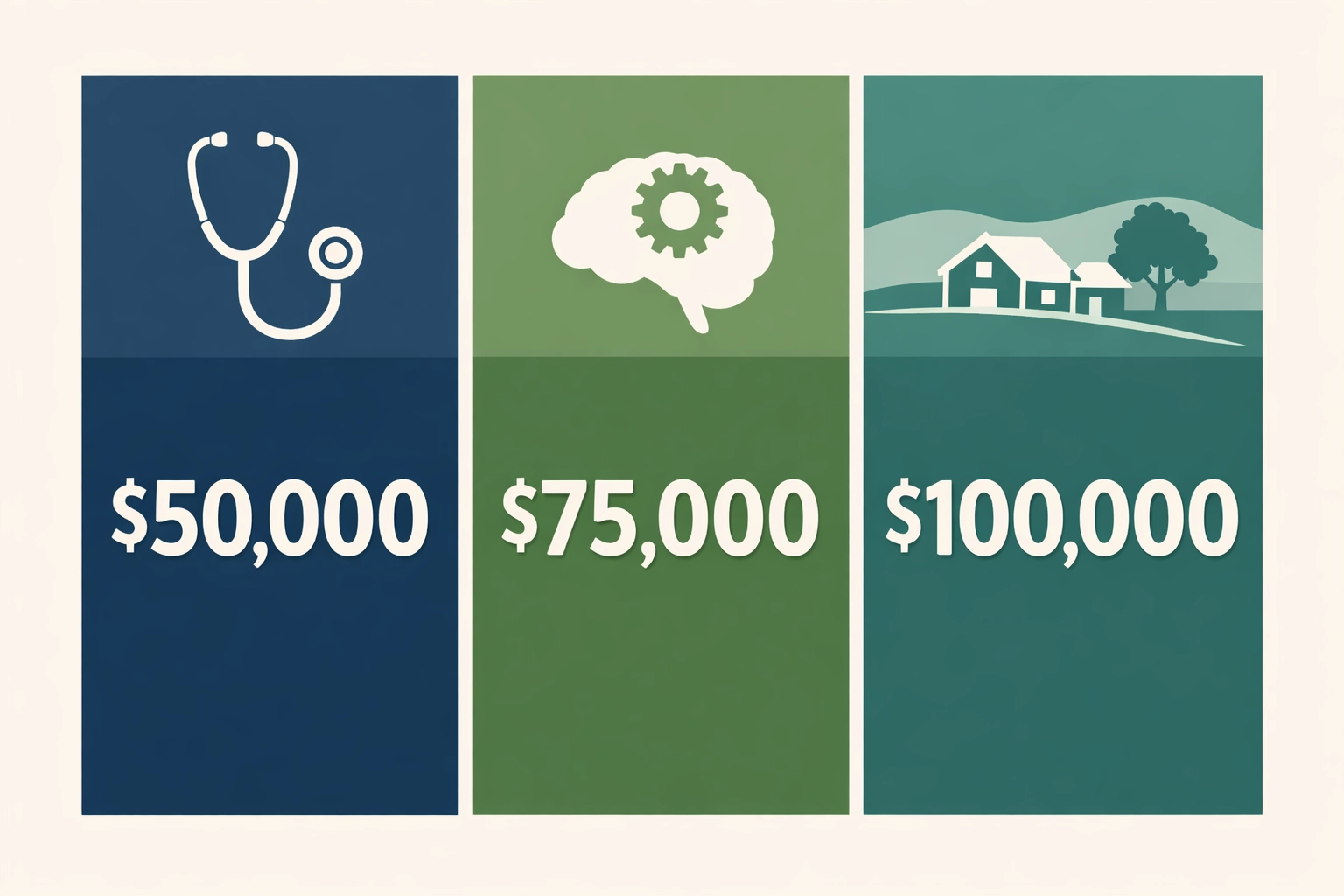
- Loan Repayment Program (LRP): Offers up to $50,000 for a two-year full-time commitment.
- SUD Workforce LRP: Specifically for those in substance abuse counselor jobs, offering up to $75,000.
- Rural Community LRP: The most aggressive federal option, offering up to $100,000 for clinicians heading to designated rural areas needing behavioral health providers.
3. California’s Mega-Grants: Up to $240,000
If you are searching for psychologist jobs or mental health jobs in the Golden State, the Medi-Cal Behavioral Health Student Loan Repayment Program (BH-SLRP) is a game-changer.
To address a massive workforce shortage, California has authorized:
- Up to $240,000 for prescribers (Psychiatrists and PMHNPs).
- Up to $120,000 for non-licensed counselors and social workers.
Hiring implications: California is currently a "magnet state." If your debt-to-income ratio is making you lose sleep, relocating to a qualifying Medi-Cal site in CA might be the fastest way to financial solvency. Explore California locations to see where these grants are most active.
4. New York’s HEALR Program: The Psychiatrist Bounty
New York has doubled down on its Health Care Employment Across Long Island and Regions (HEALR) and state-level equivalents.
The standout feature of NY’s 2026 strategy is the focus on psychiatrist jobs.
High-need areas in New York City and rural upstate regions are offering payouts of up to $300,000... This isn't only a "repayment": it's a total balance wipeout for many early-career doctors.
5. Texas, Florida, and Arizona: The Rest of the Big Five
The other high-employment states have refined their 2026 offerings:
- Texas: The Physician Education Loan Repayment Program and the Mental Health Professional LRP are accepting applications through July 31, 2026. Texas focuses heavily on state hospitals and community centers.
- Florida: The Florida Reimbursement Assistance for Medical Education (FRAME) program provides annual payments to licensed clinicians.
- Arizona: The Arizona Primary Care Loan Repayment Program includes behavioral health providers and requires a two-year commitment in an underserved area.
6. The LEAP Act PSA: Higher Limits Incoming
We are closely watching the LEAP Act (Loan Expansion for Advanced Professionals). This new bill aims to increase the graduate loan limit to $50,000 per year.
What this means for you: If you are currently in grad school or considering a doctorate, this act could significantly change how you finance your education.
It acknowledges that the cost of becoming a psychologist or licensed clinical social worker has outpaced traditional loan caps.

7. It’s Not Just for Doctors: Broad Eligibility
A common myth is that loan repayment is only for those with "Dr." in their title. That is false in 2026. Many state programs have expanded to include:
- Registered Behavior Technicians (RBTs)
- SUD Counselors (Associate level)
- Peer Support Specialists
State-level grants often prioritize the "front line" of the workforce. If you are working in substance abuse counselor jobs, check your state’s Department of Health website: not just the federal NHSC.
8. Negotiation Tactics: Ask Before You Sign
When interviewing for behavioral health careers, your salary isn't the only number that matters. Use these tactics:
- Check the HPSA Score: Before signing an offer, ask the recruiter for the site’s HPSA score. If it’s high (usually 14+), you have a much better shot at federal NHSC money.
- The Stipend Ask: If the employer is a for-profit entity (meaning no PSLF), ask for a "Loan Repayment Stipend."
- Example: "Since this site isn't PSLF-eligible, I'd like to discuss a monthly $500 loan repayment stipend as part of the total compensation package."
9. Tax Implications: PSLF vs. IDR
This is a critical "reality check" for your 2026 taxes:
- PSLF Forgiveness: Currently, federal tax-free.
- Income-Driven Repayment (IDR) Forgiveness: If you hit the 20- or 25-year mark on a standard IDR plan, the forgiven amount may be treated as taxable income (the "tax bomb").
Always consult a tax professional. However, the general rule for 2026 is that service-based repayment (NHSC, state grants) is typically tax-exempt, while time-based forgiveness (IDR) is a bit more complicated.
10. Employer Note: Retention is the New Recruitment
If you are an employer reading this, listen closely: offering loan repayment is no longer a "perk": it is a survival strategy for 2026 staffing.
According to our Behavioral Health Workforce Outlook 2026, clinicians list "Financial Stability" as their #1 reason for job-hopping.
By becoming an NHSC-approved site or offering direct repayment, you drop your turnover rate significantly.
For more on building a competitive offer, check our Hiring Toolkit.
Your Loan Repayment Action Plan
To maximize your chances of getting your debt covered this year, follow this workflow:
- Confirm Your Loan Type: Ensure you have Federal Direct Loans (Private loans are excluded from almost all of these programs).
- Verify Site Eligibility: Use the NHSC Site Search to see if your current or future employer is on the list.
- Check the "Big Five" Deadlines: Especially the March 31 federal cutoff.
- Document Everything: Keep a folder with every employment certification form and payment receipt.
The burden of student debt shouldn't keep you from the work you love.
Whether you're looking for remote therapist jobs or facility-based roles, the money is out there: you just have to be intentional about where you land.
We hope you found a good series of reference points for programs with our resource, and we pledge to keep it updated as offerings evolve.