

If you are a licensed professional counselor weighing remote or multi-state work, the Counseling Compact is an interstate agreement that lets counselors practice in other member states through a privilege to practice instead of getting a separate full license in each one.
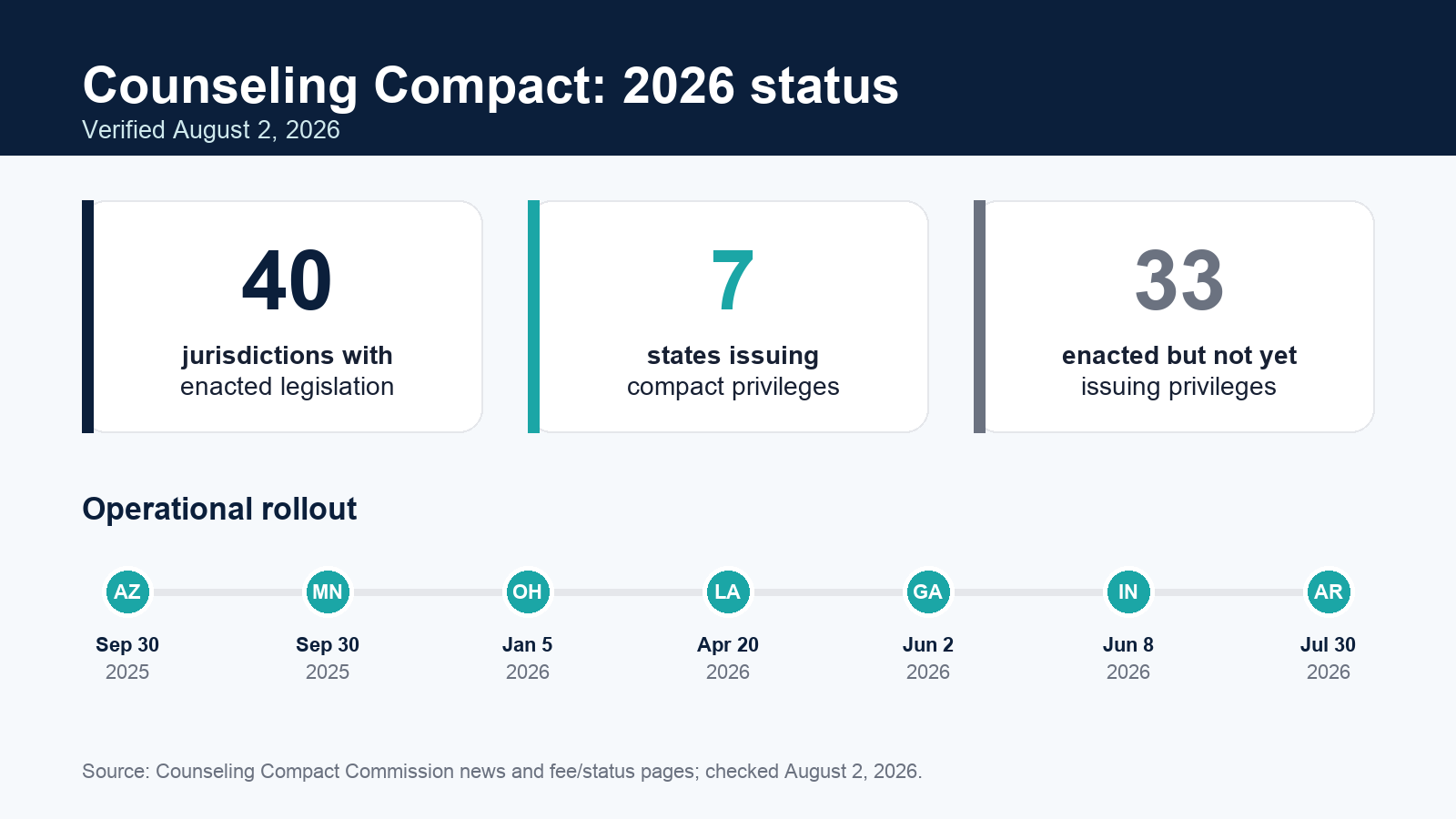
The short version: seven states are issuing compact privileges as of August 2, 2026, while 40 jurisdictions have enacted compact legislation. Those numbers are not the same thing. Most confusion about the compact comes from mixing enacted states up with operational states.
Last verified August 2, 2026: The Commission added Arkansas as the seventh state issuing privileges on July 30. Because rollout status and fees change, use the linked official sources before practicing or hiring.
This guide from BehavioralHealth.careers is for LPCs, LPCCs, LMHCs, LCPCs, and counselors with equivalent independent counseling licenses who want to understand where they can work, whether they qualify, and how the compact changes remote and cross-state practice.
It explains what the compact does, which states are live right now, eligibility requirements, how to obtain a privilege to practice, how it differs from PSYPACT, what it means for counselors and employers, and the common misunderstandings and FAQs that trip people up.
Who this guide is for
This is the counselor’s compact: LPCs, LPCCs, LMHCs, LCPCs, and equivalent independent counseling licenses. If you are a psychologist, the compact you want is PSYPACT, covered in our PSYPACT guide for psychologists. If you are a clinical social worker, your compact is the separate Social Work Licensure Compact. Marriage and family therapists do not currently have a compact, according to the Counseling Compact Commission FAQ.
What the Counseling Compact is and how the counseling compact works
The Counseling Compact is an interstate compact allowing professional counselors licensed in one member state to practice across state lines through a credential called a privilege to practice, without the need for multiple licenses. It was championed by the American Counseling Association and built on a model used by other health professions. The compact creates the shared rules and data infrastructure that support interstate counseling and public protection.
The privilege is issued through a single online portal, Compact Connect. This is how the counseling compact works: once a counselor qualifies in one compact member state, they can obtain a privilege in other compact states through the portal rather than multiple licenses. That makes the interstate counseling compact faster to use, with approval for another member state sometimes coming through in minutes rather than the weeks or months a fresh state license takes.
One point that sets the counseling privilege apart from some other compacts: it covers both in-person and telehealth practice in the remote state. You are not limited to a screen. Whatever your license allows you to do at home, the privilege generally lets you do in a remote member state, subject to that state’s laws and scope of practice.
How the Counseling Compact differs from PSYPACT
People search “counseling compact” and “PSYPACT” as if they were the same tool. They are not, and applying for the wrong one wastes time. Here is the practical breakdown.
| Counseling Compact | PSYPACT | |
|---|---|---|
| Profession | Licensed professional counselors (LPC, LPCC, LMHC, LCPC) | Licensed psychologists |
| Credential | Privilege to practice | E.Passport plus APIT for telepsychology; TAP/IPC for temporary in-person practice |
| Practice covered | In-person and telehealth in remote member states | Telepsychology across state lines; temporary in-person practice is separate |
| Governing body | Counseling Compact Commission | PSYPACT Commission (ASPPB) |
| Where to apply | Compact Connect | PSYPACT Commission and ASPPB |
The single sentence to remember: PSYPACT is for psychologists, the Counseling Compact is for counselors, and holding one tells you nothing about the other. Employers building multi-state teams often need both, tracked separately, because a psychologist and a counselor on the same telehealth service line follow different rules.
Which member states are operational right now
This is where accuracy matters most, so read the distinction carefully.
A state can be in one of two positions. Enacted means the legislature passed the compact law. Operational means the state has finished the technical and regulatory work and is actually issuing or honoring privileges through Compact Connect. Virginia became the 12th state to enact the Compact on January 1, 2024, which illustrates enactment without meaning the state was live at that point. Only operational states matter for practice today. A counselor cannot get a privilege from an enacted-but-not-live state, and cannot use a privilege in one either.
As of August 2, 2026, 40 jurisdictions have enacted the Counseling Compact and seven states are operational and issuing privileges. The current live states are Arizona, Minnesota, Ohio, Louisiana, Georgia, Indiana, and Arkansas. Arkansas became the seventh operational state on July 30, 2026. See the Commission’s dated rollout announcements and live-state fee table.
| Live state | First issued | Eligible license | Total fee | Extra requirement |
|---|---|---|---|---|
| Arizona | Sep. 30, 2025 | LPC | $280 | Jurisprudence exam |
| Minnesota | Sep. 30, 2025 | LPCC | $80 | None listed |
| Ohio | Jan. 5, 2026 | LPCC | $55 | Required video |
| Louisiana | Apr. 20, 2026 | LPC | $160 | None listed |
| Georgia | Jun. 2, 2026 | LPC | $130 | None listed |
| Indiana | Jun. 8, 2026 | LMHC | $80 | None listed |
| Arkansas | Jul. 30, 2026 | LPC | $80 | Jurisprudence exam |
Here is the part most articles get wrong. For a privilege to work, both ends have to be live. Your home state must be operational for you to obtain a privilege, and the remote state must be operational to honor it. The practical network currently runs among the seven live states. A counselor licensed in one can generally apply for privileges in the others, but confirm the exact state pairing in Compact Connect before relying on it. The other 33 enacted jurisdictions are not yet issuing privileges.
Because states move from enacted to operational on a rolling basis, refer to the official website for up-to-date information, and date-stamp what you find before you rely on it.
Who is eligible in a compact member state
The compact is built for counselors who already practice independently. In general, to qualify for a privilege you need to:
- Be residing in a compact member state and hold an active, unencumbered counseling license there as your home state license (your primary state of residence)
- Be licensed at the independent tier that lets you assess, diagnose, and treat clients on your own, not a provisional, associate, or supervised license
- Pass an FBI background check
- Have no disciplinary action that would bar eligibility
Some license types do not qualify, and it is worth being blunt about them. The compact covers professional counselors licensed at the independent level, whatever the state calls that credential. Eligibility is for a member state to practice in other compact member states, not for nonmember jurisdictions. It does not cover marriage and family therapists, art, music, or dance therapists, social workers, or school counselors. Counselors still under supervision toward full licensure are not eligible either. State naming adds friction here: Ohio issues privileges to its Licensed Professional Clinical Counselors, and Indiana works through its Licensed Mental Health Counselors, but the compact treats all of these qualifying independent counselors under the umbrella term LPC.
How to get your privilege to practice
The process is short once your home state is operational.
- Confirm your home state is live. You can only start if the state where you hold your primary residence and license is operational, not merely enacted, because some compact member states without completed technical or regulatory setup still cannot issue privileges yet.
- Confirm your license tier. It has to be the independent, full-practice level. If you hold an associate or supervised license, you are not eligible yet.
- Create a Compact Connect account. This is the single portal for the whole system.
- Complete the FBI background check as directed in the application.
- Apply and pay the fee. The Commission charges a $30 administrative fee for each privilege, and each remote state adds its own fee. As of August 2, 2026, the total ranges from $55 in Ohio to $280 in Arizona. Budget per remote state, and check the official fee table because amounts and state requirements can change.
- Receive your privilege. For a clean application, approval often comes through quickly, sometimes within minutes, and once a state can begin issuing privileges, counselors may start using the compact there, subject to any remaining state-specific steps.
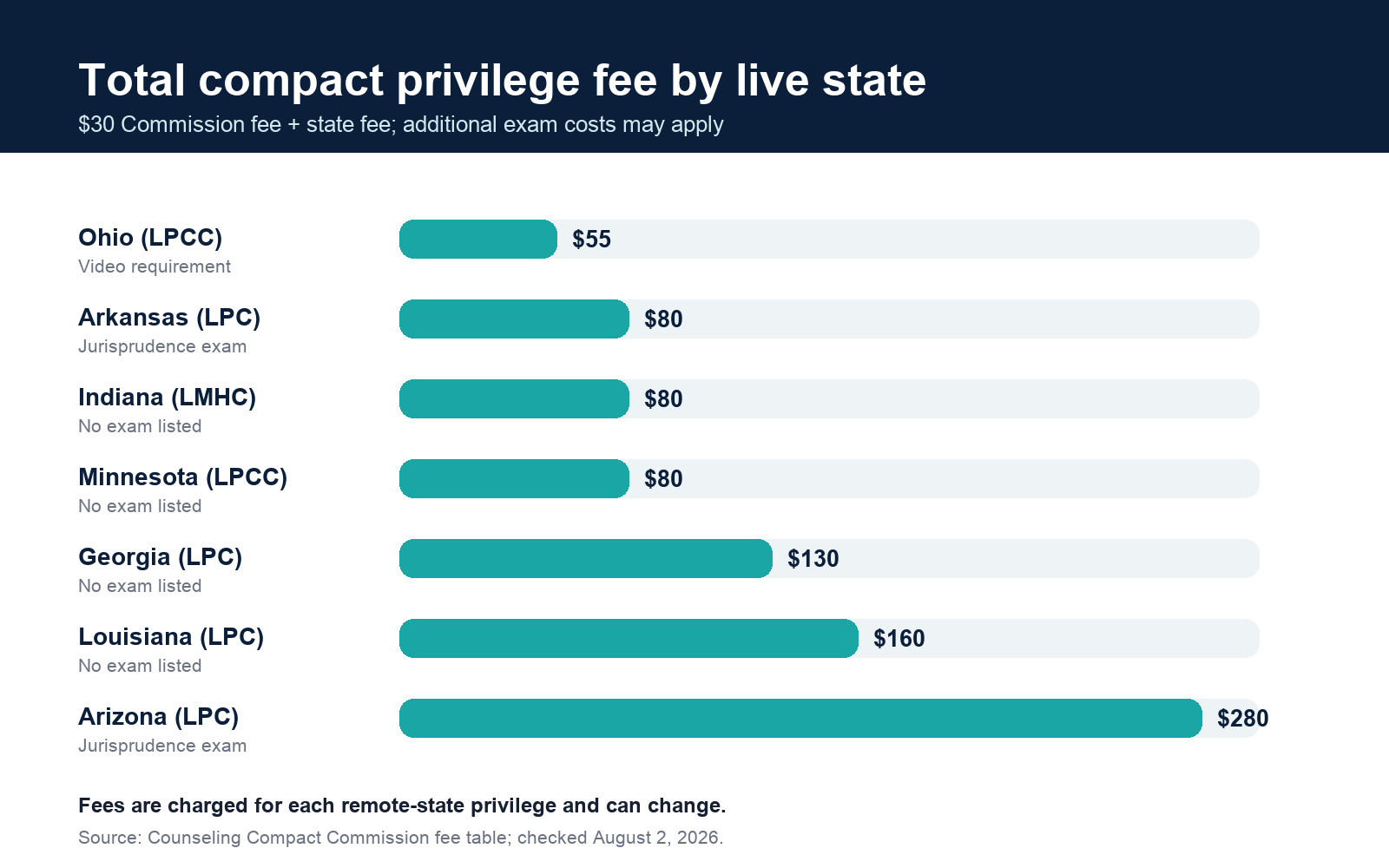
Some states add their own steps before they will issue or recognize a privilege, such as a jurisprudence exam or an eligibility screening, so check your home state board’s page for extras.
Two details that trip people up. Your privilege expires on the same date as your home state license at the time it was issued, so renewals track your home license, not a separate compact calendar. One practical consequence: buying a privilege right before your home license renews can leave you paying for it again soon after, so when the timing is close, renew your home license first. A privilege is also not a license. You still answer to the laws, scope of practice, and telehealth rules of the state where the client is located during each session.
What it means for counselors looking for work
For job seekers, the compact changes which roles are realistically open to you. If your home state is operational, multi-state and remote counseling roles that used to require a second or third license can open up through a compact privilege. The current practical footprint is seven operational states, so read job postings carefully and confirm the coverage the employer actually needs.
When you describe compact eligibility on a resume or in interviews, keep it accurate and verifiable. A few safe framings:
- “LPC (home state). Eligible for Counseling Compact privileges; obtains and verifies privileges per the states a role requires.”
- “LPC (home state). Experienced with multi-state telehealth workflows; confirms client-location rules before each session.”
- “LPC (home state). Holds active Counseling Compact privilege in [state]; maintains documentation for employer verification.”
Avoid implying national coverage or a guarantee. The honest signal is that you understand how privileges work and that you verify before you practice, which is exactly what a compliance-minded employer wants to see.
What it means for employers hiring counselors
For behavioral health organizations, the compact widens the candidate pool for hard-to-staff counseling roles, but only among operational states, and only if you verify. A short checklist before you hire for multi-state counseling coverage:
- Confirm the candidate’s home state license type, tier, and standing through primary-source verification
- Confirm the candidate holds, or can obtain, an active privilege for each state the role serves
- Confirm each state in the coverage footprint is operational at the time of service, and date-stamp that check
- Track privileges per clinician alongside their expiration dates, which follow the home state license
- Set a re-verification schedule and a stop-work process for when a state’s status or a clinician’s standing changes
- Remember that disciplinary action in any member state is shared through the compact’s data system, so a clinician’s standing can change based on events outside your state
- Keep counselor privileges and psychologist PSYPACT authorizations in separate tracking, since they follow different rules
The organizations that get multi-state hiring right treat the compact map as a required pre-check, not a formality, and they document the “verified on” date every time.
Common misunderstandings
- Myth: If a state passed the compact, I can practice there now. Reality: Enacted is not operational. Only states actively issuing and honoring privileges count—seven as of August 2, 2026.
- Myth: The Counseling Compact covers all therapists. Reality: It covers independent-level professional counselors only. MFTs, social workers, art and music therapists, and school counselors are not included.
- Myth: A privilege is basically a second license. Reality: It is a privilege to practice under compact rules, and you still follow the client-location state’s laws and scope.
- Myth: PSYPACT and the Counseling Compact are interchangeable. Reality: Different professions, different credentials, different commissions. Psychologists use PSYPACT; counselors use this compact.
- Myth: The privilege is telehealth only. Reality: It generally covers both in-person and telehealth practice in the remote member state.
- Myth: One privilege covers every member state. Reality: You obtain a privilege for each remote state, not one credential for all other compact states, and each must be operational.
Frequently asked questions
What is the Counseling Compact?
It is an interstate agreement and binding contract among states that lets a licensed professional counselor practice in other member states through a privilege to practice, without a separate full license in each state. It is run by the Counseling Compact Commission through the Compact Connect portal.
Which states are operational in 2026?
As of August 2, 2026, seven states are operational: Arizona, Minnesota, Ohio, Louisiana, Georgia, Indiana, and Arkansas. Forty jurisdictions have enacted compact legislation, but the others are not yet issuing or honoring privileges. Verify through the Commission’s dated announcements and current fee/status table because states go live on a rolling basis.
What is the difference between enacted and operational?
Enacted means the legislature passed the compact. Operational means the state is actually issuing and honoring privileges through Compact Connect. Only operational states let you practice today.
Who is eligible for a privilege to practice?
Counselors with an active, unencumbered independent license in an operational home state who can independently assess, diagnose, and treat, and who pass an FBI background check. Associate, provisional, and supervised licenses do not qualify.
Does the Counseling Compact cover marriage and family therapists or social workers?
No. It covers independent professional counselors only. Social workers have the separate Social Work Licensure Compact. The Counseling Compact Commission FAQ states that marriage and family therapists do not currently have a compact.
How is this different from PSYPACT?
PSYPACT is for licensed psychologists and uses the E.Passport and APIT credentials. The Counseling Compact is for professional counselors and uses a privilege to practice. Holding one has no bearing on the other.
How much does a privilege cost?
The Commission charges a $30 administrative fee per privilege, and each remote state adds its own fee. As of August 2, 2026, total fees among the seven operational states range from $55 to $280 per remote-state privilege. Jurisprudence-exam costs may be additional. Check the official fee table for current amounts.
Does the privilege cover telehealth, in-person, or both?
Both, in general. The privilege lets you practice in the remote member state in person and by telehealth, subject to that state’s rules and your scope.
When does a privilege expire?
It expires on the same date as your home state license at the time the privilege was issued, so it renews on your home license schedule.
Can I practice in a state that has not gone operational?
Not through the compact. For non-operational or non-member states, you follow that state’s own licensing path and rules.
Where do I apply?
Through Compact Connect, the compact’s single online portal. You complete the FBI background check and application there.
Related coverage
- PSYPACT guide for psychologists (the psychologist equivalent)
- how counselors compare to therapists, social workers, and psychologists
- Remote Therapist Jobs in 2026
- Mental Health Counselor Salaries
- Social Work Licensure Compact states guide
References and resources
- Counseling Compact Commission news — dated state rollout announcements.
- Counseling Compact map — enacted jurisdictions and legislation links.
- Information for counselors and FAQ — eligibility, home-state rules, expiration, and financial FAQ.
- Fees, eligible license types, and jurisprudence requirements — current live-state data.
- Compact Connect — application and verification portal.
- Ohio Revised Code § 4757.51: Counseling Compact — enacted compact text.

Pingback: Our Guide to Remote Therapist Jobs in 2026 | BehavioralHealth.careers