To become a substance abuse counselor, you have to meet your state’s credentialing rules – usually addiction-specific education, supervised work experience with clinical supervision hours, a licensing or certification exam, and ongoing ethics and continuing-education requirements – but the exact title, steps, and portability rules vary by state.
There is no national license to counsel people with substance use disorders.
Every state writes its own rules, the credential goes by a different name in nearly every one of them, and a certification that qualifies you in Illinois may not transfer anywhere else.
That is the whole problem this guide solves for people who want to enter the field and need a clear way to compare state requirements before they invest time, tuition, or supervised hours.
Enter our resource from BehavioralHealth.careers, with truly detailed guidance on how to become a substance abuse counselor and various considerations for those seeking to enter the field.
Below are the actual requirements in the ten states with the most counselor jobs, followed by what holds true almost everywhere else, including education and supervised experience mandates, the main exam paths through IC&RC and NAADAC, and the reciprocity issues that affect whether you can use your credential in another state.
The essential takeaways
- No federal license exists, and no federal agency credentials individual addiction counselors. SAMHSA publishes model frameworks for states to adapt, nothing more.
- Five things show up in every state pathway: addiction-specific education hours, supervised work experience, a separate block of clinical supervision hours inside that experience, an examination, and a code of ethics with continuing education to renew.
- Addiction-specific education is required everywhere, and a general degree does not satisfy it. Most states count it in clock hours, verified totals running from 180 to 350 for the main counselor credential. A few, including Washington and Minnesota, count college credits inside a required degree instead.
- Supervised experience commonly runs from 2,000 to 6,000 hours depending on the state and your degree, and some states go lower or structure it differently. In many states, a higher degree cuts the hours sharply. In Ohio and at the top of the Massachusetts ladder, it does not.
- Two national exam systems dominate: IC&RC and NAADAC’s NCC AP. Which one your state uses determines where your credential can travel.
- Portability is the thing people get wrong. Illinois issues a CADC that is explicitly non-reciprocal and a CRADC that transfers. Same job, nearly the same name, completely different futures.
What the addiction counselor job is called depends on where you are standing
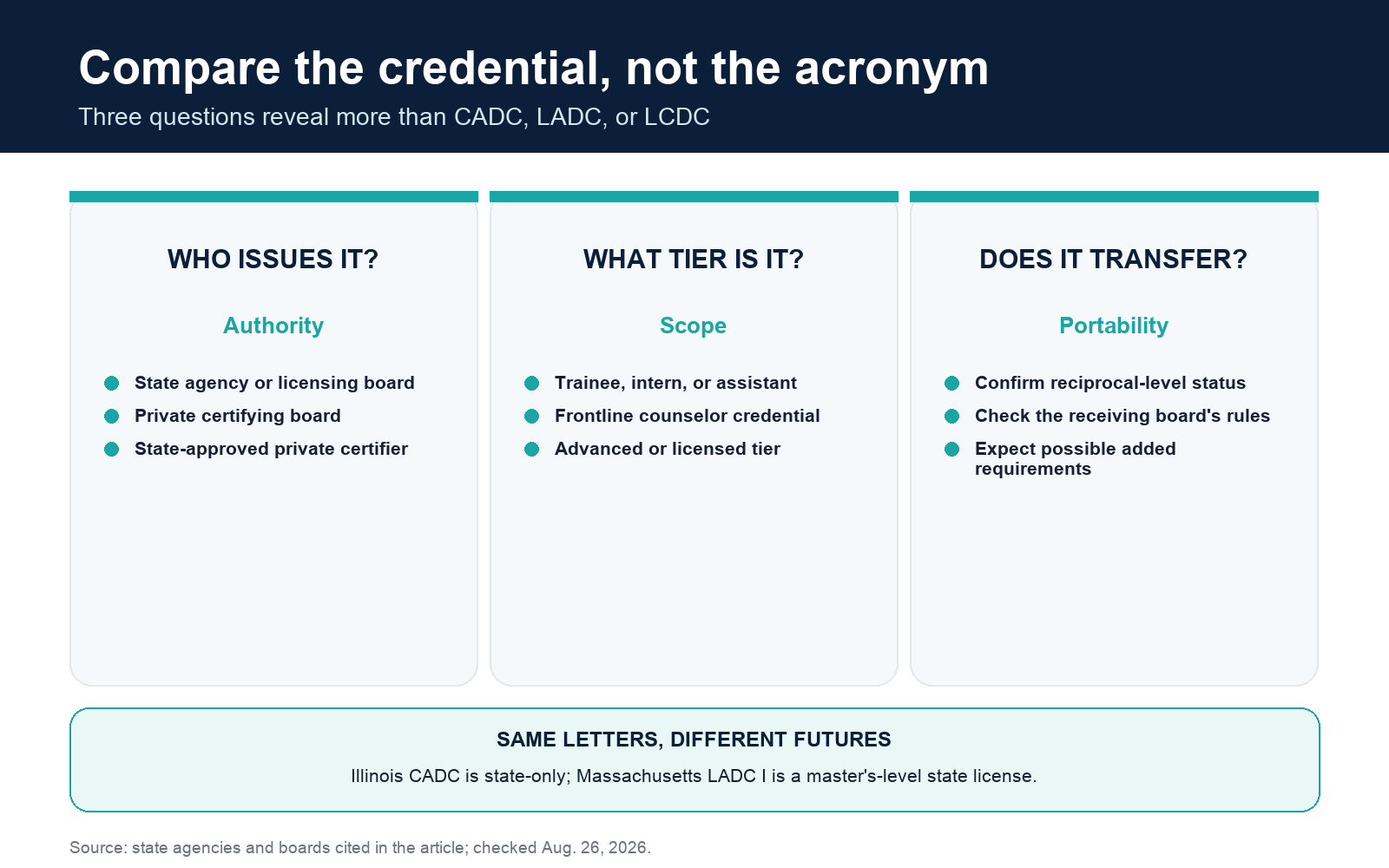
CADC, LADC, LCDC, CASAC, CAC, CAP, CSAC, CAT, SUDCC. Nine acronyms, one frontline role, nine state naming systems. The letters tell you almost nothing until you know which state issued them.
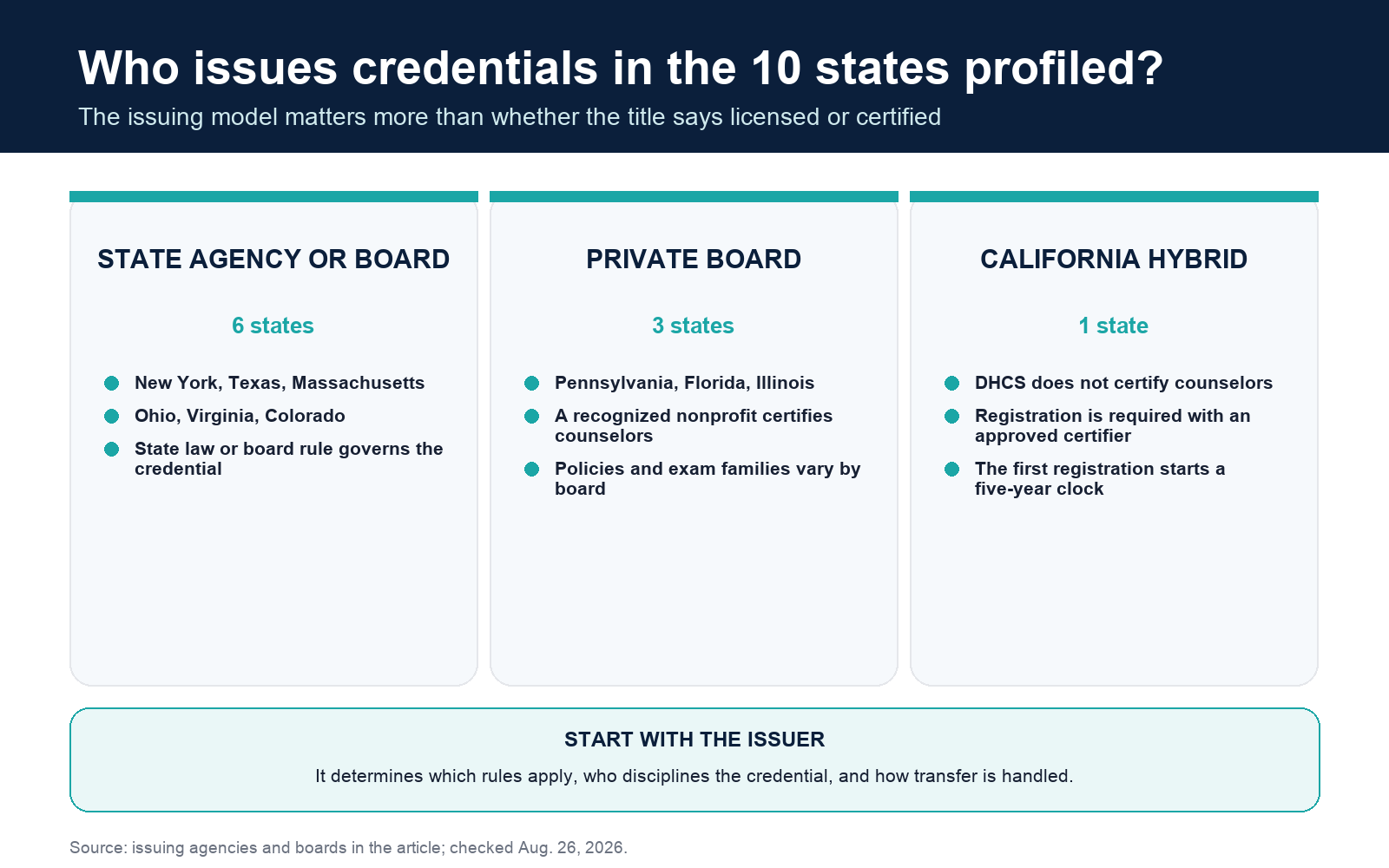
The deeper split is who issues the credential. Some states run a genuine licensing board inside a state agency, which means an administrative code governs your credential and the word license is accurate.
Others have no state credential at all and instead recognize a private nonprofit certifying board, so what you hold is a certification governed by that organization’s policy manual. A few, California among them, sit in between: the state approves several competing private certifiers and lets you pick.
This matters more than the naming. It determines who can discipline you, whose rules can change under you, and what your credential is worth in the next state.
For how addiction counseling fits against the other clinical roles, our therapist vs counselor vs social worker vs psychologist vs psychiatrist guide sorts out the wider field.
The five education requirements every state asks for
Across every state pathway verified for this guide, plus both national credentialing bodies, the same five components appear. The numbers move. The structure does not.
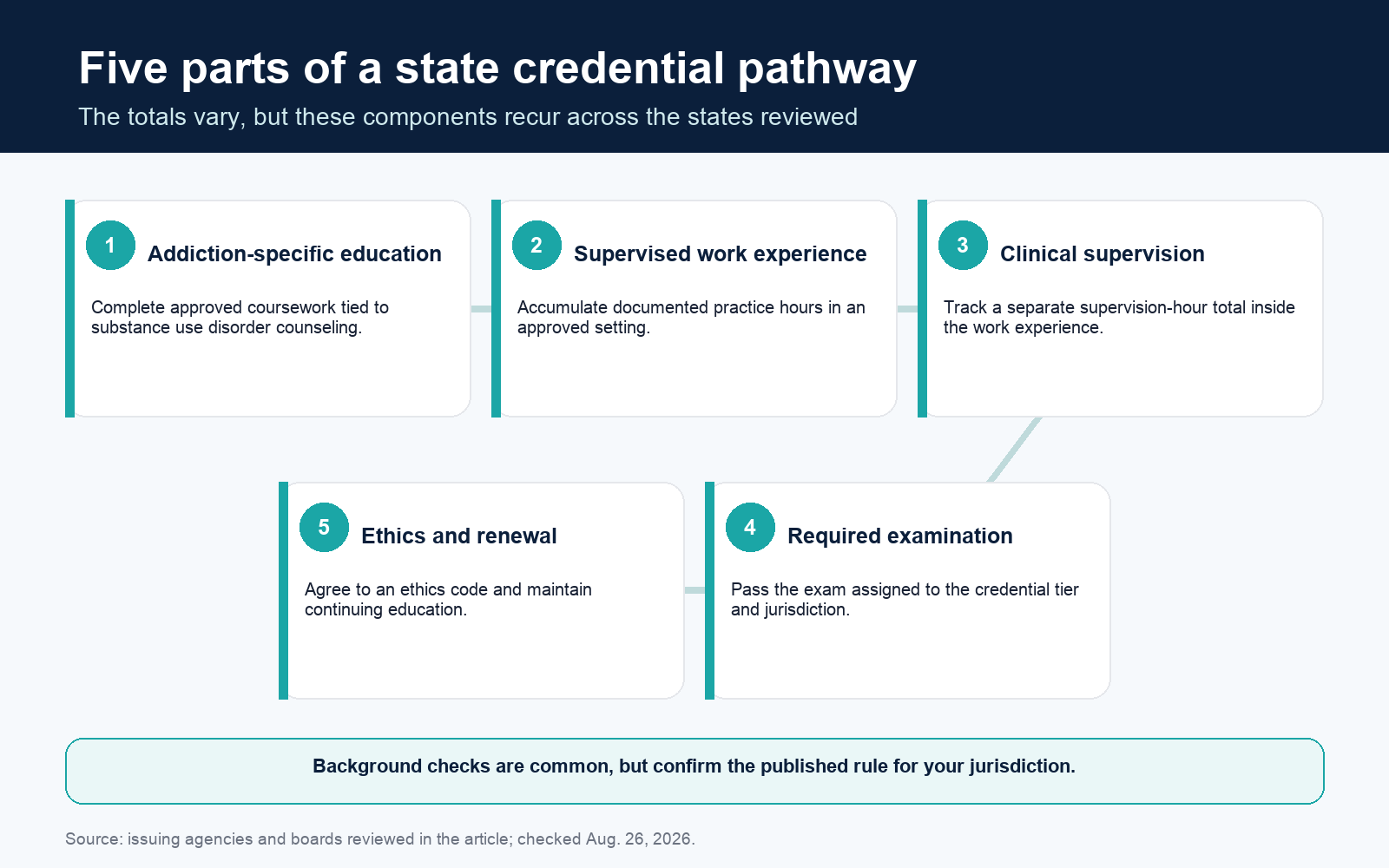
Addiction-specific education. A general degree does not satisfy this anywhere. This kind of formal education in substance abuse counseling typically includes pharmacology and counseling theories.
Most states count it in clock hours, and verified totals for the main counselor credential run from 180 hours in Ohio to 350 in New York, with 270 and 300 the most common landing points.
Some states measure it differently: Washington requires an associate degree or 60 semester credits with at least 30 of them in substance use disorder coursework, and Minnesota asks for 18 semester credits, which its own board glosses as 270 clock hours.
These education requirements also often leave room for additional training tied to state rules or credentials such as IC&RC pathways.
Supervised work experience. The common band runs from 2,000 hours to 6,000, with New York, Massachusetts, and Pennsylvania’s high-school-diploma pathway at the top. Two states show how far the structure can bend: Washington drops to 1,000 hours for applicants already licensed in another approved profession, and Minnesota’s standard route asks for no work-experience hours at all, replacing them with an 880-hour practicum.
Clinical supervision hours inside that experience. This is a separate, smaller count of hours spent actually being supervised, usually 100 to 300, and it is commonly broken down by domain so you cannot spend it all on one skill. People routinely miss that these do not overlap with the work-experience total. They sit inside it and get documented separately.
An examination, and in most states a written one. Every full counselor credential verified for this guide requires an exam, though the form varies: Minnesota offers a written or a written-and-oral route, and some states waive the exam entirely for people who already hold another clinical licence such as an LCSW or LPC.
Trainee and assistant tiers often skip it, which is part of what makes them the fast way in, but not always: Massachusetts requires a passing exam score even at the LADC Assistant tier.
An ethics code and continuing education. Six hours of ethics education in the initial requirements is the most common figure. Renewal is commonly 40 hours of continuing education every two years, though Florida runs annually at 20 hours a year, and some states add ongoing clinical supervision on top of the education.
Most states also require a criminal background check. This is verified in Texas, Ohio, Florida, and Minnesota, and standard practice elsewhere, but it was not able to be confirmed on the official pages for several states despite our ongoing research, so treat it as near-universal rather than guaranteed until we are able to update this resource soon.
IC&RC and NAADAC: the two systems behind the exams
Nearly every state exam is one of two families, and the difference shapes your career more than the study material does.
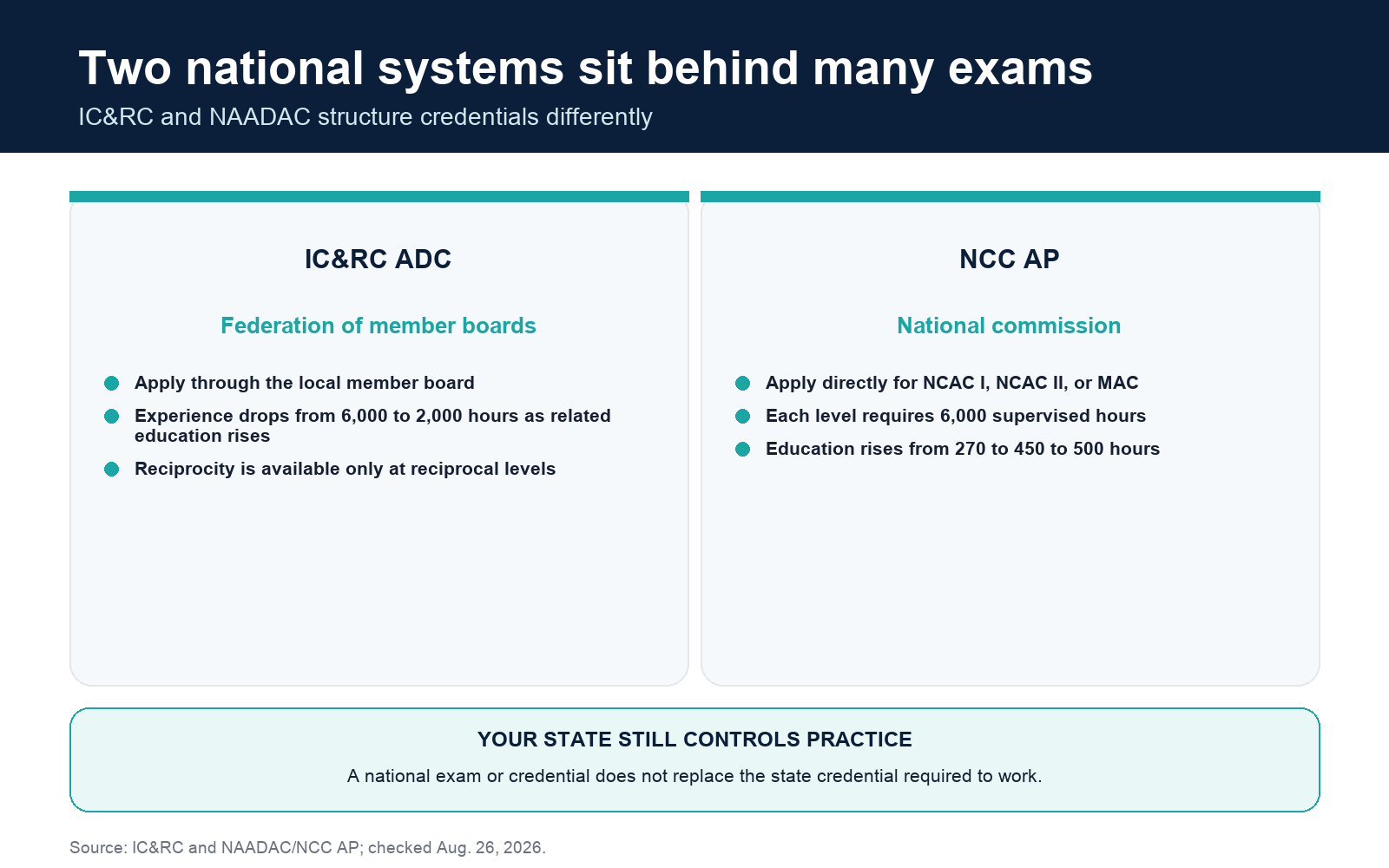
IC&RC is a federation of state and national member boards. It describes its own reach as member boards across 50 US states and territories, three Native American regions, branches of the military, and 11 international regions. Its two addiction counselor credentials are the ADC and the advanced AADC.
The exams are scored on a 200 to 800 scale with 500 to pass, and the ADC runs 150 questions in three hours, of which 125 are scored, and 25 are unscored pretest items. You cannot buy the exam from IC&RC directly: you apply through your local member board, always.
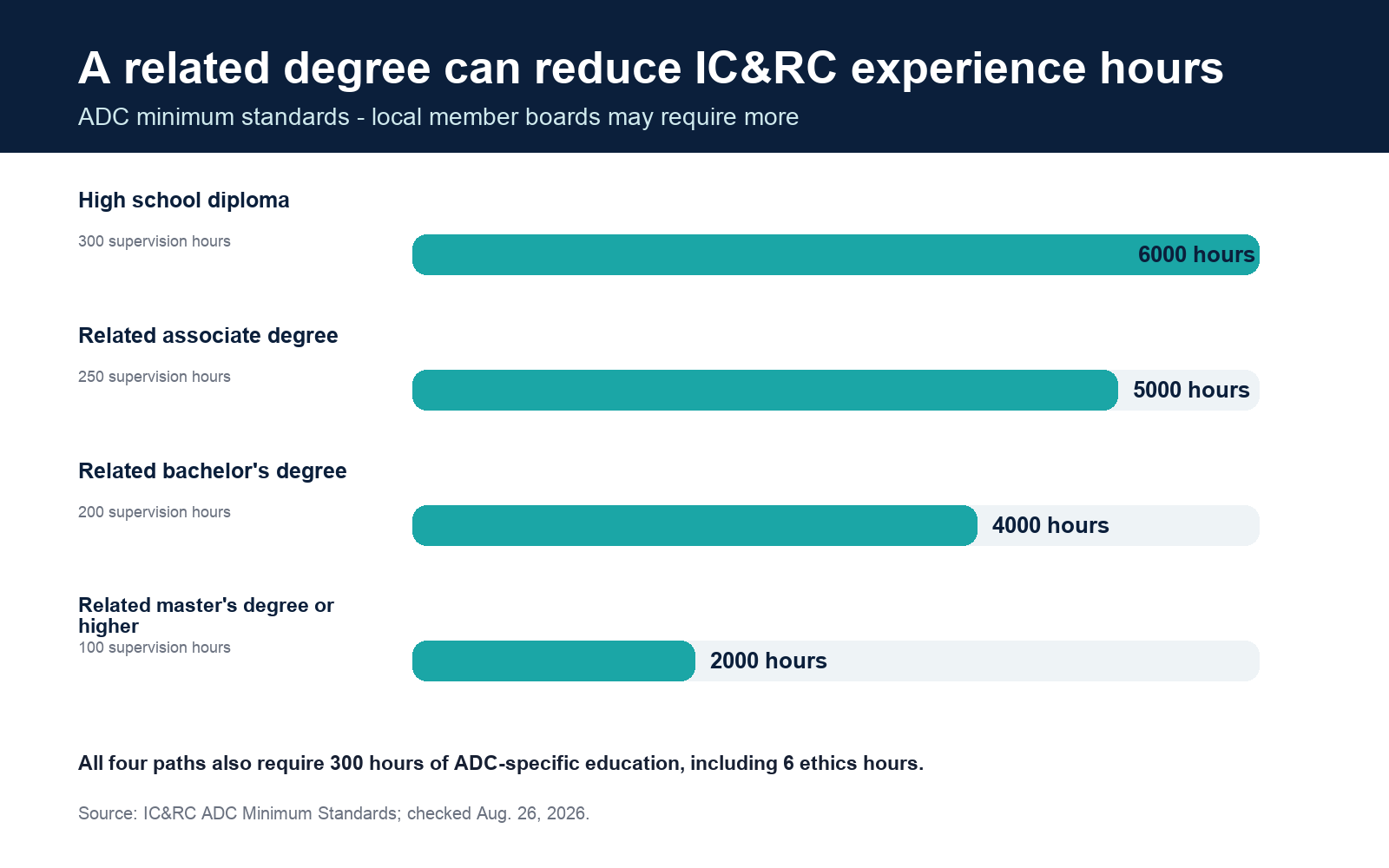
The IC&RC ADC reciprocal standards are worth knowing even if your state never mentions them, because most states copy them: a high school diploma floor, 300 hours of addiction-specific education including six in ethics, and supervised work experience that steps down by degree from 6,000 hours at high school to 5,000 with an associate, 4,000 with a bachelor’s, and 2,000 with a master’s, with supervision hours stepping 300, 250, 200, 100 alongside.
NAADAC’s NCC AP is a single national commission rather than a federation. It issues NCAC I, NCAC II, and MAC, you apply to it directly, and it is voluntary everywhere: it is not the state credential in any state verified here. It also works differently.
Where IC&RC drops your hours as your degree rises, NCC AP holds supervised experience at 6,000 hours across all three counselor levels and raises the education hours instead, from 270 to 450 to 500. It also requires six hours of HIV and bloodborne pathogens education that IC&RC does not.
Some states use NAADAC exams as their state exam anyway. Virginia and Colorado both do. What matters is which system your state has adopted, and whether the states you might move to use the same one.
Requirements in the ten states with the most counselor jobs
These ten states hold roughly 56 percent of national employment in the occupation, based on Bureau of Labor Statistics May 2025 state employment for occupation code 21-1018.
That code covers substance abuse, behavioral disorder, and mental health counselors together, so the ranking reflects counseling employment broadly rather than addiction counseling alone. It is the best available proxy, and no cleaner federal count of addiction counselors exists.
Everything below was confirmed on the issuing board’s or state agency’s own website in August 2026. Requirements change, sometimes mid-year, so treat this as your starting map and confirm on the board’s site before you pay for anything.
Counselors work in treatment facilities, hospitals, and mental health organizations, so these state-specific rules matter across settings for licensed professionals.
| State | Credential ladder | Issued by | Exam family |
|---|---|---|---|
| California | RADT or equivalent registration, then CADC-I, CADC-II, LAADC (names vary by certifier) | Three DHCS-approved private certifiers: CCAPP, CAADE/ACCBC, CADTP | IC&RC, except CADTP which uses its own exam |
| Pennsylvania | CAAC, CADC, CAADC (PCB) or PAC I, PAC II, PMAC (PCC AP) | Two recognized private boards: PCB and PCC AP | IC&RC (PCB); NCC AP or IC&RC (PCC AP) |
| Florida | CAC, CAP, MCAP | Florida Certification Board, a private nonprofit | IC&RC for CAC; FCB’s own exam for CAP and MCAP |
| New York | CASAC-T or CASAC-P, then CASAC | NYS Office of Addiction Services and Supports | IC&RC ADC |
| Texas | Counselor Intern registration, then LCDC | Texas Health and Human Services Commission | IC&RC ADC, plus a written case presentation |
| Illinois | CADC (state only), CRADC, CAADC, CSADC | Illinois Certification Board (IAODAPCA) | State exam for CADC; IC&RC for CRADC |
| Massachusetts | LADC Assistant, LADC II, LADC I | Bureau of Substance Addiction Services, DPH | IC&RC, administered by MBSACC |
| Ohio | CDCA Preliminary, CDCA, LCDC II, LCDC III, LICDC | Ohio Chemical Dependency Professionals Board | No exam for CDCA; IC&RC ADC for licenses |
| Virginia | CSAC-A, CSAC, LSATP | Virginia Board of Counseling | NAADAC NCC AP, not IC&RC |
| Colorado | CAT, CAS, LAC | DORA Division of Professions and Occupations | Set by board rule; confirm with the board |
California
California has no state license and no single board. The Department of Health Care Services approves three private certifying organizations, and you choose one: CCAPP, CAADE through its certification arm ACCBC, or CADTP. R
egistration with one of them is mandatory before you may provide counseling in a licensed program, and you then have five years from that first registration to complete certification.
Requirements differ by certifier. CCAPP’s entry credential, CADC-I, requires 315 hours of approved education plus 3,000 hours of supervised work experience, including a 255-hour practicum, dropping to 2,080 hours with a relevant associate degree.
CADTP’s SUDCC uses the same 315 education hours with 2,080 work hours and 255 practicum hours. ACCBC’s CATC works off semester units instead: 30 units with 21 specific to addiction, plus 2,240 supervised hours.
Two traps to watch out for. The five-year certification clock starts at your first registration with any approved organization, so switching certifiers does not reset it.
And the exam is not consistent: CCAPP and ACCBC use IC&RC, while CADTP has stopped accepting IC&RC entirely and requires its own exam. Also note that CCAPP’s LAADC, despite the L, is not a state license.
Assembly Bill 2473 changed the education rules effective January 1, 2026. Anyone registering on or after July 1, 2025 must complete 80 hours of core competency education within six months of registering, and those hours count toward the 315-hour total.
Pennsylvania
Pennsylvania licenses treatment facilities, not individual addiction counselors, so what you earn is a private certification. Two bodies are recognized: the Pennsylvania Certification Board, an IC&RC member, and the newer Pennsylvania Certification Commission for Addiction Professionals, affiliated with NAADAC and established around 2024.
The most common mistake here is assuming CADC is the entry point. PCB’s CADC requires a bachelor’s degree. The true entry credential is the CAAC, which takes a high school diploma or GED, 300 hours of education and training with 100 specific to substance use disorders and six in ethics, three years or 6,000 hours of work experience, and 300 hours of on-the-job supervision with at least ten hours in each counselor domain.
With a relevant bachelor’s, CADC drops the work experience to two years or 4,000 hours. A non-relevant bachelor’s leaves you at 6,000. The advanced CAADC requires a master’s, 180 education hours, 2,000 work hours, and 100 supervision hours.
Florida
Certification comes from the Florida Certification Board, a private nonprofit, and the state ties employment eligibility to it through the qualified professional definition in Florida Statutes section 397.311.
The entry credential, CAC, requires a high school diploma or GED and 300 hours of training including six in ethics. Work experience scales cleanly with education: 6,000 hours with a high school diploma or unrelated degree, 5,000 with a related associate, 4,000 with a related bachelor’s, and 2,000 with a related master’s, with supervision hours of 300, 250, 200, and 100 alongside.
Two things catch people. The CAC uses the IC&RC ADC exam and carries the international ICADC credential with it, but the next rung up, CAP, uses the Florida board’s own exam, which does not carry IC&RC reciprocity on its own.
And a CAC held on a high school diploma alone does not make you a qualified professional under the statute, which requires a minimum bachelor’s degree. Experience also expires: CAP counts hours from the previous ten years, MCAP from the previous five.
New York
New York runs credentialing through a state agency, the Office of Addiction Services and Supports, and the credential is the CASAC.
There are now two ways in. CASAC-T is the trainee route and requires 350 clock hours of education. CASAC-P, created in a September 2023 rule change, is for people who already hold a bachelor’s or master’s in an approved human services field and skips the 350 hours entirely. You cannot hold both, and most degree-holders should be taking the provisional route rather than grinding through coursework they do not need.
The full CASAC requires 6,000 hours of supervised experience, of which at least 2,000 must have been earned in the five years before you submit, plus 300 hours of supervised practical training covering twelve core functions with at least ten hours in each.
One degree may be substituted against the 6,000: an associate is worth up to 1,000 hours, a bachelor’s 2,000, a master’s or higher 4,000. Degrees do not stack, and no degree touches the 300 practical training hours. The exam is the IC&RC ADC.
Texas
Texas issues a genuine state license, the LCDC, through the Health and Human Services Commission. The rules moved to Title 26, Chapter 562 of the Texas Administrative Code effective January 31, 2025, and some pages still point at the old chapter.
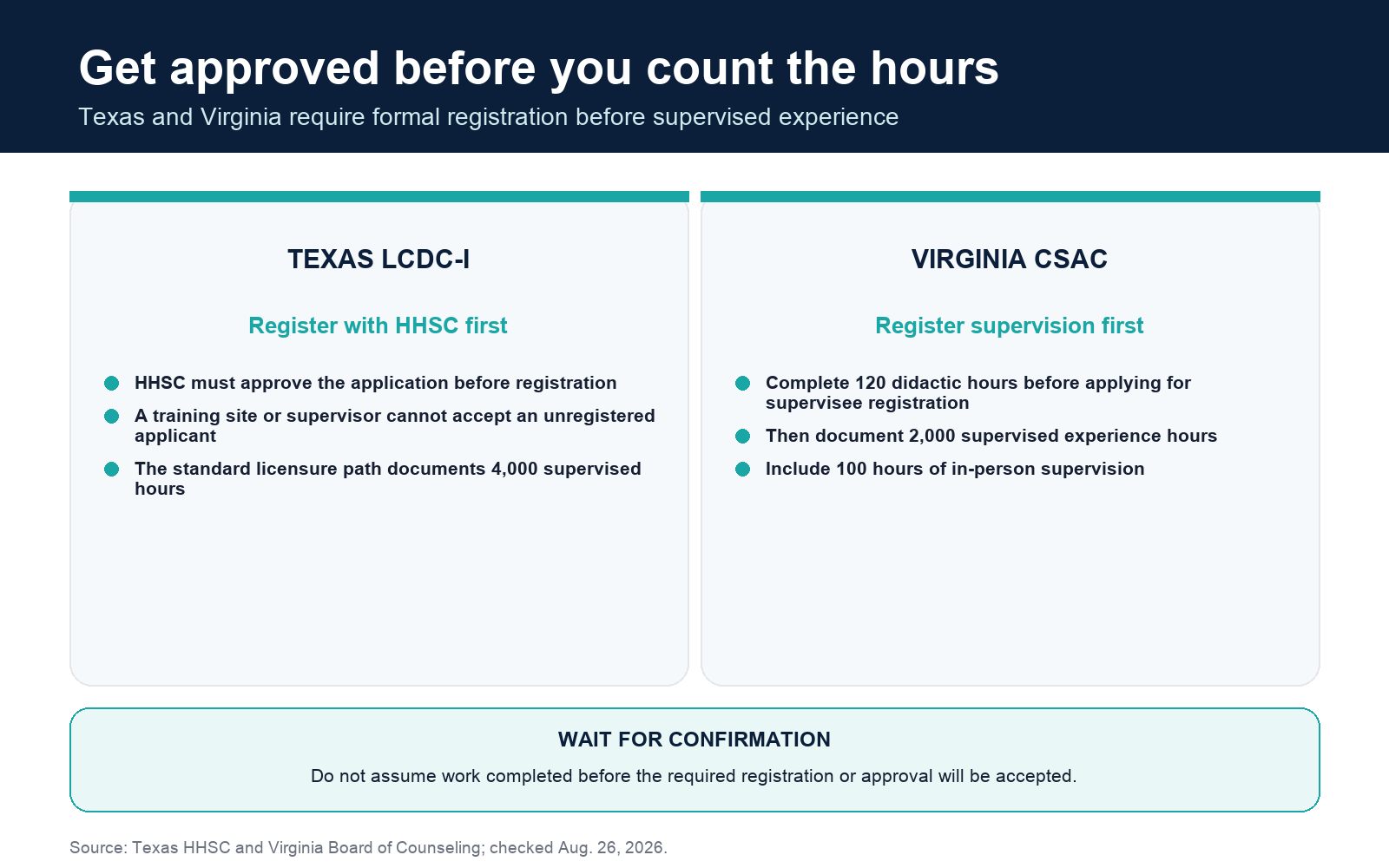
The registration sequence is where people lose months. You must be registered as a Counselor Intern and hold written notice from the agency before any supervised hours count, before you may take the exam, and before you may provide services at all.
Hours accrued ahead of that notice are void. Intern registration requires being 18 or older, a high school diploma, 270 classroom hours of chemical dependency curricula, and a 300-hour supervised practicum.
Full licensure adds an associate degree or higher and 4,000 hours of supervised experience, and those hours must be earned in Texas.
A master’s or doctoral degree in social work or a counseling-related field with 48 graduate semester hours can waive the 4,000 hours entirely rather than merely reducing them. The exam is the IC&RC ADC, administered by the Texas Certification Board, and a separate written case presentation is required alongside it.
Illinois
This is the state most worth reading carefully even if you do not live here, because Illinois shows what non-portability looks like. The Illinois Certification Board issues two credentials with nearly identical names and very different reach.
The CADC requires a high school diploma or GED and 225 clock hours of training, including 100 addiction-specific hours, 15 on treatment services for women and families, 15 on adolescents and families, six in ethics, and ten in race and equity.
On top of that: one year, or 2,000 hours, of paid qualifying work experience earned in the past four years, plus 150 hours of face-to-face clinical supervision covering twelve core skill areas with no fewer than ten hours in each. There is no degree substitution against the work hours at this level.
The board states plainly that the CADC is not eligible for reciprocity and is an Illinois-specific credential. The CRADC is the reciprocal version, and it maps to the IC&RC ICADC credential.
Be clear-eyed about what that upgrade costs before you take the advice. The CRADC asks for 300 education hours against the CADC’s 225, and 6,000 hours of work experience in the past five years against the CADC’s 2,000.
Aiming at the reciprocal credential from the start roughly triples the work requirement. That is worth it if you may leave Illinois and wasteful if you will not, so decide deliberately rather than by default.
Massachusetts
Massachusetts has two parallel systems that get confused constantly. The Bureau of Substance Addiction Services at the Department of Public Health issues the actual state licenses: LADC Assistant, LADC II, and LADC I. The Massachusetts Board of Substance Abuse Counselor Certification is a separate private IC&RC member board issuing voluntary certifications alongside them.
LADC II requires a high school diploma or equivalent, 270 hours of education split across four specified categories, 6,000 hours of supervised work experience or 4,000 with a bachelor’s, and a 300-hour supervised counseling practicum covering twelve core functions.
LADC I requires a master’s in a behavioral science with 18 graduate semester hours in counseling and still asks for 6,000 hours unless you already documented 4,000 as a bachelor’s-level LADC II. The exam is an IC&RC exam administered by the certification board.
Ohio
Ohio uses one state board, the Chemical Dependency Professionals Board, and has the lowest first step of any state covered here. The CDCA Preliminary certificate takes a high school diploma and 40 hours of approved substance use disorder education, broken into specified topics.
It is valid for 13 months, cannot be renewed, and you must hold it at least ten months before applying for the full CDCA, which adds another 30 education hours. Neither requires an exam.
The licensed tiers work differently from most states. LCDC II, LCDC III, and LICDC all require the same 180 hours of substance use disorder education and the same 2,000 hours of work experience.
Only the degree separates them: an associate in a behavioral science or nursing or any bachelor’s for LCDC II, a behavioral science or nursing bachelor’s for LCDC III, and a master’s or higher for LICDC. The degree buys a higher tier and wider scope, not fewer hours. All three require the IC&RC ADC exam and a state criminal background check.
One dated change: effective July 1, 2026, initial CDCA education must come from college courses or a board-approved bundle. Assembled continuing education no longer satisfies it.
Virginia
Virginia’s credentials come from the Board of Counseling, a state board, which means the CSAC is a state-issued certification rather than a private one. The latter runs CSAC-A, CSAC, then the licensed LSATP.
The CSAC requires a bachelor’s degree or higher, 240 clock hours of didactic training in substance abuse education with a minimum of 16 hours in each of thirteen content areas, 2,000 hours of supervised experience, and 100 hours of supervision inside that experience. A graduate degree does not reduce the hours here. The bachelor’s is a floor, not a credit.
The sequencing rule is the one that costs people time. Supervision must be registered with and approved by the board before you begin accumulating experience, and at least 120 of the 240 didactic hours must be completed before you register supervision.
Approval takes roughly 45 to 60 days. Hours earned before approval do not count. Virginia also uses NAADAC’s NCC AP exams rather than IC&RC: the NCAC I for CSAC and the MAC for LSATP, with a Virginia-written exam for the CSAC-A.
Colorado
Colorado splits the work between two agencies. The Department of Regulatory Agencies issues the credentials through the State Board of Addiction Counselor Examiners, while the Behavioral Health Administration approves the required training curriculum and the trainers who deliver it. The ladder is Certified Addiction Technician, Certified Addiction Specialist, and Licensed Addiction Counselor, which replaced the older CAC I, CAC II, and CAC III names.
State law sets a high school diploma for the technician tier. The specialist tier requires a bachelor’s in a clinical behavioral health concentration or a human services equivalent plus 3,000 hours of supervised clinical work over a minimum of 18 months. The licensed tier requires 2,000 direct clinical hours, fewer than the tier below it, because the graduate degree offsets them.
A caveat worth stating plainly: Colorado publishes its detailed training-hour requirements in documents hosted outside its own websites, and its board rules sit behind a commercial publisher.
The credential names, issuing agencies, and the statutory hour figures above are confirmed from Colorado sources, but the per-course training hour totals for each tier could not be verified against a first-party state page for this guide.
Definitely request the current training requirement documents from the Behavioral Health Administration before planning around a specific hour count.
If your state is not on this list
Roughly forty states are not covered above, and rather than guess at their numbers, here is what holds true broadly enough to plan against. Each of these was verified across every state and both national bodies checked for this guide.
Start by identifying who issues the credential in your state, because everything follows from that. Search for your state name with the phrase substance use disorder counselor certification and look for a state agency page or a board that IC&RC or NAADAC lists as its member.
If a private board comes up, confirm it is the one your state actually recognizes before you enroll in anything.
Then expect this shape. There will be a tiered ladder, most commonly between two and five rungs, with the tier tied to your degree level and your scope of practice.
There will be an addiction-specific education requirement that your degree alone does not satisfy, most likely stated in clock hours between 180 and 350, though some states express it as college credits inside a degree.
There will also be supervised experience, most commonly between 2,000 and 6,000 hours, with a separate clinical supervision count inside it, usually 100 to 300 hours and often broken out by domain.
A minority of states replace some or all of the work hours with a long practicum instead, so check which model yours uses. There will be an exam for the full credential, most likely the IC&RC ADC. There will be a code of ethics, dedicated ethics hours in your initial education, and continuing education to renew, commonly 40 hours every two years.
Most states also offer some way to work while you accumulate hours, whether it is called a trainee, intern, registered, or assistant tier. That is usually the cheapest and fastest first step, and it usually has no exam. Pennsylvania is a reminder not to assume: its lowest rung is a full credential requiring 6,000 hours, not a work permit.
Four questions are worth answering before you spend money anywhere.
- Does my state require registration before my hours start counting, as Texas and Virginia do?
- Must my hours be earned in-state, as Texas requires?
- Is there a recency window on my hours, as New York, Illinois, and Florida apply?
- Is the credential I am aiming at reciprocal?
Reciprocity, and what actually transfers
IC&RC reciprocity is a transfer mechanism between member boards.
Your current board verifies your record and forwards it through IC&RC to the receiving board, which typically contacts you within ten business days, with processing running two to three weeks.
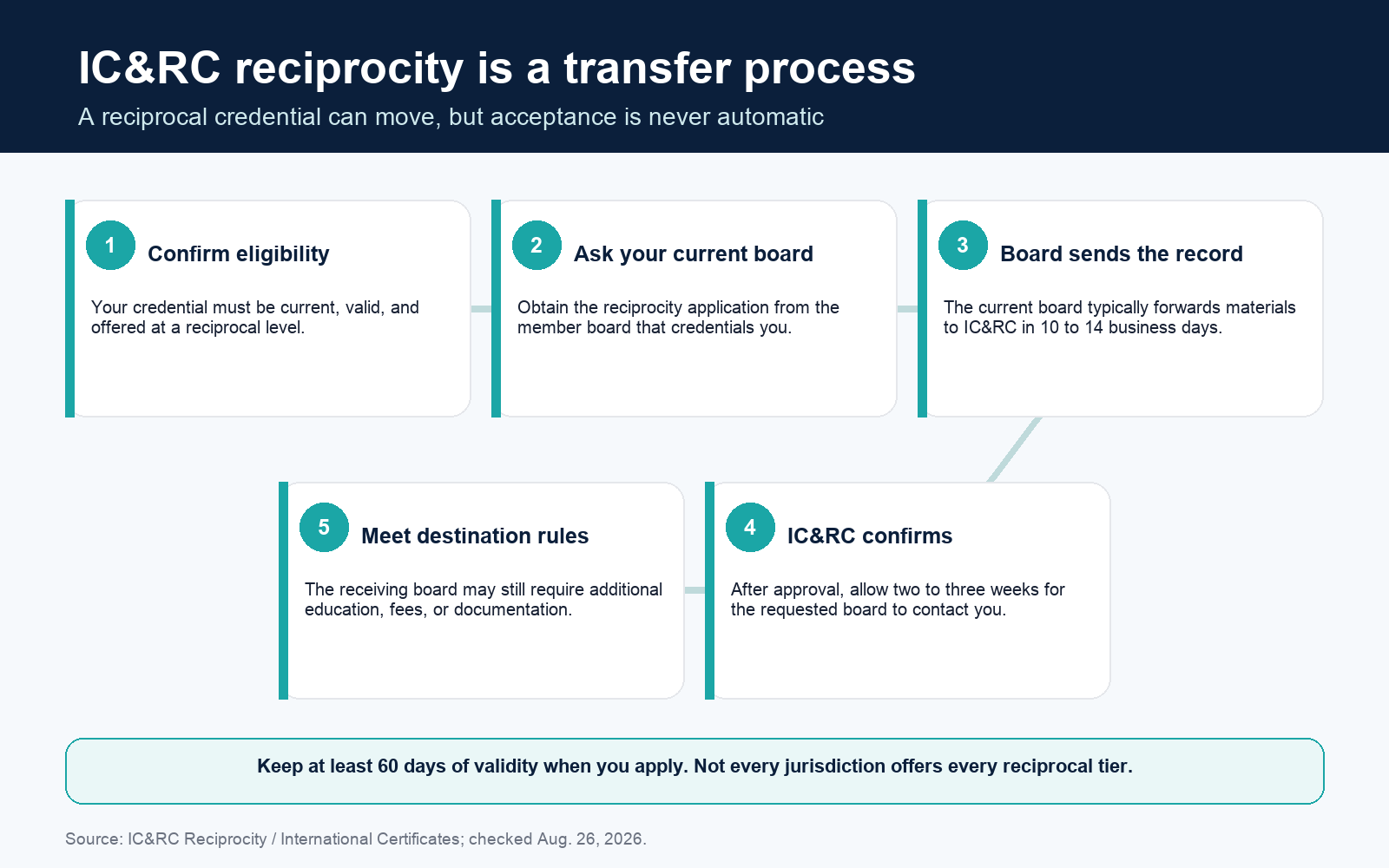
It guarantees nothing, though. IC&RC states directly that member boards have the right to require additional standards before accepting a credentialed professional, and its own guidance acknowledges those can be extensive and costly.
Some states require extra credentials depending on where your clients live. Your credential must be current and valid, and valid for at least 60 days at the time you apply. Not every certification or license is eligible in the first place.
Three limits catch people. Not every jurisdiction offers every tier, so an advanced credential can be less portable than a basic one.
A license in one state can become a certification in the next, depending on how the receiving state regulates the profession, so check licensure rules in every state where your clients live. And some state credentials, Illinois’ CADC being the clearest case, are deliberately not reciprocal at all.
There is no federal fallback. The one genuine federal standard, the Department of Transportation Substance Abuse Professional qualification under 49 CFR 40.281, is a qualification to perform one regulatory function, and it presupposes that you already hold a state credential.
SAMHSA funds programs, publishes model scopes of practice, and certifies treatment programs, but it does not license or examine counselors.
Pay and demand for Substance Abuse Counselors is rising
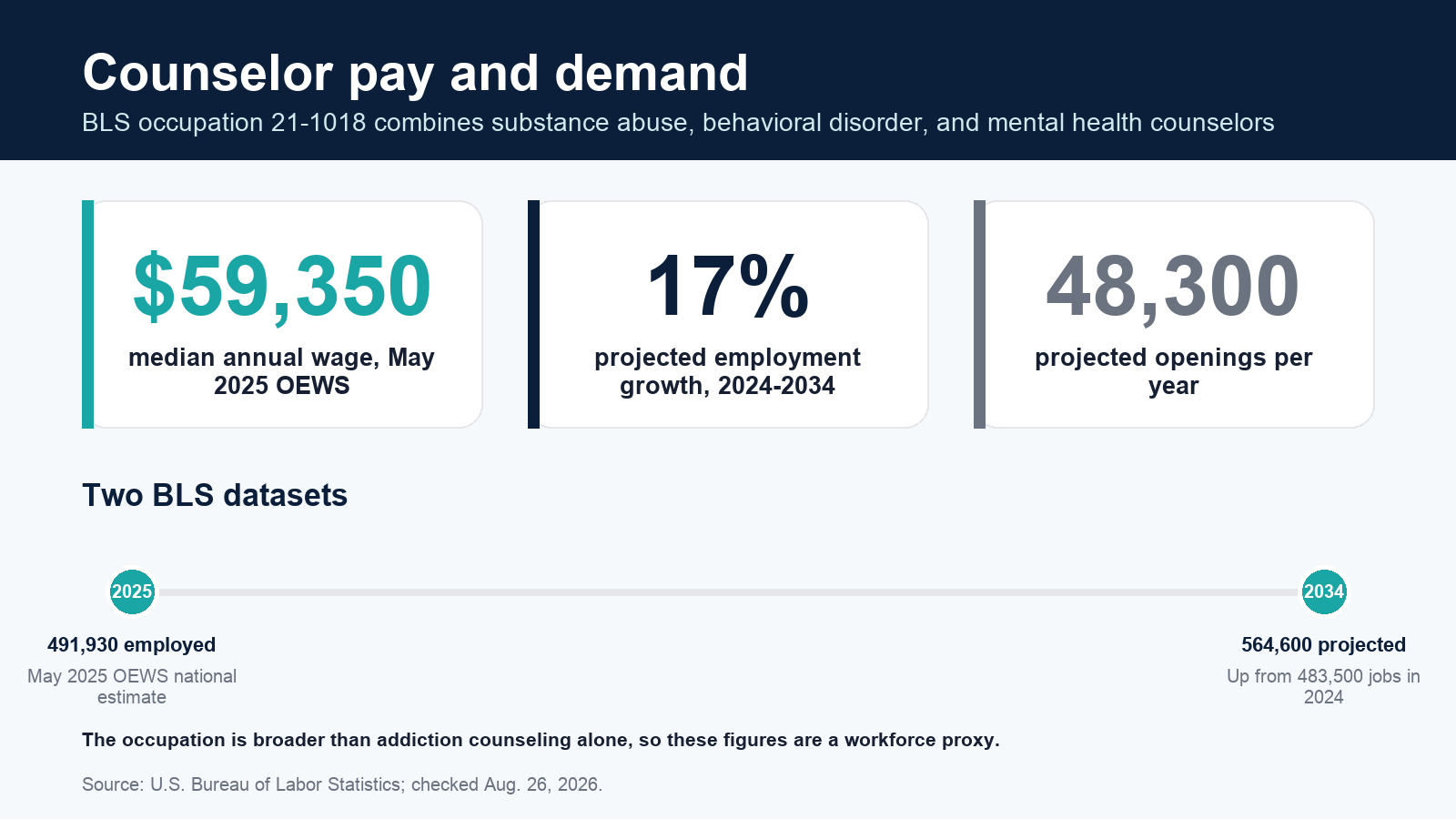
Substance abuse, behavioral disorder, and mental health counselors earn a median of $59,350 a year according to the latest federal wage data (BLS, May 2025 estimates). And an older BLS benchmark projected that the number of substance abuse counselors would grow 23 percent by 2026.
Our substance abuse and mental health counselor salary page carries the full breakdown, including the percentile spread and how pay moves by state, and it uses the same occupation code.
The growth outlook for such roles is the strongest in behavioral health. Employment in the occupation is projected to grow 17 percent from 2024 to 2034, much faster than average, on a base of 483,500 jobs.
That increased demand reflects the continued need for counselors who support recovery with families and communities, especially those facing opioid use disorder and co-occurring behavioral disorders.
Federal data also reflects the split this guide has been describing: BLS notes that substance abuse and behavioral disorder counselors typically need at least a bachelor’s degree while mental health counselors typically need a master’s, which is exactly why one occupation code covers two quite different entry standards.
Because the credential ladders are tiered, pay tracks the rung you are on more than the years you have served, and the jump from a certification tier to a licensed tier is usually the largest single raise available.
Our Complete Guide to Careers in Behavioral Health maps how these roles connect to the rest of the field.
If you are weighing a faster entry-level start while you work toward a counseling credential, our guides on How to become a behavioral health technician and How to become an RBT cover those routes.
Ready to look? Browse counselor jobs on our board.
Frequently asked questions
What is the difference between a CADC and an LADC?
Usually just the state. Both name a frontline substance use counselor, but CADC generally signals a certification from a certifying board while LADC signals a state license, and the letters mean whatever the issuing state says they mean.
Massachusetts LADC I is a master’s-level license. Illinois CADC is a high-school-entry certification that does not leave the state. Compare requirements, not acronyms. Regardless of title, the role still depends on strong communication skills, listening abilities, and the practical skills needed to support treatment.
Can I become a substance use counselor without a degree?
In several states, yes. Illinois, Florida, Massachusetts, Ohio, New York, and Pennsylvania all have a pathway that starts at a high school diploma or GED, and the IC&RC model standards set a high school floor. The tradeoff is hours: no-degree pathways commonly require 6,000 supervised hours, where a master’s pathway requires 2,000. Formal education is only part of the job, and successful counselors also need strong empathy skills to support patients.
Effective counselors can connect with diverse clients, set aside biases and preconceptions, and keep patient well-being at the center of their work. Other states, including Virginia, require a bachelor’s for the main credential with no way around it.
How long does it take?
Plan in years, not months, unless you already have a relevant graduate degree, since the timeline depends on your education requirements and which positions require a degree in your state.
The binding constraint is supervised experience: 4,000 hours is roughly two years of full-time work, and 6,000 is roughly three, and some positions require only a high school diploma while others call for a master’s degree.
Education hours and the exam can be done alongside that work, which is why most people start on a trainee or assistant tier and earn the hours on the job rather than waiting until they qualify.
Which exam will I have to take?
Most likely the IC&RC ADC, which is 150 questions in three hours, 125 of them scored, on a 200 to 800 scale with 500 to pass. The exam tests the knowledge and skills required for safe practice.
You apply for it through your state’s member board and never directly through IC&RC. Some states use NAADAC’s NCC AP exams instead, including Virginia and Colorado, and a few use their own, including Illinois for its state-only CADC and Florida for the CAP.
Will my credential transfer if I move?
Sometimes, and never automatically. Independent or private practice usually requires a higher-level state license rather than an entry certification. If both states use IC&RC and your credential is current and reciprocal-eligible, there is a formal transfer process.
The receiving board can still impose additional requirements, the destination may not offer your tier, and some credentials are non-reciprocal by design. If you expect to move, choose the reciprocal version of your state’s credential from the start, even if it costs more hours.
Do I need a background check?
Almost certainly. It is confirmed as a requirement in Texas, Ohio, Florida, and Minnesota, and it is standard practice across the field given the population served.
Some states check the abuse registry as well. Ask your board what it screens for before you apply if you have anything in your history you are unsure about, because timing a disclosure badly costs more than the disclosure itself.
References
California Department of Health Care Services. (n.d.). Counselor certification. Retrieved August 25, 2026, from https://www.dhcs.ca.gov/providers-partners/counselor-certification/
Colorado Division of Professions and Occupations. (n.d.). Colorado addiction counselor. Retrieved August 25, 2026, from https://dpo.colorado.gov/AddictionCounselor
Colorado General Assembly. (2021). House Bill 21-1305: Sunset continue regulation of addiction counselors. https://content.leg.colorado.gov/sites/default/files/2021a_1305_signed.pdf
Florida Certification Board. (n.d.). Certified Addiction Counselor (CAC): Requirements and application. Retrieved August 25, 2026, from https://flcertificationboard.org/certifications/cac-requirements-application/
Illinois Certification Board. (2025). Alcohol and other drug counselor model. https://iaodapca.org/Portals/0/PDF/AODCounselorModel-July2025.pdf
Illinois Certification Board. (n.d.). Credentialing. Retrieved August 25, 2026, from https://iaodapca.org/Credentialing
International Certification & Reciprocity Consortium. (n.d.-a). Alcohol and Drug Counselor (ADC). Retrieved August 25, 2026, from https://internationalcredentialing.org/icrc-credentials/credentials/
International Certification & Reciprocity Consortium. (2022). Alcohol and Drug Counselor (ADC) candidate guide. https://internationalcredentialing.org/wp-content/uploads/2024/01/ADC-Candidate-Guide-09.2022_Final-Edit_10.31.22.pdf
International Certification & Reciprocity Consortium. (n.d.-b). Reciprocity and international certificates. Retrieved August 25, 2026, from https://internationalcredentialing.org/reciprocity-international-certificates/
Massachusetts Bureau of Substance Addiction Services. (2016). Alcohol and drug counselor licensing fact sheet. https://www.mass.gov/files/documents/2016/10/wp/ladc-requirements.pdf
Massachusetts Department of Public Health. (n.d.). Information for licensed alcohol and drug counselors. Retrieved August 25, 2026, from https://www.mass.gov/info-details/information-for-licensed-alcohol-and-drug-counselors
Minnesota Board of Behavioral Health and Therapy. (n.d.). Apply for LADC licensure. Retrieved August 25, 2026, from https://mn.gov/boards/behavioral-health/applicants/apply/apply-for-ladc.jsp
NAADAC, the Association for Addiction Professionals. (n.d.). Certification. Retrieved August 25, 2026, from https://www.naadac.org/certification
New York State Office of Addiction Services and Supports. (n.d.). Credentialed Alcoholism and Substance Abuse Counselor (CASAC). Retrieved August 25, 2026, from https://oasas.ny.gov/credentialing/casac
Ohio Chemical Dependency Professionals Board. (n.d.). Get certified or licensed. Retrieved August 25, 2026, from https://ocdp.ohio.gov/get-certified-licensed
Pennsylvania Certification Board. (n.d.). Certifications. Retrieved August 25, 2026, from https://www.pacertboard.org/certifications
Substance Abuse and Mental Health Services Administration. (2021). Competencies for supervision in substance use disorder treatment: An overview (PEP20-02-01-018). https://library.samhsa.gov/sites/default/files/PEP20-02-01-018.pdf
Texas Health and Human Services Commission. (n.d.). Licensed Chemical Dependency Counselor program. Retrieved August 25, 2026, from https://www.hhs.texas.gov/business/licensing-credentialing-regulation/professional-licensing-certification-compliance/licensed-chemical-dependency-counselor-program
U.S. Bureau of Labor Statistics. (2026). Occupational employment and wages, May 2025: 21-1018 Substance abuse, behavioral disorder, and mental health counselors. Occupational Employment and Wage Statistics. Retrieved August 25, 2026, from https://www.bls.gov/oes/current/oes211018.htm
U.S. Bureau of Labor Statistics. (n.d.). Substance abuse, behavioral disorder, and mental health counselors. Occupational Outlook Handbook. Retrieved August 25, 2026, from https://www.bls.gov/ooh/community-and-social-service/substance-abuse-behavioral-disorder-and-mental-health-counselors.htm
U.S. Department of Transportation. (n.d.). Who is qualified to act as a SAP? (49 C.F.R. § 40.281). Retrieved August 25, 2026, from https://www.ecfr.gov/current/title-49/subtitle-A/part-40/subpart-O/section-40.281
Washington State Department of Health. (n.d.). Substance use disorder professional certification requirements. Retrieved August 25, 2026, from https://doh.wa.gov/licenses-permits-and-certificates/professions-new-renew-or-update/substance-use-disorder-professional/certification-requirements
Virginia Board of Counseling. (n.d.). Certified Substance Abuse Counselor application information. Retrieved August 25, 2026, from https://www.dhp.virginia.gov/Boards/Counseling/ApplicantResources/CSACapplicationinfo/