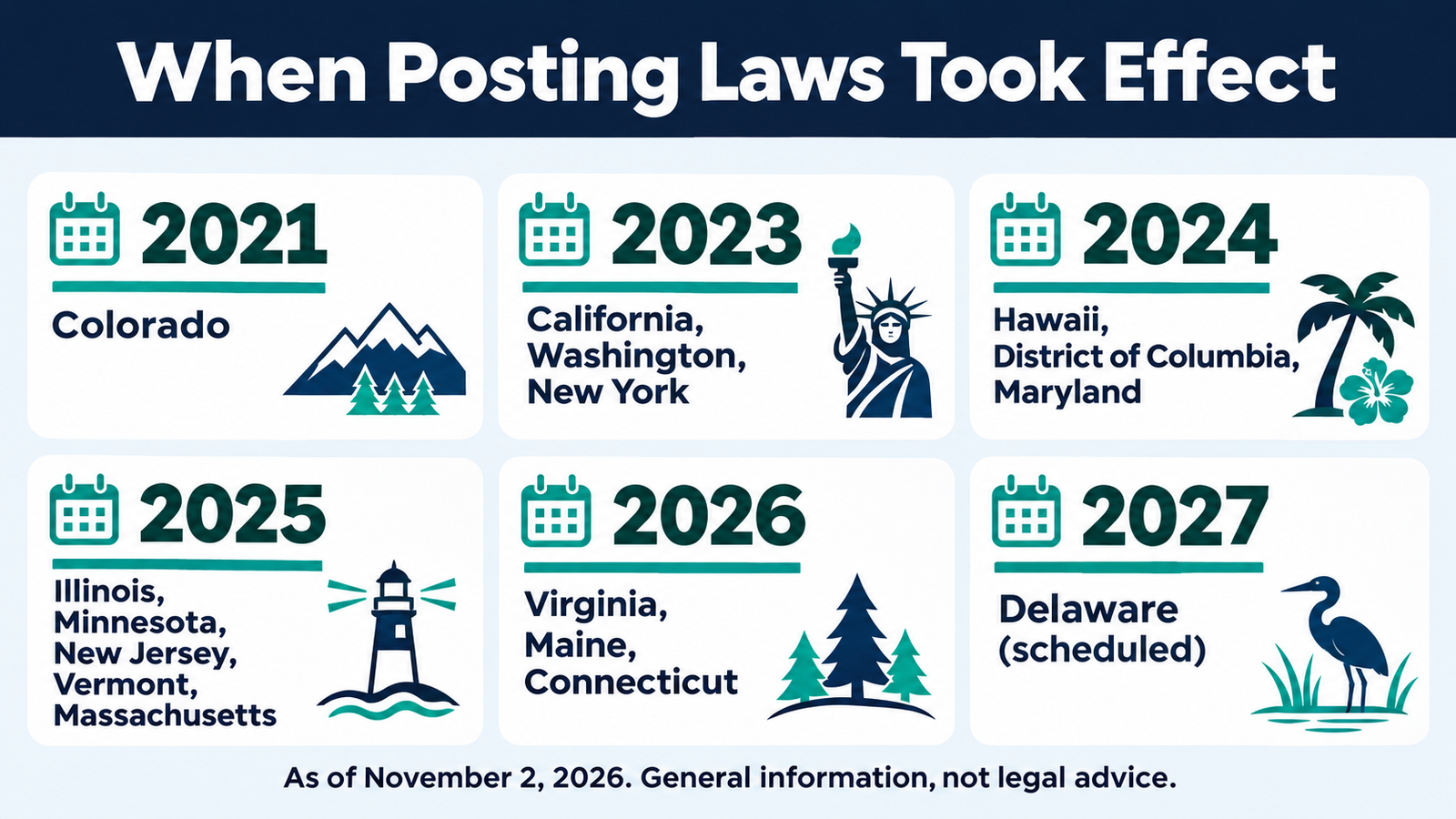
As of early November 2026, 14 states and the District of Columbia require employers to put pay in job postings. Delaware joins them in September 2027. Two more states, Nevada and Rhode Island, require employers to share pay ranges with applicants at certain points in hiring, and several cities have their own posting rules.
At this time, there is no generally applicable federal requirement for private employers to include pay ranges in job postings. State and local rules set most posting requirements (Loio).
For behavioral health employers that hire across state lines, especially telehealth practices, many job postings fall under more than one state’s rules.
This guide covers what each law requires employers to disclose to job applicants and how to write postings for clinical roles with the strictest states in mind.
This guide is general information, not legal advice. Laws and agency guidance change, so confirm the current rules with the agency or an employment attorney before you rely on them. Last verified November 2, 2026.
States that require pay in job postings
| State | In force since | Who’s covered | What the posting must include | Source |
|---|---|---|---|---|
| Colorado | January 1, 2021 | Employers with employees in Colorado | Compensation, a description of benefits, and how and when to apply | Colorado Division of Labor Standards and Statistics |
| California | January 1, 2023 | Employers with 15 or more employees | The pay scale: a good faith estimate of the salary or hourly range expected at hire | Labor Code § 432.3 |
| Washington | January 1, 2023 | Employers with 15 or more employees | A wage scale or salary range, or the fixed amount if that is all the employer offers, plus a general description of benefits and other compensation | Washington Department of Labor and Industries |
| New York | September 17, 2023 | Employers with 4 or more employees | A compensation range and the job description if one exists. For commission-only jobs, a written statement that pay is based on commission | New York State Department of Labor |
| Hawaii | January 1, 2024 | Employers with 50 or more employees | An hourly rate or salary range that reasonably reflects expected pay | Haw. Rev. Stat. § 378-2.4 (summary) |
| District of Columbia | June 30, 2024 | Employers in D.C. | The minimum and maximum salary or hourly pay; health care benefits must be disclosed before the first interview | Wage Transparency Omnibus Amendment Act of 2023 (summary) |
| Maryland | October 1, 2024 | Employers, for work performed at least partly in Maryland | The wage range and a general description of benefits and other compensation | Lab. & Empl. § 3-304.2 |
| Illinois | January 1, 2025 | Employers with 15 or more employees | The pay scale, benefits and other compensation, or a link to a public page that has them | 820 ILCS 112/10 (summary) |
| Minnesota | January 1, 2025 | Employers with 30 or more employees at sites in Minnesota | The starting salary range or, if there is no range, the fixed rate, plus a general description of benefits and other compensation | Minn. Stat. § 181.173 |
| New Jersey | June 1, 2025 | Employers with 10 or more employees over 20 calendar weeks | The hourly wage or salary, or its range, plus a general description of benefits and other compensation | New Jersey Department of Labor |
| Vermont | July 1, 2025 | Employers with 5 or more employees | The compensation or range of compensation for a Vermont job opening | 21 V.S.A. § 495p |
| Massachusetts | October 29, 2025 | Employers with 25 or more employees in Massachusetts | The annual salary or hourly wage range | Mass.gov |
| Virginia | July 1, 2026 | All employers | The wage, salary, or wage or salary range, in public and internal postings | Va. Code § 40.1-28.7:12 |
| Maine | July 29, 2026 | Employers with 10 or more employees | The prospective pay range, or a statement that the job is paid solely by commission | LD 54 (summary) |
| Connecticut | October 1, 2026 | All employers | The wage range and a general description of benefits | Public Act 26-12 (summary) |
Coverage thresholds and exceptions vary. Several laws also reach internal job postings and promotion or transfer opportunities for current employees, and some add a duty to share the pay range upon request.
California, for example, requires employers to give the pay scale to an applicant who asks and to current employees for their own position (Labor Code § 432.3).
Where a row links to a summary rather than the statute or agency, the official text was not reachable when we checked in October 2026; read the statute before relying on the details.
Enacted, not yet in force
Delaware. Employers with 26 or more employees must include the hourly or salary amount or range and a general description of benefits and other compensation in postings, starting September 26, 2027.
The law applies to Delaware jobs and non-international remote jobs offered by Delaware-based employers. Postings covered by collective bargaining agreements have separate transition rules. The law was signed September 26, 2025 (Delaware HB 105).
States that require disclosure, but not in the posting
- Nevada. Employers must give the wage or salary range or rate to an applicant “who has completed an interview for a position” (NRS 613.133). The law doesn’t require pay in the posting.
- Rhode Island. Employers must give an applicant the wage range on request, and should provide it before discussing compensation. Employees get the range at hire, when they move to a new position and on request (R.I. Gen. Laws § 28-6-22).
Salary history bans are a separate rule
Many pay transparency laws sit next to a salary history ban, which limits what employers can ask job applicants about past pay. California’s Labor Code § 432.3, for example, bars employers from seeking an applicant’s salary history and from relying on it to decide whether to hire or what to offer.
These bans cover the interview and hiring process, not the posting, so check them separately in each state and city where you hire.
Cities with their own rules
Local laws can apply even where the state has none, or set a stricter rule than the state. Examples:
- New York City has required a good faith pay range in job advertisements since November 1, 2022 (NYC Commission on Human Rights). Westchester County, Ithaca and Albany County have their own rules as well.
- Jersey City, New Jersey requires pay information in postings from employers with five or more employees, a lower threshold than the state’s (City of Jersey City).
- Cleveland, Ohio has required a pay range in postings from employers with 15 or more employees in the city since October 27, 2025 (Ordinance 104-2025; summary).
- Columbus, Ohio requires pay in postings from employers with 15 or more employees in the city; the rule took effect in December 2025, and penalties start January 1, 2027 (summary).
Ohio has no statewide posting law. Cleveland requires pay in postings now, and Columbus will enforce its rule from January 1, 2027. Other Ohio cities, including Toledo, have narrower rules on salary history or disclosure on request.
Remote and telehealth jobs
Remote behavioral health jobs are where these laws get complicated. A telehealth therapist role posted once may be open to applicants in a dozen states. Each state draws the line differently.
Check employer headcount separately from whether the job is covered. New York and Illinois can cover jobs performed out of state when the role reports to a covered in-state office or worksite under the applicable rule.
Vermont covers remote roles that predominantly work for a Vermont office or work location. Colorado’s exception for jobs performed entirely outside the state generally cannot be established just by excluding Colorado applicants from a remote posting.
Massachusetts counts only employees whose primary place of work is in Massachusetts (Mass.gov). Maryland’s rule covers work “physically performed, at least in part, in the State” (§ 3-304.2).
Colorado’s labor division has issued separate guidance on remote jobs, linked from its pay transparency page.
Posting a good-faith range and a benefits description on every job covers the most common requirements, though some states add more (Colorado, for example, requires application details). On our board, most listings already show pay.
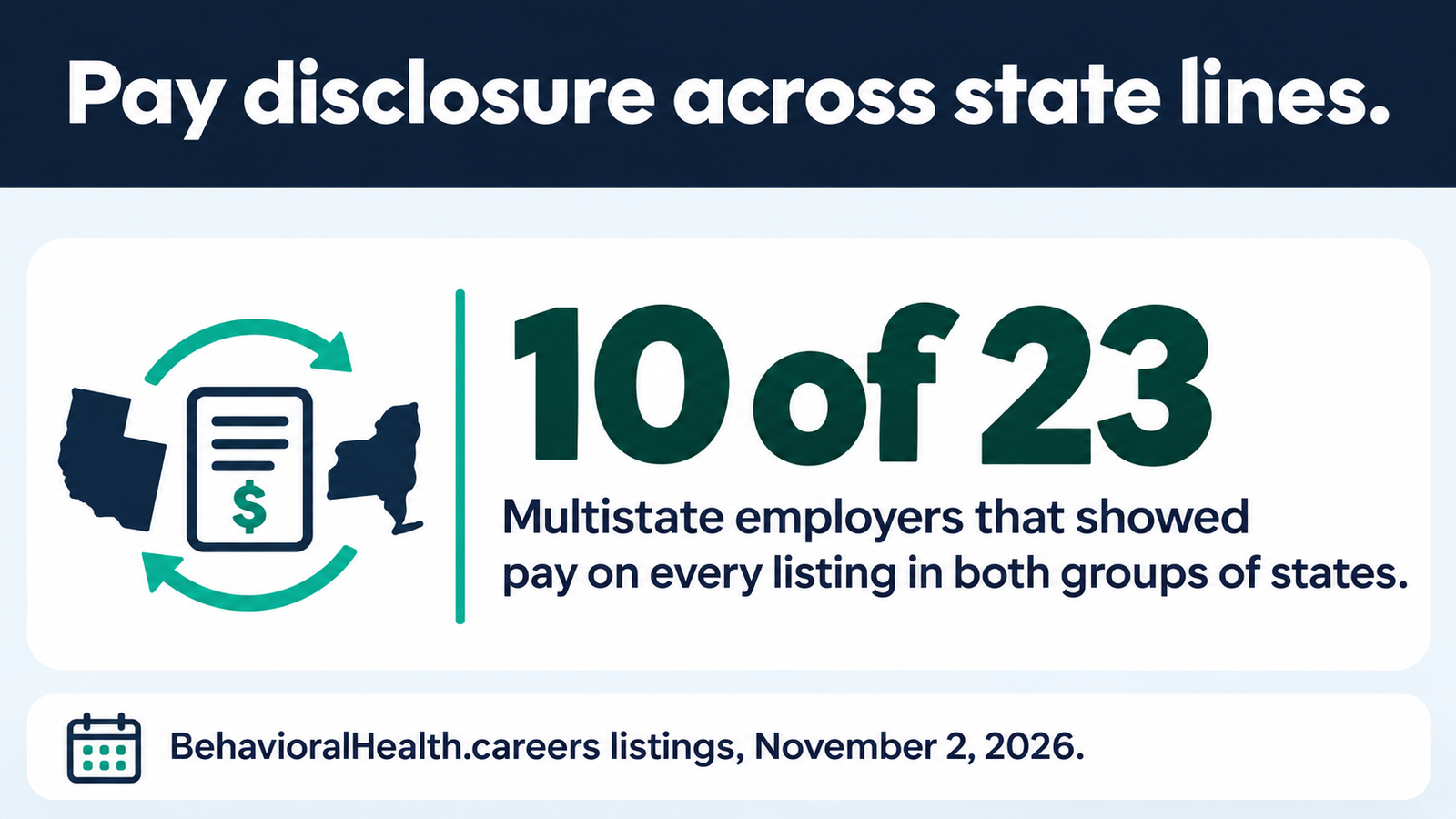
In our Q4 2026 posted-pay report, 10 of the 23 employers hiring in both kinds of state posted pay on every listing in both.
Writing postings for clinical roles
Behavioral health postings raise a few questions general guides don’t cover. These are practical approaches, not legal conclusions; check them against the rules in the states where you hire.
One posting, several licenses. Many therapist postings accept the LCSW, LPC and LMFT. If pay is the same regardless of license, one range works. If pay differs, say so. The Emily Program’s posting on our board, for example, lists separate starting ranges for associate-licensed and independently licensed therapists.
Associate and licensed levels. A posting open to both pre-licensed and fully licensed clinicians usually needs either two ranges or one range wide enough to cover both. Two ranges tell candidates more.
Per-session and productivity pay. If you pay per session, state the per-session rate or range. Some laws treat commission and piece-rate pay differently, so check each state’s guidance for how to state them. Bonuses and incentive pay belong in the “other compensation” description where the law asks for one.
Benefits. Colorado, Washington, Maryland, Illinois, Minnesota, New Jersey and Connecticut all ask for a description of benefits or other compensation. A short list (health insurance, paid time off, retirement, CEU stipend, licensure supervision) is a common starting point.
Keep the range honest. Laws in California, Maryland and elsewhere require ranges set in good faith, and Virginia’s law names a range’s breadth as one factor in judging good faith (Ogletree Deakins).
As a market reference, not a legal line, the median salaried range on our board runs 22 percent from bottom to top. A range much wider than that tells candidates little.
Frequently asked questions
Is there a federal pay transparency law?
As of November 2, 2026, there is no generally applicable federal requirement for private employers to include a pay range in a job ad. State and local posting rules depend on the employer and the job (Loio).
Which states require salary ranges in job postings in 2026?
As of November 2, 2026: California, Colorado, Connecticut, Hawaii, Illinois, Maine, Maryland, Massachusetts, Minnesota, New Jersey, New York, Vermont, Virginia and Washington, plus the District of Columbia. Delaware’s law takes effect September 26, 2027.
Do small behavioral health practices have to post pay?
It depends on the state. Colorado, Maryland, Virginia, Connecticut and D.C. cover employers of any size, as described above. Other states start at thresholds from 4 employees (New York) to 50 (Hawaii).
Do pay transparency laws apply to remote telehealth jobs?
It depends on each state’s test. Check both employer coverage and the job’s work location or reporting line. Some remote roles are covered because they report to or serve an in-state office even when the employee works elsewhere.
Check each state’s guidance. Posting a good-faith range and a benefits description on every job covers the most common requirements, though some states require more.
Does Florida or Texas require pay in job postings?
Neither has a statewide posting law as of November 2, 2026. Remote postings open to applicants in other states may still fall under those states’ laws.
Sources
Official statutes and agency pages are linked in the table.
- Buchanan Ingersoll and Rooney, Pay transparency laws expand to two more jurisdictions (Hawaii, Illinois).
- Davis Wright Tremaine, New pay transparency requirements for D.C. employers in 2024.
- Ogletree Deakins, Virginia and Maine enact pay transparency laws to take effect in July 2026, May 6, 2026.
- Foley and Lardner, Connecticut expands pay transparency requirements starting October 1, 2026, September 14, 2026.
- Duane Morris, Delaware enacts new pay transparency law to go into effect September 2027.
- Baker Donelson, Pay transparency in 2026: what employers need to do now, January 21, 2026 (Columbus).
- Loio, Pay transparency laws by state: 2026 tracker, updated July 24, 2026 (federal status, Cleveland).
- BehavioralHealth.careers live listings, read November 2, 2026.