
Hiring a pre-licensed therapist lets a private or group practice add capacity at a lower salary than a fully licensed clinician usually commands. It also changes how your practice runs.
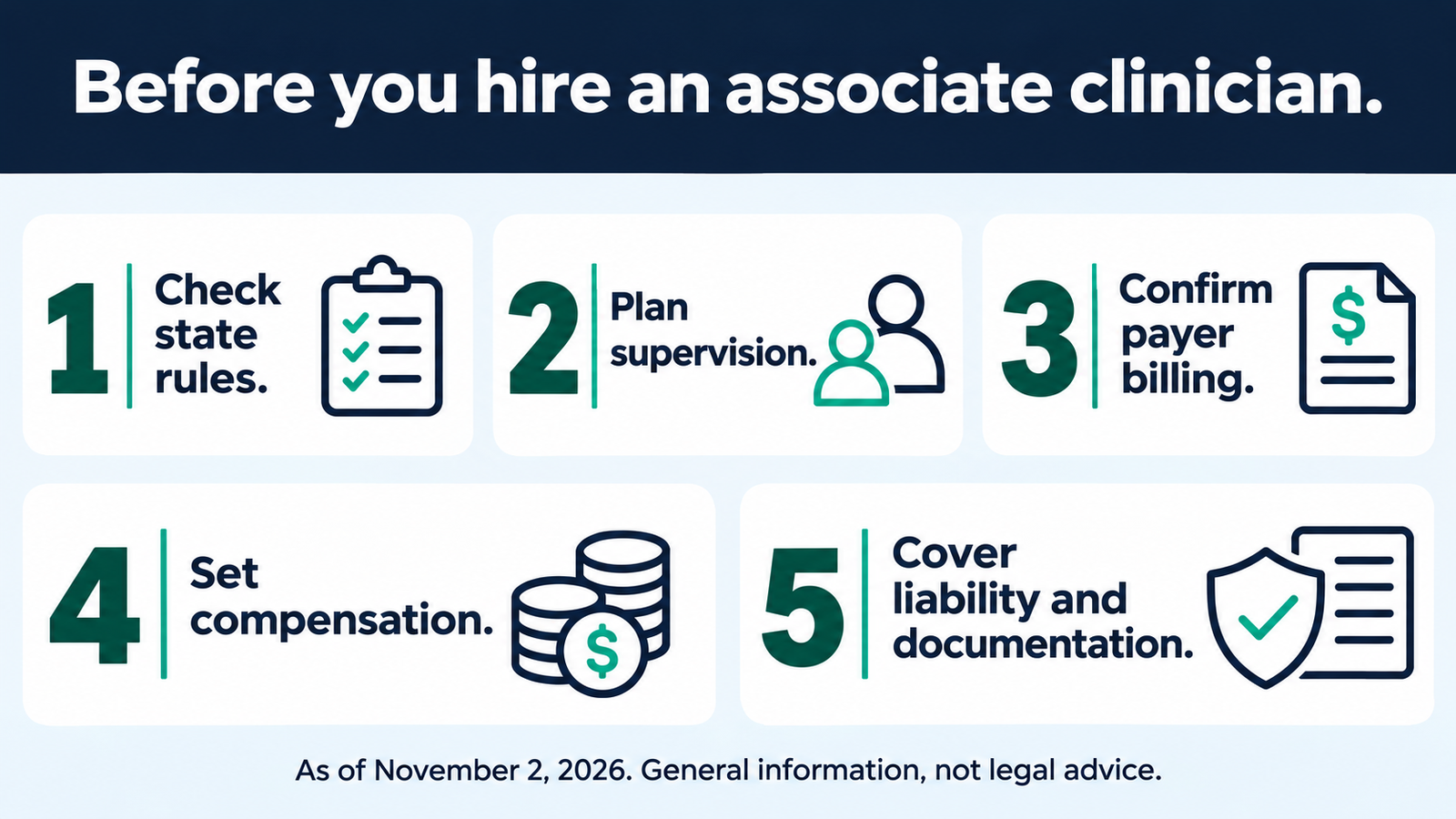
Before you post the job, work through five questions: what your state allows, who will supervise, how you will get paid for the associate’s sessions, how you will pay the associate, and how you will cover liability.
This guide walks through each one with examples from Texas and California rules, Medicare billing rules, and pay that employers posted on BehavioralHealth.careers on November 2, 2026. It is general information for practice owners, not legal or billing advice.
Your state board, a billing specialist and an employment attorney have the final word for your practice.
What an associate clinician is
An associate has finished a qualifying master’s degree and is earning the supervised hours and direct client hours that independent licensure requires.
The title depends on the state and the profession: LPC Associate in Texas, Associate Marriage and Family Therapist (AMFT), Associate Clinical Social Worker (ASW) or Associate Professional Clinical Counselor (APCC) in California, and Registered Mental Health Counselor Intern in Florida, among others.
Associates can provide therapy, but only under supervision and within their state’s rules.
Our guide to types of therapy licenses explains how each license path works, and our guide to associate therapist jobs shows where associates get hired and what those jobs pay.
Step 1: Check what your state allows
State rules decide where an associate can work, who can supervise them and how the job must be set up. Two examples show how much they differ.
Texas: LPC Associates
In Texas, an LPC Associate needs 3,000 hours of supervised experience under a Council-approved supervisor, including at least 1,500 hours of direct client counseling, completed over no less than 18 months. Associates must receive at least four hours of supervision a month while they are counseling, and no more than half of total supervision hours can be group supervision (22 Tex. Admin. Code § 681.92).
The supervisor must hold Council-approved supervisor status (the LPC-S) and cannot be an employee of the associate. Supervisors must keep a signed supervisory agreement and a record of each session.
Both the supervisor and the associate are “fully responsible for the professional counseling activities” of the associate (22 Tex. Admin. Code § 681.93). An LPC Associate can have up to two supervisors at a time (Texas Behavioral Health Executive Council).
California: AMFTs, ASWs and APCCs
California is stricter about private practice. Its Board of Behavioral Sciences supervision agreement (revised May 2026) sets out these rules (BBS supervision agreement):
- A supervisee who does not yet hold an associate registration cannot work in a private practice or professional corporation.
- In a private practice, the supervisor must be employed or contracted by the associate’s employer, or be an owner of the practice.
- The associate must be a W-2 employee or a volunteer, not an independent contractor. Volunteer status is generally not an option at a for-profit practice, because under federal wage law “employees may not volunteer services to for-profit private sector employers” (U.S. Department of Labor). For most private practices, that leaves W-2 employment.
- Associates may not rent space, pay for furnishings, equipment or supplies, or “pay for the obligations of the supervisee’s employer.”
- In nonexempt settings, which include private practices, a supervisor may supervise no more than six supervisees who are not fully licensed at a time, in individual or triadic supervision.
If your practice is in another state, find the equivalent rules on your licensing board’s site before you write the job description.
Look for four things: whether associates can work in private practice, who can supervise, how many supervisees a supervisor can take on, and whether the associate must be an employee.
Step 2: Plan supervision before you hire
Supervision is central to an associate’s job search, and it costs you time or money either way.
- In-house clinical supervisor. If you or a licensed clinician on staff holds supervisor status, the supervision hours come out of that person’s billable time.
- Contracted clinical supervisor. Some states allow an outside supervisor. In California, that person must be contracted by the practice and either see the practice’s clients or have a written contract giving access to clinical records, and the associate’s clients must authorize release of their records to the supervisor.
Offering supervision is also a recruiting edge. On our board, Brave Health’s associate therapist postings list “Free qualified supervision offered (must meet qualifications).”
Talkiatry’s remote therapist postings say the opposite: the role “is not designed for clinicians seeking supervision toward licensure.”
Associates read those lines closely. If you provide supervision at no cost and on paid time, say so in the posting.
Hiring an associate therapist: what competing postings offer
When you are hiring an associate therapist, your posting sits next to larger employers that spell out supervision, training and benefits. A few examples from our board on November 2, 2026:
- Northern California Behavioral Health System’s per diem inpatient clinician posting, open to AMFTs, ASWs and APCCs, notes that clinical supervision assistance is available.
- Lighthouse Behavioral Health Solutions in Ohio lists “paid continuing education with supervision,” medical, dental and vision coverage, and eligibility for loan forgiveness programs.
- Bright Harbor Healthcare lists opportunities for training and continuing education credits, along with Public Service Loan Forgiveness opportunities.
A small group practice may not match every benefit, but it can compete on what associates care about most: supervision that counts toward licensure, a realistic caseload, training in the population you serve and a clear raise at independent licensure.
Put those in the posting, along with whether the role is full time and how scheduling works.
Our therapist onboarding checklist includes a pre-licensed associate checklist and a supervision agreement outline you can adapt.
Step 3: Confirm how you will get paid for their sessions
Work this out before you hire. An associate’s sessions only support the practice if you can bill for them.
Medicare. Since January 1, 2024, marriage and family therapists and mental health counselors can bill Medicare on their own. To enroll, they need a state license and at least two years or 3,000 hours of post-master’s supervised clinical experience, and Medicare pays them 75 percent of what it pays a clinical psychologist (CMS). Associates don’t meet that bar, so they cannot enroll on their own.
Medicare does allow some behavioral health services to be provided by “auxiliary personnel” under general supervision and billed by the supervising practitioner. Those personnel must meet any licensure requirements the state imposes, the service must be an integral part of the billing practitioner’s own service, and “only the supervising physician (or other practitioner) may bill Medicare for incident to services” (42 CFR 410.26).
Whether that works for your practice depends on which type of practitioner supervises, whether that practitioner is involved in the client’s course of treatment, your state’s rules and how the service is documented. Get billing advice before you count on it.
Medicaid and commercial health insurance. Each plan sets its own policy on associates. Before you hire, ask each payer you work with whether it credentials, or panels, associates directly, allows billing under a licensed supervisor, or doesn’t cover associate services at all.
Never bill an associate’s sessions under a licensed clinician’s credentials unless that payer’s written policy allows it; doing so without permission can be a false claim.
If a payer that brings in a large share of your clients says no, plan the associate’s caseload around clients whose coverage allows it, such as self-pay clients or plans that do accept associates.
Step 4: Decide how you will pay them
What employers post
Few associate-level listings on our board post pay, too few to report a median. A few clear examples from November 2, 2026:
| Employer | Role | Location | Posted pay |
|---|---|---|---|
| The Emily Program | Therapist, associate licensed | Dunwoody, Georgia | $60,000 to $68,000 starting |
| The Emily Program | Therapist, independently licensed | Dunwoody, Georgia | $70,000 to $75,000 starting |
| Brave Health | Associate therapists (LMHCA, LSW) | Remote | $60,000 to $63,000 |
| LifeStance Health | Candidate licensed therapist (LPCC, LSW, MFTC, SWC) | Greeley, Colorado | $41,000 to $60,000 |
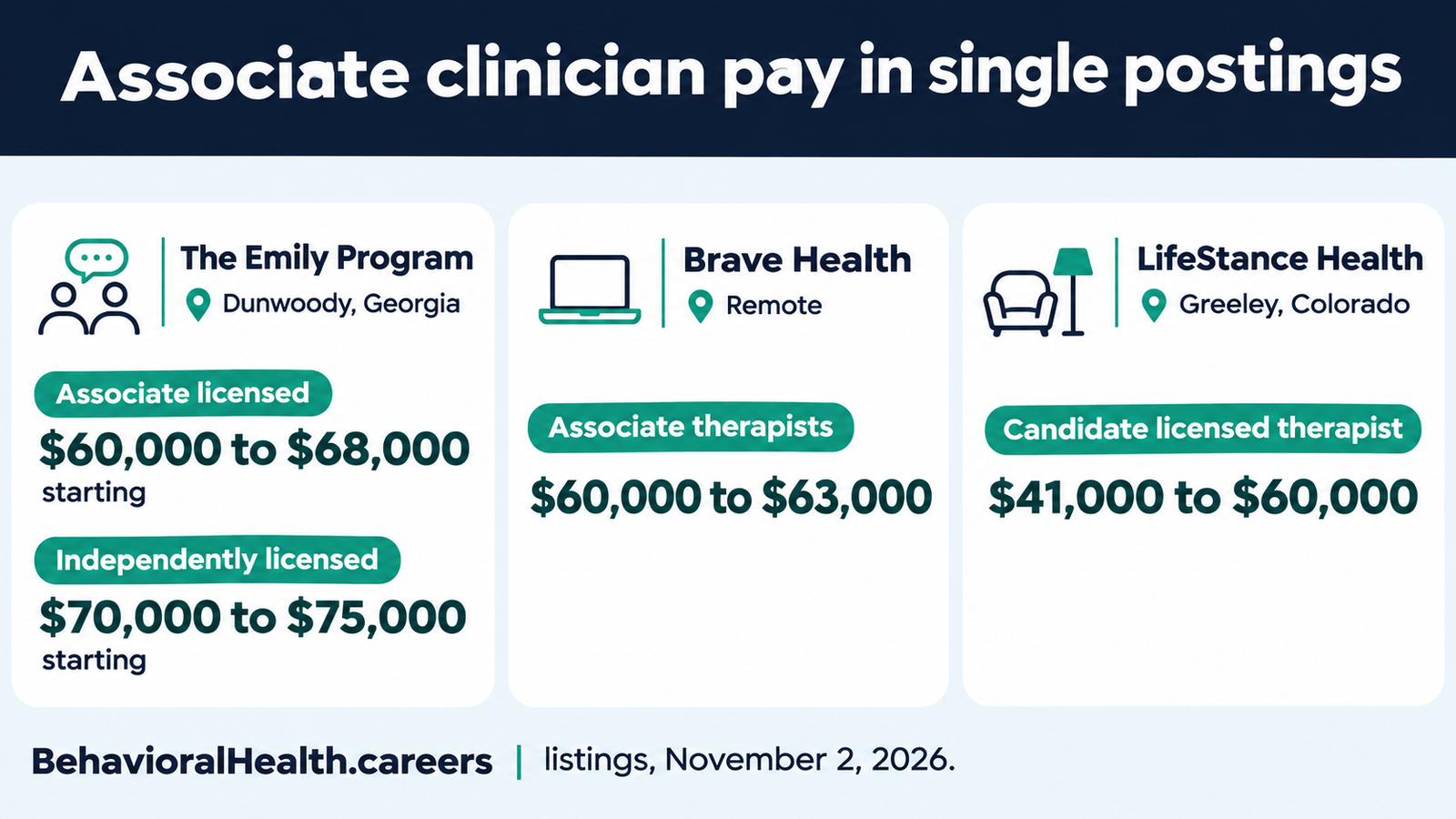
Source: BehavioralHealth.careers live listings, November 2, 2026. Single postings, not medians.
The Emily Program’s posting shows one way to build the gap: its associate range tops out below its starting range for licensed therapists.
For comparison, salaried therapist, counselor and social worker listings across the board had a median posted range of $63,800 to $97,800 (146 listings, 21 employers).
Our mental health counselor salary guide and LMFT salary guide cover national pay.
Salary, hourly or per session
Practices pay associates in three common ways:
- Salary gives the associate stable income while their caseload builds, and you carry the risk of a slow ramp. A salary doesn’t by itself make the role exempt from overtime. Salary thresholds and duties tests apply: in California, an exempt employee must earn at least twice the state minimum wage for full-time work, $70,304 a year at 2026’s $16.90 minimum wage (California Department of Industrial Relations) That is above all three associate salaries in the table below.
- Hourly pay ties cost to time worked. An hourly associate is generally not exempt from overtime, so documentation, required supervision and other work time count as hours worked and must be paid.
- Per-session pay ties cost to billed sessions and shifts the ramp-up risk to the associate, which makes the job harder to fill. For a W-2 associate, it still has to meet minimum wage and overtime rules for all hours worked, and California requires separate pay for nonproductive time under piece-rate pay (California Labor Code section 226.2).
Confirm any hourly or per-session structure with an employment attorney before you post it.
Whatever you choose, post the range. A clear range, like The Emily Program’s split between associate and licensed pay, tells candidates exactly what changes when they get licensed.
W-2 employee or 1099 contractor
Settle this with legal advice before you weigh cost. California’s board requires associates to be W-2 employees or volunteers, not independent contractors. Federally, the test is in flux. The U.S. Department of Labor’s 2024 independent contractor rule took effect March 11, 2024, but on May 1, 2025, the department told its investigators to stop applying it and use its earlier framework instead (Jackson Lewis). It proposed a replacement rule on February 26, 2026 (U.S. Department of Labor). The IRS and many states, including California with its ABC test, apply their own tests as well.
An associate works under your clinical supervision, with your clients and your records. Control over how the work is done is a central factor in most classification tests, and an employment attorney can tell you how your arrangement is likely to be viewed before you choose.
Step 5: Cover liability and documentation
In Texas, the supervisor and the associate are both fully responsible for the associate’s counseling work, and the supervisor can be disciplined for violations they “should have known about” (22 Tex. Admin. Code § 681.93).
Make sure your malpractice coverage names the associate, keep a signed supervision agreement on file, and decide in advance how you’ll handle a remediation plan if one is needed.
Your first-associate checklist
- Read your state board’s rules on associates in private practice, supervisor qualifications and supervisee limits.
- Decide who will supervise, how often, and whether supervision time is paid.
- Ask each payer you work with how it handles associate services, and get billing advice on Medicare.
- Choose a pay model and write down the range, including what changes at full licensure.
- Confirm employment status with an employment attorney. In California, associates cannot be independent contractors, and volunteer status generally isn’t available at a for-profit practice.
- Add the associate to your malpractice policy and sign a supervision agreement.
- Write the posting with pay, supervision, caseload expectations and the licensure path spelled out. Use the therapist example in our behavioral health job description templates to draft the posting.
Frequently asked questions
What does it mean to be an associate therapist?
An associate therapist has a qualifying master’s degree and a state associate registration or license, and provides therapy under a clinical supervisor while completing the hours required for independent licensure. Titles vary by state, such as LPC Associate in Texas or AMFT in California.
How many associates can a supervisor take on in California?
In nonexempt settings, which include private and group practices, a supervisor may supervise no more than six supervisees who are not fully licensed at a time, according to the Board of Behavioral Sciences supervision agreement.
Can a private practice hire a pre-licensed therapist?
In many states, yes, with conditions. California, for example, requires an associate registration before private practice work, bars independent contractor arrangements, and requires a supervisor who owns or is employed or contracted by the practice. Check your state board’s rules first.
How much should I pay an associate therapist?
Posted pay varies by market and setting. On our board, associate roles posted from $41,000 to $68,000 across three employers, against a board-wide median of $63,800 to $97,800 for salaried therapist listings. Build in a raise at full licensure.
Can I bill Medicare for an associate’s sessions?
Associates can’t enroll in Medicare on their own, because enrollment requires at least two years or 3,000 hours of post-master’s supervised clinical experience, which associates are still completing. Medicare’s incident-to rules allow some services by supervised staff who meet state requirements to be billed by the supervising practitioner. Get billing advice before relying on that.
Can an associate be a 1099 contractor?
Not in California, where the board bars independent contractor arrangements for associates. Elsewhere, it depends on the federal and state classification tests, which weigh how much control you have over the work. Ask an employment attorney.
Posting on BehavioralHealth.careers
BehavioralHealth.careers is a job board for behavioral health, built around posted pay. We are opening job posting to a small group of behavioral health employers first, by invitation.
To ask about it, email [email protected].
Our guide to writing a behavioral health technician job description shows a posting format that carries over to clinical roles.
Sources
- BehavioralHealth.careers live listings and listing text, read November 2, 2026 (1,364 published listings).
- Texas Administrative Code, 22 TAC § 681.92, Experience Requirements, and 22 TAC § 681.93, Supervisor Requirements.
- Texas Behavioral Health Executive Council, Supervision FAQs.
- California Board of Behavioral Sciences, Supervision Agreement, form 37M-300, revised May 2026.
- Centers for Medicare and Medicaid Services, Marriage and family therapists and mental health counselors.
- Electronic Code of Federal Regulations, 42 CFR 410.26, Services and supplies incident to a physician’s professional service.
- U.S. Department of Labor, Employee or independent contractor classification rulemaking, and elaws: volunteers.
- Jackson Lewis, DOL won’t enforce 2024 independent contractor rule (Field Assistance Bulletin 2025-1, May 1, 2025).
- California Labor Code section 226.2.
- California Department of Industrial Relations, 2026 minimum wage announcement.