
Despite the word, most states don’t simply swap your LPC, LCSW or LMFT for their own license. Some boards use “reciprocity” as the name of their out-of-state application, but you still apply and meet their requirements.
If you move, or want to see clients who live in another state, you have three main routes to license portability: apply for a license in the new state by endorsement, use an interstate compact if your profession and both states are in one, or, if you’re a military family, use the federal rule for servicemembers and spouses.
Which route fits depends on your license, your home state and the state you’re moving to.
This guide explains each one, with examples from Texas, California and Florida, and what employers on BehavioralHealth.careers expect from clinicians who work across state lines.
This guide is general information, not legal advice. Licensing rules change, so confirm the current requirements with the board in the state where your clients are. Last verified November 2, 2026.
Reciprocity, endorsement and compacts: what the terms mean
- Reciprocity usually means two states agree to honor each other’s licenses as they are. For therapy licenses, that arrangement is rare, and some boards, including Texas’s, say outright that they don’t offer it.
- Licensure by endorsement is the common path. You apply for a full license in the new state, and the board gives credit for the license, exam and experience you already have. You still apply, pay fees and meet that state’s requirements.
- An interstate compact lets a licensee in one member state practice in other member states without a separate full license in each, through a privilege to practice or a multistate license, depending on the compact. Each profession has its own compact, and each is at a different stage.
How licensure by endorsement works
Each state writes its own rules, but most endorsement and out-of-state applications ask for some mix of the following:
- An active license in good standing in another state, often held for a minimum period
- Passing scores on the national exam for your profession
- A state law or jurisprudence exam
- Verification of your license from every state where you’ve held one
- Official transcripts, and sometimes proof that your degree meets the new state’s coursework rules
- Documentation of your supervised hours
- Fingerprints and a background check
Three large states show how much the rules differ.
| State | Endorsement or reciprocity? | What out-of-state LPCs (and others) need |
|---|---|---|
| Texas | Neither. “Texas does not offer reciprocity, licensure-by-endorsement, or temporary licensure” | Meet Texas’s full LPC requirements, including 3,000 hours of supervised experience, NCE or NCMHCE scores, the Texas jurisprudence exam, transcripts, supervision documentation and fingerprints (Texas Behavioral Health Executive Council) |
| California | A shorter path for LMFTs, LCSWs and LPCCs | Same license type, at the highest level for independent clinical practice, held current, active and unrestricted for at least two years immediately before the board receives your application. Applicants must document qualifying education, submit fingerprints and disclose prior restrictions or discipline; the California Law and Ethics exam (the clinical exam is waived); California law and ethics, California cultures and child abuse reporting coursework, plus suicide risk training. LCSW applicants need a CSWE-accredited social work degree (California Board of Behavioral Sciences) |
| Florida | Licensure by endorsement for clinical social workers, MFTs and mental health counselors | Under Florida’s MOBILE Act: an active, unencumbered license with a similar scope, active practice for at least 2 of the last 4 years, a passing national exam or recognized national certification, no discipline in the last 5 years, no pending complaints or investigations, and background screening. Florida must issue the license to a qualified applicant within 7 days after receiving all required documents. Review the statutory exclusions and any applicable jurisprudence requirement (§ 456.0145, applied to these professions by § 491.006) |
The takeaway: in Texas, a counselor licensed for 20 years elsewhere still documents the same supervised hours as a new applicant.
In California, two years of current, unrestricted licensure and state-specific coursework can replace much of that.
In Florida, recent active practice and a national exam do most of the work. Check your new state’s board early, because missing documents from an old supervisor can take the longest to collect.
The endorsement paths above are for fully licensed clinicians. If you hold an associate license, expect in most cases to apply for the new state’s associate credential and to have your supervised hours reviewed.
Our guide to associate therapist jobs lists associate titles by state.
Where the interstate compacts fit
Compacts can save you from applying for a full license in every state, but only where your profession has one and both states are live in it.
For licensed professional counselors, here’s how it works. You generally must reside in and hold a qualifying license in a live home state, then obtain a privilege for each client state before practicing there.
Apply through the Commission’s CompactConnect system. Each privilege is tied to your home state license and lets you serve clients located in that member state.
Our Counseling Compact guide covers eligibility, fees and how privileges renew.
| Profession | Compact | Status |
|---|---|---|
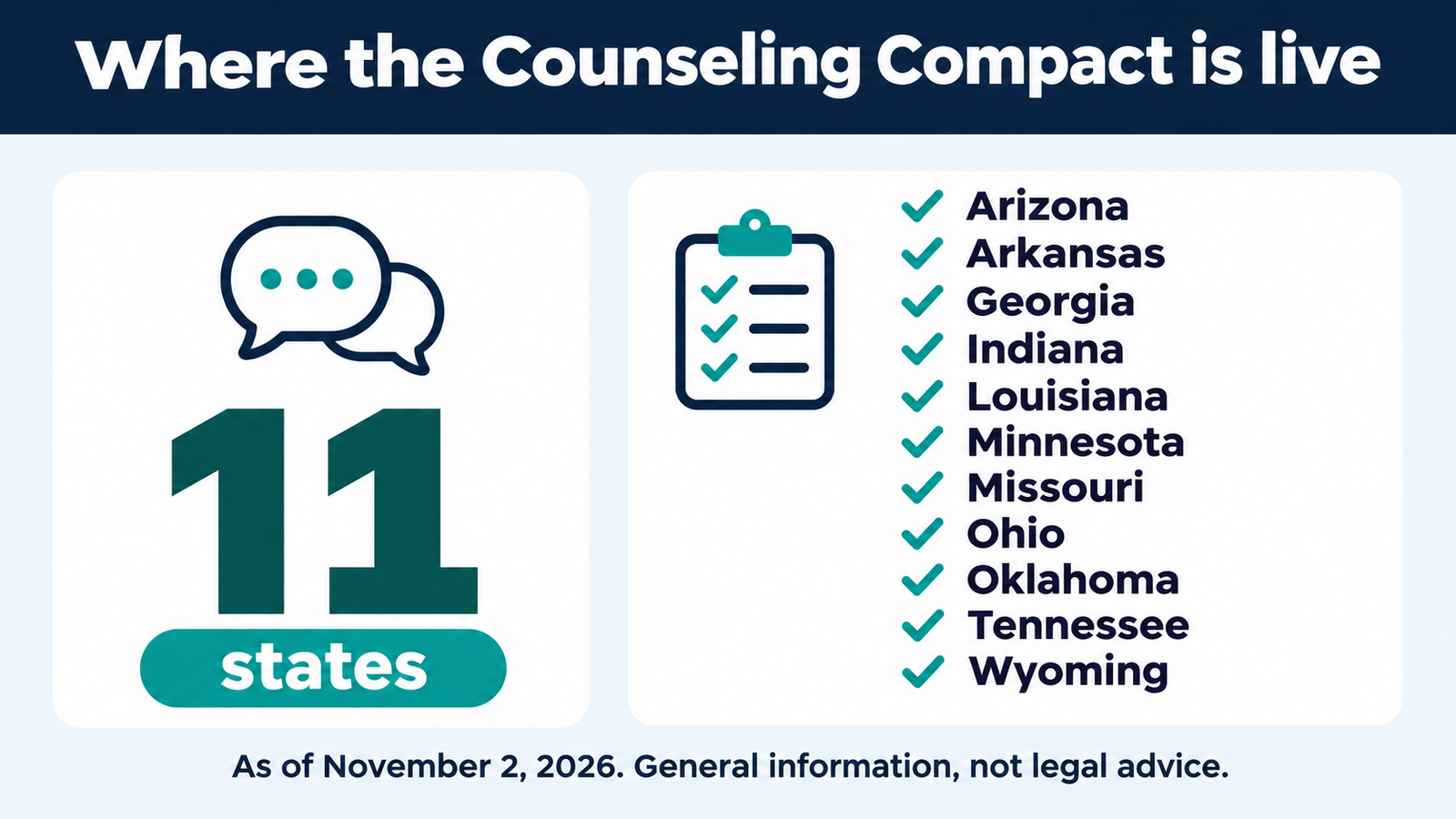
| Counselors (LPC, LPCC, LMHC, LCPC) | Counseling Compact | Live in 11 states as of the Commission’s October 19, 2026 announcement: Arizona, Arkansas, Georgia, Indiana, Louisiana, Minnesota, Missouri, Ohio, Oklahoma, Tennessee and Wyoming. The Commission says 29 more states and D.C. are working toward going live (Counseling Compact) |
| Social workers | Social Work Licensure Compact | Enacted, but not yet issuing multistate licenses (Social Work Licensure Compact) |
| Psychologists | PSYPACT | Operating; telepsychology runs through an Authority to Practice Interjurisdictional Telepsychology (APIT), and temporary in-person practice through a Temporary Authorization to Practice (TAP). See our PSYPACT guide |
| Marriage and family therapists | None | No MFT compact exists. AAMFT promotes a model “full endorsement” portability law instead (AAMFT) |
Our guides cover each compact in depth: Counseling Compact states, Social Work Licensure Compact and PSYPACT.
A compact privilege is not the same as moving. If you relocate to a new state, it becomes your home state, and you’ll generally need a license there.
Check the compact’s rules on changing your home state before you move.
Military servicemembers and spouses
Federal law gives servicemembers and their spouses a separate path. Under the Servicemembers Civil Relief Act, if you hold a covered license in good standing and move to another state because of military orders, your license “shall be considered valid for licensed work in the new State” once you apply there with proof of orders and a notarized affidavit. The applicant must be in good standing in every state where they hold or previously held a license.
If you hold a license that already permits multistate practice under a compact, follow the applicable compact and state rules. Confirm permitted scope with the receiving board. The new state may run a background check and issue a temporary license while it reviews your application (U.S. Department of Justice).
Tell the new state’s board that you’re applying under this provision.
Telehealth across state lines
The rule that trips up remote clinicians: licensure follows the client. If your client is physically in another state during the session, you generally need authority to practice there, through a license, a compact privilege, or a telehealth registration or temporary-practice allowance where the state offers one.
Florida, for example, lets out-of-state licensees register to provide telehealth to clients in Florida without a Florida license, if they meet its conditions and open no office there (§ 456.47).
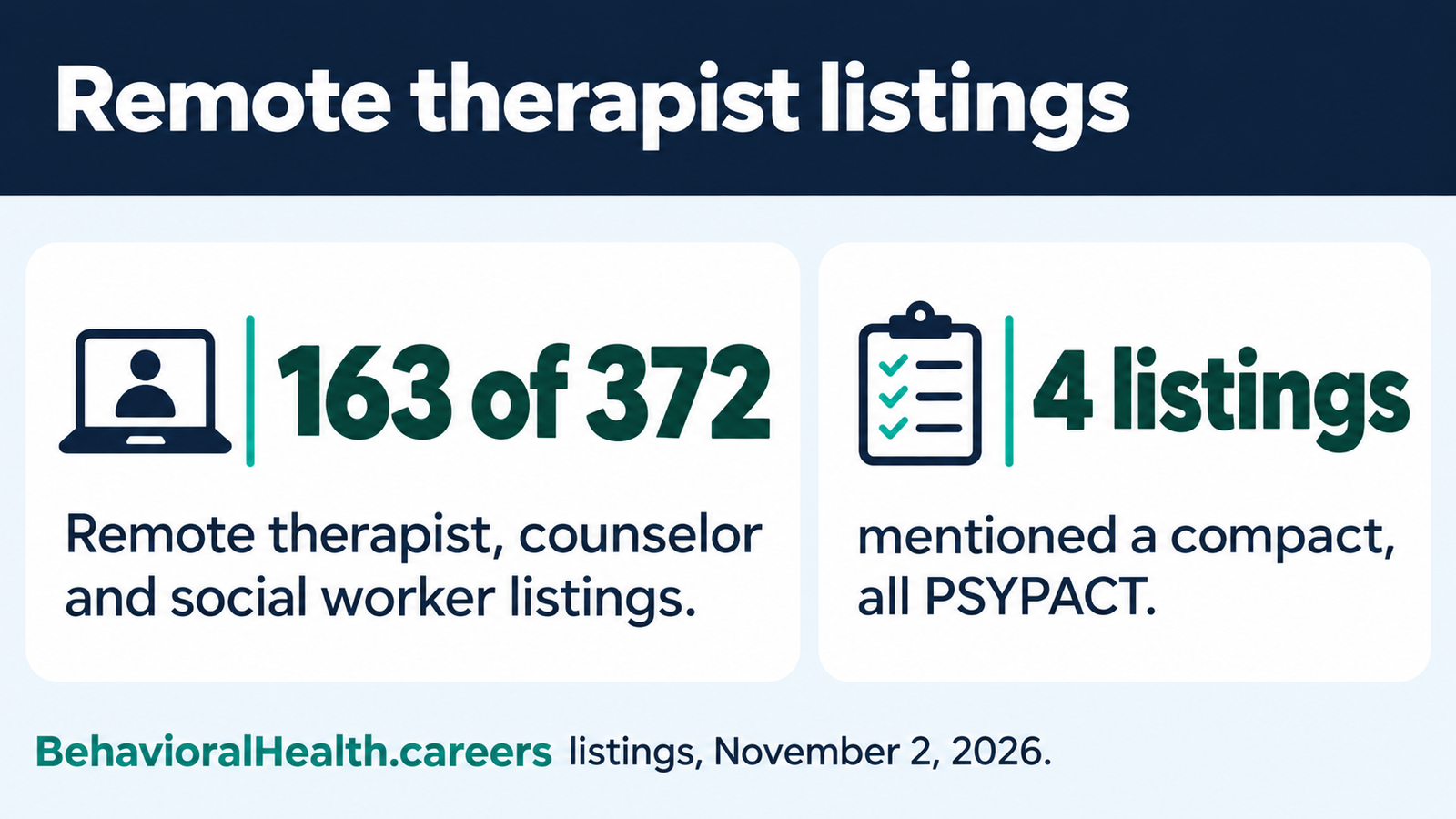
On November 2, 2026, 163 of the 372 therapist, counselor and social worker listings on BehavioralHealth.careers (grouped by job title) were remote. Some employers, like Talkiatry, posted a separate remote listing for each state where they hire.
Only four of those 372 listings mentioned a compact, all from one telehealth employer, and all four referred to PSYPACT for psychologists. None mentioned the Counseling Compact. Few employers on our board mention compacts at all.
Some help pay for licensing costs:
- Talkiatry lists “Licensing support with upfront coverage of costs.”
- Charlie Health lists reimbursement for new license applications and “cross-licensure sponsorship (if eligible).”
- Array Behavioral Care’s teletherapist posting says, “You will likely be required to work with Array to obtain additional state licensure.”
- Brightline lists license maintenance reimbursement.
If you plan to hold several licenses, ask about license support in the interview, since application, exam and renewal fees add up in every state.
Before you move: a checklist
- Find the board for your profession in the new state and read its out-of-state or endorsement page.
- Check for a compact. If you’re a counselor, check your residence and qualifying home-state license, whether both states are live, and whether you need to change your home-state license before applying for a privilege.
- Request license verifications from every state where you’ve held a license.
- Find your supervision records. Some states, like Texas, want supervised hours documented by your former supervisor or board.
- Schedule the state law or jurisprudence exam and any required state-specific coursework.
- Get fingerprinted for the new state’s background check.
- Plan for current clients. If they stay behind, you’ll need authority to practice in their state, through an applicable license, compact privilege, telehealth registration or temporary-practice allowance.
- Line up the job. Employers can tell you which licenses they’ll sponsor or reimburse.
Frequently asked questions
Can you transfer your LPC license to another state?
Not directly. You apply for a license in the new state, usually by endorsement or as an out-of-state applicant, and the board decides how much of your existing license, exam and experience it accepts. If you reside in and hold a qualifying license in a live home state, you may be eligible to obtain a privilege in another live state before practicing there.
Which states have LPC reciprocity?
Few states offer true reciprocity for counselors. Most offer some form of endorsement or an out-of-state application path, and some, like Texas, offer neither and require you to meet their full requirements. The Counseling Compact is the closest thing to reciprocity, and it was live in 11 states as of October 19, 2026.
Can I use my MFT license in another state?
Usually by getting licensed there. A few states also offer telehealth registration (Florida, for example) or short temporary-practice allowances, so check the board in the client’s state. MFTs have no interstate compact. Check whether the client’s state requires a full license or offers an applicable telehealth registration or temporary-practice route. California, for example, offers a shorter path for LMFTs licensed at least two years elsewhere.
Can LPCs work across state lines through telehealth?
Only where they’re authorized to practice: usually a license in the client’s state, or a Counseling Compact privilege obtained before practice if you meet home-state residence and license requirements. A few states also offer telehealth registration or temporary practice. Licensure follows where the client is during the session.
How long does it take to get licensed in another state?
It varies by state and by how quickly you can gather documents. Florida’s endorsement law requires a license to be issued to a qualified applicant within 7 days after the board receives all required documentation. So the timeline depends largely on how quickly other state boards, exam bodies and former supervisors send what the new board needs.
Does Texas have reciprocity for LMFT licenses?
No. “Texas does not have a reciprocity agreement for MFT license types with any other state.” Out-of-state LMFTs apply through the standard process: a qualifying degree, verified practicum hours, a passing AMFTRB exam (or California’s LMFT exam), the Texas MFT jurisprudence exam, verification of every license held, and a fingerprint background check (Texas Behavioral Health Executive Council).
Sources
- Texas Behavioral Health Executive Council, LPC: Licensed in Another Jurisdiction, and Applying for LMFT with a non-Texas license.
- California Board of Behavioral Sciences, License Portability.
- Florida Statutes, § 491.006, Licensure or certification by endorsement, § 456.0145, MOBILE Act, and § 456.47, Use of telehealth.
- Counseling Compact Commission, counselingcompact.gov.
- Social Work Licensure Compact, swcompact.org.
- American Association for Marriage and Family Therapy, MFT License Portability.
- U.S. Department of Justice, Portability of Professional Licenses (SCRA).
- BehavioralHealth.careers live listings and listing text, read November 2, 2026 (1,364 published listings).