
Psychiatric technicians provide hands-on patient care for people with mental illness and developmental disabilities in hospitals, state hospitals, and residential treatment programs. They observe and record how patients are doing and, in many settings, give medications and treatments under the direction of nurses and doctors.
How you become one depends on where you live. Four states license psychiatric technicians: California, Colorado, Kansas, and Arkansas.
In those states, you usually complete an approved training program and meet the state’s licensing requirements before you can work under the title.
Elsewhere, and in many California hospital jobs too, the hospitals on our board hire mental health technicians with a high school diploma, often with some experience, and some provide de-escalation training after hire.
This guide covers how to become a psychiatric technician on both paths, what a psychiatric technician program involves, and what the career pays.
What a psychiatric technician does
The U.S. Bureau of Labor Statistics groups psychiatric technicians and psychiatric aides together but describes different jobs.
Technicians “listen to patients’ concerns, observe their behavior, and record their condition,” and “provide medications and other treatments to patients, following instructions from doctors and other medical professionals.”
They also monitor vital signs and help with intake and discharge. Aides focus more on safety, daily living, and supervision on the unit (BLS).
In 2025, there were about 161,500 psychiatric technician jobs and 36,900 psychiatric aide jobs in the U.S. (BLS).
Job titles blur these lines. Many hospitals call the role mental health technician (MHT), behavioral health technician (BHT), or simply psych tech.
Our comparison of behavioral health technicians, mental health technicians, and psych aides sorts out the titles.
Do you need a psychiatric technician license?
Only in four states. Psychiatric technicians typically need a postsecondary certificate, and “some states require psychiatric technicians to have a license,” which may involve an accredited program and an exam (BLS).
| State | Credential | Licensing board |
|---|---|---|
| California | Psychiatric Technician (LPT) | Board of Vocational Nursing and Psychiatric Technicians |
| Colorado | Psychiatric technician license | Colorado State Board of Nursing |
| Kansas | Licensed Mental Health Technician (LMHT) | Kansas State Board of Nursing |
| Arkansas | Licensed Psychiatric Technician Nurse (LPTN) | Arkansas State Board of Nursing |
The four licensing states match the Institute for Justice’s 50-state review of occupational licenses (Institute for Justice). Check your state board before you enroll in a program.
In the other states, hospitals hire unlicensed technicians under titles like MHT or BHT. On October 27, 2026, 27 listings on BehavioralHealth.careers had titles naming a mental health technician (MHT) or psychiatric technician role.
Two asked for a psychiatric technician license, both at California hospitals, and both accepted a licensed vocational nurse (LVN) license instead. The other eight California listings with these titles didn’t ask for the license.
The California path
California’s requirements for becoming a licensed psychiatric technician are the most detailed of the four. To be licensed by the California board, you need to (BVNPT):
- Be at least 18.
- Have completed 12th grade or its equivalent.
- Qualify through one of three routes:
- Complete a California-approved psychiatric technician program,
- document equivalent education and experience, or
- qualify through nursing service in the medical corps of the U.S. armed forces, with additional coursework and experience.
- Submit Department of Justice and FBI fingerprints.
- Pass the California Psychiatric Technician Licensure Examination.
The equivalent education route shows what a psychiatric technician program covers. It requires 576 hours of theory and 954 hours of supervised clinical experience within the 10 years before you apply, including:
- At least 54 hours of pharmacology
- 126 hours of nursing science theory and 270 clinical hours
- 108 hours of theory on mental disorders and 270 clinical hours
- 108 hours of theory on developmental disabilities and 270 clinical hours
Paid work experience can satisfy some or all of the clinical hours, but experience can’t replace formal coursework.
The approved-program route is the more direct one, and graduates then apply to take the licensure exam. Confirm a program’s approval status and prerequisites with the board before you enroll.
Colorado, Kansas and Arkansas
Colorado. State law defines psychiatric technician practice as giving selected treatments and medications, and observing and recognizing symptoms, for patients with a behavioral or mental health disorder or an intellectual and developmental disability.
The work is done “under the direction of a licensed physician and the supervision of a registered professional nurse” (C.R.S. § 12-295-103). Applications go through the Colorado State Board of Nursing.
Kansas. Kansas licenses Mental Health Technicians through its State Board of Nursing. The law defines the practice as services for people with mental illness, emotional disturbance, or intellectual disability, performed under the direction of a physician or registered nurse, including “carrying out of treatments and medications as prescribed” (K.S.A. 65-4202).
Arkansas. Arkansas licenses Psychiatric Technician Nurses through its State Board of Nursing. Its rules accept LPTN applicants by endorsement only from California and Kansas, and allow LPTNs who completed an Arkansas board-approved LPTN program after March 18, 1980, to sit for the practical nurse licensing exam if otherwise qualified (Arkansas State Board of Nursing rules).
In all three states, check the board’s current application requirements before you choose a program. Arkansas, for example, accepts LPTN applicants by endorsement only from California and Kansas.
Entry-level psych tech jobs in every other state
Outside the four licensing states, you usually start as a mental health technician, and even in California, two hospitals on our board hire technicians without the license. Hospitals on our board asked for a short list of things.
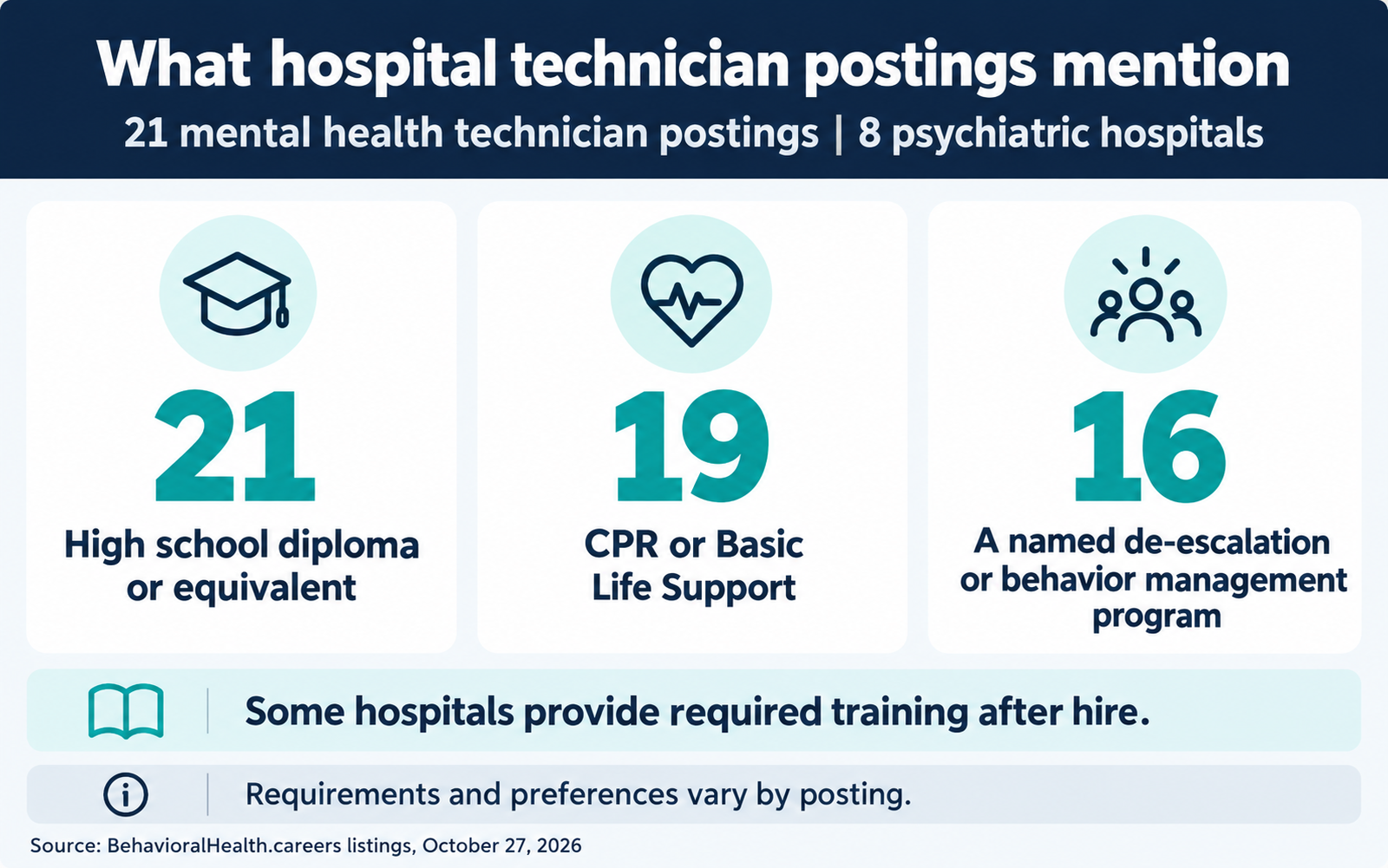
On October 27, 2026, all 21 mental health technician postings from eight psychiatric hospitals mentioned a high school diploma or equivalent, and 19 named CPR or Basic Life Support. Sixteen named a de-escalation or behavior management program, such as Crisis Prevention Institute (CPI) training, SAMA, Therapeutic Options, Handle with Care or the Mandt System. Some hospitals provide that training after hire.
Experience requirements varied. Eight Texas postings asked for at least two years of experience, while a Nevada hospital listed six months as preferred.
Our guide to becoming a behavioral health technician walks through certification options and first jobs, and our guide to working in a psychiatric hospital covers shifts and units.
Psychiatric technician pay
The median annual wage was $45,130 for psychiatric technicians and $44,910 for psychiatric aides in May 2025 (BLS).
Two California hospitals on our board posted mental health technician pay on October 27, 2026. Northern California Behavioral Health System posted $23.00 to $26.62 an hour for a full-time role in Sacramento, $23.84 to $27.50 an hour in Santa Rosa, and $27.50 to $32.31 an hour for a lead technician in Santa Rosa. Charter Oak Hospital in Covina posted $23 to $25 an hour.
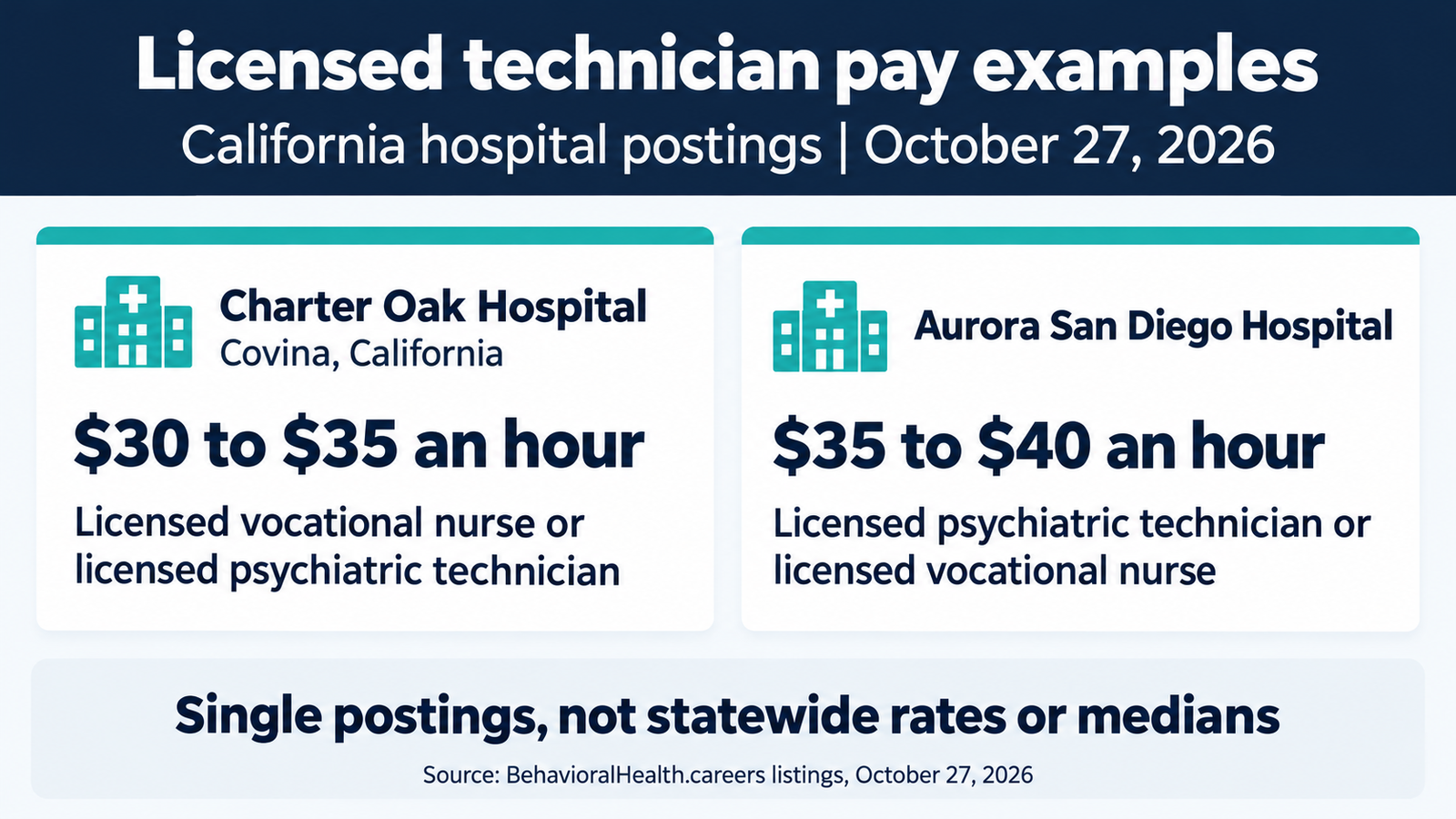
The licensed jobs paid more. Charter Oak posted $30 to $35 an hour for a licensed vocational nurse or licensed psychiatric technician, and Aurora San Diego Hospital posted $35 to $40 an hour for a licensed psychiatric technician or licensed vocational nurse. These are single employers in two California regions, not statewide rates.
Across 33 behavioral and mental health technician listings with posted hourly pay from seven employers, the median range was $18 to $22 an hour.
For state-by-state survey data, see our psychiatric aide salary guide and behavioral health technician salary guide.
Demand is strong. BLS projects employment of psychiatric technicians and aides to grow 18 percent from 2025 to 2035, much faster than the average for all occupations (BLS).
Where the work leads
Psychiatric technician experience can lead into nursing. In Arkansas, the board’s rules give LPTNs who completed an Arkansas board-approved LPTN program after March 18, 1980, a route to the practical nurse exam. Elsewhere, some technicians go on to licensed vocational or practical nursing, then registered nursing.
Our guide to behavioral health nurse jobs covers psychiatric nursing roles.
Others move into intake, case management or, with a degree, counseling and social work.
Our guide to entry-level behavioral health jobs shows where each starting role can lead.
Frequently asked questions
Which states require a psychiatric technician license?
California, Colorado, Kansas, and Arkansas. Kansas calls the credential a Licensed Mental Health Technician, and Arkansas calls it a Licensed Psychiatric Technician Nurse. In other states, hospitals hire unlicensed mental health technicians.
How long does it take to become a psychiatric technician in California?
It depends on the program. California’s equivalent-education route requires 576 hours of theory and 954 hours of supervised clinical experience.
Approved programs set their own schedules, so ask each one how long it takes, then plan time for the state licensing exam.
Can you be a psychiatric technician without a degree?
Yes. California requires completion of 12th grade or its equivalent plus approved training, not a college degree.
For unlicensed mental health technician jobs, all 21 psychiatric hospital MHT postings on our board, including those in California, mentioned a high school diploma or equivalent.
What is the difference between a psychiatric technician and a psychiatric aide?
Technicians usually have more training and, in many settings, give medications and treatments under a nurse’s or doctor’s direction. Aides focus on safety, supervision, and daily living support.
Sources
- U.S. Bureau of Labor Statistics, Occupational Outlook Handbook, Psychiatric Technicians and Aides, 2025 employment, May 2025 wage data and 2025 to 2035 projections.
- California Board of Vocational Nursing and Psychiatric Technicians, Summary of Requirements for Licensure as a Psychiatric Technician.
- Colorado Revised Statutes, § 12-295-103.
- Kansas Statutes, K.S.A. 65-4202.
- Arkansas State Board of Nursing, Licensure rules, 17 CAR Part 121.
- Institute for Justice, License to Work: Psychiatric Technician.
- BehavioralHealth.careers live listings and listing text, read October 27, 2026 (1,279 published listings).