
Counselors are the first job many people think of in addiction treatment. On our board, counselors and therapists are fewer than half.
As of late October, 2026, 10 employers on BehavioralHealth.careers whose core business is substance use treatment had 129 live listings. Seventy-six of them, 59 percent, were for roles other than counselor or therapist: behavioral health technicians, peer recovery specialists, case managers, admissions staff, recovery housing staff, prescribers and clinical leaders.
Several of those roles need no college degree. Here’s what each one does, what employers asked for, and what they posted for pay.
Addiction treatment jobs at a glance
| Role | Listings | Employers | Posted pay on our board |
|---|---|---|---|
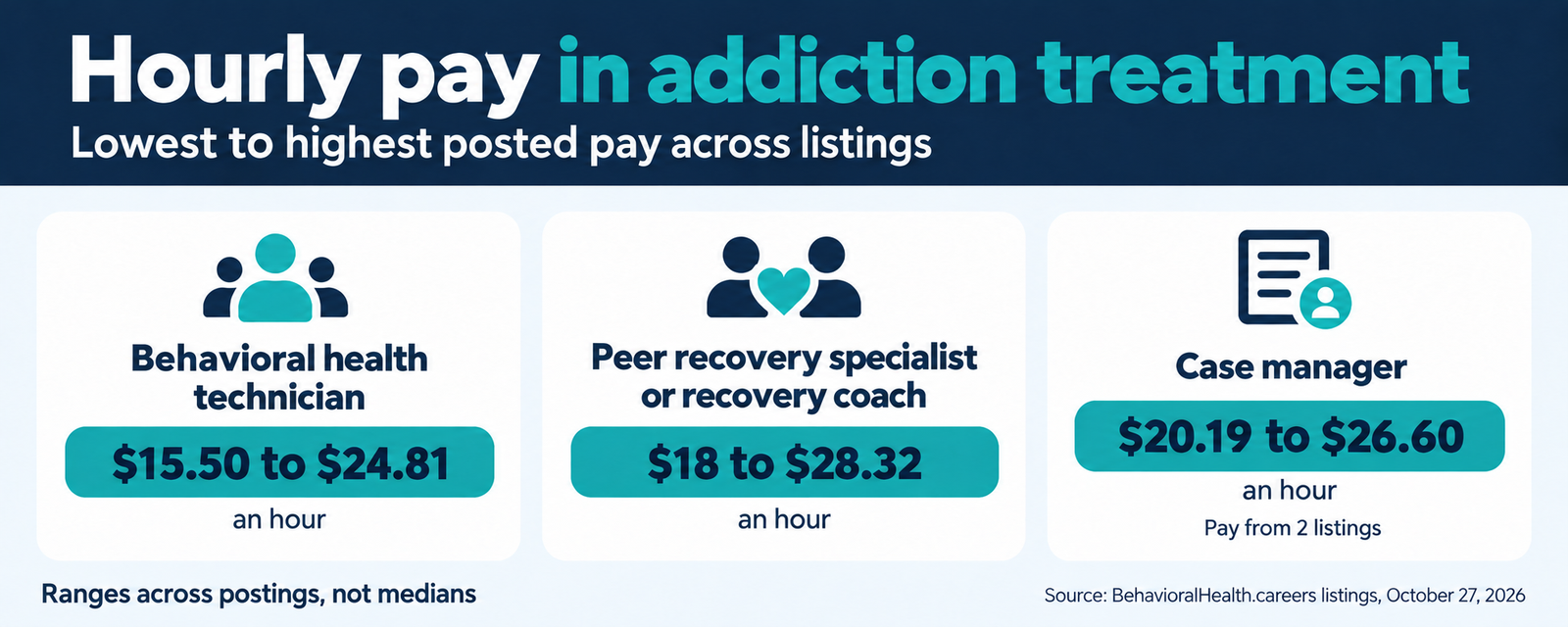
| Behavioral health technician | 26 | 4 | $15.50 to $24.81 an hour |
| Peer recovery specialist or recovery coach | 9 | 5 | $18 to $28.32 an hour |
| Case manager | 9 | 3 | $20.19 to $26.60 an hour (2 listings) |
| Recovery housing staff | 4 | 2 | $18 to $24.81 an hour; coordinators $45,500 to $58,000 a year |
| Admissions | 1 | 1 | Not posted |
| Nurse practitioner, physician assistant, or physician | 18 | 5 | $117,500 to $240,000 a year; some PRN roles $80 to $120 an hour |
| Clinical director or supervisor | 9 | 3 | $90,000 to $110,000 a year (1 listing) |
| Counselor or therapist | 53 | 6 | See our counselor guide |
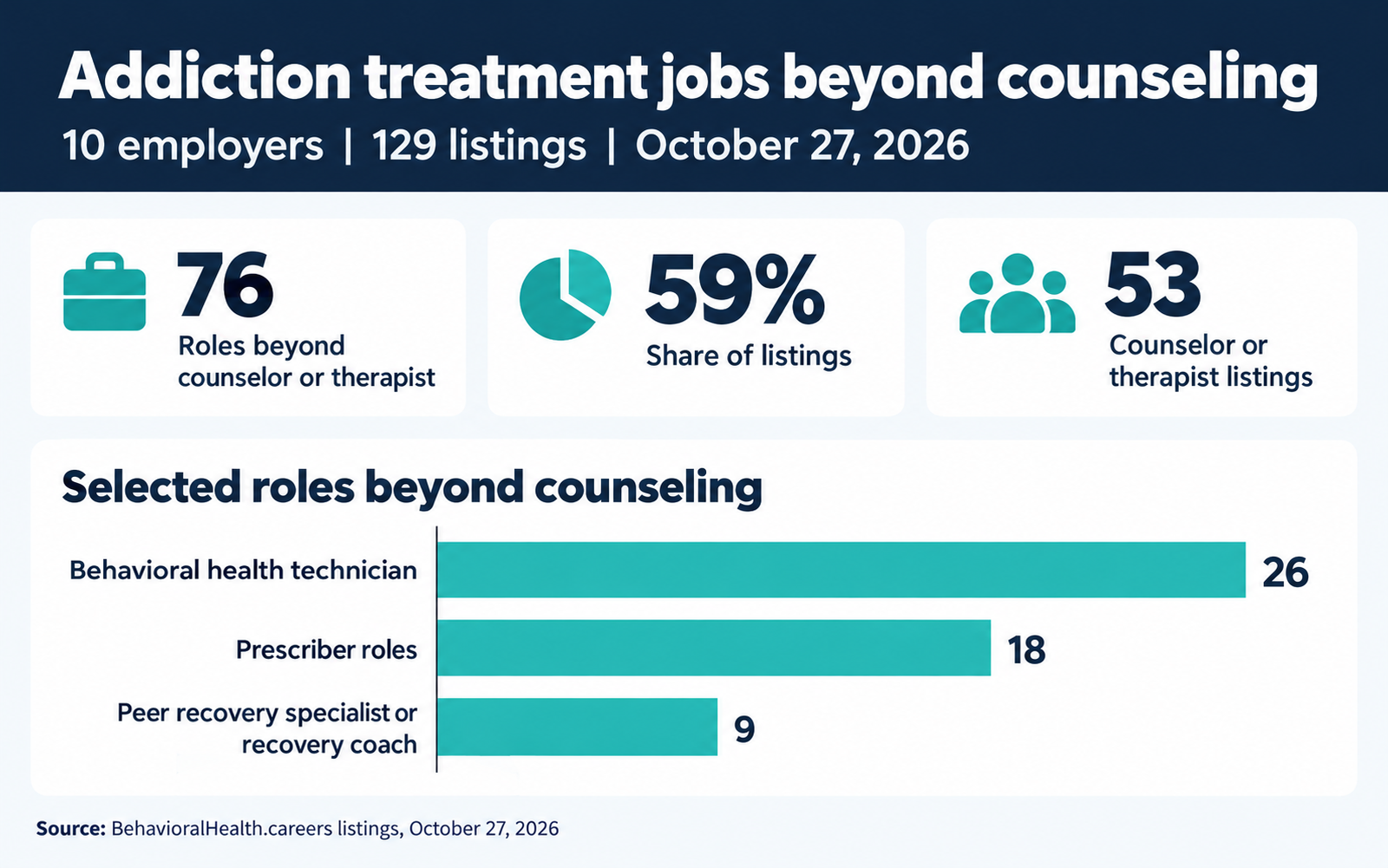
Source: BehavioralHealth.careers live listings, October 27, 2026, from The Recovery Village, Kolmac Integrated Behavioral Health, Boca Recovery Center, Lighthouse Behavioral Health Solutions, Boulder Care, Sandstone Care, Workit Health, Bicycle Health, Ophelia and Marigold Health. Pay shows the lowest and highest posted figures across listings, not medians.
Behavioral health technician
Behavioral health technicians (BHTs) work in residential and detox programs, among others, and The Recovery Village posted day, night and third-shift openings.
At The Recovery Village, BHT duties include collecting and documenting vital signs, completing medication observations, and assisting the medical and nursing team.
Requirements. The Recovery Village’s requirements varied by site. Some postings required a high school diploma or equivalent plus two years of patient care experience, or one year plus an associate degree, and a good driving record. Others listed the diploma and a year of experience as preferred and required a valid driver’s license. Sandstone Care required a high school diploma plus two years of college or a year of human services experience. Lighthouse Behavioral Health Solutions in Ohio required a diploma or GED, prior experience as a client advocate, personal care aide, or similar, and a minimum age of 25, with a state chemical dependency counselor assistant (CDCA) certification desired.
Pay. The Recovery Village posted $15.50 to $22 an hour, depending on the site, from $15.50 in Lewisville, Texas, and Dickson, Tennessee, to $22 in Upper Marlboro, Maryland. Sandstone Care posted $18 and $19.50 an hour. Lighthouse posted $17 to $24.81 an hour.
Our guide to becoming a behavioral health technician covers certification and first jobs.
Peer recovery specialist and recovery coach
Peer recovery specialists use their own experience of recovery to support people in treatment. SAMHSA’s core competencies for peer workers include sharing lived experience of recovery, supporting recovery planning, linking people to resources, and helping peers manage crises (SAMHSA).
Requirements. Lived experience is the core qualification. Lighthouse requires that its peer recovery support specialists “live a life in recovery,” hold an Ohio peer recovery support certification, and be at least 25.
Boulder Care, a telehealth addiction treatment provider, asked for two years of peer recovery experience, including with opioid use disorder treatment resources, plus state peer certification where available and national certification through NAADAC, or the ability to get it within nine months of hire.
Pay. All nine peer listings at these employers posted pay. Lighthouse posted $18 to $20 an hour. Boulder Care posted $24.52 to $28.32 an hour for 100% remote roles for residents of Colorado, Michigan, and Oregon.
Marigold Health posted $25 to $28 an hour for a virtual certified recovery coach role in Massachusetts, typically Tuesday through Saturday, 1 to 9 p.m.
Eastern. Workit Health posted $25 an hour, and Bicycle Health posted a target of $23 to $25 an hour for a remote recovery coach supporting people with opioid use disorder.
Several of these roles are remote.
Our peer support specialist career guide and state certification guide cover how to get certified.
Case manager
Case managers in addiction treatment handle the parts of recovery that happen outside the therapy room: insurance and benefits, housing, employment, legal issues, medical appointments, and aftercare.
Requirements. The Recovery Village’s integrated case manager posting in Salem, Oregon, required a high school diploma, preferred a bachelor’s degree in a health-related field, and posted $23 to $25 an hour.
Boca Recovery Center’s case manager postings required a high school diploma and at least a year of experience, preferred a bachelor’s degree in human services or a related field, and required CPR certification within 30 days of hire.
Lighthouse required the Ohio CDCA certification, at $20.19 to $26.60 an hour.
What a CDCA is. In Ohio, a chemical dependency counselor assistant must be at least 18, with a high school diploma or equivalent and 40 hours of approved substance use disorder education, for a preliminary certification that lasts 13 months.
Moving to the two-year renewable CDCA takes 30 more hours of approved education (Ohio Admin. Code 4758-5-01). Other states have their own entry-level credentials; check your state board.
Our behavioral health case manager career guide covers the role in more depth.
Admissions
Admissions staff take calls from people seeking treatment and their families, verify insurance, and schedule intake.
Boca Recovery Center’s admissions posting prefers experience coordinating admissions in a chemical dependency treatment setting, knowledge of addiction treatment approaches (including 12-step programs), and experience entering data in Salesforce. The listing didn’t post pay.
Our intake coordinator and admissions specialist guide covers the work.
Recovery housing
Recovery housing staff support people living in sober or recovery residences. Lighthouse and Boca Recovery Center both had openings. Lighthouse’s recovery housing support specialists help residents get access to medical, social, educational, vocational, and legal services, connect them to mutual support groups, assist with daily living, and transport residents.
Support specialist postings required a high school diploma or GED, a year of experience in behavioral health, recovery housing, or a related field, and a minimum age of 25. Lighthouse posted $18 to $24.81 an hour for support specialists and $45,500 to $58,000 a year for program coordinators, who oversee housing operations, inspections, and compliance.
Prescribers and medical roles
Addiction treatment providers also hire medical staff, and several of these roles on our board were telehealth.
- Nurse practitioners. Boulder Care posted telehealth addiction medicine nurse practitioner roles at $125,000 to $140,000 a year in eight states. The Recovery Village posted PRN nurse practitioner roles at $80 to $120 an hour in Washington and starting at $100 an hour in Oregon and Indiana.
- Physician assistants and psychiatric nurse practitioners. Ophelia posted a telehealth role at $117,500 to $125,000 a year.
- Medical directors. Boulder Care posted a telehealth addiction medicine medical director role at $200,000 to $240,000 a year. Boca Recovery Center posted psychiatrist medical director roles without pay.
Our guides to behavioral health nurse jobs and becoming a PMHNP cover these paths.
Outreach and leadership
Treatment programs also hire clinical directors and supervisors. Kolmac posted a licensed clinical director role in Elkton, Maryland, at a base of $90,000 to $110,000 a year.
Outside our 10-employer group, Charlie Health posted territory manager roles focused on substance use programs in 18 metro areas at $70,000 to $90,000 a year. These roles build relationships with referral partners such as detox centers, residential treatment centers, and rehabilitation facilities.
Counselors and therapists
Counselors and therapists are still the largest single group: 53 of the 129 listings. Requirements range from entry-level state credentials to independent clinical licenses. Kolmac posted addiction counselor roles for Maryland credentials (ADT, CSC-AD or CAC-AD) at $25 to $30 an hour, and licensed therapist roles at $34 to $44 an hour.
Nationally, substance abuse, behavioral disorder, and mental health counselors earned a median of $59,350 in May 2025, and BLS projects 18 percent job growth from 2025 to 2035. BLS says substance abuse counselors typically need at least a bachelor’s degree, though requirements “may vary from a high school diploma to a master’s degree” (BLS).
Our guide to becoming a substance abuse counselor covers state credentials.
How to get a job in addiction treatment
- Pick an entry point that fits your background. BHT roles start with a high school diploma. Boca’s admissions posting prefers admissions experience in a chemical dependency treatment setting. Peer roles start with lived experience and certification. Case management often prefers a bachelor’s degree.
- Get the credential employers name. For peer roles, that’s your state’s peer certification. At Lighthouse in Ohio, the CDCA was required for case management and preferred for BHT roles.
- Get CPR or BLS certified. 49 of the 129 listings mentioned CPR or Basic Life Support, and Boca Recovery Center allows 30 days after hire to get it.
- Expect background checks and drug screens at some employers. Lighthouse’s peer and recovery housing postings, for example, require a state background check and an employment drug screen.
- Plan your next credential. If you want to move into counseling, check your state’s addiction counselor credential, since many require supervised work experience.
Frequently asked questions
Can you work in addiction recovery without a degree?
Yes. On our board, behavioral health technician jobs at addiction treatment employers asked for a high school diploma or equivalent, and none required a degree; some Recovery Village postings listed even the diploma as preferred.
Peer recovery roles ask for lived experience and, at many employers, certification rather than a degree, and Lighthouse’s recovery housing support roles required a high school diploma or GED plus a year of related experience.
What does a peer recovery specialist do?
They use their own recovery experience to support people in treatment: building trust, helping set recovery goals, connecting people to resources and mutual support groups, co-leading groups, and helping in a crisis.
How much does a certified peer recovery coach make?
On October 27, 2026, the nine peer recovery listings at addiction treatment employers on our board posted $18 to $28.32 an hour. Too few peer listings posted pay across the whole board for us to report a median, which we do only with at least 10 listings from three or more employers.
Can I work in addiction treatment if I’m in recovery?
Yes, and for peer roles it’s required. For other roles, policies vary. Some employers screen for substance use at hire, and some state credentials have their own requirements, so read each posting and ask.
What jobs help people with substance use disorders without being a counselor?
Behavioral health technician, peer recovery specialist, case manager, admissions coordinator, recovery housing specialist, nurse practitioner and other prescriber roles all work directly with people in treatment.
Sources
- BehavioralHealth.careers live listings and listing text, read October 27, 2026 (1,279 published listings).
- Substance Abuse and Mental Health Services Administration, Core Competencies for Peer Workers in Behavioral Health Services.
- Ohio Administrative Code, 4758-5-01, Requirements for certification of chemical dependency counselor assistants.
- U.S. Bureau of Labor Statistics, Occupational Outlook Handbook, Substance Abuse, Behavioral Disorder, and Mental Health Counselors.