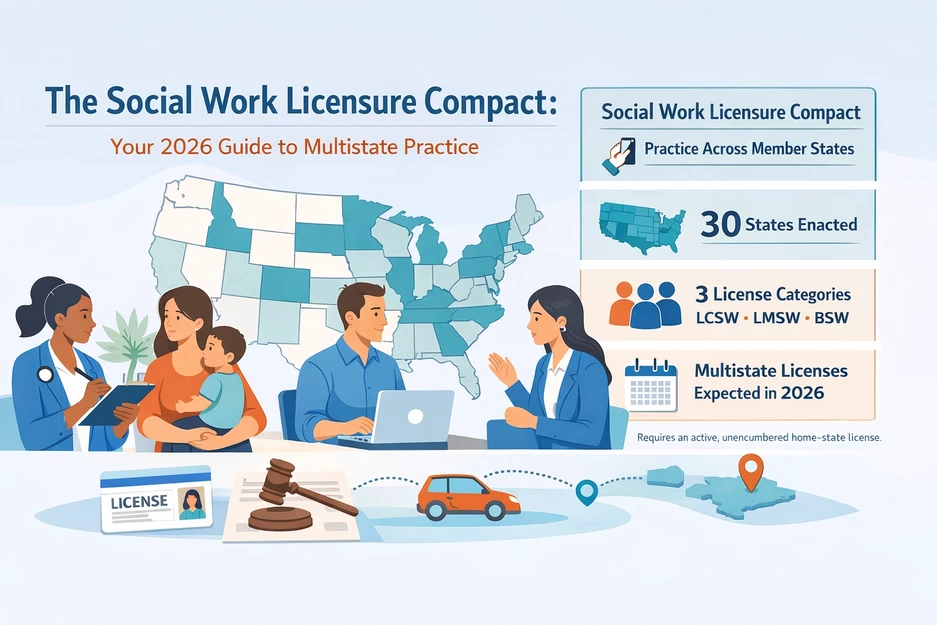
Disclaimer: This guide provides an overview of the Social Work Licensure Compact as of March 2026. Licensure requirements and compact participation are subject to change by individual state boards. This is not legal advice.
The era of "one state, one license" is officially ending. If you are a social worker, the geographic boundaries that once restricted your practice are dissolving.
The Social Work Licensure Compact is the final piece of the behavioral health mobility puzzle, joining the ranks of PSYPACT for psychologists and the Counseling Compact for professional counselors.
For years, social workers faced the most significant administrative hurdles when trying to cross state lines. In 2026, that friction is finally disappearing in a concerted regulatory effort to promote licensure portability.
This guide breaks down exactly what the compact means for your career, your caseload, and your ability to land remote therapist jobs in a competitive market.
At a Glance: The 2026 Compact Cheat Sheet
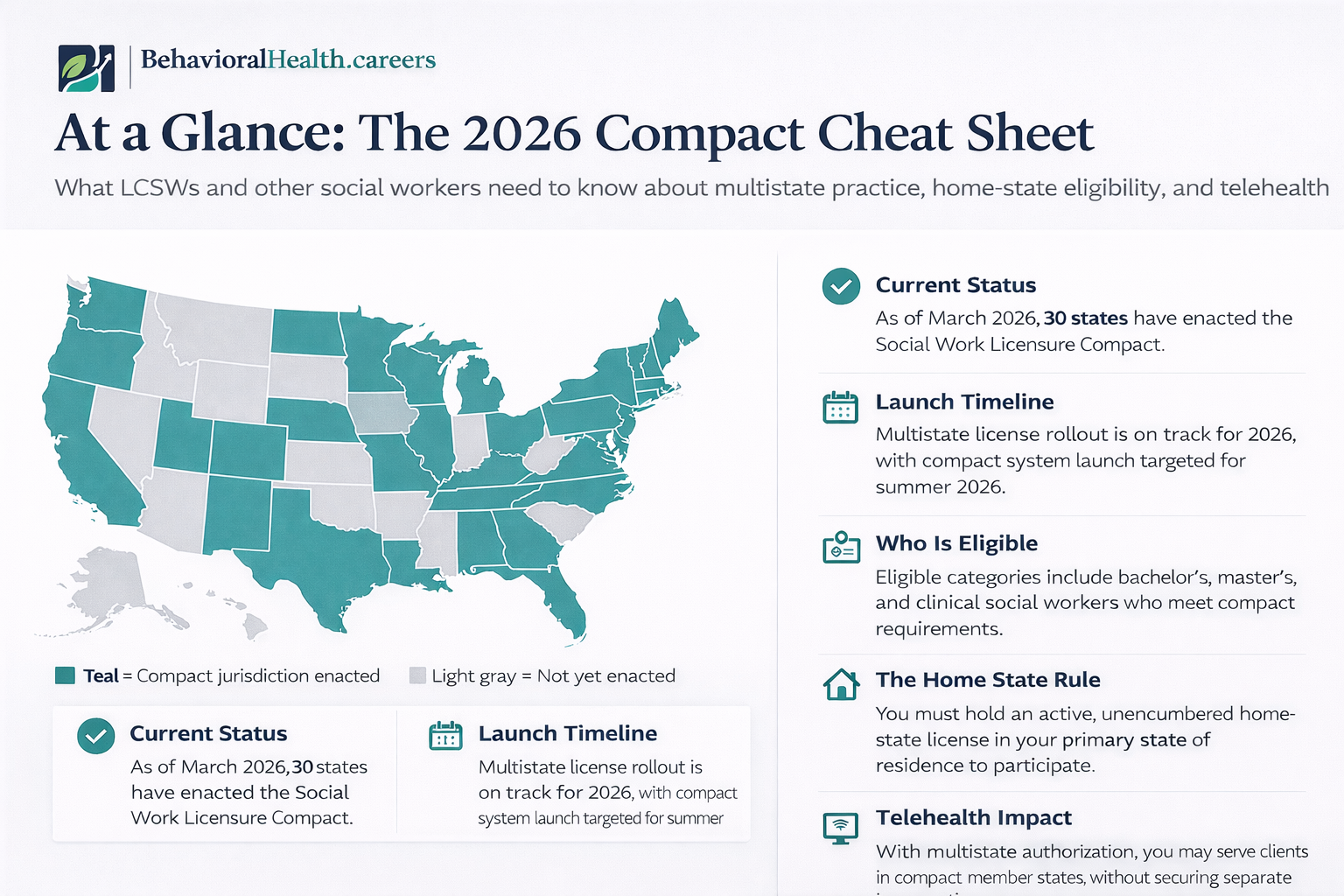
If you only have 60 seconds, here is the essential data you need to know:
- Current Status: As of March 2026, 30 states have formally enacted the interstate licensure compact.
- Launch Timeline: The Compact Commission expects to begin issuing the first multistate authorizations later this year.
- Who is eligible: Unlike other compacts, this includes LCSWs, LMSWs, and even BSWs (provided they meet exam requirements).
- The Home State Rule: You must hold an active, unencumbered license in your primary state of residence to participate.
- Telehealth impact: You can provide services to clients in any member state without applying for additional individual licenses.
The Mobility Puzzle: Why This Matters Now
For the last decade, the behavioral health industry has been moving toward a borderless model.
We’ve watched the Counseling Compact gain massive traction and PSYPACT become the gold standard for psychologists.
Social workers, who make up the largest segment of the mental health workforce, were the last major group to secure a legislative path to multistate practice.
How the Social Work Compact Differs from PSYPACT and Counseling
It is a common misconception that all interstate compacts are the same. While the goal is mobility, the "Social Work Licensure Compact" has unique features that set it apart from its predecessors:
- Broader Inclusion: PSYPACT is strictly for doctoral-level psychologists. The Counseling Compact is for Master’s level clinicians (LPCs/LMHCs). The Social Work Compact is the most inclusive, offering pathways for Bachelor’s (BSW), Master’s (LMSW), and Clinical (LCSW) levels.
- Exam Requirements: To participate in the compact, you must have passed the relevant ASWB national qualifying exam. This is a point of contention in states that have recently moved away from exam requirements for LMSWs, but it remains a baseline for the multistate license.
- Grandparenting Provisions: If you were licensed before your state required the ASWB exam, the compact includes a "grandparent" clause, provided you have maintained continuous, unencumbered licensure.
Eligibility: Who Can Get a Multistate License?
To qualify for the compact, you don't just need a degree; you need to meet the standard of the "Home State" model.
The Eligibility Checklist for Social Workers
- Primary Residence: You must live in a state that has officially joined the compact.
- Unencumbered License: Your current license must have no history of disciplinary action or active restrictions.
- Education: You must have graduated from a program accredited by the Council on Social Work Education (CSWE).
- Examination: You must have passed the BSW, MSW, or Clinical exam offered by the Association of Social Work Boards (ASWB).
- Background Check: You must submit to a fresh FBI fingerprint-based criminal background check.
If you meet these criteria, you will be able to apply for a "Multistate Authorization" through a centralized portal rather than applying to each state board individually.
Why You Should Prioritize the Compact in 2026
The benefits extend far beyond just avoiding paperwork.
For professionals looking at behavioral health careers, the compact is a massive value-add to your resume.
1. Remote Therapist Jobs and Telehealth
The most immediate benefit is the explosion of remote therapist jobs. Before the compact, a telehealth company had to wait months for you to get licensed in multiple states before you could carry a full caseload.
Now, a single authorization allows you to see clients across 30+ states. This makes you significantly more "hirable" for national telehealth platforms. You can explore these opportunities via our Remote jobs category.
2. Continuity of Care
We know that clients move. In the past, if your client moved from a compact state like Ohio to another like North Carolina, you would often have to terminate the relationship or face a lengthy licensing process. The compact ensures that the therapeutic bond remains intact regardless of the client's location, provided both states are members.
3. Support for Military Families
Military spouses in the social work profession have historically faced the highest rates of underemployment due to frequent PCS moves. The compact allows military spouses to maintain their career trajectory without restarting the licensure process every two to three years.
The Reality Check: What the Compact Legislation is NOT
While we are bullish on the benefits, we must clarify the limitations.
- It is not a "National License": There is no such thing. The compact is an agreement between specific states. If a state like California or New York has not joined, you still need a traditional license to practice there.
- Scope of Practice Varies: You must abide by the laws and rules of the state where the client is located. If a state has specific mandatory reporting laws or age-of-consent rules that differ from your home state, you are legally obligated to follow the rules of the "remote state."
- It is not Free: There will be a fee for the multistate authorization, though it is expected to be significantly lower than the cost of maintaining 30 individual licenses.
Strategic Career Moves: What to Do Next as an LCSW
If you are currently looking for licensed clinical social worker jobs, your strategy should shift to reflect the new multistate reality.
Update Your Resume: Explicitly state your eligibility for the compact. Use phrasing like: "LCSW in [Home State], eligible for Multistate Authorization via the Social Work Licensure Compact."
Check Your Home State Status: If your state hasn't joined yet, look at the legislative tracking maps. Many states are in the "active bill" stage. Advocacy at the state level can accelerate this process and move forward the Compact state for professional social work services in your home state.
Research Employers by Region: Focus your job search on companies that operate across compact member states. These employers are currently hungry for clinicians who can bridge the gap between states. You can browse companies currently hiring to see who has a multistate footprint.
FAQs on the LCSW Compact
Does the social workers compact change my CEU requirements?
No. You still fulfill the Continuing Education requirements of your home state. You do not need to complete CEUs for every state where you practice under the compact. The Clinical Social Work Association is one source of CEUs, among a range of others.
What if I move my primary residence?
If you move to another compact state, you must apply for a new "Home State" license in your new state of residence. Your multistate authorization will then be re-issued based on the new home state, and enable regulated social workers to practice.
Can I use the LCSW Compact if I have a disciplinary mark on my license?
Typically, no. The interstate occupational licensure compact for LCSWs requires an "unencumbered" license. If you have active restrictions or a history of certain disciplinary actions, you will likely be ineligible and must continue using the traditional single-state licensure path.
For more insights into the evolving job market, check out our Behavioral Health Workforce Outlook 2026 or dive into our Therapist Onboarding Checklist to stay ahead of the curve.
Ready to find your next multistate role? Search Behavioral Health Jobs Now.
References
Association of Social Work Boards. (2025, June 12). Social Work Licensure Compact on track for implementation timeline. https://www.aswb.org/social-work-licensure-compact-on-track-for-implementation-timeline/
Association of Social Work Boards. (2025). The licensed social work workforce: 2024 Social Work Workforce Study, second report. https://www.aswb.org/wp-content/uploads/2025/07/Social-Work-Workforce-Study-Series-Report-2.pdf
Case Management Society of America. (2024, March 4). A focus on the military spouse: How to overcome barriers to build a thriving professional career in social work. https://cmsatoday.com/2024/03/04/a-focus-on-the-military-spouse-how-to-overcome-barriers-to-build-a-thriving-professional-career-in-social-work/
Council of State Governments. (n.d.). Social work – National Center for Interstate Compacts. https://compacts.csg.org/compact-updates/social-work/
Council on Social Work Education. (n.d.). Accreditation. https://www.cswe.org/accreditation/
The Counseling Compact. (n.d.). About the compact. https://counselingcompact.org/about/
D'Aniello Institute for Veterans and Military Families. (2025, July). Military spouse employment landscape: Trends, barriers, and opportunities. Syracuse University. https://ivmf.syracuse.edu/article/military-spouse-employment-landscape/
D'Aniello Institute for Veterans and Military Families. (n.d.). Military spouse employment report. Syracuse University. https://ivmf.syracuse.edu/article/military-spouse-employment-survey/
Health Resources and Services Administration. (2018). Behavioral health workforce projections, 2016–2030: Social workers. U.S. Department of Health and Human Services. https://bhw.hrsa.gov/sites/default/files/bureau-health-workforce/data-research/social-workers-2018.pdf
Lombardi, B. M., Zerden, L. de S., & Fraher, E. (2024). Varying estimates of social workers in the United States: Which data source to use? Health Services Research & Managerial Epidemiology. https://doi.org/10.1177/10775587241257983
National Association of Social Workers. (n.d.). Interstate Licensure Compact for Social Work. https://www.socialworkers.org/Advocacy/Interstate-Licensure-Compact-for-Social-Work
PSYPACT. (n.d.). About PSYPACT. https://psypact.org/page/aboutpsypact
Social Work Licensure Compact. (n.d.). About the Social Work Licensure Compact. https://swcompact.org/
Social Work Licensure Compact. (n.d.). Compact map. https://swcompact.org/compact-map/
U.S. Bureau of Labor Statistics. (2024). Social workers: Occupational Outlook Handbook. U.S. Department of Labor. https://www.bls.gov/ooh/community-and-social-service/social-workers.htm
U.S. Bureau of Labor Statistics. (2024). Mental health and substance abuse social workers: Occupational Employment and Wage Statistics. U.S. Department of Labor. https://www.bls.gov/oes/current/oes211023.htm