The Counseling Compact is an interstate agreement that allows licensed professional counselors (LPCs) and those with equivalent state designations to practice in other compact member states without the need for multiple licenses.
A compact member state is defined as a state that has enacted Counseling Compact legislation and completed the necessary steps for implementation, allowing counselors licensed and residing in one member state to practice in other member states.
This comprehensive guide is designed for therapists (specifically LPCs and equivalent titles) and employers in the mental health field.
It covers the scope, requirements, and practical implications of the Counseling Compact, including how it enables multi-state practice, impacts hiring and service delivery, and supports telehealth and military spouse mobility.
The Counseling Compact is a game-changer for mental health professionals and organizations, reducing licensing burdens, expanding access to care, and ensuring continuity of services across state lines.
Core points covered in this guide
- Who the Counseling Compact applies to (LPCs and equivalent designations only)
- How the Compact enables multi-state practice for eligible counselors
- The impact on telehealth, military spouse support, and hiring practices
- The requirement for counselors to follow the laws of the state where the client is located
- Step-by-step action plan for getting compact-ready
State requirements and participation can change rapidly; always verify with your state board before making licensing decisions.
For up-to-date information on state participation and requirements, visit the Counseling Compact Commission website.
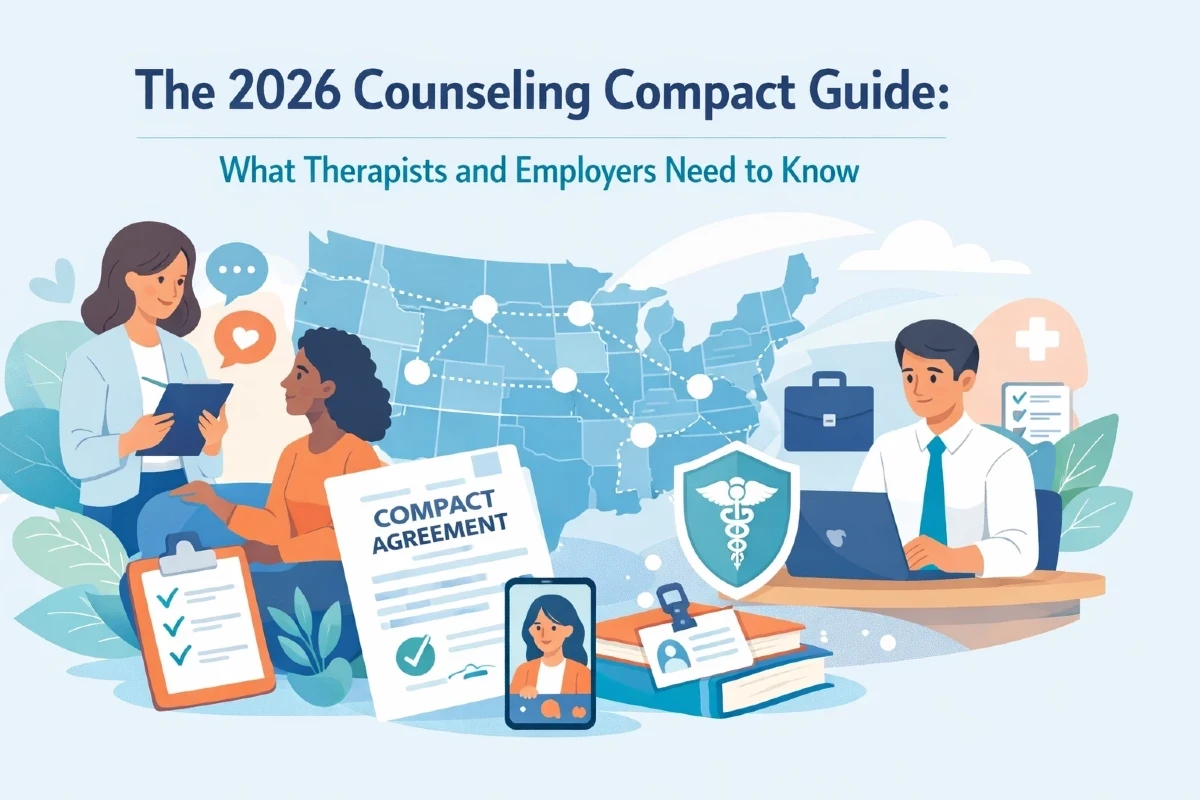
The EZ-Pass for Therapists: What the Compact Actually Is
Think of the Counseling Compact as the EZ-Pass for mental health professionals. Instead of stopping at every state border to pay fees and fill out 50 pages of paperwork for each new license, you get one “transponder” (your home state license) that lets you practice across 39+ member states.
The Counseling Compact is a mutual recognition model, meaning every participating state agrees to recognize the license of all eligible counselors from every other member state.
As of early 2026, over 35 states and jurisdictions have enacted compact legislation, and the Counseling Compact has now been passed by the legislatures of 39 states and jurisdictions.
And more participating states will be onboarding through the CompactConnect IT platform: the impact is already reshaping how therapists find work and how employers hire talent across state lines.
A New Model Enhancing Portability in Mental Health Treatment
This isn’t a new license. It’s a privilege-to-practice model; you maintain your home state license and apply for “compact privilege” in each additional state where you want to see clients.
A compact state is a participating state that has enacted compact legislation and completed the necessary steps for implementation, allowing professional counselors licensed in one member state to practice in other member states.
The main difference: one application process, shared standards, and significantly less administrative burden.
The Counseling Compact applies only to counselors licensed as LPCs or the equivalent designation used by the state. It does not include other licenses such as MFTs, art therapists, or other mental health professionals.
The Counseling Compact At-a-Glance: Member States and Status
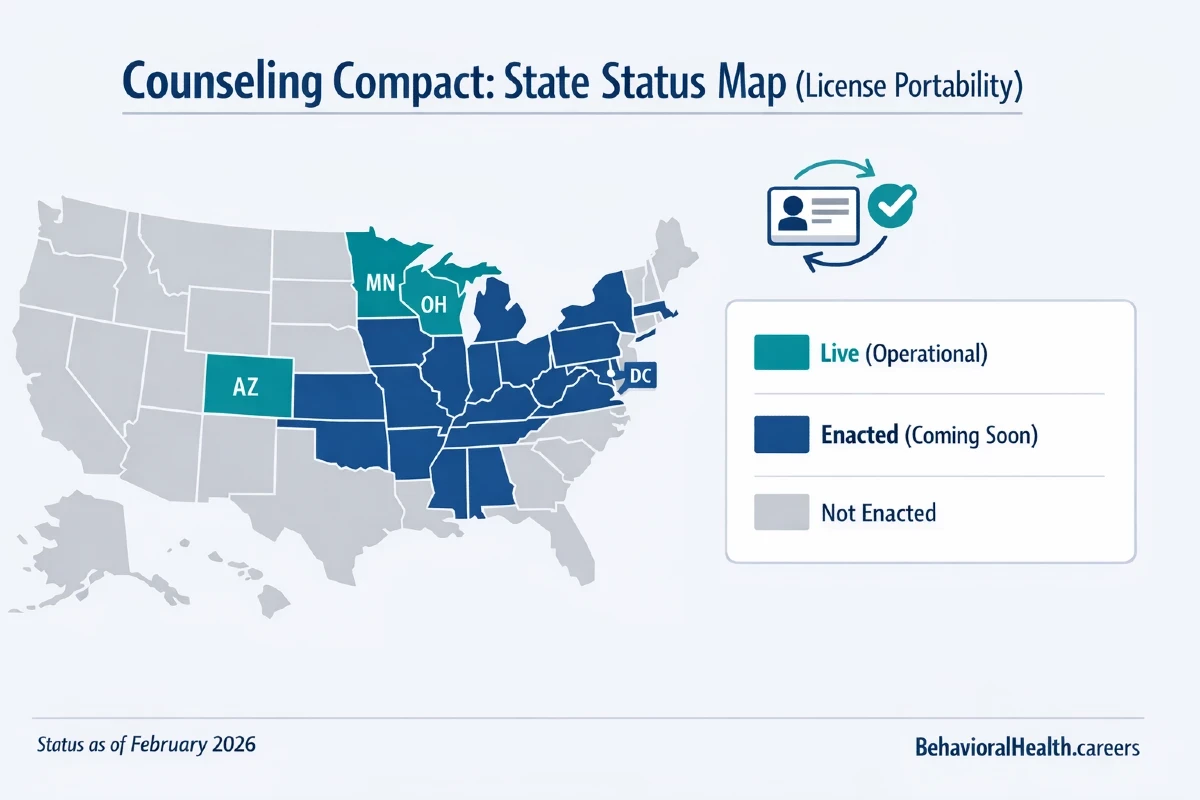
What “Operational” Means
The state’s licensing board is actively processing compact privilege applications through the CompactConnect system.
In this context, "member states" refers specifically to compact member states that have enacted Counseling Compact legislation and have completed the necessary technical and regulatory steps for participation.
Counselors licensed in one participating state can apply for privileges to practice in other compact member states, ensuring seamless mobility and continuity of care across jurisdictions.
This interconnectedness allows licensees to work in other member states and other compact member states, expanding professional opportunities and access to care.
What “Enacted” Means
The state passed the law, but the IT infrastructure and board procedures are still being finalized. Timeline varies by state; some will be live by mid-2026, others may take until 2027.
For Therapists: How the Privilege to Practice Model Works
The Counseling Compact doesn’t issue you multiple licenses.
Instead, you hold one valid, unencumbered license in your home state (where you are residing in a compact member state or maintain your primary practice) and then apply for the privilege to practice in each additional member state where you want to provide licensed professional counseling services.
This eliminates the need for multiple licenses and allows licensees to practice across state lines.
Eligibility Requirements
To be eligible for compact privilege, you must:
- Hold a master’s degree or higher in counseling or a related field (minimum 60 graduate semester hours)
- Have an active, valid, unencumbered license in good standing in your home state (must be licensed as an LPC or the equivalent designation used by the state)
- Reside in a compact member state at the time of application
- Have no disciplinary actions or investigations pending
- Complete an FBI background check with fingerprinting (this is the step that takes the longest; start early)
- Complete the jurisprudence requirements for each state where you request privilege
- Be able to practice independently and assess, diagnose, and treat behavioral health conditions
Once approved, you pay a privilege fee (typically $100-$300 per state, though this varies) and can begin practicing in the member state. You must follow the practice standards and laws of the state where your client is physically located, not your home state.
This is especially important for telehealth, as you must comply with the client’s state laws regarding confidentiality, record retention, mandated reporting, and informed consent.
The Counseling Compact is a mutual recognition model, allowing professional counselors licensed in one member state to practice in other member states without the need for multiple licenses.
States can join the compact if their licensure requirements include a 60-hour degree in counseling or designated graduate coursework, post-degree supervised experience, and passing a nationally recognized examination.
The compact also provides support for military spouses, enabling them to practice in any compact state during relocations, and increases access to care in underserved areas by expanding the pool of available therapists.
Reporting Obligations
If your license status changes (disciplinary action, lapse, criminal conviction), you must report it to both your home state and every state where you hold compact privilege.
Licensees in Arizona and other states must maintain a valid license, and disciplinary actions in one state affect privileges in all other member states. Failure to report results in immediate loss of privileges and potential disciplinary action across all member states.
Now that you understand how the privilege-to-practice model works, let's look at what this means for employers.
For Employers: The Talent Gold Rush
The Counseling Compact is transforming the way employers hire and manage mental health professionals, solving the “shortage area” problem and opening up hiring pools exponentially.
Core Benefits for Employers
- Hire therapists in Georgia to serve clients in Nebraska, legally and without navigating 50 different licensing boards
- Support remote work without geographic restrictions for roles that don’t require in-person contact
- Expand employee assistance programs (EAPs) to cover multi-state workforces with fewer contractors
- Reduce turnover caused by relocation; therapists can move without losing the ability to serve existing clients
- Improve access to mental health care by increasing the pool of available therapists, especially in underserved areas
- Support military spouses by allowing them to practice in any compact state during relocations
- Ensure increased continuity of care for clients who move between states
Hiring Implications
When you post a role as “Compact Eligible” on BehavioralHealth,careers, you signal to candidates that you’re set up to support multi-state practice.
This is a competitive advantage in 2026, especially for remote therapist jobs or hybrid positions.
What You Need in Place
- Telehealth infrastructure that complies with HIPAA and state-specific regulations
- Contracting language that clarifies which state’s laws govern the therapeutic relationship
- Malpractice insurance that covers compact privilege practice (verify with your carrier)
- Supervision protocols if you employ provisionally licensed counselors, as compact privilege doesn’t automatically extend to pre-licensed clinicians
With these employer benefits in mind, let’s consider whether the compact is worth the cost for individual therapists.
Is the Counseling Compact Worth the Cost?
Let's talk money. Most states charge $200-$500 for an initial compact privilege, plus renewal fees every 1-2 years.
Add in the FBI fingerprinting fee ($50-$100), and you're looking at $300-$600 per state to get started.
Worth it if:
- You want a remote-first career and plan to see clients in 3+ states regularly
- You live near a state border and draw clients from both sides (think DC/Maryland/Virginia or Kansas City, Kansas/Missouri)
- You're building a telehealth practice and want to maximize your client pool
- Your employer requires multi-state coverage for EAP or group contracts
Skip it if:
- You only see clients in one state and have no plans to expand
- You're still building your caseload locally and need to minimize upfront costs
- Your state isn't operational yet, and you need immediate multi-state access (you'll need to pursue traditional licensure by endorsement)
The ROI calculation: If you add just 5 clients per month from a new state at $120/session, that's $7,200/year in additional revenue. The compact privilege pays for itself in 2-3 weeks.
Ready to get started? Here’s your step-by-step action plan to become compact-ready.
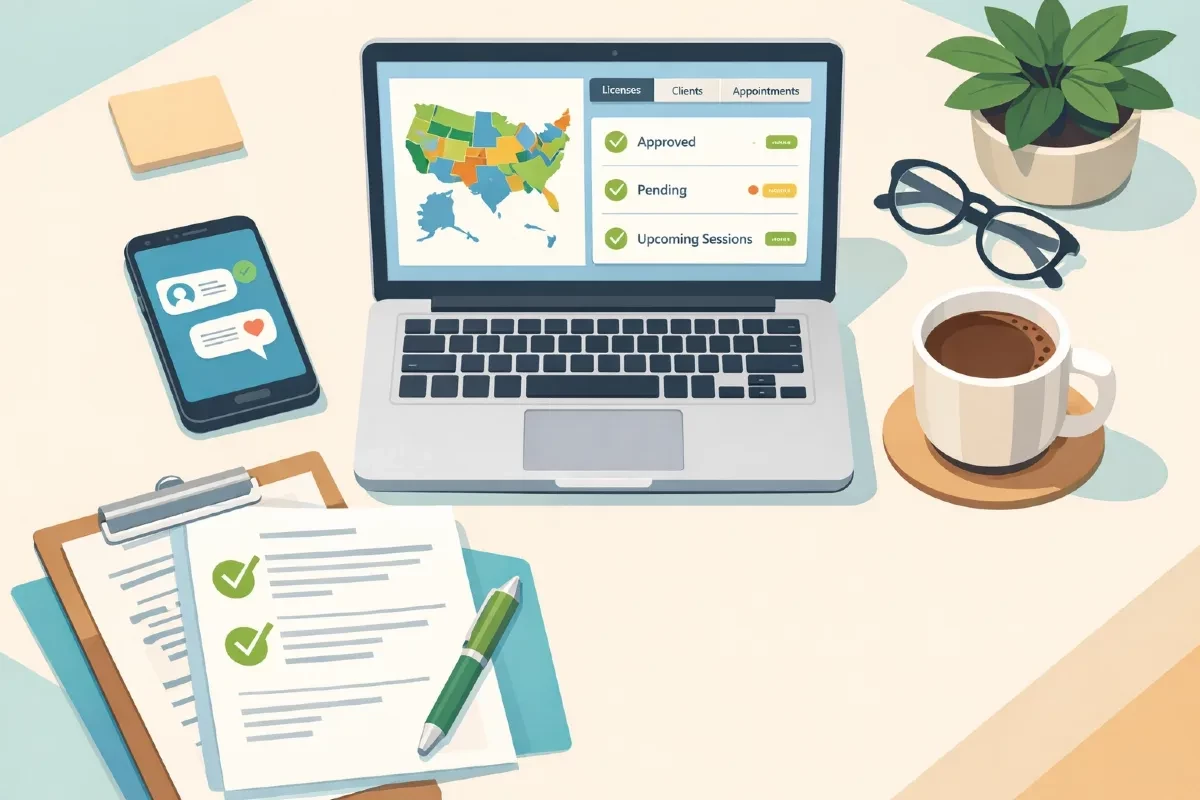
Our Action Plan on How to Get Compact-Ready
Follow this sequence to position yourself for compact practice. Before you can process compact privilege applications, your state must complete the technical and regulatory steps necessary for implementation, including secure data sharing and system testing.
1. Verify your home state is a member
Check the Counseling Compact Commission website for current operational status. Some states are actively completing the technical and regulatory steps required for implementation, such as secure data sharing and system testing. As of early 2026, applications for compact privileges are operational in several states, including Ohio. If your state is “enacted but not operational,” you can prepare but not yet apply.
2. Start FBI fingerprinting early
This is the bottleneck. Schedule your fingerprinting appointment through an approved vendor 60-90 days beforeyou plan to apply. Results can take 4-8 weeks.
3. Audit your license status
Confirm your home state license is unencumbered, active, and current on continuing education requirements. Any disciplinary actions or lapses will disqualify you.
4. Identify target states
Look at where your potential clients are located. If you’re job searching, filter by “Compact Eligible” roles on BehavioralHealth.careers to see which states have the most opportunities.
5. Apply through CompactConnect
Once your target state is operational, submit your application through the centralized portal. You’ll need transcripts, verification of licensure, and fingerprint results.
6. Update your malpractice insurance
Notify your carrier that you’re practicing under compact privilege. Some policies automatically cover this; others require an endorsement.
With your action plan in place, let’s address some of the most common questions about the Counseling Compact.
FAQs on Counseling Compact States and Other Considerations
Does the Counseling Compact include social workers?
No. Licensed Clinical Social Workers (LCSWs) have a separate Social Work Licensure Compact with different member states and requirements. The two systems don’t overlap; check which compact applies to your credential.
Can I use compact privilege for telehealth?
Yes, the Counseling Compact allows counselors to use telehealth in their practice, but you must follow the laws of the state where the client is physically located during the session. This includes informed consent requirements, record-keeping rules, and mandated reporting standards.
Can provisionally licensed counselors use the compact?
No. Compact privilege is only available to independently licensed counselors. If you’re still accruing supervised hours toward full licensure, you must practice under your home state’s supervision rules.
How long does it take to get approved?
Once your state is operational, 30-60 days is typical from application submission to privilege approval. The FBI background check is usually the longest part of the process.
How is the Counseling Compact governed, and what is the Commission’s structure?
The Counseling Compact Commission is made up of representatives from each compact member state, with each state’s licensing board appointing one current board member to serve as a commissioner.
The full Commission meets at least twice a year to address the business of the Compact, and counselors are welcome to attend Commission meetings or review past meeting minutes at CounselingCompact.Gov.
The Commission has four subcommittees: the Executive Committee, Finance Committee, Rules Committee, and Compliance Committee. The Executive Committee oversees operations and the budget, while the Rules Committee develops rules to implement the Compact.
The Commission has promulgated rules, developed the budget, and hired a vendor to develop the database for the Compact. The Commission cannot go beyond the requirements of the Compact legislation, but can provide details and clarity about the regulations.
Find Compact-Friendly Employers Now
Whether you're expanding your private practice across state lines or looking for a remote role that lets you serve clients nationwide, the Counseling Compact is the infrastructure change that makes it possible.
Whether you are a job seeker or employer, BehavioralHealth.careers is your single source platform for careers and career-enhancing resources in the industry. Check out our growing list of compact-friendly roles by searching and filtering, or submit a Compact-related role now!
Related Resources
- Careers in Behavioral Health
- PSYPACT States and Telepsychology Portability
- Behavioral Health Pay Transparency in 2026
- Therapist Onboarding Checklist (for employers and clinicians)
- PMHNP Jobs: Path to Credentialing and Role Definition
- Collaborative Care Model for Mental Health: CoCM Guidance