If you have found our resource, you probably already know the reality: PSYPACT can affect how psychologists pursue remote roles and how employers hire for multi-state telepsychology coverage.
Our guide from BehavioralHealth.careers is purposefully designed for all parties affected by PSYPACT legislation: job seekers (licensed psychologists), recruiters, and behavioral health employers hiring for US-only telepsychology roles.
The compact was developed by the Association of State and Provincial Psychology Boards (ASPPB), which serves as the main association for psychology licensing boards.
The PSYPACT Commission acts as the governing body responsible for overseeing the compact and creating its rules and bylaws. Participation and requirements can change, so always verify using official PSYPACT resources and the relevant state psychology boards.

What is PSYPACT?
PSYPACT (the Psychology Interjurisdictional Compact) is a mutual recognition compact designed to support interstate practice and interjurisdictional telepsychology for a psychologist licensed in a participating US jurisdiction.
Only a psychologist licensed in a participating jurisdiction can apply for PSYPACT credentials.
The authority of PSYPACT is granted through specific credentials, such as the APIT (Authority to Practice Interjurisdictional Telepsychology), which enables psychologists to practice interjurisdictional telepsychology (APIT) and provide mental health services across state lines.
PSYPACT facilitates access to mental health services, particularly in rural areas and underserved communities, helping to minimize disparities in mental health care and improve overall mental health outcomes.
In plain English: if a psychologist is licensed in a participating jurisdiction and meets PSYPACT requirements, they may be able to deliver telepsychology across state lines to clients located in other participating jurisdictions, subject to compact rules and each jurisdiction’s laws and scope of practice.
A core clarification for hiring
PSYPACT is for licensed psychologists, not a general “therapist compact.” It does not automatically apply to counselors, marriage and family therapists, or social workers.
What “privilege to practice” means
Under a compact model, PSYPACT eliminates the need for additional licenses for both telepsychology in terms of remote roles and temporary in-person (face-to-face) practice in another participating jurisdiction.
Psychologists may practice telepsychology or obtain temporary authorization to practice (TAP®) for face-to-face practice in another PSYPACT state for up to 30 days per calendar year, as long as the psychologist holds the appropriate compact authorization and follows the rules of the jurisdiction where the client is located.
This is a compliance and credentialing topic, so employers should verify requirements through official PSYPACT resources and state boards.
PSYPACT basics: E.Passport vs APIT
Important correction for hiring:
- APIT is the authorization for telepsychology under PSYPACT.
Temporary in-person practice is typically tied to TAP/IPC (not APIT). The Interjurisdictional Practice Certificate (IPC) is required for psychologists to provide temporary, face-to-face clinical services across PSYPACT states without obtaining additional state licenses, usually for up to 30 days per year.
Both E.Passport and IPC authorizations are valid for one year and must be renewed annually. Employers should confirm what the role actually requires.
Our PSYPACT map of states participating
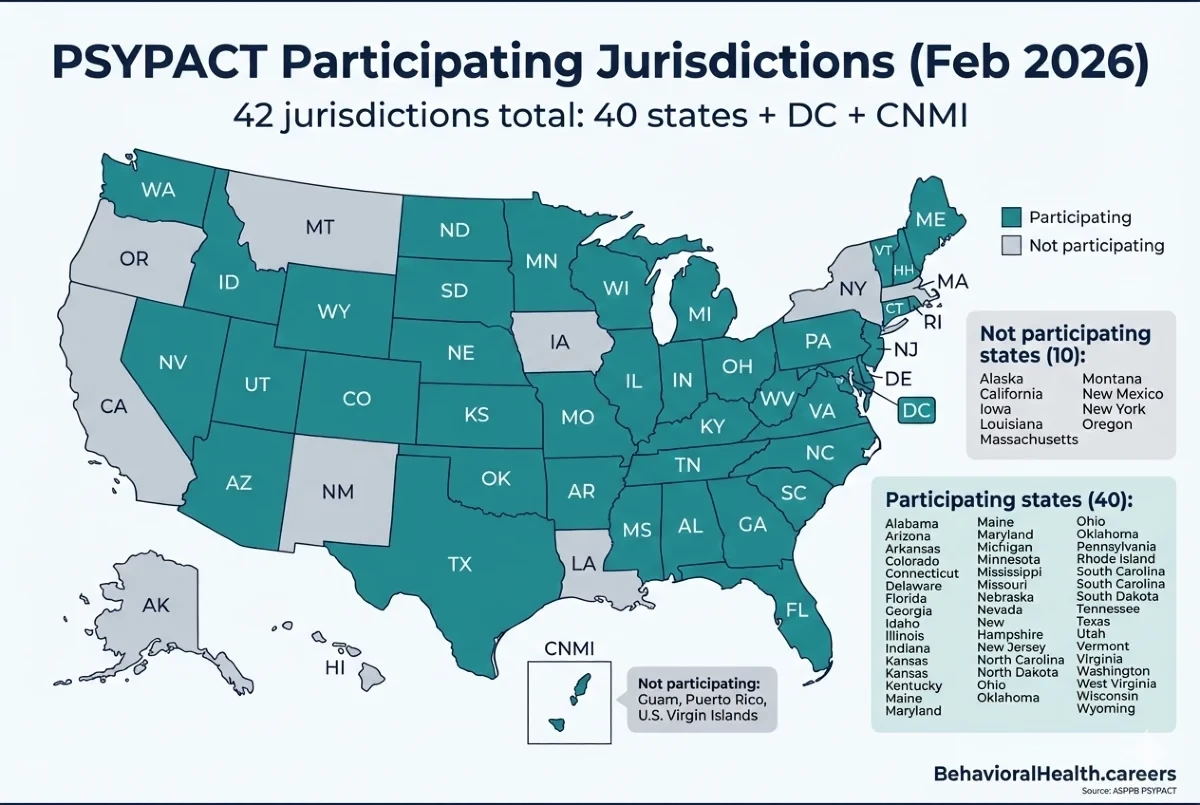
Participating jurisdictions as of February 2026
As of 2026, PSYPACT has been adopted by 42 jurisdictions, including 40 states, the Northern Mariana Islands, and the District of Columbia.
Based on the PSYPACT participating-jurisdictions listing available from official compact-related sources, participating states include the following states:
- Alabama
- Arizona
- Arkansas
- Colorado
- Connecticut
- Delaware
- District of Columbia
- Florida
- Georgia
- Idaho
- Illinois
- Indiana
- Kansas
- Kentucky
- Maine
- Maryland
- Michigan
- Minnesota
- Mississippi
- Missouri
- Nebraska
- Nevada
- New Hampshire
- New Jersey
- North Carolina
- North Dakota
- Ohio
- Oklahoma
- Pennsylvania
- Rhode Island
- South Carolina
- South Dakota
- Tennessee
- Texas
- Utah
- Vermont
- Virginia
- Washington
- West Virginia
- Wisconsin
- Wyoming
- Commonwealth of the Northern Mariana Islands (US territory)
States that are not part of PSYPACT include Alaska, California, Guam, Iowa, Hawaii, Louisiana, Massachusetts, New Mexico, New York, Oregon, Puerto Rico, and the U.S. Virgin Islands.
Always verify because participation can change and the list is rapidly expanding. For hiring and onboarding, treat the map as a required pre-check and document the “verified on” date internally.
Who is typically eligible for PSYPACT?
Eligibility is state-dependent and can change. In general, PSYPACT eligibility commonly involves:
- Holding a full, unrestricted license as a psychologist in a participating PSYPACT jurisdiction
- Being in good standing (no active encumbrances or discipline that would affect eligibility)
- Completing PSYPACT-related credentialing steps for the type of practice the role requires (telepsychology vs temporary in-person)
- Following compact rules about where the psychologist is located and where the client is located during service delivery
Because requirements vary and can change, employers should verify through:
- The official PSYPACT map and PSYPACT Commission materials
- The candidate’s licensing board(s)
- The board(s) in the client-serving jurisdictions for role-specific expectations
A step-by-step PSYPACT eligibility checklist
PSYPACT eligibility checklist (job seeker or psychologist)
[ ] Confirm your home jurisdiction participates in PSYPACT (use the official PSYPACT map)
[ ] Confirm your psychologist license is active, full, and unrestricted
[ ] Confirm you are in good standing (no encumbrances that could affect eligibility)
[ ] Confirm what the role requires:
- Telepsychology across state lines (typically needs E.Passport + active APIT)
- Temporary in-person practice across jurisdictions (typically uses TAP/IPC)
[ ] Review the official PSYPACT requirements and any notes from your home state psychology board
[ ] Review the receiving/client-location jurisdiction requirements and scope expectations (state board verification)
[ ] Confirm employer policies for multi-state telepsychology (documentation, workflow, coverage areas)
[ ] Confirm malpractice coverage aligns with multi-jurisdiction practice (high-level, verify with insurer and employer)
[ ] Keep documentation ready:
- License verification details
- PSYPACT credentials/authorizations (for example, proof of E.Passport and active APIT if needed)
- Any employer-required attestations or compliance forms
What employers should verify before hiring for multi-state telepsychology
Employer verification checklist for PSYPACT hiring
[ ] Confirm the candidate’s license type and level:
- Licensed psychologist (independent practice level)
- State/jurisdiction of licensure
- Active and in good standing (primary source verification)
[ ] Confirm the candidate’s credentials are approved:
- Verify that the candidate’s APIT or IPC status is officially approved by the PSYPACT Commission and relevant state licensing boards
[ ] Confirm PSYPACT status for the role:
- If telepsychology across state lines is required, verify active APIT
- If occasional temporary in-person practice is required, verify TAP/IPC as applicable
[ ] Define the coverage footprint:
- Which client-location jurisdictions will be served
- Confirm each is participating in PSYPACT at the time of service (official map verification and date-stamp)
[ ] Align scope and modality:
- Telehealth-only vs hybrid expectations
- Any in-person travel requirements and which jurisdictions that includes
[ ] Confirm documentation and supervision expectations (as applicable to role and setting)
[ ] Confirm malpractice coverage (high-level):
- Ensure coverage fits multi-jurisdiction telepsychology and role duties
[ ] Set an internal compliance process:
- Track served jurisdictions per clinician
- Re-verify PSYPACT participation on a schedule and when roles expand
- Store verification screenshots or logs with “verified on” dates
[ ] Establish a change-management process:
- What happens if a jurisdiction’s status changes or if a clinician’s authorization status changes
[ ] When appropriate, confirm with internal legal/compliance counsel how your organization documents and audits these checks
Note: Employers are encouraged to contact state licensing boards or the PSYPACT Commission directly to verify approval status or obtain additional information as needed.
Hiring implications for 2026: what changes in recruiting and staffing
These are practical patterns employers are likely to see as multi-state telepsychology and telepsychiatry remain a major staffing strategy. Outcomes depend on jurisdiction status, organizational policy, and candidate supply.
PSYPACT is designed to facilitate interstate practice for providers, streamlining licensure and credentialing processes so licensed psychologists can deliver telehealth services and human services across state lines.
This not only expands access to care for patients but also supports military families by improving access to mental health services and allows military spouses who are psychologists to sustain a counseling practice through telecommunications in PSYPACT states.
With PSYPACT, all of our specialists in the state can now access patients in many other states, enhancing both recruitment and service delivery options.
- Potentially larger candidate pools for remote therapist jobs and psychologist roles when multi-state coverage is permitted and verifiable.
- Potentially faster time-to-fill for hard-to-staff service lines if you can recruit beyond one-state boundaries.
- Increased demand for “multi-state eligible” psychologists and more explicit job-posting requirements (for example, specifying PSYPACT and the jurisdictions served).
- More structured credential tracking (APIT status, served jurisdictions, verification dates, and ongoing monitoring).
- Clearer candidate positioning: job seekers may benefit from stating their telepsychology readiness accurately and documenting their verification habits.
How to list PSYPACT on a resume and during interviews
Safe, non-misleading resume line examples
Use language that is accurate, avoids guarantees, and signals you understand verification is required.
- “Licensed Psychologist (State). PSYPACT telepsychology authorization status available upon request (jurisdiction requirements verified per role).”
- “Licensed Psychologist (State). Experience supporting multi-state telepsychology workflows; verifies client-location jurisdiction requirements before service delivery.”
- “Licensed Psychologist (State). Holds PSYPACT-related credentials (for example, E.Passport and active APIT if applicable) and maintains documentation for employer verification.”
Interview questions employers may ask + how to answer accurately
Which jurisdictions can you serve via telepsychology?
Answer with the jurisdictions you have verified as participating, plus your process for re-checking changes.
Do you currently hold an active APIT?
Provide the verification-ready details and confirm you understand APIT must be active for telepsychology under PSYPACT.
Do you hold an E.Passport, and do you renew as required?
Be specific about your credential status and renewal practices.
Where will you be physically located while providing telepsychology services?
Describe your home-state setup and that you verify location-related requirements per PSYPACT rules and employer policy.
How do you document client location and jurisdiction at time of service?
Explain your workflow (intake location capture, session confirmation, EHR documentation standards).
Have you supported multi-state compliance processes before?
Share examples (verification logs, audits, coordination with credentialing teams).
Does your role ever require temporary in-person services?
Clarify whether you have (or would obtain) the required temporary in-person authorization pathway if the job requires it.
How do you respond if a jurisdiction’s participation status changes?
Explain your escalation and stop-work process until requirements are confirmed.
Common misunderstandings about PSYPACT
- Myth: PSYPACT applies to all therapists.
- Reality: PSYPACT is specific to licensed psychologists and does not automatically apply to counselors, MFTs, or social workers.
- Myth: PSYPACT eliminates all state requirements.
- Reality: Employers and psychologists still need to follow compact rules and the laws and scope expectations of the client's location jurisdiction.
- Myth: If you can do telehealth in one state, you can do it anywhere.
- Reality: Telepsychology across state lines depends on participation status, credentials/authorizations, and jurisdiction rules that can change.
- Myth: Having an E.Passport alone is enough to practice telepsychology under PSYPACT.
- Reality: Telepsychology under PSYPACT typically requires an active APIT (verify for role and jurisdiction).
- Myth: “Multi-state telepsychology” always means national coverage.
- Reality: Coverage is limited to participating PSYPACT jurisdictions and the role’s defined service footprint.
- Myth: Employers can skip verification if the candidate says “PSYPACT eligible.”
- Reality: Hiring teams should verify license status, authorization status, and participating jurisdictions using primary sources.
- Myth: Temporary in-person work is covered by the same authorization as telepsychology.
- Reality: Telepsychology and temporary in-person practice generally use different compact pathways (verify what the role requires).
- Myth: You can practice temporarily in another PSYPACT state without special approval.
- Reality: To practice temporarily in another PSYPACT state, a psychologist must obtain temporary authorization, known as Temporary Authorization to Practice (TAP), and follow the formal notification and verification process as required by the compact.
FAQs on telepsychology licensing across states
What does PSYPACT stand for?
It refers to the Psychology Interjurisdictional Compact, a compact intended to support interjurisdictional practice for licensed psychologists in participating US jurisdictions.
Which states are in PSYPACT?
Participation changes. Use the official PSYPACT map to verify current participating jurisdictions and document the verification date.
Where can I find the PSYPACT map?
On the official PSYPACT website map page, as well as our version from BehavioralHealth.careers. Employers should use it as a required pre-check for any multi-state telepsychology role.
Do all psychologists qualify automatically?
No. Eligibility is state-dependent and typically requires an active psychologist license in good standing plus PSYPACT-related credentials/authorizations for the practice type.
What is E.Passport?
E.Passport is an ASPPB-issued credential used in the PSYPACT telepsychology pathway.
What is APIT?
APIT is the Authority to Practice Interjurisdictional Telepsychology, issued by the PSYPACT Commission when active and applicable requirements are met.
Does PSYPACT allow telehealth across state lines?
It can allow telepsychology across participating jurisdictions for psychologists who meet requirements. Employers should verify both participation status and the clinician’s authorization status.
Can I see clients in a non-PSYPACT state?
PSYPACT coverage is limited to participating jurisdictions. For non-participating jurisdictions, requirements differ and must be verified with the relevant state board and employer compliance process.
How do employers verify PSYPACT eligibility?
Verify the candidate’s license status via state board primary sources and confirm PSYPACT authorization status using official PSYPACT verification tools and documentation.
How should I list PSYPACT on my resume?
Use accurate language that reflects your license, authorization status (if applicable), and your verification process. Avoid implying guaranteed multi-state coverage.
Have all states enacted PSYPACT legislation?
No. As of early 2026, states like Hawaii, Iowa, and New Mexico have introduced PSYPACT legislation but have not yet enacted it. This means they are considering joining but are not yet participating.
What roles do provincial psychology boards and health and human services play in PSYPACT?
Provincial psychology boards, along with state boards and health and human services departments, help oversee licensing, certification, and the implementation of PSYPACT. They support cross-country and interstate practice by standardizing telepsychology practices and facilitating cooperation between jurisdictions.
What legal and regulatory issues does PSYPACT address?
PSYPACT addresses legal and regulatory issues that have complicated interjurisdictional practice in the past, making it easier for psychologists to provide services across state lines while maintaining compliance with state and country regulations.
Related Coverage
- Careers in behavioral health
- Therapist vs counselor vs social worker vs psychologist vs psychiatrist
- LCSW career guidance
- Mental Health Counselor Career Guide
- Therapist onboarding checklist
- Our Social Worker Licensure Compact Guide
- How to transfer a counseling license to another state
- Counseling Compact Guide
References and Resources
- Official PSYPACT map page (use to verify participating jurisdictions). (psypact.gov)
- ASPPB PSYPACT overview and participating jurisdictions listing (includes telepsychology and temporary practice pathway notes). (ASPPB The Centre)
- ASPPB E.Passport overview (explains the telepsychology pathway and emphasizes that APIT is necessary to practice under PSYPACT). (asppb.net)
- PSYPACT Rule Book (revised November 18, 2025) definitions for E.Passport and APIT and compact practice framework.
- PSYPACT authorization verification site (primary-source verification for APIT and TAP and change notice). (verifypsypact.org)