
A behavioral health technician job description is the hiring document that defines the role, pay, shift, duties, requirements, supervision, training, and compliance lines for an entry-level direct-care worker in a behavioral health setting. The employer your behavioral health technician posting competes with is probably an ABA provider, and their posting is better than yours in the two ways that decide who applies.
We pulled every listing that crossed our feeds between July 11 and September 5, 2026, deduplicated to 8,956 unique jobs, and split out the entry-level direct-care roles.
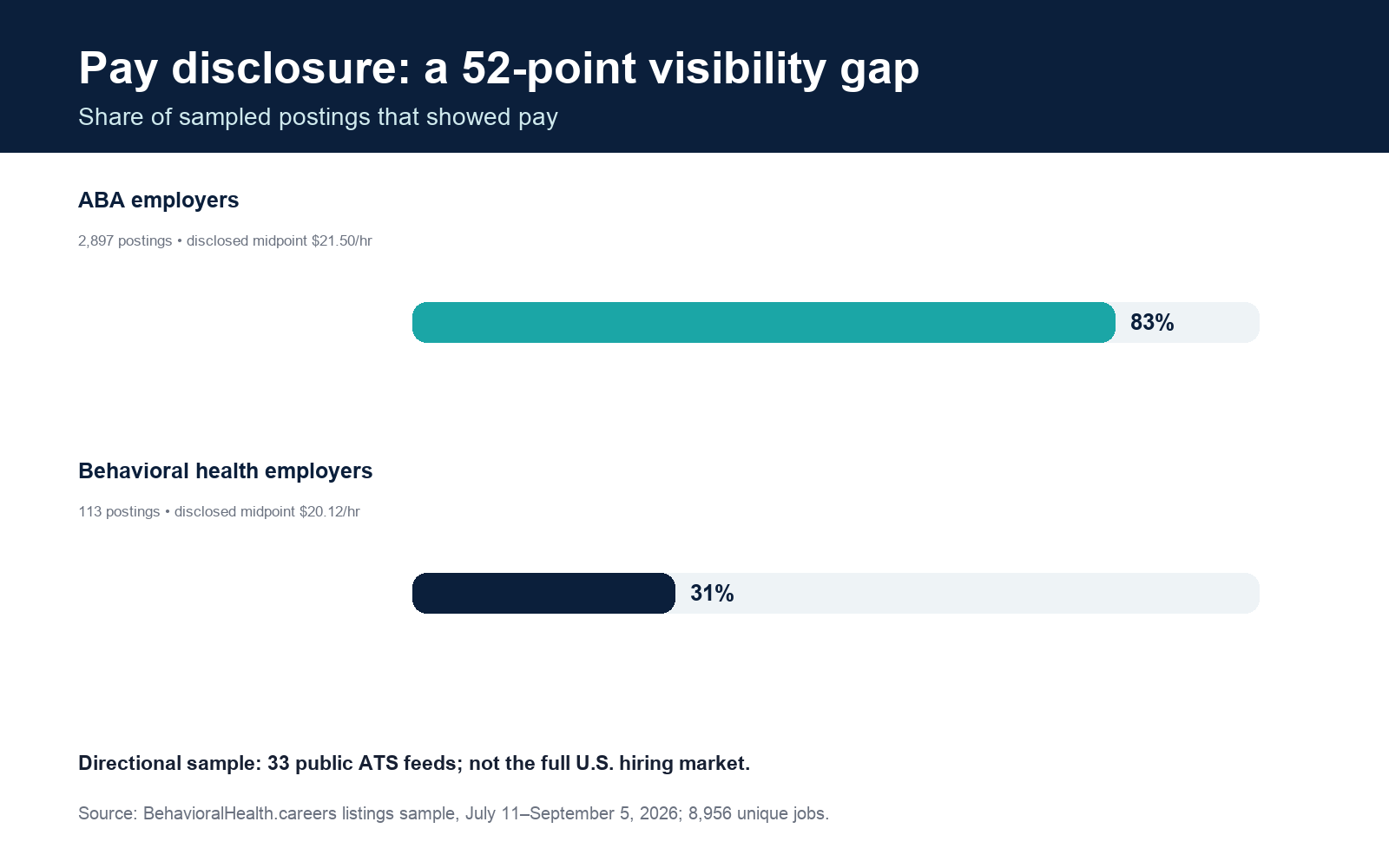
ABA employers accounted for 2,897 behavior technician and RBT postings. Behavioral health employers accounted for 113 technician, mental health tech, psych tech and milieu postings. Both sets chase the same candidate: someone with a high school diploma, no clinical license, and a willingness to do hard direct-care work.
Read the sample limits before you use any of this. Those 8,956 listings came from 33 public ATS feeds, which means this measures employers who publish structured feeds rather than the whole hiring market. The behavioral health postings came from 14 employers and the ABA postings from 19, so a single large chain moves the counts substantially.
For scale, federal data puts about 198,400 people in psychiatric technician and aide jobs nationally with roughly 21,900 openings a year, so 113 postings over eight weeks is a thin slice of national hiring. The direction of what follows is worth acting on. The decimal places are not.
With that stated: ABA postings disclosed pay about 83% of the time. Behavioral health technician postings disclosed pay about 31% of the time. Same labor pool, same weeks, roughly a fifty-point gap in whether a candidate can see what the job pays before deciding whether to apply.
Among the postings that did disclose, the ABA midpoint was around $21.50 an hour and the behavioral health midpoint around $20.12.
Both of those pay figures sit below the federal medians quoted later in this guide, and they should. Advertised entry rates and the median wage of everyone already doing the job are different measures. What matters here is the comparison between the two sectors, which uses the same measure on both sides.
This guide is for employers and hiring managers who need to write or fix a behavioral health technician job posting. It covers how to build an effective behavioral health technician job description section by section: job title, pay disclosure, shift details, duties, requirements, supervision, training, compliance language, what to require rather than prefer, the duty lines that carry regulatory weight, and a template you can copy.
The quality of that posting changes who applies, how your opening stacks up against ABA listings, and how much avoidable hiring friction you create before a candidate ever speaks to your team. It is also a companion to the two candidate-side guides on this site: how to become a behavioral health technician and behavioral health technician vs mental health technician vs psych aide, which is what your applicants are reading before they answer your posting.
One thing this guide is not: legal advice.
Restraint rules, scope of practice, background-check timing and pay-disclosure duties all vary by state, by setting and by payer. Run anything here that touches those through your own counsel or compliance team before it goes into a live posting.
Four things ABA employers do that you should copy
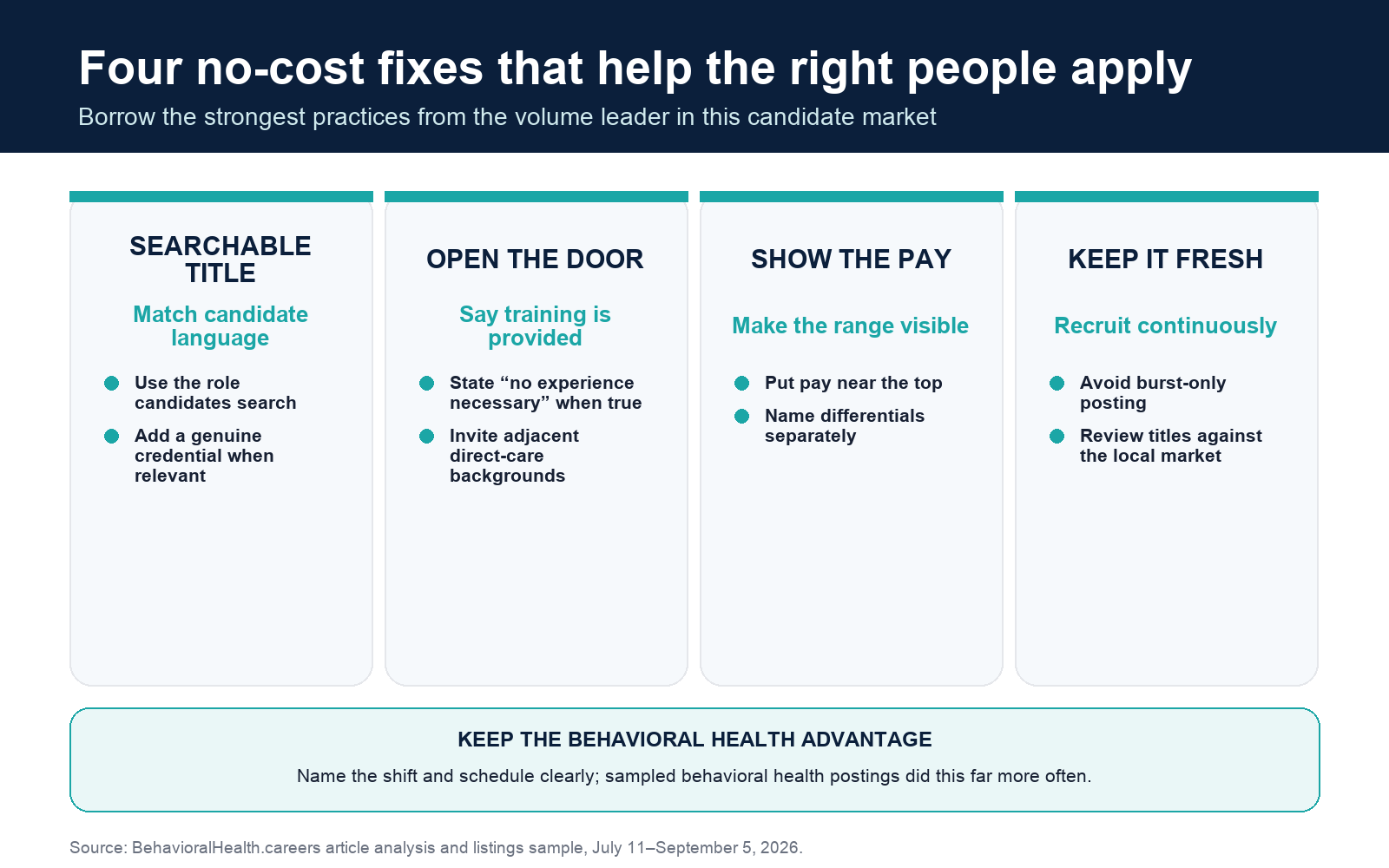
Before the section-by-section, here is the short version of what the volume leader in this candidate market does differently. None of it requires budget. Our guide to the ABA career ladder shows the roles and pay those employers post.
They put the credential in the title, which matches how candidates search. They put “training provided” and “no experience necessary” in the title too, which reaches the career changer who assumes they are unqualified. They disclose pay at more than eight in ten postings, so their range is the one a candidate anchors on. And they post continuously rather than in bursts, which keeps their listings fresh.
The one thing they mostly skip is naming the shift, and the behavioral health postings in our sample were far better at that. The rest of this guide is about the four gaps above, starting with pay.
The pay line, and the field nearly everyone skips
Start with the bigger number: about 69% of the behavioral health technician postings in our sample named no pay at all. That is the gap to close first, and it costs nothing.
Then there is a smaller, cheaper edge sitting underneath it.
Of the 35 behavioral health technician postings that did disclose pay, all 35 did it in the description text and none populated the structured salary field their applicant tracking system offers. We know because our pipeline reads structured pay first and falls back to parsing the description.
Before treating that as a sector failing, the honest comparison: 154 ABA postings used the structured field, out of 2,897. That is about 5%. Nearly nobody in either sector fills it in, and at a base rate that low, seeing zero in a sample of 35 is unremarkable. The finding is not that behavioral health employers are behind. It is that a field almost no competitor populates is sitting there unused.
Why bother with it. Google’s JobPosting structured data treats baseSalary as a recommended property, and Google is explicit that only employers can supply it and that it must be actual pay rather than an estimate.
Where you leave it empty, any salary a candidate sees attached to your role is somebody else’s estimate.
Aggregators and job boards vary in whether they parse pay out of description text; ours does, plenty do not, and none of them are obliged to. The structured field is the only route that does not depend on someone else’s parser working.
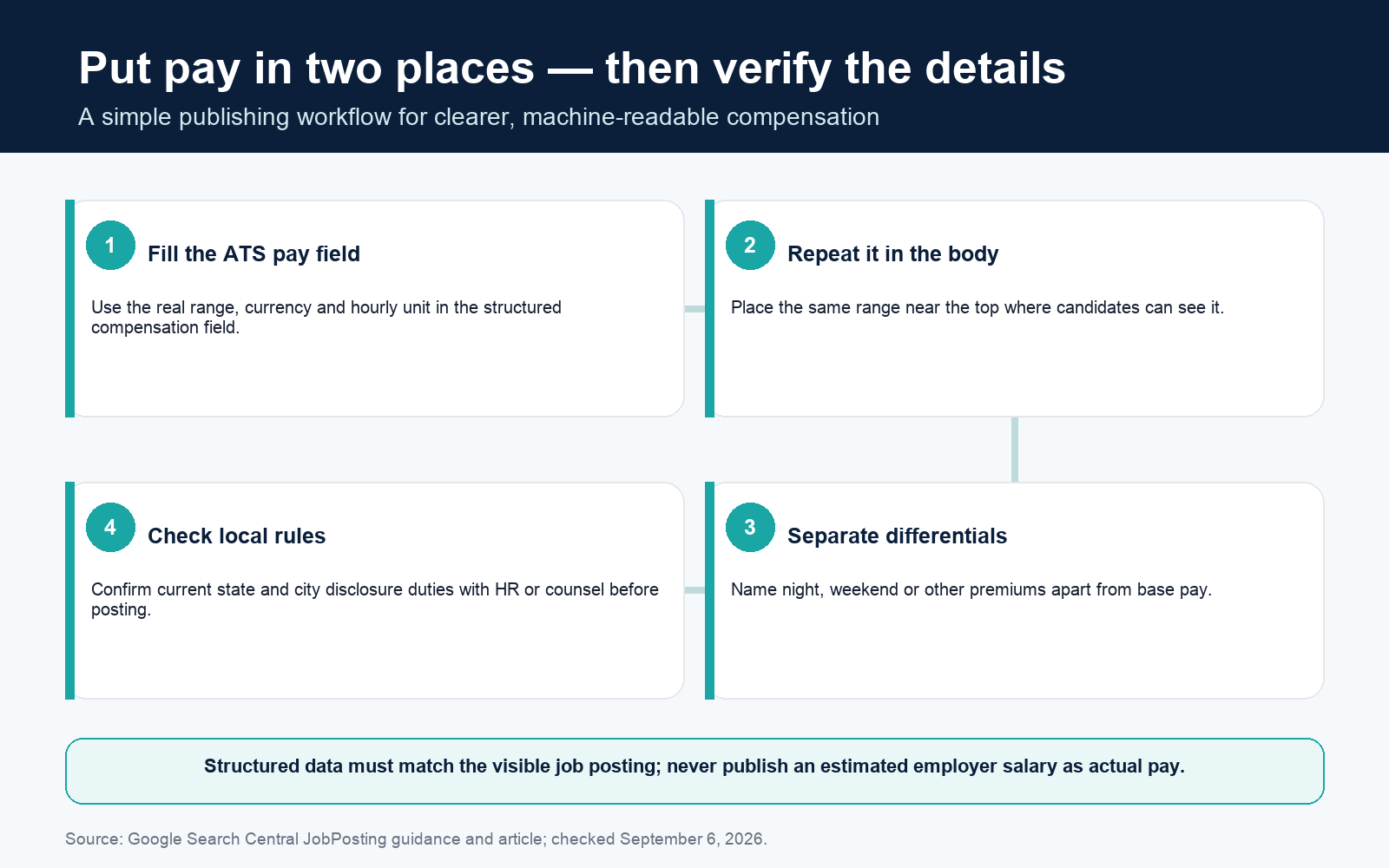
Three fixes, all free:
- Put a real range in the structured pay field in your ATS, with the unit set to hourly. If your ATS has a compensation section you have been skipping, that is the one.
- Put the range in the body text as well, near the top, with any shift differential named separately. Differentials are a real advantage in this role and burying them wastes it. “$19.50 to $23.00 per hour, plus $2.50 nights and $3.00 weekends” tells a candidate more in one line than three paragraphs about your culture.
- Check whether you have a choice. A growing number of states and cities require pay ranges in job postings, and the list keeps expanding. If you are in one of them, this is a compliance question rather than a strategy question, and your counsel or HR lead will know which category you are in.
The title decides your candidate pool
Titles in this corner of the field are a mess, and the mess is expensive.
“Behavioral health technician”, “mental health technician”, “psychiatric technician”, “psych aide”, “milieu therapist” and “behavioral health associate” all describe overlapping work, and employers use them interchangeably.
Federal wage data splits only two of them out: psychiatric technicians earned a median of $45,130 in May 2025 and psychiatric aides $44,910, with 198,400 people employed across both.
Here is what our listings showed about how titles get used. In the ABA set, 1,765 of 2,897 postings named the RBT credential in the job title. In the behavioral health set, not one of the 113 named a credential of any kind.
Part of that difference is structural rather than a mistake: ABA has one dominant national credential to name and behavioral health mostly does not, as the requirements section below covers. It is still a search-visibility gap.
Candidates who hold a credential search for it, and so do candidates who want one.
A behavioral health employer writing “Behavioral Health Technician” matches a vaguer one, and misses the candidate who typed “CBHT jobs” or “psych tech no experience”. Where a credential genuinely applies to your role, or where you pay for one, put it in the title.
Practical guidance:
- Use the title your candidates search, not the title in your org chart. If your internal title is “Behavioral Health Associate II”, post it as “Behavioral Health Technician (BHT)” and keep the internal title in the body.
- Name a credential in the title when one genuinely applies, and only then. “Behavioral Health Technician (CBHT preferred)” works in Florida. “Psychiatric Technician – Certification Provided” works if you actually pay for it.
- Say the setting. “Behavioral Health Technician – Adolescent Residential” and “Behavioral Health Technician – Adult Detox” attract different people, and both attract more of the right people than an unqualified title does.
- Skip the internal codes. A candidate does not know what “BHT II – Req 40117” means, and neither does a search engine.
Shift belongs in the title
One place the behavioral health postings in our sample clearly beat the ABA ones: 66 of the 113 behavioral health technician titles named a shift or schedule. Nights, evenings, overnights, weekends, PRN, part time. In the ABA set only 148 of 2,897 did.
With 14 employers behind that number, a chain that standardizes its titles could account for much of it, so read it as a practice that works rather than a sector-wide achievement.
Either way, do it. Shift mismatch is a common reason applicants withdraw late in a hiring process for a 24-hour facility, and putting it in the title costs nothing and saves both sides a week. The employer who writes “Behavioral Health Technician – Full Time Nights” gets fewer applicants and more hires.
The same logic applies to the schedule detail inside the posting. Write the actual pattern. “Three 12-hour shifts, 7pm to 7am, every other weekend” is a real answer. “Must be flexible” is a warning sign to anyone who has worked in this field, because it usually means the schedule is unpredictable and the employer knows it.
The duties list: two lines that carry regulatory weight
Most behavioral health technician duty lists are recycled from each other, and two of the recycled lines create real exposure.
Restraint
Job descriptions routinely include something like “assist with restraining patients as needed”.
If you are a Medicare-participating hospital, 42 CFR Part 482, the Conditions of Participation for Hospitals, is explicit at 482.13: patients have a right to be free from restraint or seclusion imposed as coercion, discipline, convenience or retaliation; restraint requires the order of a physician or other licensed practitioner who is responsible for the patient’s care and authorized to order it by hospital policy; and staff must be trained and able to demonstrate competency in the application of restraints before they use them, including training in how to recognize and respond to signs of physical and psychological distress.
If you are not a hospital, Part 482 does not govern you. Residential programs, group homes, community residential settings and freestanding crisis units sit under other authorities: state licensure rules, other parts of the federal regulations, and payer contracts. The specific rules differ. The principle that a staff member must be trained and assessed before taking part in physical intervention is close to universal across them, and your state licensure rules will say what yours requires.
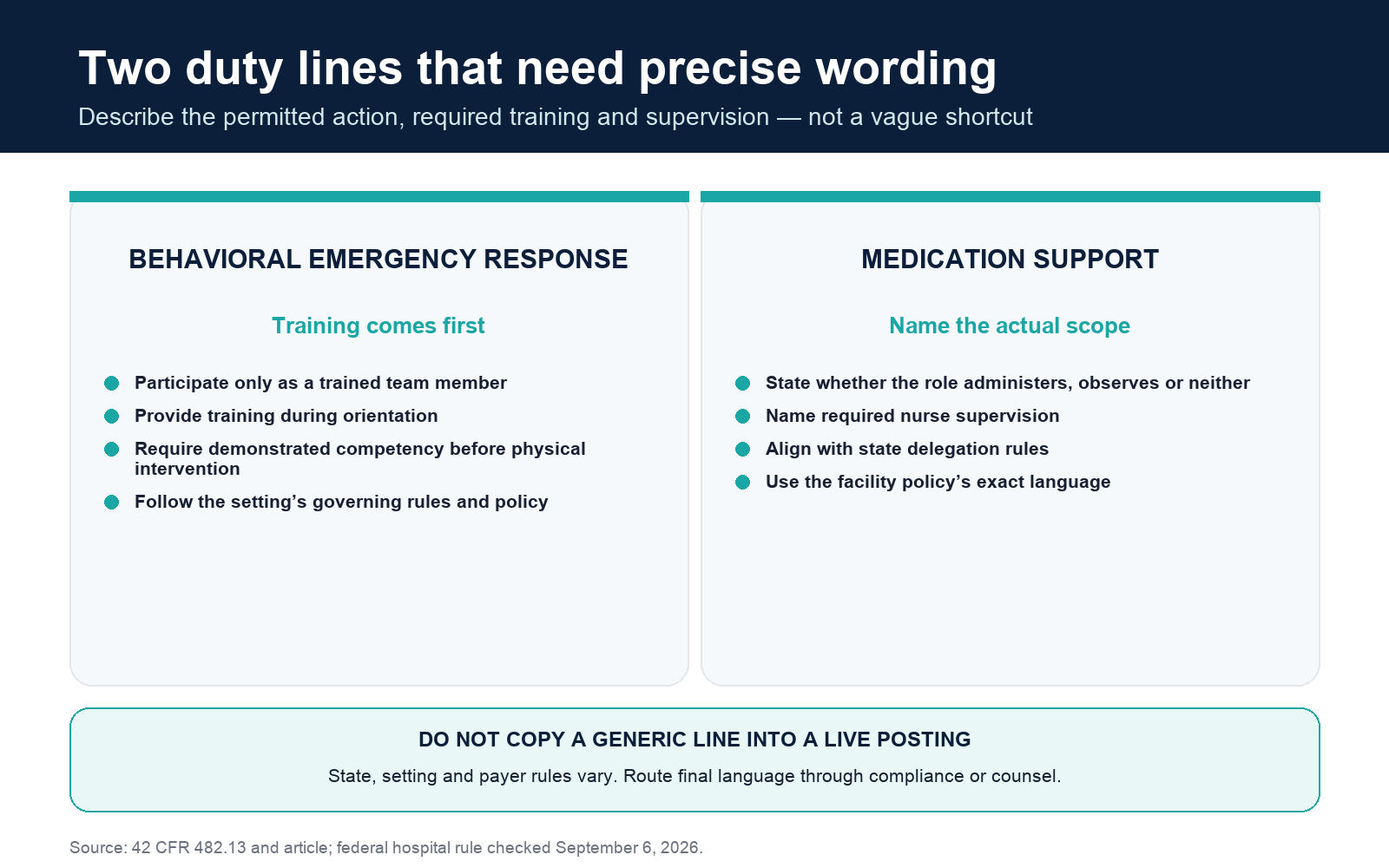
So a duty line that lists restraint without naming the training is describing something the candidate is not permitted to do on day one. Write it the way the regulation works:
“Participate in behavioral emergency response as a trained team member. We provide crisis prevention and physical intervention training during orientation and require demonstrated competency before you take part in any physical intervention.”
That version is accurate, it signals to an experienced candidate that you run a compliant program, and it doubles as a recruiting line. Candidates in this role have worked somewhere that got this wrong, and they screen for it.
Medication
The other recycled line is some version of “assist with medication administration”. Whether an unlicensed technician may administer, observe, or neither is set by your state’s nurse practice act, its delegation rules and its medication aide provisions, and those differ enough between states that no general statement here would be safe to act on.
Some states permit trained unlicensed staff to administer under delegation. Some do not. This is not a detail you want a new hire discovering in month two, and it is not one to copy from another employer’s posting.
Write what your state and your policy actually permit. “Observe and document medication self-administration under nurse supervision, in line with state scope of practice and facility policy” is a sentence that survives an audit. “Assist with medication administration” is not.
The rest of the list
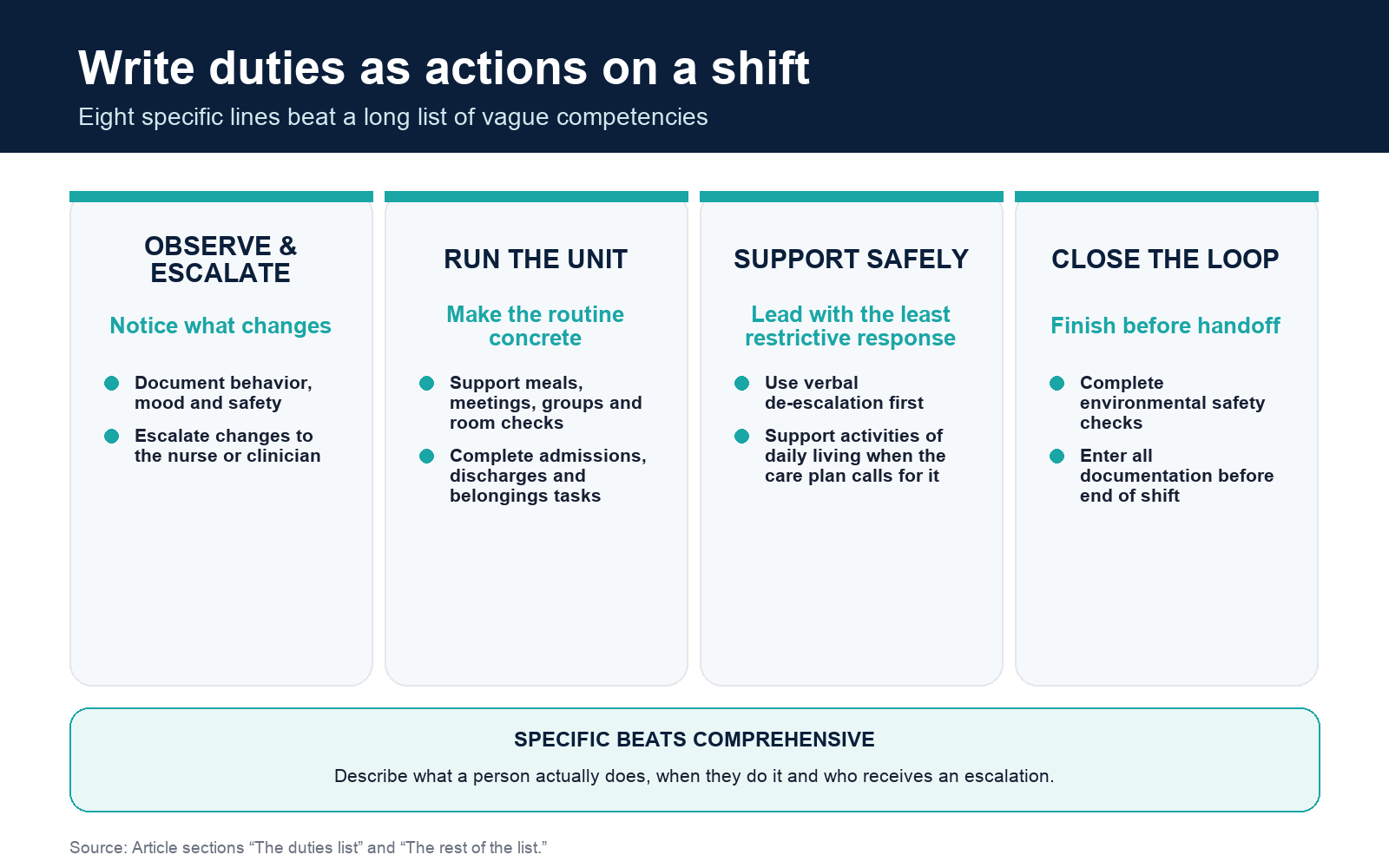
Beyond those two, write duties as things a person does on a shift, not as competencies. Specific beats comprehensive, and eight sharp bullets beat eighteen vague ones, with duties tailored to the patient population and any relevant behavioral disorders.
- Observe and document patient behavior, mood and safety throughout the shift, monitor patient progress, record vital signs when the setting requires it, and escalate changes to the nurse or clinician on duty
- Run scheduled unit routines: wake-ups, meals, community meeting, groups, room checks at the ordered interval
- Co-lead skills and recreation groups from written plans provided by clinical staff
- Use verbal de-escalation as the first response to agitation, and follow the facility’s behavioral emergency protocol when it is not enough
- Support patients with activities of daily living where their care plan calls for it
- Complete admission and discharge tasks, including belongings searches and orientation to the unit
- Maintain the physical environment to safety standards, including ligature and contraband checks on the schedule your policy sets
- Document in the electronic record before the end of shift
That last one earns its line. Documentation timeliness is a recurring performance problem in this role, and naming it in the posting sets the expectation before hire rather than in a first review.
Requirements: what to require, what to prefer, and what to stop asking for
The costliest thing you can get wrong in a behavioral health technician posting is a requirements list that screens out the people you want.
Education
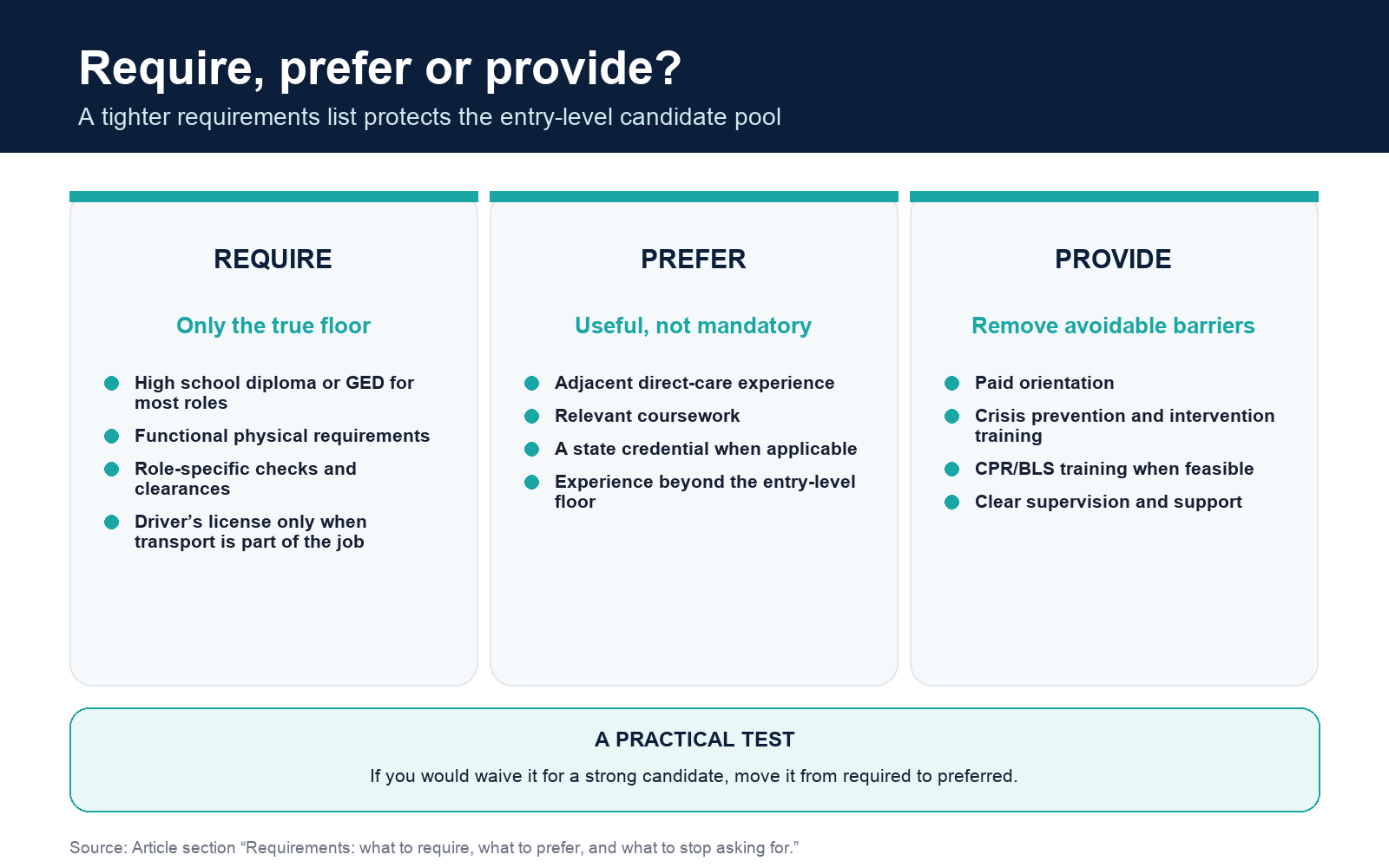
A high school diploma or GED is the real floor for most of these roles and should be the stated requirement. Federal data does distinguish here: BLS lists a postsecondary certificate as typical entry-level education for psychiatric technicians and a high school diploma for psychiatric aides. If your role genuinely needs the certificate, say so and say why. If it does not, requiring an associate degree for a job that pays $20 an hour narrows your pool for no return. Move it to preferred.
Credentials
Requirements vary by state, and in much of the country there is no state credential for this role to require, though some states also require completion of an approved training program before certification or licensure. SAMHSA’s Behavioral Health Career Navigator publishes entry requirements state by state and is the fastest way to check your own before you write a requirements line. Two states are worth calling out:
Florida
The Florida Certification Board runs a Certified Behavioral Health Technician credential requiring a high school diploma or GED, 30 hours of approved training, 1,000 hours of work experience in a substance use or related setting, at least 24 hours of supervised work experience, three letters of recommendation, and a 100-item exam passed at 65%.
The board describes the credential as recognized for billable services under Florida’s state Medicaid plan, which is the actual reason a Florida employer might require it rather than prefer it. Check whether your services and payer mix make it billable-relevant for the specific role. If they do not, note the shape of the requirement: 1,000 hours of prior experience means a CBHT-required posting is closed to career changers by definition.
Utah
This one is commonly reported wrong, and the detail matters for your job title rather than your requirements list. Utah’s Division of Professional Licensing certifies behavioral health technicians and requires either an associate degree in a listed field or a one-year academic certificate in relevant applied skills.
But the state’s own explanation of the 2024 law is that unlicensed people may lawfully do the work, and what is unlawful is using the title without the certification. So in Utah you can hire a person with a high school diploma to do this job. You cannot advertise the position as “Behavioral Health Technician” and fill it with someone uncertified. If you hire in Utah, take advice on what to call the role before you post it.
ABA credentials and supervision
If you are hiring for ABA work rather than behavioral health, the RBT is the relevant credential and it changed for 2026: recertification moved from a one-year to a two-year cycle and now requires 12 professional development units.
RBTs also need ongoing supervision covering at least 5% of the hours they spend delivering services in a calendar month, including two face-to-face contacts, at least one of which must be an individual meeting rather than a group. That individual meeting is the part people forget to budget for. Price the supervisor time before you post the role.
CPR and crisis training
Requiring current CPR at time of hire is common and mostly harmless. Requiring a specific proprietary crisis intervention certification at time of hire is not, because almost every employer trains it in-house and almost no candidate arrives holding it. Make it something you provide.
Driver's license
It should be required only if the role will transport patients. It appears in postings for roles with no driving in them, and it screens out candidates in cities.
Experience
“Two years of experience preferred” in an entry-level posting reads as a contradiction and suppresses applications from exactly the people the role is designed for. An experienced technician may fit higher-acuity or lead roles, but that should not be the default for entry-level hiring.
Candidates also need strong communication skills because the work depends on clear documentation and handoffs while implementing treatment plans. If you will hire someone with no experience, say that in the posting, in those words. The ABA sector says it constantly, in job titles like “Behavior Technician – Training Provided”, and it is part of why they win the entry-level candidate.
Supervision, training and turnover: the part candidates actually read
Anyone who has worked a year in this field reads a behavioral health technician posting looking for a short list of answers, and most postings supply none of them.
How many patients will I have?
Ratios are the first question and the one employers most avoid. If your ratio is good, publishing it is a competitive advantage, with one caution worth taking seriously: a staffing statement in a public posting is a written representation, and one you do not consistently meet can resurface in a survey finding or after an adverse event.
Publish a ratio you can hold, or describe the staffing model without committing to a number. If the ratio is bad, a candidate finds out in week one regardless and leaves in month three.
Who supervises me and how often?
Name the role and the cadence. “You will report to the charge nurse on shift, with a scheduled monthly one-to-one with the unit manager” is worth more than a paragraph about teamwork.
What training do I get, and am I paid for it?
Say the length, the format and that it is paid. Paid orientation is not universal in this sector and saying it plainly separates you.
Adding those three answers costs about eighty words. They are the eighty words most likely to convert a reader into an applicant, and they are missing from nearly every posting in our set.
The same title, four different jobs
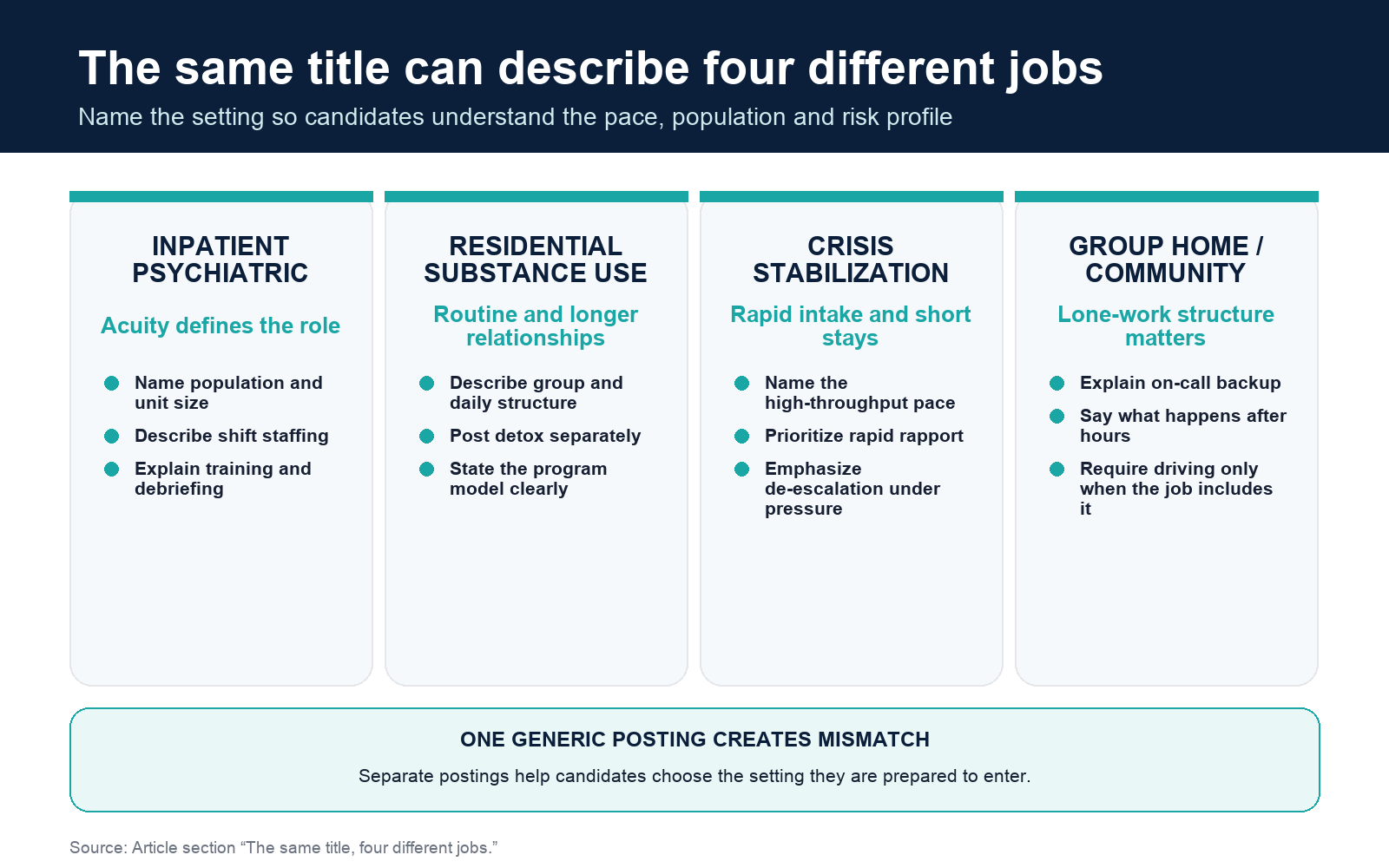
A behavioral health technician on a locked adult psychiatric unit and a behavioral health technician in a sober living residence do work that overlaps by maybe half. Postings that ignore this attract applicants who withdraw once they understand the setting, which is expensive in a role where you are already fighting turnover.
Four settings, and what changes in the posting for each, though these roles may also show up in shelters and private residences.
Inpatient psychiatric
Acuity is the defining feature. Your posting needs to say so honestly, because a candidate who arrives expecting counseling work and finds continuous observation, ligature checks and behavioral emergencies will not stay. Name the population, the unit size and the staffing on the shift you are hiring for. Emphasize the training and the debrief process, because this is the setting where they matter most and where experienced candidates screen hardest.
Residential substance use treatment
Longer relationships with clients, more group facilitation, more of the day spent on structure and routine rather than acute risk. Detox is the exception inside this category and should be posted separately, because withdrawal management is closer to inpatient in pace and in what it asks of staff. These roles also show up outside hospitals, including in mental health facilities. If your program is abstinence-based, or if it uses medication for opioid use disorder, say which. Candidates hold views on this and you want the ones whose views match your program.
Crisis stabilization and psychiatric emergency
Short stays, rapid admissions and discharges, constant intake. The skill you are hiring for is rapid rapport and de-escalation under time pressure. Say that the pace is the job rather than describing it as fast-paced, which is filler. Candidates from EMS, emergency department and corrections backgrounds do well here and are worth naming in your preferred list.
Group homes and community residential
Often one staff member alone with several residents, frequently including people with intellectual and developmental disabilities alongside behavioral health needs. Lone working changes the risk profile and the posting should be direct about it: how you are reached, what the on-call structure is, and what happens when something goes wrong at 2am. This is also the setting where the driver’s license requirement is usually real rather than copy-pasted.
Writing one posting for all four is the usual shortcut, and it produces the mismatch that ends a lot of these hires inside ninety days.
The compliance lines that belong in the posting
Four pieces of boilerplate earn their space, and most postings either omit them or get them backwards.
Physical requirements, phrased as functions. Write what the job requires done, not the body that does it. “Able to stand and walk for the majority of a 12-hour shift, and to respond quickly to a behavioral emergency” describes a function. “Must be able-bodied” describes a person, invites an ADA problem, and tells a qualified candidate with a disability not to apply.
Background check and clearances, stated up front. Say which checks you run and when in the process. Candidates in this field frequently have records, and a vague reference to “successful background check” at the bottom of the posting produces late-stage withdrawals. Where your state or payer sets the disqualifying list, say that the list is set by regulation rather than by you.
Equal opportunity language that is actually specific. A single line naming your organization is better than a paragraph of generic text nobody reads.
Immunization and health requirements. If you require particular immunizations or a TB screen, name them. It is a common late-stage surprise and it is trivially avoidable.
What to cut
Some conventions in this genre actively cost you applications.
- “Dynamic team”, “fast-paced environment”, “wear many hats”, “passionate about our mission”. These are filler, and in a 24-hour clinical setting “fast-paced” reads as understaffed.
- Long paragraphs about organizational history at the top. Lead with the job. Your history can sit at the bottom for the reader who got that far.
- Undefined acronyms. ADL, PRN, LOS and QMHP mean nothing to a candidate who has not worked in the setting, and this role hires career changers.
- “Other duties as assigned” as a substitute for the duties you did not want to write down. Experienced candidates read it as a warning.
- Requirements you do not enforce. Every unenforced requirement is a filter on honest applicants only.
A behavioral health technician job description you can copy
Behavioral Health Technician (BHT) – Full Time Nights, Adult Inpatient
Copy and adapt this behavioral technician job description for your setting.
Pay: $[19.50] to $[23.00] per hour depending on experience, plus $[2.50]/hour night differential and $[3.00]/hour weekend differential. Paid orientation.
Schedule: Three 12-hour shifts per week, [7:00pm to 7:30am], every other weekend. [Facility] operates 24 hours; this position is permanently assigned to nights.
Location: [Facility name], [City, State]. On-site.
About the unit: [Facility] is a [24]-bed adult inpatient behavioral health unit treating [adults experiencing acute psychiatric crisis and co-occurring needs, including substance abuse, where applicable]. [Typical staffing on nights is two technicians and one nurse for the unit.]
What you will do
- Observe and document patient behavior, mood and safety through the shift, help implement treatment plans in coordination with clinical staff, and escalate changes to the nurse on duty
- Complete safety rounds and environmental checks at the intervals set by unit policy
- Run overnight unit routines and support patients who are awake, distressed or unable to sleep
- Support patients with daily living skills where their care plan calls for it
- Use verbal de-escalation as the first response to agitation, and take part in behavioral emergency response as a trained team member
- Observe and document medication self-administration under nurse supervision, consistent with [state] scope of practice and facility policy, and collaborate with medical professionals as needed
- Complete admission tasks including belongings inventory and orientation to the unit
- Communicate appropriately with family members when the role allows and privacy requirements are met
- Complete all documentation in [EHR] before end of shift, and coordinate updates with other medical professionals and assigned staff members
What we require
- High school diploma or GED
- [18 years or older, if that is a genuine requirement for your setting]
- Current CPR/BLS certification, or willingness to obtain within [30] days of hire (we pay for it)
- Ability to stand and walk for most of a 12-hour shift and to respond quickly to behavioral emergencies
- [Background check and pre-employment screening as required for this role. Name the specific checks you run and when in the process they happen. Several states and cities restrict when criminal history may be raised in hiring and in job postings, so have this line reviewed for your jurisdiction rather than pasting it.]
What helps but is not required
- Any direct care experience: CNA, home health aide, residential counselor, peer support, corrections, EMS, childcare
- Coursework in psychology, human services or a related field
- [State] behavioral health technician certification such as [CBHT]
No behavioral health experience? Apply anyway. We hire people from other direct-care backgrounds and train them. Orientation is [three weeks], fully paid, and includes crisis prevention and physical intervention training with a competency check before you take part in any physical intervention.
Supervision and support: You report to the [charge nurse] on shift and to the [unit manager], with a scheduled one-to-one every [month]. [Facility] provides [debriefing after every behavioral emergency and access to the employee assistance program].
Growth: [Technicians here have moved into senior technician, unit coordinator and nursing roles, with clear paths for professional growth. We offer tuition assistance of $X per year toward LPN, RN and counseling programs.]
To apply: [Application instructions.] [We review applications within three business days and respond to every applicant. Only promise a response time you can hold at volume; a broken promise here costs more than never making it.]
Before you hit post
- Fill the structured pay field in your ATS, with a real range and the unit set to hourly. Everything above about disclosure is wasted if the field is empty.
- Check that your posting carries valid JobPosting schema with the pay, employment type, location and dates populated. Most modern applicant tracking systems generate it and most employers never look at whether the fields came through.
- Read the requirements list one more time and move everything you would waive for a strong candidate into the preferred section.
- Then compare it against the ABA postings your candidates are seeing in the same city on the same day. That is the actual competitive set, and it is the comparison that tells you whether your posting is ready.
How to tell whether the posting worked
Rewriting a job description is only worth doing if you can see whether it changed anything, and the metric most employers watch is the wrong one.
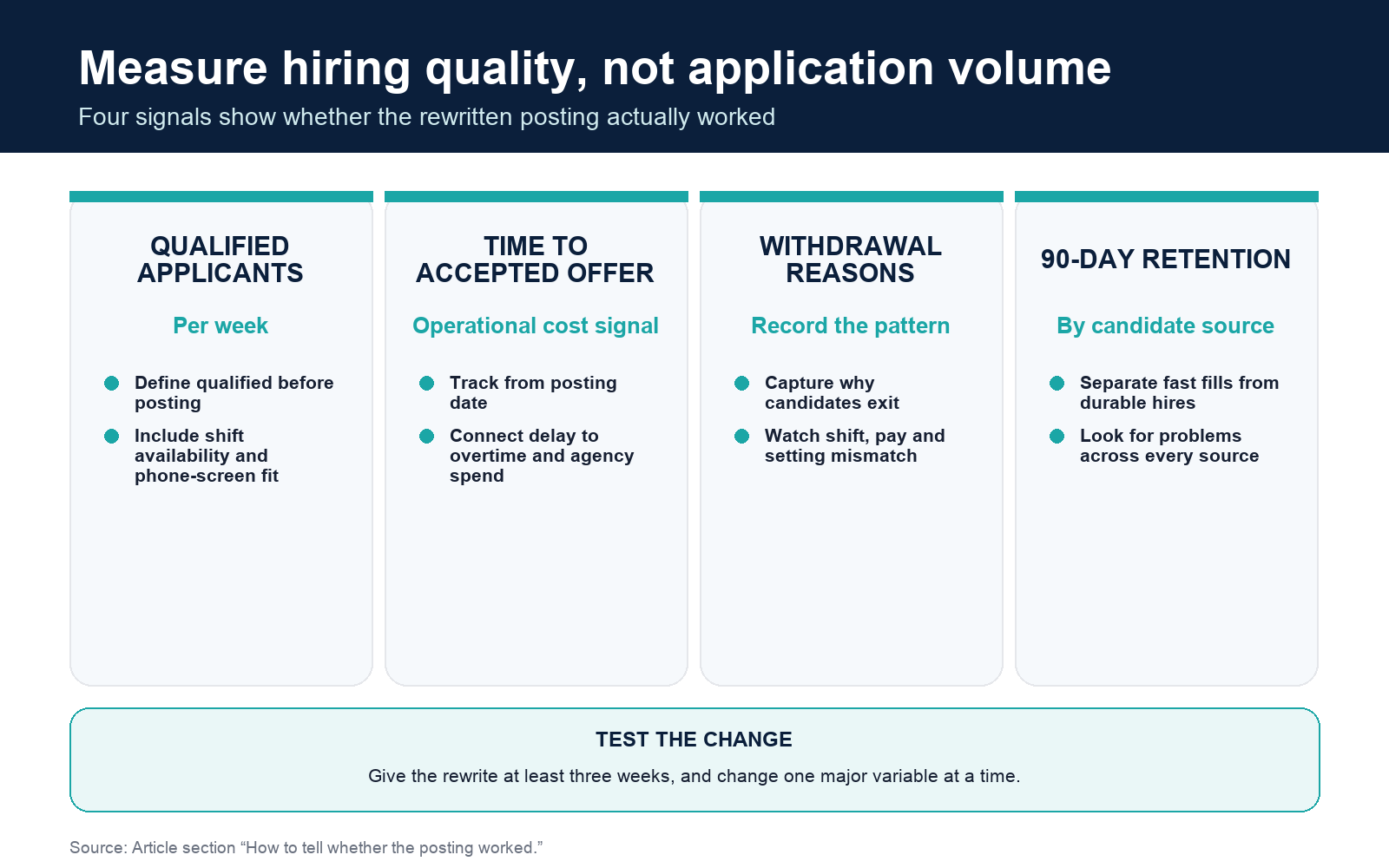
Applications per posting is a vanity number. A posting that pulls 80 applicants and 2 interviewable ones performed worse than a posting that pulled 15 and 6, and it cost your team more to process. Track these instead:
Qualified applicants per week
Define qualified once, in writing, before you post. For most entry-level behavioral health technician roles that means: meets the stated requirements, available for the shift, and passes a phone screen.
Time from posting to accepted offer
This is the number that maps to overtime spend and agency spend, and it is the one to take to whoever controls the pay range.
Withdrawal reasons, recorded
Every candidate who drops out between application and start date is telling you which line in the posting was wrong. Shift, pay and setting will be most of them. Three months of recorded reasons will improve the posting more than any template.
Ninety-day retention by source
A posting that fills the role fast and empties it by month three has not worked. This is the number that separates a posting problem from a program problem, and if retention is bad across every source, the posting is not what needs fixing.
Give a rewritten posting at least three weeks before judging it, and change one thing at a time. If you rewrite the title, the pay disclosure and the requirements together and applications double, you have learned nothing about which change did it.
FAQs for Employers Writing BHT Job Descriptions
Should the salary range go in the job description or just the ATS field?
Both. The body text is what a human reads. The structured field is the only version guaranteed to be machine-readable, because whether a given aggregator parses pay out of your description is that aggregator’s choice and not yours. Google’s JobPosting schema treats the salary property as recommended and accepts it only from the employer, so leaving it empty means any figure shown against your role came from somebody else’s estimate.
In our sample, all 35 behavioral health technician postings that disclosed pay did it in text only, and so did roughly 95% of the ABA postings, which makes this a cheap edge rather than a sector failing.
Is “behavioral health technician” or “mental health technician” the better title?
Neither is universally better, and both are searched. Pick based on your setting: mental health technician skews toward hospital and inpatient psychiatric work, behavioral health technician skews toward residential and substance use treatment. Then add the setting and shift to the title, which does more for match quality than the choice between the two terms. If your applicant tracking system allows a subtitle or alternate title field, use it to carry the other term.
Can I list restraint as a job duty?
You can describe participation in behavioral emergency response, and you should describe the training and competency check that comes first.
For Medicare-participating hospitals, 42 CFR 482.13 requires that staff be trained and able to demonstrate competency in the application of restraints before applying them, that restraint be ordered by an authorized licensed practitioner responsible for the patient’s care, and that it never be used for coercion, discipline, convenience or retaliation.
Non-hospital settings sit under state licensure and other rules rather than Part 482, and the training-before-intervention principle runs through those too. A duty line that omits all of it describes the job as it should not be performed.
What experience should I actually require?
For most entry-level behavioral health technician roles, none. Require the diploma, the age minimum, the physical ability and the clearances, then list every adjacent background you would happily hire from and say plainly that you train. Requiring two years of experience for a $20-an-hour entry-level role suppresses applications without improving the shortlist, and your largest competitor for that candidate is advertising “training provided” in the job title.
How do I compete with ABA employers on pay?
The gap at the median was about $1.40 an hour among the postings in our sample, small enough that pay may not be your binding constraint. That said, 35 behavioral health postings from 14 employers is not enough to tell you whether it is, so check your own offer-decline reasons before concluding anything.
What is worth doing regardless is naming the advantages behavioral health roles often carry and ABA roles often do not: benefits, guaranteed full-time hours, shift differentials, and no unpaid gaps when a client cancels. An ABA behavior technician whose hours drop with a cancellation reads “guaranteed 36 hours per week with benefits from day 30” carefully.
Do I need to name a certification requirement?
Only where your state creates one. Utah requires an associate degree or a one-year academic certificate for its behavioral health technician certification. Florida’s CBHT is a credential candidates can hold but requires 1,000 hours of prior work experience, so requiring it at hire closes the role to career changers. In most states there is no certification for this role and adding one to the requirements list only shrinks your pool.
Where to post it
Once the posting is rewritten, you can share it with BehavioralHealth.careers. We are opening job posting to a small group of behavioral health employers first; email [email protected] to ask about it.
If you want to see how your range compares before publishing it, our salary pages summarize the pay employers post, which is the quickest way to check your number against the market you are hiring in.
For employers hiring adjacent roles, see our technician and psych aide comparison guide to compare expectations and attract qualified candidates.
Sources
- U.S. Bureau of Labor Statistics, Occupational Outlook Handbook, Psychiatric Technicians and Aides : https://www.bls.gov/ooh/healthcare/psychiatric-technicians-and-aides.htm
- 42 CFR 482.13, Condition of participation: Patient’s rights (restraint and seclusion) : https://www.ecfr.gov/current/title-42/chapter-IV/subchapter-G/part-482/subpart-B/section-482.13
- Florida Certification Board, CBHT Requirements and Application Pathway : https://flcertificationboard.org/certifications/cbht-requirements-application-pathway/
- Utah Division of Professional Licensing, Behavioral Health Technician Certification : https://commerce.utah.gov/dopl/behavioral-health/behavioral-health-technician-certification-apply-for/
- Behavior Analyst Certification Board, RBT 2026 Requirements : https://www.bacb.com/wp-content/uploads/2025/07/RBT-2026-Requirements_250723-a.pdf
- SAMHSA, Behavioral Health Career Navigator, careers by state : https://www.samhsa.gov/about/careers/behavioral-health-workforce/careers-by-state
- Utah Department of Commerce, SB26 explainer (behavioral health technician title protection) : https://commerce.utah.gov/wp-content/uploads/2024/03/SB26-Explainer-March-18-vPOSTED.pdf
- Google Search Central, JobPosting structured data : https://developers.google.com/search/docs/appearance/structured-data/job-posting
- BehavioralHealth.careers listings data, 8,956 unique postings from 33 public ATS feeds, July 11 to September 5, 2026