
On our board, "ABA therapist" jobs are generally behavior technician or Registered Behavior Technician (RBT) roles. From there, the applied behavior analysis career ladder runs through the Board Certified Assistant Behavior Analyst (BCaBA) and the Board Certified Behavior Analyst (BCBA). The analyst credentials need more education and supervised fieldwork and bring more responsibility; the BCBA-D adds a doctoral designation without expanding BCBA practice rights.
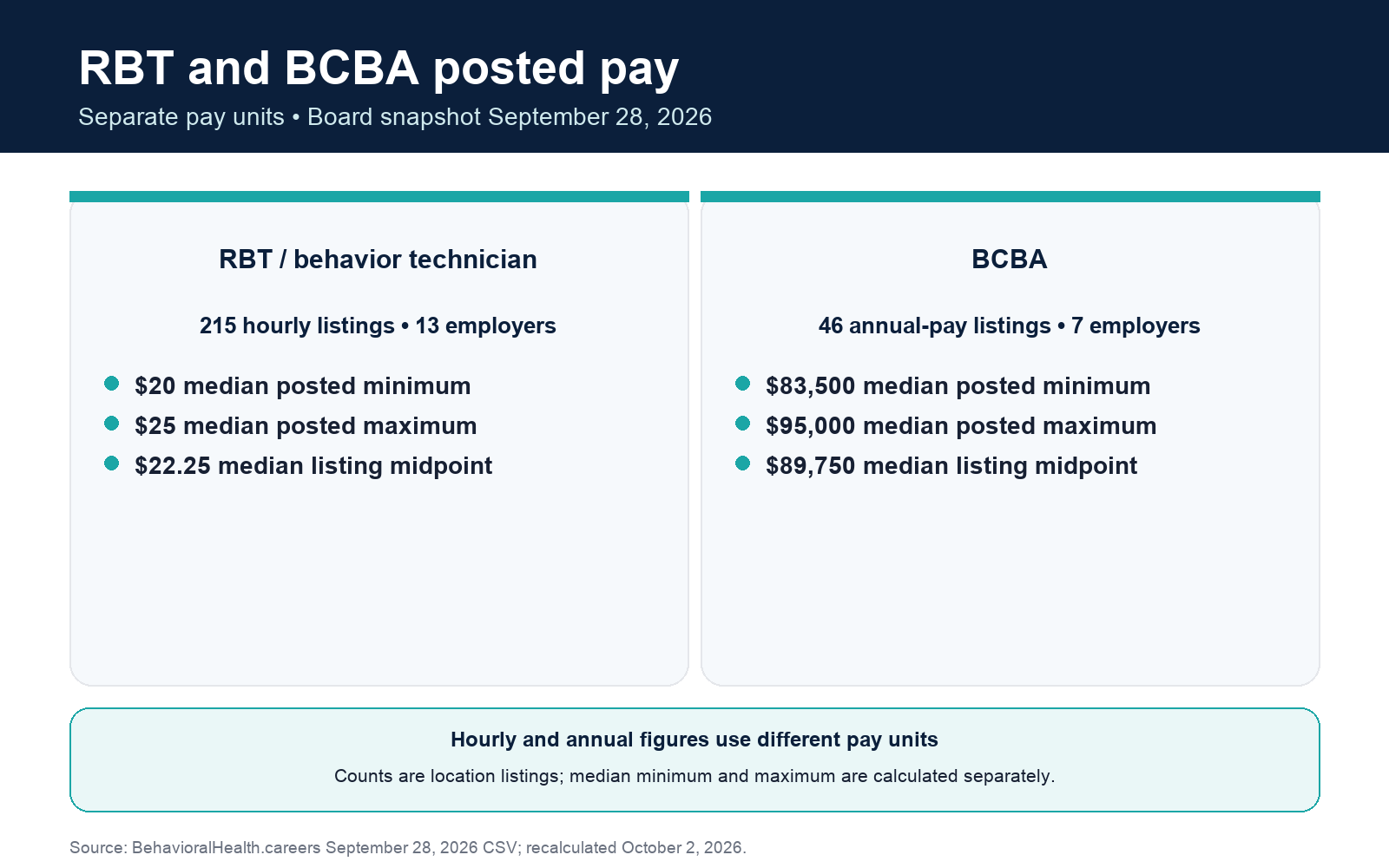
The pay figures in this guide come from our own job board, not salary surveys. In our September 28, 2026 pull, RBT and behavior technician jobs had a median posted minimum of $20 and maximum of $25 an hour. BCBA jobs had a median posted minimum of $83,500 and maximum of $95,000 a year. Credential requirements come from the Behavior Analyst Certification Board (BACB), and we link to each source.
ABA jobs at a glance
| Role | Education | Supervised fieldwork | Posted pay on BehavioralHealth.careers |
|---|---|---|---|
| Behavior technician / RBT | High school diploma | No analyst fieldwork; RBT requires 40-hour training, competency assessment and exam | Median $20 to $25 an hour (215 hourly listings, 13 employers) |
| BCaBA | Bachelor's degree | 1,300 hours, or 800 concentrated (2027 rules) | No current listings |
| BCBA | Master's degree | 2,000 hours, or 1,500 concentrated (2027 rules) | Median $83,500 to $95,000 a year (46 salaried listings, 7 employers) |
| BCBA-D | Doctorate | Same as BCBA | Not tracked separately |
Pay data: BehavioralHealth.careers curated board, pull of September 28, 2026. Figures are the median posted minimum and median posted maximum among listings with employer-posted pay, calculated separately, so they don't describe any single listing. Counts refer to location listings: some share an employer posting URL, so they are not counts of unique vacancies. More than 92% of our RBT and BCBA listings in that pull included posted pay.
What is an ABA therapist job?
"ABA therapist" is a job title, not a credential. The BACB offers three certifications (RBT, BCaBA and BCBA) plus the BCBA-D designation. In our board’s ABA therapist postings, the role is generally a behavior technician or RBT position, and the posting may ask you to hold the RBT or earn it after hire.
ABA therapists work one-on-one with clients, most often children diagnosed with autism spectrum disorder or other developmental disabilities, using individualized treatment plans written by a BCBA. ABA therapy sessions teach communication, social, and daily living skills, reinforce positive behaviors, and record data on client progress after every session. ABA therapy is delivered in clinics, clients' homes, schools, and early intervention programs.
Demand keeps rising: the BACB's employment demand report counted a 28% increase in BCBA job postings from 2024 to 2025. Autism identification has also grown. The CDC's most recent surveillance report, released in 2025 using 2022 data, identified autism in about 1 in 31 eight-year-olds in the areas it monitors.
ABA career opportunities: how the ladder works
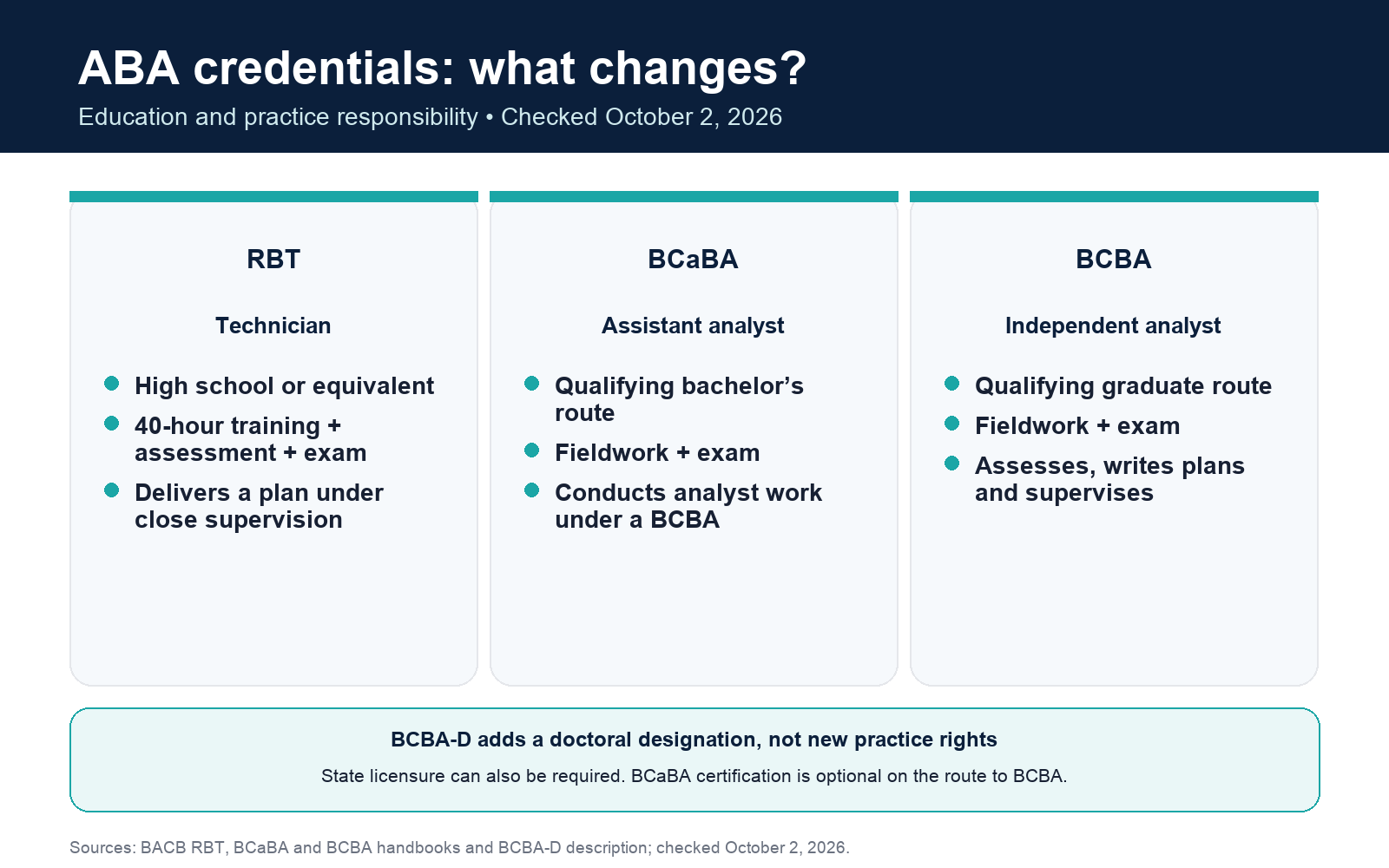
The ladder is built around supervision. Behavior technicians and RBTs deliver sessions under a BCBA or BCaBA. BCaBAs design parts of programs and supervise RBTs, but they must practice under a qualified supervisor themselves. BCBAs hold primary case responsibility: they assess clients, write behavior intervention plans, and supervise everyone below them. The BCBA-D is a designation for BCBAs with a qualifying doctorate. It carries the same practice rights as a BCBA and shows up most in research, teaching, and clinical leadership.
You can move from RBT straight to BCBA; earning the BCaBA first is not required. BCaBA roles are uncommon. The BACB's employment demand report counted 14,479 US job postings for BCaBAs in 2025, against 132,307 for BCBAs and BCBA-Ds. Our own board had no BCaBA listings in the September 28 pull.
Step 1: Behavior technician and RBT jobs
This is the entry point, and most ABA therapy jobs sit here. Candidates often come from psychology, education, or a related field, and many are students working part time. Employers use "behavior technician," "ABA therapist," "behavior therapist," and "RBT" interchangeably.
What the job involves: running sessions from a BCBA's plan, collecting data, using positive reinforcement to build skills, responding to challenging behavior with the strategies in the plan, and keeping families informed.
RBT requirements. Under the BACB's RBT Handbook (updated June 2026), you need to:
- be at least 18 when you apply
- have a high school diploma or equivalent
- pass criminal and abuse registry background checks within 180 days before paying for the application (the handbook provides an exception where an abuse registry is unavailable)
- complete a 40-hour training program meeting the 2026 curriculum, taken over no less than 5 days and no more than 180 days
- pass the initial competency assessment within 90 days before applying
- pass the RBT exam
New RBTs certified in 2026 already enter a two-year cycle. Existing RBTs move to that cycle after their 2026 recertification, which still includes a competency assessment. The new cycle requires 12 professional development units (PDUs); the BACB’s transition guidance explains exceptions for inactive status. Many employers hire behavior technicians first and pay for RBT training on the job. Our guide on how to become a Registered Behavior Technician walks through each step.
Posted pay: 215 hourly RBT and behavior technician listings from 13 employers posted a median range of $20 to $25 an hour, with a median midpoint of $22.25. Using inclusive quartiles, the middle half of listings had midpoints between $21 and $24.60. At $22.25 an hour, 2,080 paid hours would come to $46,280 a year, though many ABA jobs are part time or have hours that depend on client schedules. Ask how many hours are guaranteed and whether drive time and cancellations are paid. Our RBT salary page shows national estimates from other sources, which use different populations from our posted-pay snapshot.
Step 2: BCaBA jobs
The BCaBA is the undergraduate-level credential. BCaBAs conduct some assessments, adjust programs, and supervise RBTs, always under a qualified supervisor.
Requirements starting January 1, 2027, from the BACB's 2027 BCaBA requirements:
- Pathway 1: a bachelor's degree or higher earned in 2015 or later while the behavior analysis program was ABAI-accredited
- Pathway 2: a bachelor's degree or higher in any field from a qualifying institution, plus 270 hours of qualifying undergraduate behavior-analytic coursework in a program with a BACB-registered Pathway 2 Program Contact
- Fieldwork: 1,300 hours of supervised fieldwork, or 800 hours of concentrated supervised fieldwork, at 20 to 160 hours a month
- Exam: the BCaBA exam
For applications before January 1, 2027, the current BCaBA handbook requires 1,300 supervised or 1,000 concentrated hours, with a monthly maximum of 130 hours. The 2027 figures above apply to applications under the new rules.
Posted pay: none to report. Our board had no BCaBA listings on September 28, 2026, and the BACB's demand data shows BCBA postings outnumbering BCaBA postings about nine to one. Before you invest in the BCaBA, check whether employers in your area actually hire for it. For many people, the more direct move is a master's program that leads to the BCBA.
Step 3: BCBA jobs
The BCBA is the master's-level credential and the independent practice level of the BACB credential system; state licensure may also be required. BCBAs conduct assessments, including functional behavior assessments, write treatment plans, make data-based decisions about programs, train families and staff, supervise RBTs and BCaBAs, and often work with multidisciplinary teams that include teachers, speech therapists, and psychologists.
Requirements starting January 1, 2027, from the BACB's 2027 BCBA requirements:
- a qualifying graduate degree through an APBA-accredited or ABAI-accredited or recognized program (Pathway 1), or a master’s degree or higher from a qualifying institution plus 315 hours of qualifying graduate behavior-analytic coursework (Pathway 2, scheduled for removal in 2032)
- 2,000 hours of supervised fieldwork, or 1,500 hours of concentrated supervised fieldwork
- a passing score on the BCBA exam
Our guide on how to become a BCBA covers each step, the timeline, and state licensing.
Posted pay: 46 salaried BCBA listings from 7 employers posted a median range of $83,500 to $95,000 a year, with a median midpoint of $89,750. The middle half of listings had midpoints between $85,000 and $95,125 (inclusive quartiles). That midpoint is roughly double the full-time equivalent of the median RBT posting.
BCBA-D
The BCBA-D is not a separate certification. It is a designation added to a BCBA's credential when they hold a qualifying doctorate. Practice rights are the same as a BCBA. The designation matters most for university teaching, research, and senior clinical leadership. Our board does not track BCBA-D pay separately.
Continuing education and professional development
Each credential comes with ongoing requirements. RBTs entering the new two-year cycle in 2026 need 12 PDUs before their next recertification. BCBAs complete 32 continuing education units every two years, including 4 in ethics and, for supervisors, 4 in supervision, under the BACB's 2027 requirements. Through 2026, supervisors need 3 supervision CEUs within the same 32-CEU total. BCaBAs have their own continuing education requirements, listed in the BACB's BCaBA handbook. Some employers fund continuing education and supervision, which is worth asking about alongside pay.
RBT vs BCBA: what changes when you move up
The jump from RBT to BCBA is the biggest one in the field, and it changes the job as much as the pay.
- Your time: RBTs spend most of the day in sessions. BCBAs spend much more time on assessments, plan writing, data review, supervision, and parent training.
- Your responsibility: RBTs follow the plan. BCBAs write it and answer for it.
- Your schedule: RBT hours often follow client availability, including after-school hours. BCBA roles are more often salaried.
- Your pay: a median midpoint of $22.25 an hour for RBTs versus $89,750 a year for BCBAs on our board. Pay also varies by geographic location and setting.
Working as an RBT while you complete a master's program is one route. Some employers offer qualifying fieldwork and pay for supervision. Ask about both in interviews, but don’t assume every paid RBT hour counts. You must start qualifying coursework, secure an eligible supervisor and sign a supervision contract before counting hours; at least 60% of BCBA fieldwork must involve unrestricted activities.
Where ABA therapy professionals work
- Center-based clinics: structured sessions, often with other staff on site.
- In-home services: sessions in the client's home and community, usually with drive time between clients.
- Schools: behavior support alongside teachers and aides.
- Early intervention programs: younger children, often with heavy family involvement.
- Telehealth: commonly used for parent training and BCBA supervision.
The BACB's Ethics Code requires behavior analysts to involve clients and families in treatment decisions. Many autistic self-advocates have criticized parts of ABA practice, so ask employers how their programs respond to that feedback and how they respect client autonomy.
Find ABA jobs with posted pay
BehavioralHealth.careers lists behavioral health jobs with posted pay wherever employers disclose it. Browse RBT and behavior technician jobs and BCBA jobs to compare pay, hours, and supervision support. Our content and salary data methods page explains how we collect and report pay.
Frequently asked questions
Is an ABA therapist the same as an RBT?
Usually. "ABA therapist" is a job title that most employers use for behavior technician or RBT roles. The BACB certifies the RBT, not the "ABA therapist" title. Read the posting to see whether the RBT is required at hire or can be earned on the job.
How long does it take to become an RBT?
The 40-hour training must take at least 5 days, and the competency assessment and exam follow. Many people go from starting training to working as an RBT within a few months, often while already employed as a behavior technician.
Do I need experience to get an entry-level ABA job?
Often not. Many employers hire and train behavior technicians with no ABA background. Experience with children, in classrooms, or in caregiving helps.
Should I get the BCaBA or go straight to the BCBA?
It depends on your local job market. BCaBA jobs are much less common than BCBA jobs nationally, and our board had none on September 28, 2026. If you plan to earn a master's degree anyway, going straight to the BCBA avoids a credential few employers hire for.
How much more does a BCBA make than an RBT?
On our board, the median BCBA posting's midpoint was $89,750 a year. The median RBT posting's midpoint was $22.25 an hour, or $46,280 for 2,080 paid hours. That makes the BCBA figure roughly double. Both roles appear in our ranking of mental health pay.