

A Board Certified Behavior Analyst (BCBA) holds a graduate level certification in applied behavior analysis, issued by the Behavior Analyst Certification Board (BACB). To become a BCBA, you need a qualifying graduate degree, behavior-analytic coursework, supervised fieldwork, and a passing score on the BCBA certification exam. Many states then add a license on top.
This guide covers each step, how long it takes, what changes in 2027, and how state licensure works in Florida, California, Texas, Georgia, and Virginia. Requirements come from the BACB or a state licensing body, and we link to each source so you can check the current version. Timelines are our estimates, and we label them that way.
What you need to become a BCBA
- Degree: a master's degree or higher. There is no route to BCBA certification without a graduate degree.
- Coursework: behavior-analytic coursework, built into an accredited applied behavior analysis program or completed alongside a master's in a related field.
- Fieldwork: 2,000 hours of supervised fieldwork, or 1,500 hours of concentrated supervised fieldwork.
- Exam: 185 questions over four hours, taken in person through Pearson VUE.
- 2027 change: starting January 1, 2027, eligibility runs through two pathways. The BACB plans to remove Pathway 2 on January 1, 2032.
- State license: BCBA is a national certification. Texas, Georgia, and Virginia license behavior analysts separately. Florida and California do not.
What a BCBA does
BCBAs assess behavior, design interventions, and track whether those interventions work. They write behavior plans built on positive reinforcement and data, train families and staff, and supervise registered behavior technicians (RBTs) and board certified assistant behavior analysts (BCaBAs).
Most behavior analysts work in autism services, but the field reaches further. Behavior analysts work in schools, clinics, hospitals, in-home programs, residential programs, private practice, and community behavioral health agencies. In schools, many serve in consultative roles alongside teachers and other professionals. The profession draws people from psychology, education, and social work.
The BCBA is the independent practitioner level of behavior analytic services: the person who signs off on treatment and oversees the other practitioners delivering it.
BACB credential levels, from RBT to BCBA-D
The BACB runs a tiered system. Knowing where each credential sits helps aspiring BCBAs plan their career path.
| Credential | Education required | Practice level |
|---|---|---|
| Registered Behavior Technician (RBT) | High school education or equivalent | Delivers services under close supervision |
| Board Certified Assistant Behavior Analyst (BCaBA) | Bachelor's degree | Works under BCBA supervision |
| Board Certified Behavior Analyst (BCBA) | Master's degree or higher | Independent practitioner |
| BCBA-D | Doctorate | A designation for BCBAs with a qualifying doctorate, with the same practice rights as a BCBA |
Many people start as an RBT. The credential takes weeks rather than years, and it puts you inside an ABA program where fieldwork later becomes possible. Our guide on how to become a Registered Behavior Technician covers that first step.
BCBA certification requirements for 2027 and beyond
The Behavior Analyst Certification Board sets the rules, and they change. Check the current BCBA Handbook before you commit to a program. The version cited here was updated in June 2026.
Under the 2027 BCBA requirements, applicants qualify through one of two pathways.
Pathway 1 requires one of two degrees: a master's degree earned while the program was accredited by APBA, or a master's or doctoral degree earned in 2015 or later from a program accredited or recognized by ABAI.
Pathway 2 requires a master's degree or higher in any field from a qualifying institution, plus 315 hours of behavior-analytic coursework across six content areas. That coursework must come from a program with a Pathway 2 Program Contact registered with the BACB. Under the 2027 rules, neither the degree nor the coursework may be completed in less than one calendar year, as defined by the BACB. The BACB plans to remove Pathway 2 on January 1, 2032.
| Pathway 2 content area | Hours |
|---|---|
| Basic principles | 45 (1 freestanding course) |
| Theory and philosophy | 45 (1 freestanding course) |
| Research methods | 45 (1 freestanding course) |
| Behavior assessment and intervention | 90 (2 freestanding courses) |
| Organizational behavior management | 45 (1 freestanding course) |
| Ethics | 45 (1 freestanding course) |
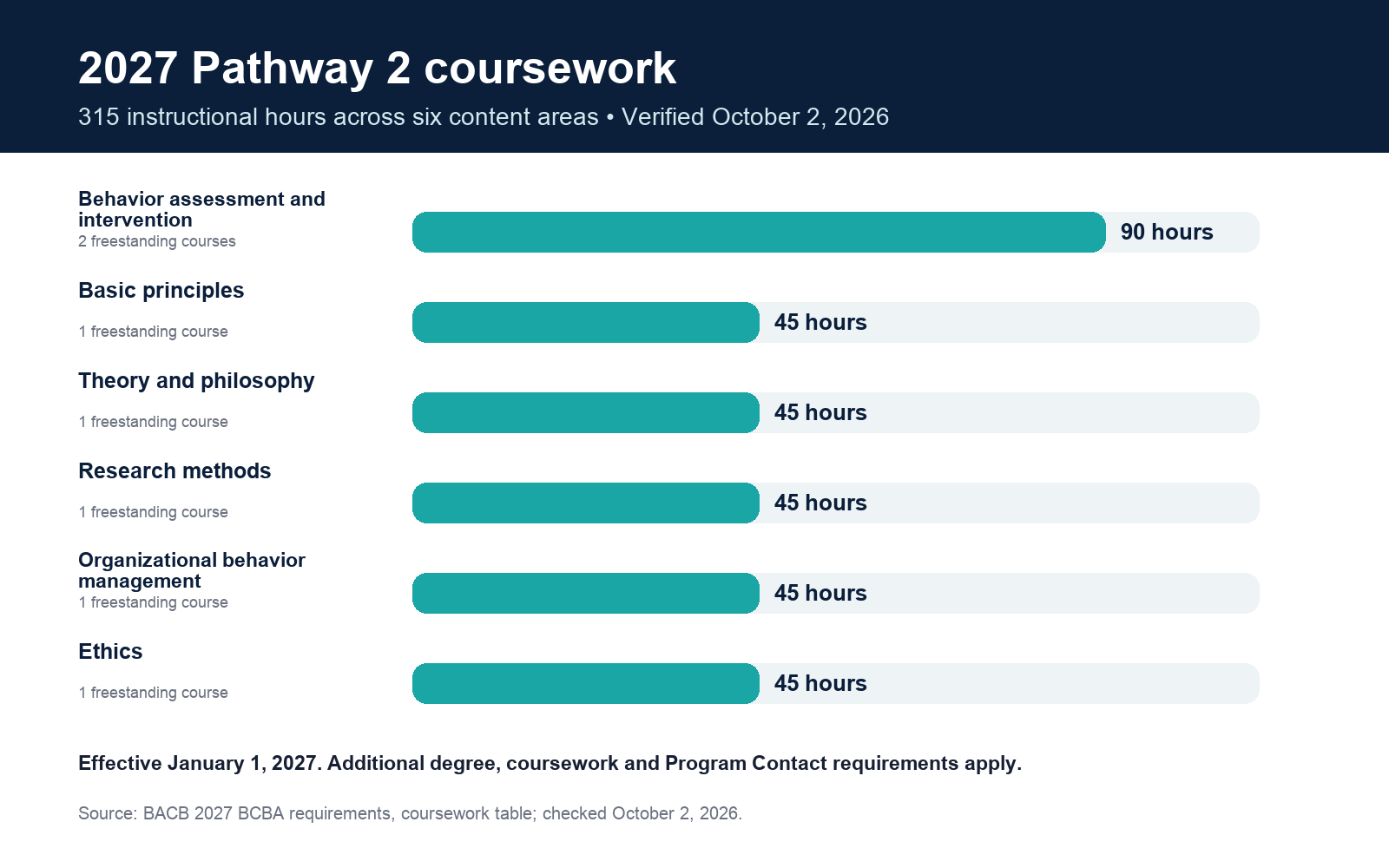
Pathway 2 coursework requirements effective January 1, 2027; checked October 2, 2026. Assessment and intervention require two freestanding courses; each other area requires one.
Both pathways require 2,000 hours of supervised fieldwork, or 1,500 hours of concentrated supervised fieldwork.
If you are choosing a program now, the January 1, 2032 date matters. A Pathway 1 program avoids the planned Pathway 2 cutoff, though you will still need to meet the requirements in place when you apply. With Pathway 2, plan to finish and apply before it closes.
How to become a BCBA, step by step
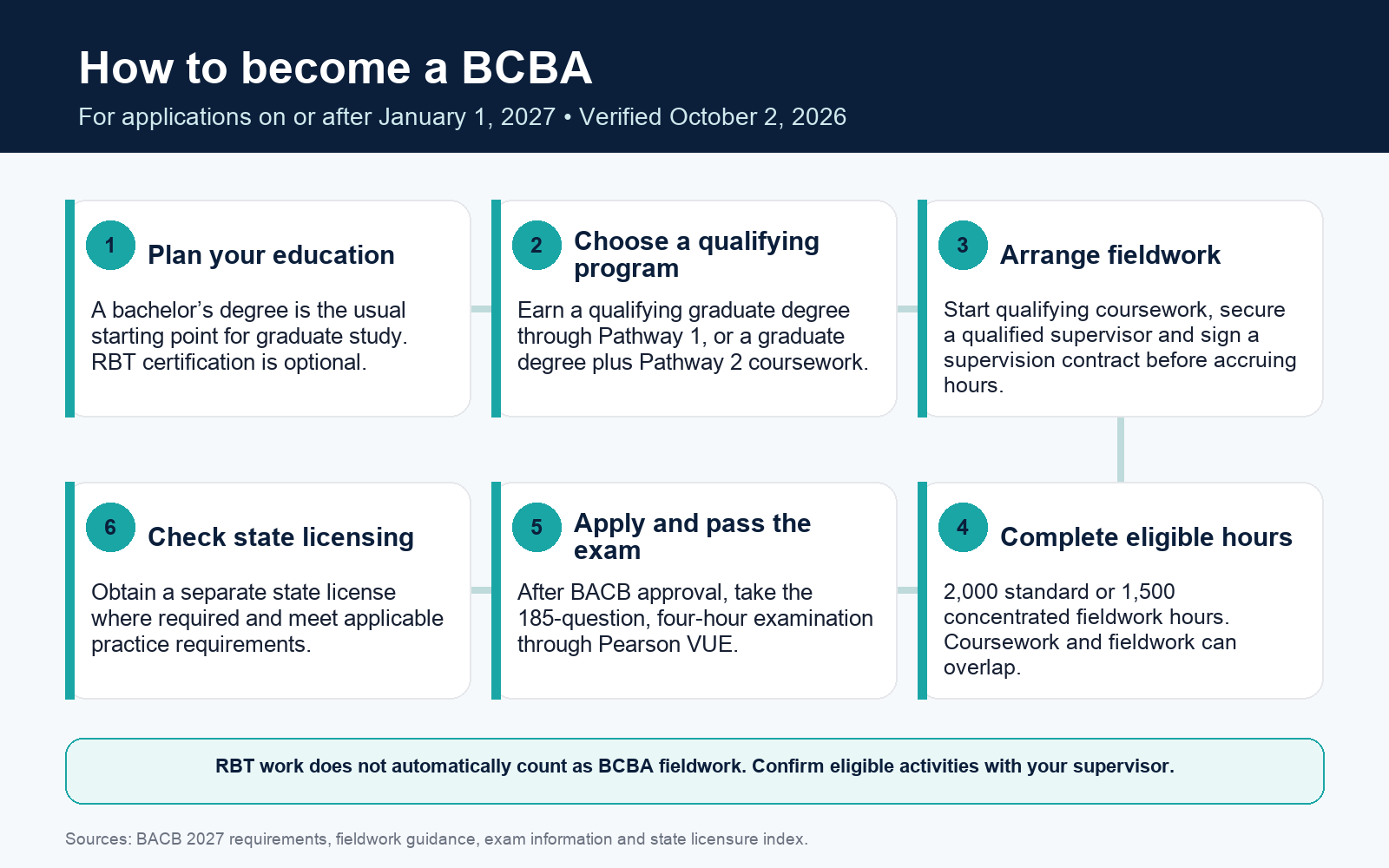
BCBA certification route for applications on or after January 1, 2027; checked October 2, 2026. Coursework and fieldwork may overlap.
Step 1: Earn a bachelor's degree
A bachelor's degree is the usual starting point for graduate study. Psychology, education, special education, and social work can all provide a useful foundation. Check the graduate program's prerequisites before choosing your courses.
Use these years to get hands on experience. Working as an RBT while you finish school shows you what behavior analysts work on day to day, and it shows graduate programs you understand the job.
Step 2: Complete a qualifying graduate degree and coursework
This is the biggest decision in the process. You can choose an applied behavior analysis program with Pathway 1 accreditation, or a master's in a related field such as education or psychology with additional coursework in behavior analysis under Pathway 2.
Required coursework covers ethics, measurement, experimental design, assessment, behavior change procedures, and supervision. Under earlier rules, students usually completed it through an ABAI verified course sequence. For 2027 applications, check whether the program meets Pathway 1 accreditation or recognition requirements, or has a Pathway 2 Program Contact registered with the BACB. Use ABAI or APBA resources to check program status before you enroll. For Pathway 2, ask the Program Contact to confirm that your courses meet the 2027 requirements, including the freestanding course structure. The coursework must also meet the BACB's rules for graduate level, academic credit, passing grades, and recency.
Online programs can qualify. The course format matters less than accreditation and content.
Step 3: Complete supervised fieldwork
Fieldwork is the critical step where you practice behavior analysis under a qualified supervisor. You can complete it during graduate coursework, including at your own workplace. Before counting hours under Pathway 1 or 2, you must have started qualifying graduate behavior-analytic coursework, secured a qualified supervisor, and signed a supervision contract. You also need a passing grade in that first qualifying course for its associated fieldwork hours to count.
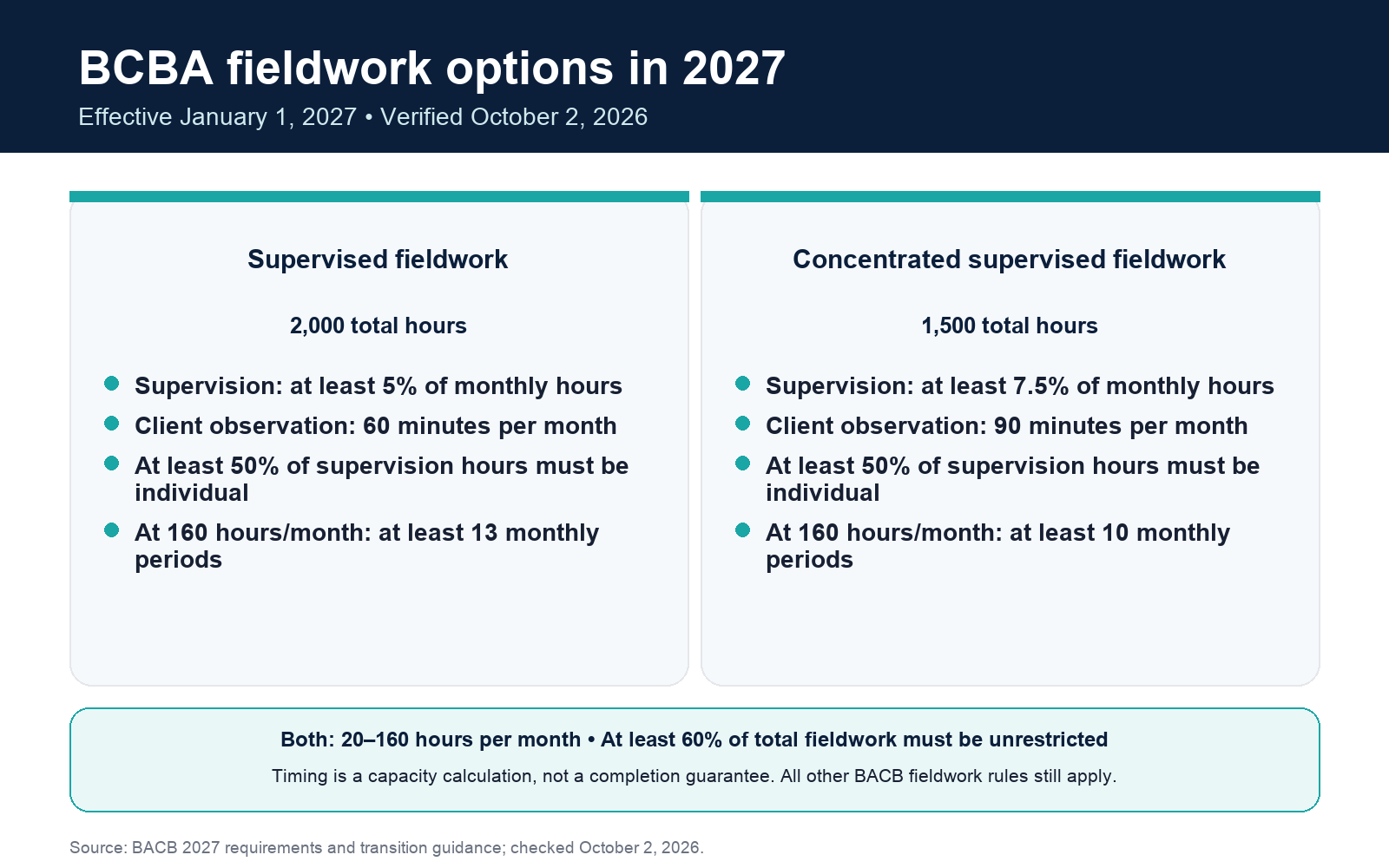
BACB fieldwork options effective January 1, 2027; checked October 2, 2026. Timing calculations assume the monthly maximum and do not guarantee completion.
The rules below come from the BACB. Anyone applying on or after January 1, 2027 follows the 2027 column and must use the 2027 monthly and final fieldwork forms. Hours earned earlier can still count if they meet the rules in place when you apply. If your application date is uncertain, review the BACB's 2027 transition guidance with your supervisor and keep documentation for both sets of requirements, including both versions of the monthly forms.
| Rule | Applying before 2027 (June 2026 Handbook) | Applying on or after January 1, 2027 |
|---|---|---|
| Total supervised fieldwork hours | 2,000 standard or 1,500 concentrated | 2,000 standard or 1,500 concentrated |
| Monthly hours | 20 minimum, 130 maximum | 20 minimum, 160 maximum |
| Supervision, standard fieldwork | 5% of hours | 5% of hours |
| Supervision, concentrated fieldwork | 10% of hours | 7.5% of hours |
| Client observation per month | 1 observation, either type | 60 minutes standard; 90 minutes concentrated |
| Individual supervision | At least 50% of supervision hours | At least 50% of supervision hours |
Across both, at least 60% of fieldwork hours must be unrestricted activities, such as assessment, writing plans, and training caregivers. Restricted activities, like direct therapy sessions, cap at 40%. Your supervisor must be a qualified BCBA or BCBA-D who meets BACB supervisor requirements.
The monthly cap helps you plan your timeline. Under the 2027 rules, 2,000 hours at the maximum of 160 hours per month spans at least 13 monthly supervisory periods; 1,500 concentrated hours spans at least 10. At 80 hours a month, those become 25 and 19 periods. These are capacity calculations, not promises of completion time: every hour and supervisory period still has to meet the BACB's requirements.
One practical route is a job as an RBT or behavior technician at an agency that offers BCBA trainee supervision. Ask whether the role includes enough unrestricted activities; routine RBT work and RBT supervision do not automatically count toward BCBA fieldwork. Keep detailed session and supervision records in a documentation system, then complete the applicable monthly and final verification forms with your supervisor. The monthly form must be signed by the last day of the following calendar month.
Step 4: Apply for and pass the BCBA certification exam
Once your degree, coursework, and fieldwork are complete, you apply to the BACB. After approval, you schedule the BCBA exam with Pearson VUE.
According to the BACB's examination information, the examination has 185 multiple-choice questions and runs four hours. It is delivered in person at Pearson VUE testing centers. The BCBA test content outline says 175 of those questions are scored and 10 are unscored pilot questions. The scored questions break down like this:
| Content domain | Scored questions |
|---|---|
| Behavior-change procedures | 25 |
| Concepts and principles | 24 |
| Behavior assessment | 23 |
| Ethical and professional issues | 22 |
| Measurement, data display, and interpretation | 21 |
| Selecting and implementing interventions | 20 |
| Personnel supervision and management | 19 |
| Experimental design | 13 |
| Behaviorism and philosophical foundations | 8 |
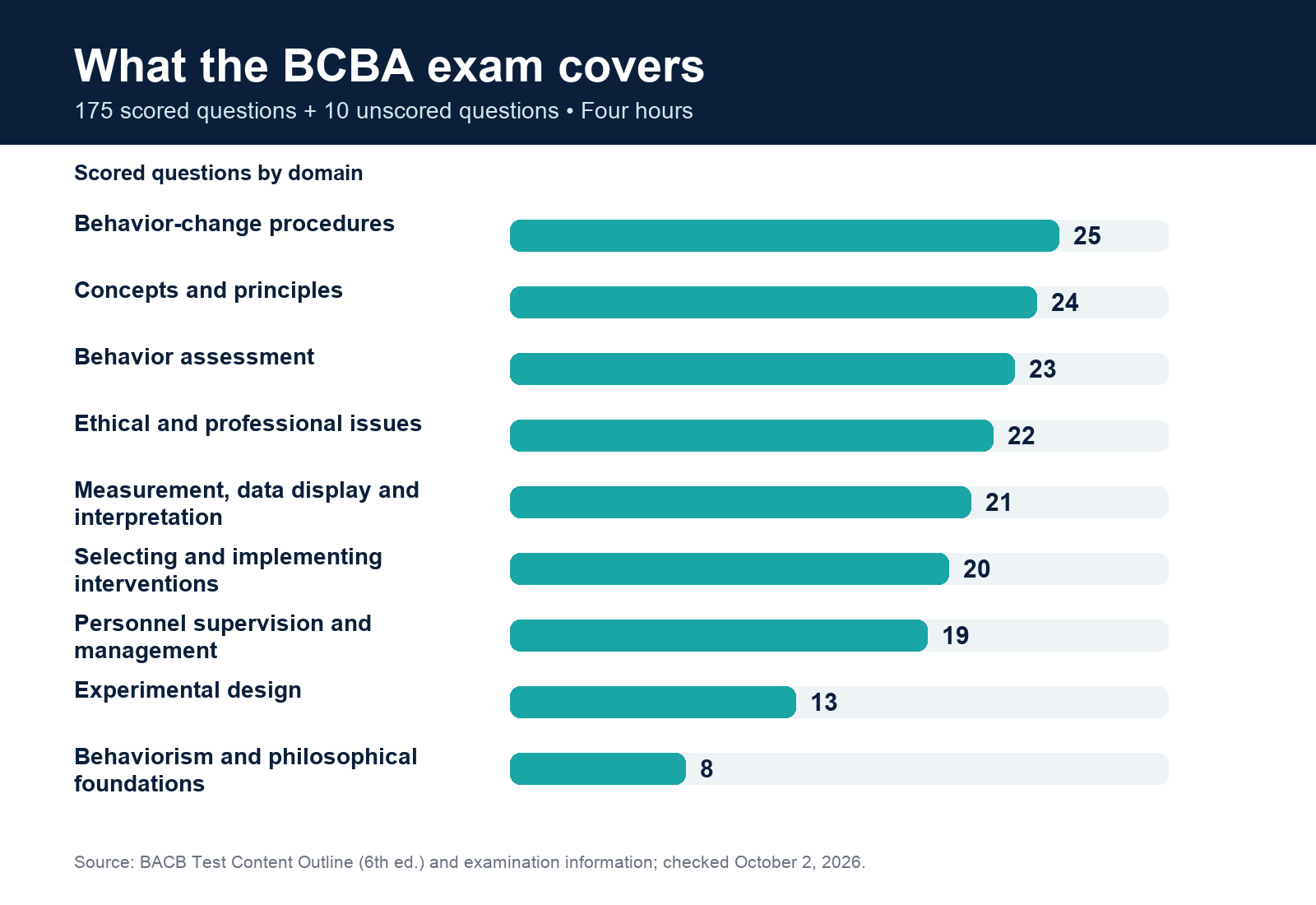
BCBA examination domains from the sixth-edition content outline; checked October 2, 2026. Bars show scored questions; the 10 unscored questions are additional.
Give yourself time to study for the BCBA exam. Build your preparation around the content outline and timed practice exams, and adjust your schedule to the areas where you need more practice.
Step 5: Get a state license if your state requires one
Passing the exam makes you a BCBA. Most states now require licensure before you can practice, and the BACB tracks them on its U.S. licensure page. The state licensure sections below cover five large states.
What BCBA certification costs
As of October 2, 2026, the BACB's certification application fee is $245, and the exam appointment fee paid to Pearson VUE is $125. Together, that is $370 before any applicable taxes or other costs. Check the Fees section of the BCBA Handbook before you pay. Rescheduling within 30 days of your exam adds a fee: $59 from 30 to 5 days out, and $69 from 5 days to 48 hours out, per the BACB.
The larger costs sit outside the BACB: graduate tuition, supervision fees if your employer does not cover supervision, study materials, and state license fees. Employer-paid supervision can reduce that bill. Ask employers you interview with whether they provide BCBA fieldwork supervision at no charge and what the arrangement includes.
How long does it take to become a BCBA?
Our planning estimate is about six years from the start of college: four years for a bachelor's degree and about two for a master's, with supervised fieldwork completed during graduate study. Your own timeline will depend on the program and how quickly you can complete eligible fieldwork.
If you already hold a bachelor's degree, roughly two to three years is a useful planning estimate for finishing a master's, completing fieldwork, and passing the exam. Part-time study, a slow fieldwork pace, or trouble finding a supervisor can stretch that. A paid RBT role may help you work while studying, but ask how the employer will support qualifying fieldwork rather than assuming your regular shifts will count.
A full-time applied behavior analysis program paired with concentrated supervised fieldwork may help you finish sooner, especially if your employer provides supervision and eligible activities. Even at the 2027 monthly maximum, concentrated fieldwork spans at least 10 monthly supervisory periods. The graduate degree and coursework have their own requirements and timelines.
Can you become a BCBA without a degree?
No. BCBA certification requires a master's degree or higher under both 2027 pathways. Guides promising a BCBA "without a degree" are describing other jobs.
If you are interested in the field but don't have a graduate degree yet, you still have options:
- Become an RBT through a paid behavior technician role. You must be at least 18 and have a high school education or equivalent, pass criminal background and abuse registry checks, and complete the required 40-hour training, competency assessment, and exam. Our RBT guide explains the application steps.
- Pursue the BCaBA once you hold a bachelor's degree.
- Start fieldwork once you have begun qualifying graduate behavior-analytic coursework, secured a qualified supervisor, and signed a supervision contract. A paid role can help, provided its activities meet the fieldwork requirements.
- Look at related roles such as school paraprofessional or behavior technician positions while you finish school.
You do not need to be an RBT before becoming a BCBA. It is a common starting point, not a requirement.
BCBA state licensure: Florida, California, Texas, Georgia, Virginia
BCBA certification is national, but licensing is state by state. Confirm current rules with the state board before you apply.
How to become a BCBA in Florida
Florida does not issue a separate behavior analyst license. Florida law (s. 393.17) directs the state to recognize qualifying national certification, which in practice means the BACB. The older Florida certification program closed, and the BACB assumed responsibility for its certificants in 2003; existing Florida Certified Behavior Analysts (FL-CBAs) may retain that designation. New candidates can follow the national BCBA steps above. Employers and payers may also have credentialing or enrollment requirements for the setting where you work.
How to become a BCBA in California
California does not license behavior analysts, so the national BCBA certification is the main credential for the role there. California accounted for 15% of US online job postings requiring or preferring BCBA/BCBA-D certification in 2025, according to the BACB's employment demand report.
How to become a BCBA in Texas
Texas licenses behavior analysts through the Texas Department of Licensing and Regulation (TDLR). It issues two credentials: the Licensed Behavior Analyst (LBA) and the Licensed Assistant Behavior Analyst (LABA). Earn your BCBA, then apply to TDLR before you practice.
How to become a BCBA in Georgia
Georgia requires a separate license through the Georgia Behavior Analyst Licensing Board in the Secretary of State's office. Earn your BCBA, then meet the board's application requirements before practicing, unless a statutory exemption applies. The board's FAQ explains the application process, including the required fingerprint background check.
How to become a BCBA in Virginia
Virginia has licensed behavior analysts since 2012, through the Virginia Board of Medicine. You will need your BCBA certification plus the board's application.
BCBA career outlook and pay
Demand for board certified behavior analysts keeps climbing. The BACB's report US Employment Demand for Behavior Analysts: 2010–2025 counted 132,307 online job postings requiring or preferring BCBA/BCBA-D certification in 2025, a 28% increase over 2024. In 2013 there were 3,901. California, New Jersey, Texas, Massachusetts, and North Carolina led demand and together made up 38% of postings. The report excludes duplicate postings; these figures measure advertised demand rather than hires or every vacancy in the field.
Among listings on our board with posted pay, 46 salaried BCBA roles had a median range of $83,500 to $95,000 (September 28, 2026 data pull); our ABA jobs explainer shows pay at each step from RBT to BCBA. Pay depends on state, setting, and experience. Compare the posted pay in current BCBA jobs to see what employers are offering for the roles and locations you are considering.
For related roles, see our RBT salary data and the full salary index by role. Our content and salary data methods page explains where our numbers come from.
How to maintain BCBA certification
Certification runs in two-year cycles, and you submit a recertification application before each recertification date. Under the 2027 requirements, the continuing education requirements are 32 CEUs per cycle, including 4 in ethics. BCBAs who supervise others also need 4 CEUs in supervision. You must follow the BACB's ethics and self-reporting requirements throughout. Recertification standards change over time, so check the Handbook for the rules that apply to your current cycle.
Is a BCBA career right for you?
The work suits people who are comfortable with data and patient with slow progress. Much of the job is writing plans, reviewing data, and supervising others. Working with families and staff can be a substantial part of the role alongside your time with clients.
Before committing to graduate school, spend time in the field. An RBT job can give you a close look at the work and pay while you decide.
Find BCBA and RBT jobs
BehavioralHealth.careers lists behavioral health jobs with posted pay wherever employers disclose it. Browse open BCBA jobs to see what employers are offering now, including supervision and pay details. If you are starting out, RBT and behavior technician jobs are where many BCBAs begin, and some of those employers provide fieldwork supervision. For more career resources, see our complete guide to careers in behavioral health.
Frequently asked questions
Can I be a BCBA without being an RBT?
Yes. The RBT credential is not a requirement for BCBA certification. An RBT job can give you paid experience while you study, but only activities that meet BCBA fieldwork requirements count toward certification.
Is an online master's program accepted?
It can be. An online program qualifies if it meets Pathway 1 accreditation or recognition requirements, or Pathway 2 coursework requirements. Confirm the program's status with ABAI, APBA, or its registered Pathway 2 Program Contact before enrolling.
Can I work full time during fieldwork?
Yes. The monthly limits apply either way: 20 to 130 hours for applications before 2027, and 20 to 160 hours for applications on or after January 1, 2027. A full-time behavior technician job can fit around fieldwork, provided you have BCBA trainee supervision and access to eligible activities, including unrestricted work.
What if BACB requirements change while I'm in school?
The BACB announces major changes ahead of time. The 2027 pathways and the planned January 1, 2032 removal of Pathway 2 were published before they take effect. Check the BCBA Handbook each year and ask your program how it is preparing students. If your plans cross a rule change, work with your program and supervisor to make sure your coursework and fieldwork will meet the requirements when you apply.
How hard is the BCBA exam?
It is a demanding four-hour, 185-question examination. The BACB publishes pass rates by university, which are worth checking before you choose a program.


Pingback: ABA Jobs Explained: RBT, BCaBA and BCBA Pay and Requirements
Pingback: Highest Paying Mental Health Careers, Ranked by Posted Pay
Pingback: How to Become a Behavioral Health Technician | And Get Hired