
Let’s start with a clarification: “Mental health specialist” is a job title, not a license.
There is no standard state license called “mental health specialist,” so the title means whatever the employer defines it to mean.
In a county behavioral health department, it can be a degreed case management and counseling role on a civil service pay scale.
In a residential treatment program, it is often a step above a behavioral health technician. In the U.S. Army, a closely related title, behavioral health specialist, is an enlisted job.
That makes the job description more important than the title.
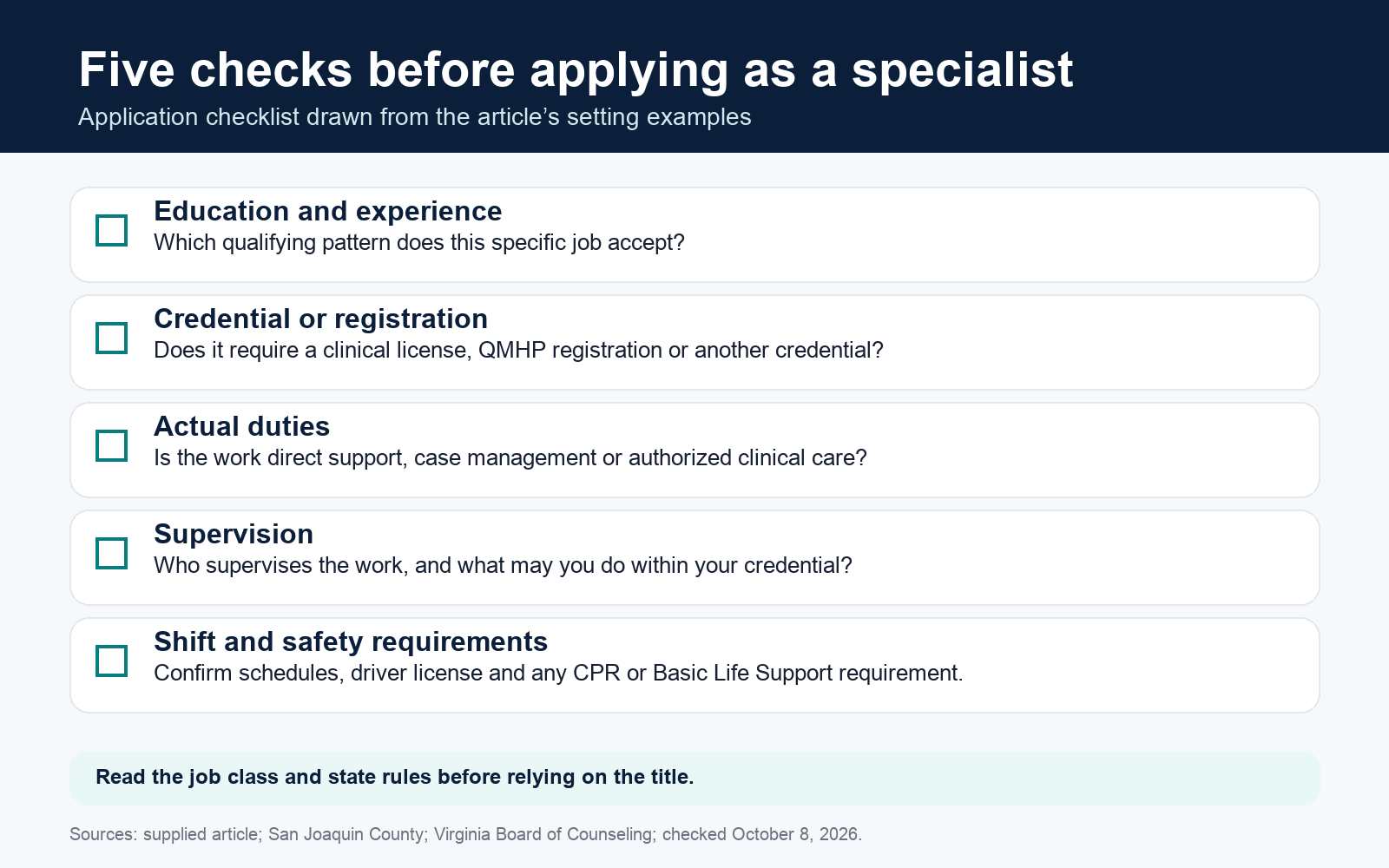
Before you apply, check three things: the degree and experience the posting asks for, whether the work is clinical or supportive, and who supervises you.
This guide walks through how the title is used in each setting, what qualifications employers ask for, and what the pay looks like in real postings.
What does a mental health specialist do?
Most mental health specialist and behavioral health specialist roles share a core set of duties, even when the titles differ:
- supporting clients day-to-day in a treatment program or the community
- leading or co-leading skills groups and activity groups
- helping carry out treatment plans written by licensed clinicians
- case management, such as connecting clients to housing, benefits, and appointments
- observing clients and documenting progress in the clinical record
- taking part in treatment team meetings
- helping keep the treatment setting safe and recovery-oriented
What usually separates a specialist from a licensed therapist is scope. A specialist supports and carries out treatment.
Diagnosing mental health conditions and providing psychotherapy on your own requires a clinical license, such as the LPC, LCSW, or LMFT.
Our guide to therapist, counselor, social worker, psychologist, and psychiatrist roles explains those licenses.
How the title is used in different settings
County and public mental health
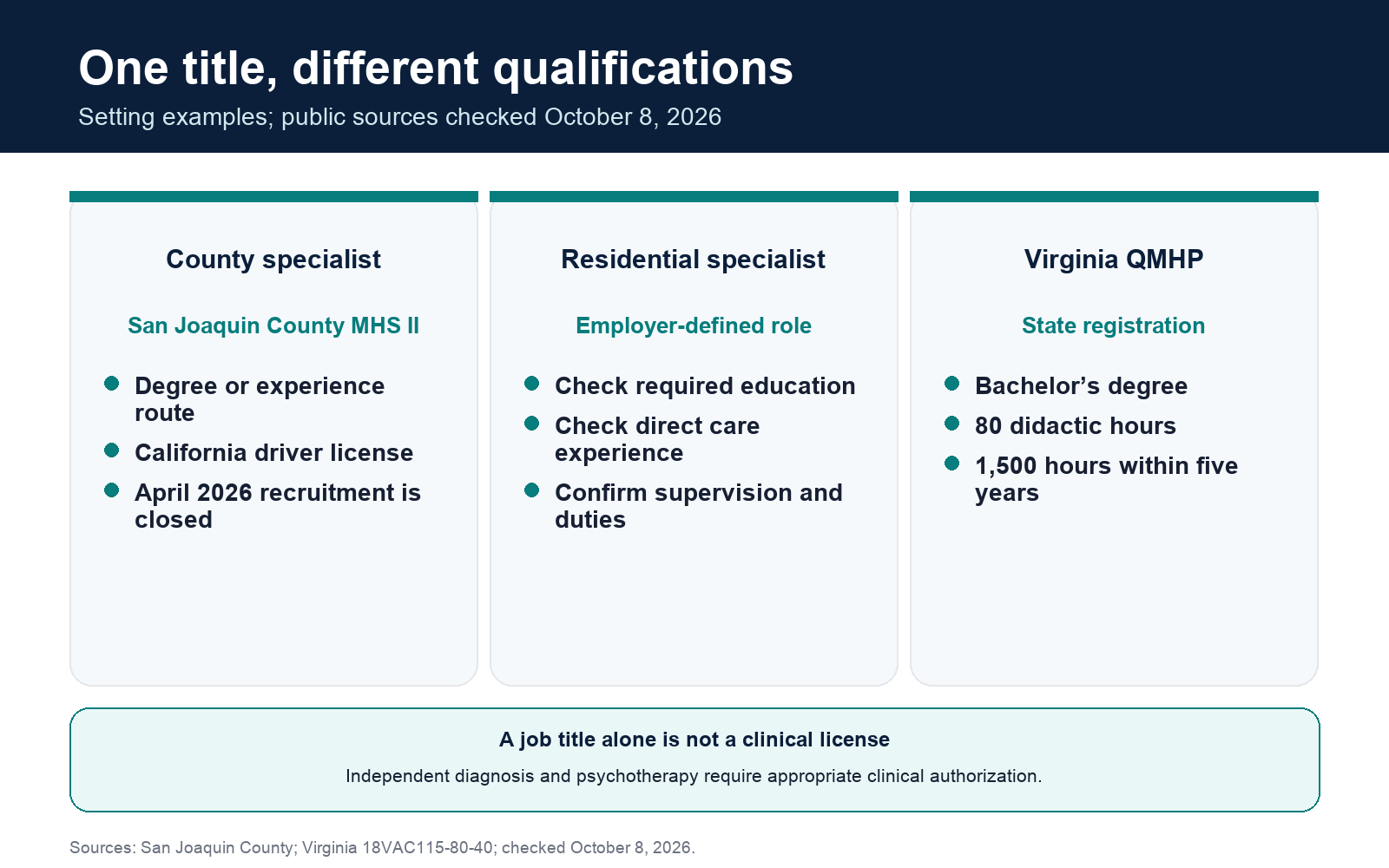
Public mental health agencies often use “mental health specialist” as a civil service job class with formal levels. San Joaquin County in California is a good example.
Its Mental Health Specialist II posting, open in April 2026, listed a salary of $5,156.20 to $6,267.40 a month. The posting described duties including developing treatment plans, providing case management and counseling, maintaining clinical records, and possibly serving as a lead over other mental health paraprofessionals. The role may include direct patient care in a 24-hour psychiatric facility or a day treatment program.
Applicants qualified through one of three patterns: two years as a Mental Health Specialist I with the county; a bachelor’s degree in psychology, social work, nursing, or a related social science; or 45 semester units, at least 30 of them in those fields, plus two years of client services experience in a mental health or social service setting. The posting required a valid California driver’s license.
Other counties use similar titles, such as mental health client specialist or behavioral health specialist, with their own levels and requirements. Each county’s job class specification is the source to check.
Residential, inpatient, and partial hospitalization programs
Treatment programs often use “behavioral health specialist” for a role that sits between a technician and a therapist. The Emily Program, an eating disorder treatment provider, is one employer on our board using the title.
Its behavioral health specialists facilitate skills groups (including CBT and DBT skills), self-monitoring groups, and activity groups, provide therapeutic meal support, coach clients in the moment, and support treatment plans developed by the therapist and treatment team.
For that role, the employer strongly prefers a bachelor’s degree in a mental or behavioral health field and requires at least one year of direct patient care experience in a mental or behavioral health setting.
Staff at its residential and inpatient sites also need a driver’s license and Basic Life Support certification.
Its behavioral health technician postings ask for less: a high school diploma or GED, with one year of mental health experience at its St. Paul site, while its Seattle night technician posting lists six months of direct care as preferred rather than required.
Mental health technician roles
Many hospitals and residential programs call the support role a mental health technician or behavioral health technician instead. The work overlaps heavily with specialist roles: observation, safety checks, milieu support, and documentation.
If you search only for “mental health specialist,” you will miss most of these jobs.
Our guides to the behavioral health technician career and to BHT vs mental health technician vs psych aide roles cover them in detail.
The Army’s 68X behavioral health specialist
In the U.S. Army, behavioral health specialist is an enlisted military occupational specialty, numbered 68X. If you see “68X” on a résumé or in a veterans’ hiring program, it refers to that military role.
Veterans moving into civilian work should ask the relevant state board or employer how military experience counts toward civilian roles and credentials.
Qualified mental health professional (QMHP)
Some states use a related term, qualified mental health professional, in regulations that define who may provide certain services.
In Virginia, the QMHP is a registration with the Board of Counseling. Under 18VAC115-80-40, applicants need a bachelor’s degree, 80 hours of didactic education in a board-approved program, and 1,500 hours of supervised experience within the five years before applying. The experience must involve direct services to adults or children with mental illness.
The application also requires an NPDB report and verification of other professional credentials, and disciplinary history may affect eligibility. Definitions differ widely from state to state, so check your state’s rules before you assume a title transfers.
Mental health specialist requirements
Because the title isn't standardized, requirements vary by employer. Across the postings and public job classes above, a few patterns show up:
| Setting | Typical education | Experience | Other requirements |
|---|---|---|---|
| County mental health (San Joaquin County MHS II) | Bachelor’s degree in psychology, social work, nursing, or a related field, or 45 units plus experience | Two years of client services experience on the non-degree pattern | California driver license |
| Residential and partial hospitalization (The Emily Program) | Bachelor’s degree strongly preferred | At least one year of direct patient care | Driver license and Basic Life Support at residential and inpatient sites |
| Virginia QMHP registration | Bachelor’s degree | 1,500 supervised hours within five years | 80 hours of didactic education; Board of Counseling registration; other application requirements |
A bachelor's degree in psychology, social work, or another human services field is a useful starting point in these examples. Direct care experience counts for a lot. Postings like The Emily Program's ask for a year of it, which technician roles provide.
Mental health specialist salary
We report posted pay from our own job board rather than survey estimates. Our board draws mainly from private employers' hiring systems and does not carry county civil service jobs, where the title often appears. On October 7, 2026, no listings on our board used the exact title "mental health specialist." One used "behavioral health specialist," from The Emily Program, which also posts technician roles in the same city:
| Role | Employer | Location | Posted pay |
|---|---|---|---|
| Behavioral health specialist, float | The Emily Program | Seattle, Washington | $26.40 to $29.70 an hour |
| Behavioral health technician, full-time nights (for comparison) | The Emily Program | Seattle, Washington | $22 to $28 an hour |
In Seattle, the specialist range sits above the technician range at both ends. That is one employer in one city, so it shows how one organization structures the ladder, not a national rate.
For the broader support tier, 33 hourly behavioral health technician and mental health technician listings from 5 employers posted a median minimum of $18 and a median maximum of $22 an hour on the same date.
Pay in the public sector follows the job class. San Joaquin County’s Mental Health Specialist II range of $5,156.20 to $6,267.40 a month works out to about $61,874 to $75,209 a year, or roughly $29.75 to $36.16 an hour at full-time hours.
How to become a mental health specialist
- Earn a relevant degree. A bachelor’s in psychology, social work, or a related human services field opens the most doors. Some public employers accept college coursework plus experience instead, as San Joaquin County does.
- Get direct care experience. Technician, residential counselor, and case aide roles build the patient care experience that specialist postings ask for.
- Read job class specifications. For county and state jobs, the job class spec spells out the qualifying patterns, and they are applied strictly.
- Check your state’s rules. If your state uses a QMHP or similar designation, find out whether employers in your area require it.
- Decide whether to pursue a clinical license. If you want to diagnose and provide therapy on your own, plan for a master’s degree and a license such as the LPC, LCSW, or LMFT.
FAQs on Mental Health Specialist Roles
Is a mental health specialist a licensed professional?
Usually not. “Mental health specialist” is a job title set by the employer. Some roles are filled by licensed clinicians, but the title itself is not a license. Virginia’s QMHP is a registration, which is a different thing from a clinical license.
What’s the difference between a mental health specialist and a mental health technician?
It depends on the employer. In the postings and job classes we reviewed, the specialist role asked for more education or experience and included more group facilitation, skills coaching, or case management.
At The Emily Program, for example, the specialist role requires a year of direct patient care and prefers a bachelor’s degree, while its technician postings accept a high school diploma or GED, with experience requirements that vary by site.
Is a behavioral health specialist the same as a mental health specialist?
They are often used for similar roles, but neither is standardized. Read the duties and qualifications in each posting.
Can a mental health specialist provide therapy?
Not independently, unless they also hold a clinical license. Specialists commonly lead skills groups and support treatment plans under the direction of licensed clinicians.
Find mental health specialist jobs
BehavioralHealth.careers lists behavioral health jobs with posted pay wherever employers disclose it.
Because employers use different titles for similar work, search more than one: behavioral health specialist jobs, mental health technician jobs, and case manager jobs.
Our content and salary data methods page explains how we collect and report pay.