
Use a staffing agency when you need coverage fast and only for a while: a clinician on leave, a unit that has to stay staffed this week, a role you can’t credential in time on your own.
Hire directly when the job is permanent. In behavioral health, the clinician-client relationship is the product, and an agency markup is a steep price to pay for someone you hope to keep for years.
This guide covers what each route costs, where each one is faster, and the contract terms to settle before you sign with an agency.
Figures come from published industry sources, and each one is cited.
What each route costs
Hiring directly
The Society for Human Resource Management puts the average cost per hire for nonexecutive roles at $5,475, based on its 2025 benchmarking data (SHRM, October 15, 2025).
That number includes advertising, recruiter time, and other hiring costs, and it is an all-industry average, not a behavioral health figure. Treat it as a reference point.
An agency’s direct-hire (placement) fee
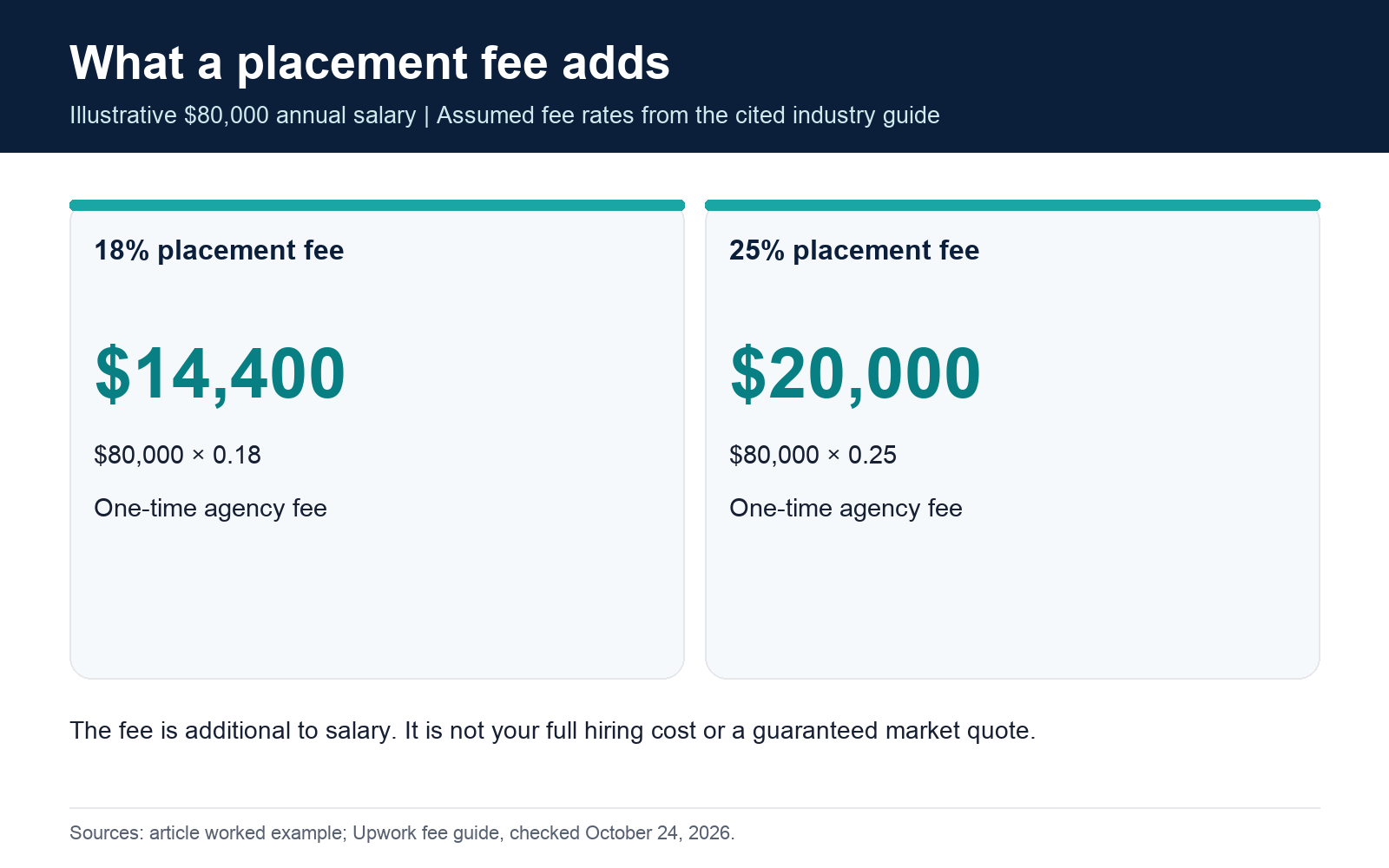
When an agency finds a permanent employee for you, it typically charges a one-time fee based on the hire’s first-year pay. A 2026 Upwork guide to staffing fees puts direct-hire fees at about 18% to 25% of annual compensation (Upwork).
That is an industry guide, not a survey of behavioral health contracts, so treat it as a starting point for negotiation.
The math adds up quickly. For an $80,000 hire, an 18% to 25% fee is $14,400 to $20,000, roughly 2.6 to 3.7 times SHRM’s average nonexecutive cost per hire.
Your own staff time on interviews and onboarding is spent either way. For context on pay, our mental health counselor salary guide and behavioral health social worker salary guide show where clinical salaries land.
Contract and temporary staff (markup)
For temporary staff, the agency employs the worker and bills you an hourly rate above what it pays them. That markup covers the agency’s payroll taxes, insurance, benefits, and margin.
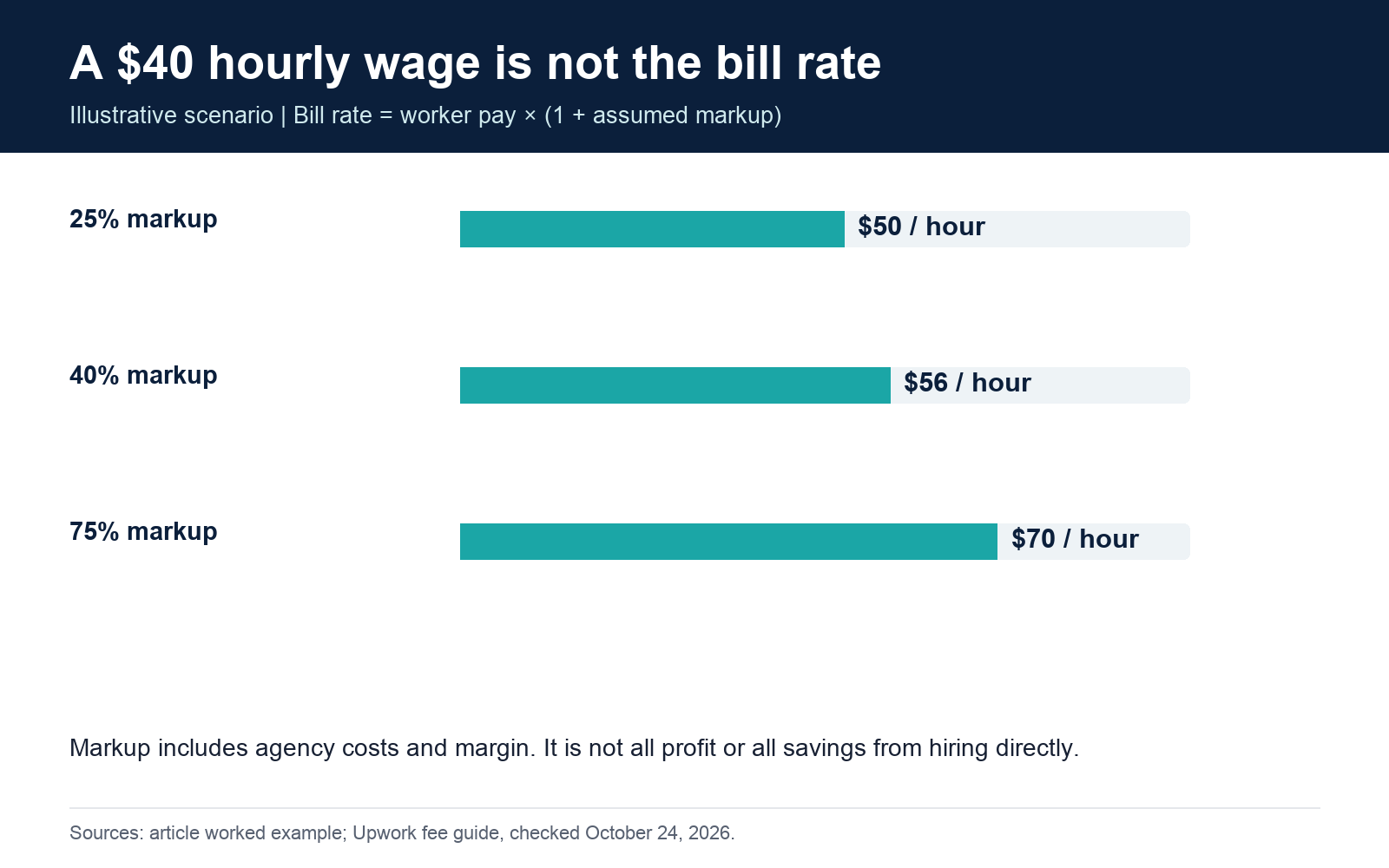
The same Upwork guide puts typical markups at about 25% to 40%, and as high as 75% for specialized or hard-to-fill positions, citing pricing guidance from Advance Partners (Upwork).
Here is what that looks like. If a contract therapist is paid $40 an hour, a 25% markup means you pay $50, a 40% markup means $56, and a 75% markup means $70.
Over a full-time year of 2,080 hours, the 25% to 40% range adds $20,800 to $33,280 above the clinician’s pay.
A direct employee carries payroll taxes and benefits too, so your true premium over hiring directly is smaller than the full markup.
Ask the agency to show you what its markup covers.
Temp-to-hire
Some agencies place a worker on contract first and let you hire them later. Expect to pay the contract markup during the trial period, and possibly a conversion fee when you hire the person.
Read the conversion terms before the first day, because they decide what it costs to keep someone you like.
How fast contract spending can grow
Hospitals saw contract labor costs climb sharply after 2019. The American Hospital Association reported a 258% increase in hospitals’ total contract labor expenses in 2022 compared with 2019 (AHA, April 20, 2023).
Those figures cover hospitals broadly, not behavioral health providers alone, but they show how fast contract spending can grow.
Which route is faster
Agencies win on speed when they already have a clinician who is licensed in your state, credentialed, and available. That bench is what you pay for. If the agency has to recruit from scratch, it faces the same shortage you do.
The shortage is real and long-running. HRSA projects a shortage of about 62,490 full-time-equivalent psychologist positions in 2036 under its status-quo scenario, along with shortages of addiction counselors, mental health counselors, marriage and family therapists, and adult psychiatrists (HRSA Behavioral Health Workforce Brief, December 2023).
As of December 2023, more than half of the U.S. population, 169 million people, lived in a Mental Health Professional Shortage Area (same source).
In a 2023 Harris Poll survey for the National Council for Mental Wellbeing, 58% of the 608 respondents who provide care said their waitlist was longer than it had ever been (National Council for Mental Wellbeing).
Direct hiring depends on your posting doing more of the work, and pay is a lever you control. As of May 2025, 59% of U.S. job postings included salary information, but only 44% of physician roles and 53% of nurse roles did (Indeed). A clinical posting that shows a real range stands out in a field where many don’t. For a behavioral health comparison, our Q4 2026 posted-pay report breaks down disclosure and posted ranges by role.
You also don’t need an agency to hire contract or per diem clinicians. On October 24, 2026, 88 listings from 18 employers on our board had contract, 1099, per diem, or PRN in the title.
Half of those came from one telehealth company, but four psychiatric hospitals and two addiction treatment providers (The Recovery Village and Kolmac Integrated Behavioral Health) were on the list too, mostly with PRN or per diem therapist, technician, and intake roles.
Fit, continuity and quality
Cost and speed are easy to compare. Fit is where the two routes really differ.
Continuity of care. A contract clinician’s assignment has an end date. When it ends, clients may need to transfer to a new clinician unless the assignment is extended or converted to a permanent role.
For short coverage, that trade-off is worth it. For a standing caseload, plan for it before the assignment starts.
Onboarding and culture. A direct hire goes through your full orientation, documentation training, and supervision structure. Ask an agency what orientation its staff will get on your site, and who pays for that time.
Our therapist onboarding checklist shows what a complete start looks like.
Verification. Ask any agency how it verifies licenses, competence, and background checks. The Joint Commission certifies health care staffing firms through its Health Care Staffing Services program.
It reviews how a firm gathers and assesses credentials, evaluates competence, supports continuing education, and matches staff to assignments (The Joint Commission). The certification covers firms that place temporary clinical staff, and you can check a firm’s status on the Joint Commission’s search of accredited and certified organizations.
When to use an agency, and when to hire directly
| Situation | Better route | Why |
|---|---|---|
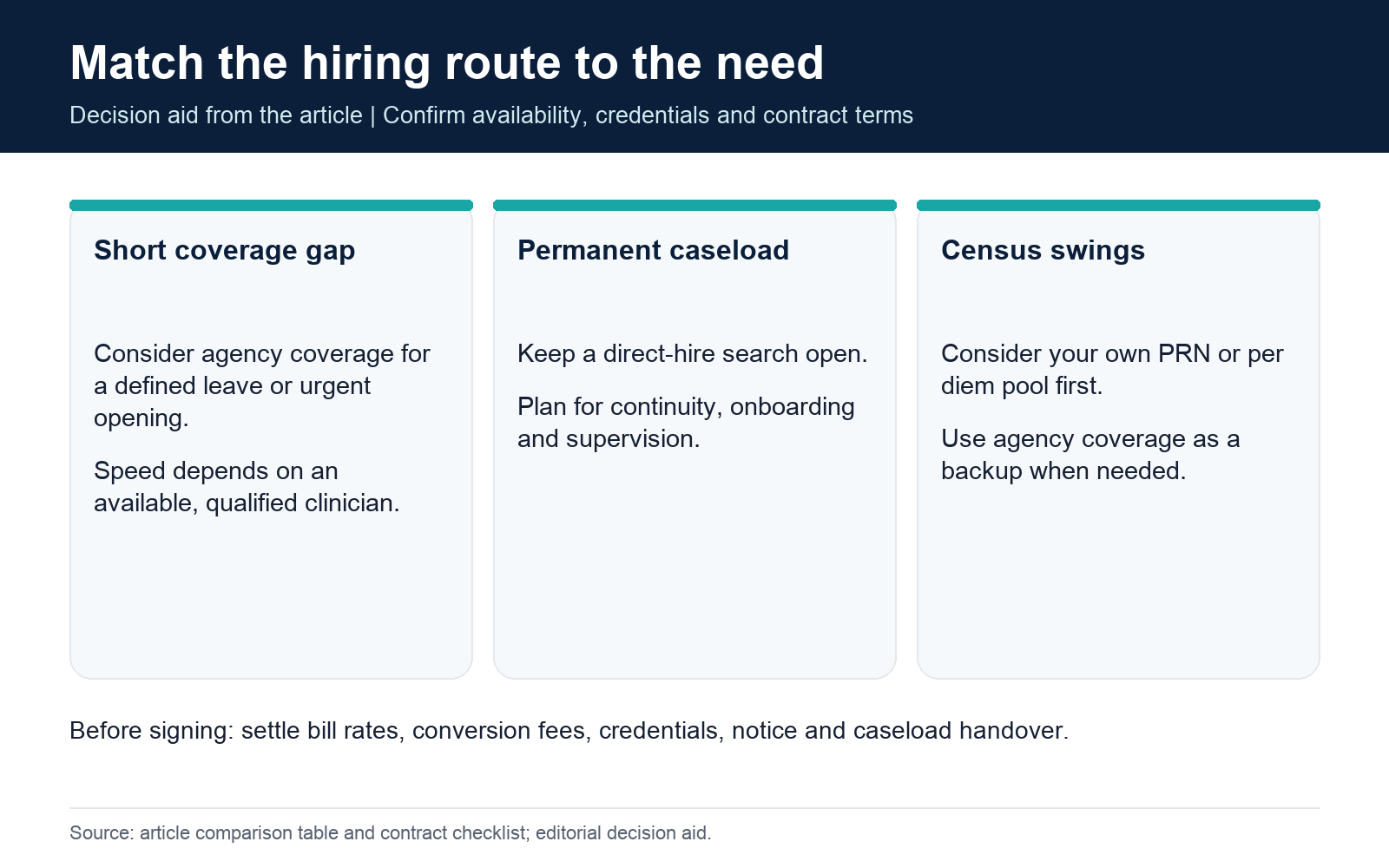
| A clinician is on leave for a set period | Agency (contract) | Short, defined need; the markup ends when the leave ends |
| A new program has to open on a fixed date | Agency for the first weeks, while you hire directly | Covers the gap without locking in contract costs |
| A role you can’t fill locally, such as psychiatry in a rural area | Agency or a telehealth contract, while you keep recruiting | Specialized roles carry the highest markups, so keep a permanent search open |
| A permanent therapist, counselor or technician position | Direct hire | Continuity of care, and you control onboarding and supervision |
| Seasonal or census-driven swings on an inpatient unit | Your own PRN or per diem pool first, agency as backup | Per diem staff already know your unit and policies |
Contract terms to settle before you sign
If you do use an agency, put these in writing:
- The bill rate and the markup, and what each covers.
- Overtime, holiday, and shift-differential billing rules.
- Whether a conversion fee applies if you hire the clinician, how much it is, and whether it ends after a set period.
- Any guarantee on a direct-hire placement: what happens if the hire leaves early.
- Who verifies licensure, competence, and background checks, and how you get the records.
- Notice periods on both sides, and what happens to the caseload when an assignment ends.
- For temporary staffing, whether the firm holds Joint Commission Health Care Staffing Services certification.
Making direct hiring work
Most of what makes direct hiring work is in your control:
- Post a real pay range. Benchmark it against our salary guides by role and our ranking of mental health careers by posted pay, which uses what employers actually post. Before publishing, check our pay transparency laws by state guide for location-specific posting requirements.
- Write the posting like you mean it. Shift, supervision, caseload, pay and the hiring timeline belong in the posting.
Our guide to writing a behavioral health technician job description shows the format, and it carries over to clinical roles. For roles beyond technician, our job description templates for behavioral health roles include examples for therapists, case managers, peer specialists, nurses and intake coordinators.
- Widen the map for telehealth roles. Licensure compacts let some clinicians serve clients in more states.
Our guides to the Counseling Compact and PSYPACT explain what each allows.
- Build a per diem pool. Former staff and part-time clinicians already know your program and how you document care.
Our behavioral health workforce outlook covers the wider hiring market.
Posting on BehavioralHealth.careers
BehavioralHealth.careers is a job board for behavioral health, built around posted pay. We are opening job posting to a small group of behavioral health employers first, by invitation.
To ask about it, email [email protected]. See how founding placements work.
Frequently asked questions
How much do staffing agencies charge for behavioral health roles?
Industry guides put direct-hire placement fees at about 18% to 25% of first-year pay, and contract markups at about 25% to 40%, rising as high as 75% for specialized roles (Upwork).
Actual rates depend on the role, the market and your contract, so get every rate in writing.
Is direct hiring cheaper than using an agency?
Direct hiring avoids an agency placement fee, but compare the full recruiting, payroll, benefit, and vacancy costs for your role. SHRM’s average nonexecutive cost per hire was $5,475 in its 2025 benchmarking data.
A placement fee of 18% to 25% on an $80,000 salary is $14,400 to $20,000. An agency earns its cost when the alternative is leaving a role empty or turning clients away.
When does a staffing agency make sense?
For short, defined gaps: leave coverage, a program launch, census spikes, or a specialized role you can’t fill locally while a permanent search continues.
What is Joint Commission Health Care Staffing Services certification?
A Joint Commission program for staffing firms that place temporary clinical staff. It reviews how a firm checks credentials, evaluates competence, supports training, and matches staff to assignments.
You can look up certified firms through the Joint Commission’s search of accredited and certified organizations.
Sources
- Society for Human Resource Management, SHRM releases 2025 benchmarking reports, October 15, 2025.
- Upwork, How much do staffing agencies charge?, accessed October 24, 2026.
- American Hospital Association, press release on the 2022 Costs of Caring report, April 20, 2023.
- Health Resources and Services Administration, Behavioral Health Workforce Brief, December 2023.
- National Council for Mental Wellbeing, Workforce shortage survey results, 2023.
- Indeed, Pay transparency across high-earning sectors, 2025.
- The Joint Commission, 2026 Health Care Staffing Services Review Process Guide.
- BehavioralHealth.careers live listings, read October 24, 2026.