
A good behavioral health job description answers the questions a candidate will otherwise ask in the first phone screen: what it pays, which licenses qualify, who supervises, what the schedule is, and what the caseload looks like.
Leave those out and you push the answers into screening calls, or lose candidates who won’t make the call.
Below are five templates you can copy and adapt, plus what employers on BehavioralHealth.careers actually put in their postings for each role.
All board figures come from the 1,364 live listings we read on November 2, 2026.
What every behavioral health job description should include
Whatever the role, a clear posting has these parts, in roughly this order:
- Job title that matches what candidates search for. “Peer Recovery Specialist” beats “Recovery Ambassador.”
- Pay range and pay type (hourly, salary or per session). Where a posting is covered, provide the applicable good-faith pay scale or range and add benefits, other compensation and application information where required. See our guide to pay transparency laws by state.
- Credentials accepted, by name. List every license or certification that qualifies, and say whether pay differs between them.
- Schedule and setting: shift, days, in person, hybrid or remote, and the client jurisdictions where a remote clinician must have authority to practice.
- A two- or three-sentence summary of the job and the people you serve.
- Responsibilities: six to ten specific duties, not a list of traits.
- Qualifications, split into required and preferred. A long required list shrinks your pool.
- Supervision and support: who supervises, how often, and whether supervision toward licensure is included.
- Benefits: health insurance, paid time off, retirement, continuing education.
- How to apply and what happens next.
What employers on our board post, by role
| Role | Listings | Employers | Show pay | Median posted pay |
|---|---|---|---|---|
| Therapists, counselors and clinical social workers | 385 | 41 | 72% | $63,800 to $97,800 a year (146 salaried listings, 21 employers) |
| Case managers and care coordinators | 38 | 13 | 63% | $23 to $24.95 an hour (20 listings, 8 employers) |
| Psychiatric nurses (RN, LPN and LVN) | 25 | 11 | 60% | No single median: RN and LPN pay differ too much (see Template 4) |
| Peer support and recovery specialists | 12 | 9 | 75% | Too few listings to report a median |
| Intake and admissions | 4 | 4 | 0% | None posted pay |
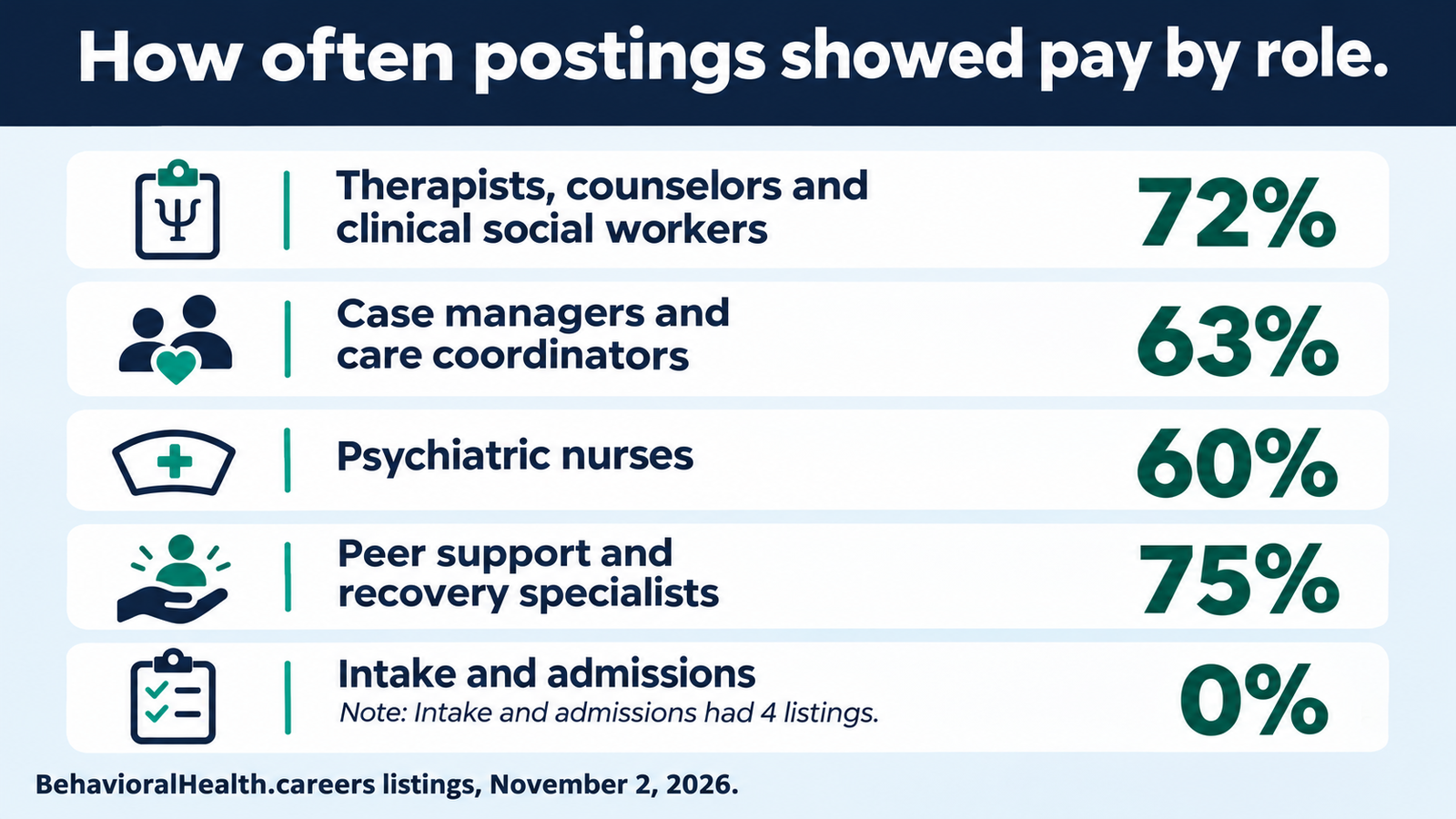
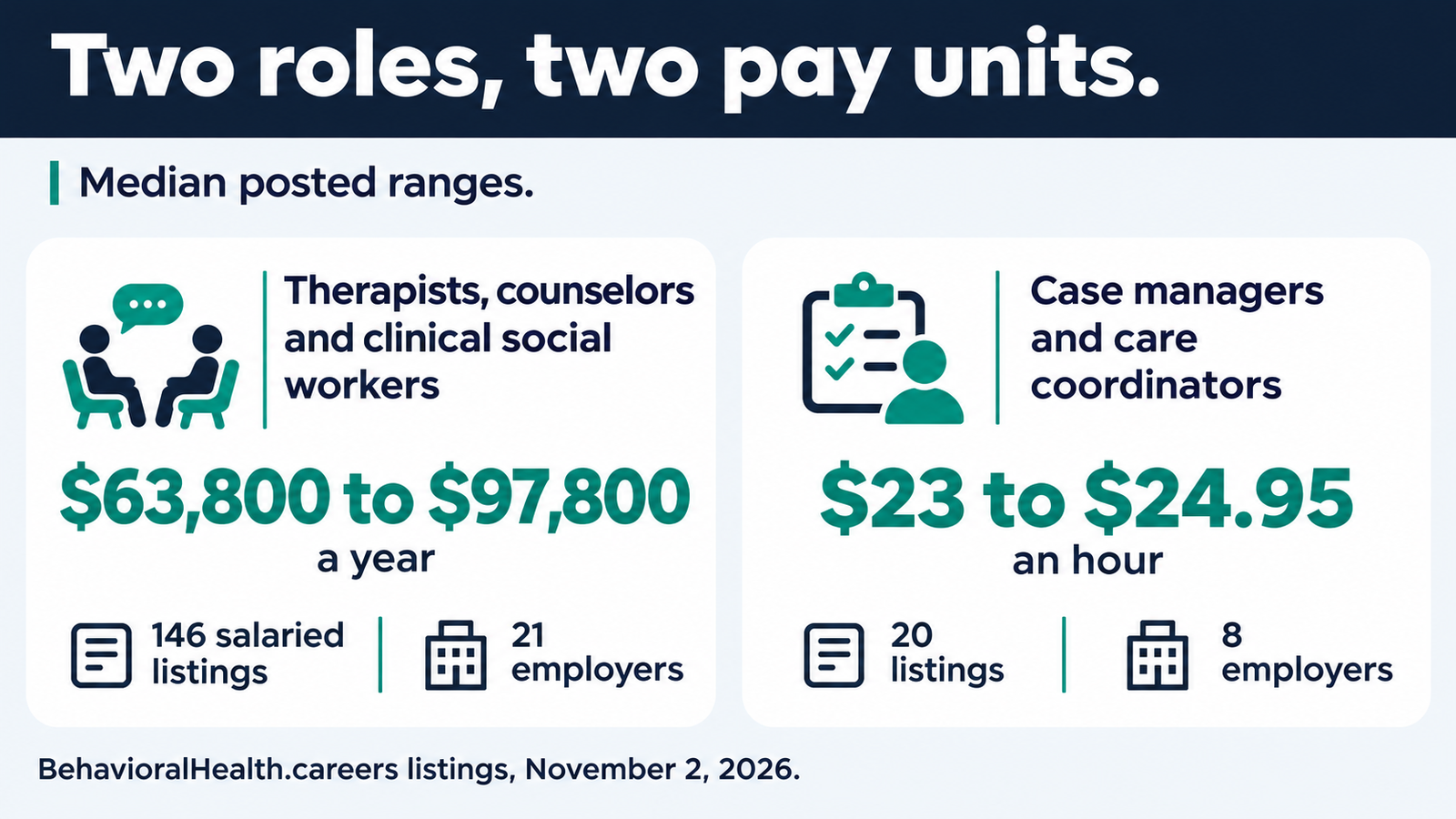
Source: BehavioralHealth.careers live listings, November 2, 2026. Therapists grouped by the role tag on each listing, other roles by job title, so counts can differ slightly from articles that group every role by tag; nurse care manager roles at a general health company were left out. We report a median only when at least 10 listings from at least three employers stand behind it; the two ends of each range are separate medians.
Every role but intake shows pay on at least six listings in ten. Intake is the exception, but the sample is small: only 4 intake and admissions listings, from 4 employers, and none showed pay.
Three of those employers post pay on no listings at all. If you hire intake staff, posting pay is an easy way to stand out.
Template 1: Therapist or clinical counselor
Job title: [Outpatient / IOP / Child and Adolescent] Therapist ([LCSW, LPC, LMFT] or [associate credential])
Pay: $[X] to $[Y] per [year / hour / session]. [If pay differs by license: Independently licensed: $[X] to $[Y]. Associate-level: $[X] to $[Y].]
Schedule and setting: [Full time / part time], [days and hours], [in person at location / hybrid / remote in states: list]. Caseload: about [N] client sessions per week once fully ramped.
About the role: You’ll provide individual, group and family therapy to [population] at our [setting]. You’ll work with [psychiatry, nursing, case management] on a shared treatment plan for each client.
Responsibilities:
- Complete intake assessments and diagnostic evaluations within the scope of the credential and applicable supervision rules
- Develop and update treatment plans with each client
- Provide individual, group and family therapy using [CBT, DBT, EMDR or your core models]
- Assess risk and follow crisis and safety protocols
- Coordinate care with psychiatric providers, case managers and outside referrals
- Complete documentation in [EHR] within [timeframe]
- Participate in clinical supervision and team meetings
Required:
- Master’s degree in counseling, social work, marriage and family therapy or a related field
- Active [state] license or associate registration: [list each accepted credential]
Preferred:
- Experience with [population or modality]
- [Language] fluency
Supervision and growth: [Clinical supervision toward licensure is provided at no cost, on paid time. / This role requires independent licensure.]
Benefits: [Health, dental and vision insurance, paid time off, retirement match, continuing education stipend, loan forgiveness eligibility.]
Notes from our board. Therapist postings are where license lines matter most. Several employers spell out who qualifies and how pay changes.
The Emily Program lists both ranges in one Georgia posting: $60,000 to $68,000 for associate-licensed therapists and $70,000 to $75,000 for independently licensed therapists.
Brave Health posts separate base salaries by license for its remote Indiana roles: $60,000 to $63,000 for an associate-level LMHCA and $76,000 to $84,000 for a fully licensed LMHC or LMFT.
If you hire associates, our guide to hiring your first associate clinician covers supervision and pay models.
Template 2: Behavioral health case manager
Job title: [Behavioral Health / Integrated / Community] Case Manager
Pay: $[X] to $[Y] per hour
Schedule and setting: [Days and hours], [site-based / community-based with travel]. Caseload: about [N] clients.
About the role: You’ll help clients in [program] get the services and supports they need during and after treatment, from benefits and housing to medical appointments and aftercare.
Responsibilities:
- Complete case management and discharge-needs assessments
- Build and update a case management plan with each client
- Connect clients to community resources: housing, food assistance, benefits, employment, legal and medical services
- Coordinate with therapists, nurses and outside providers
- Schedule and track appointments and referrals
- Plan aftercare and discharge with the treatment team
- Document services accurately and on time
Required:
- [Bachelor’s degree in social work, psychology, human services or a related field / High school diploma plus [N] years of related experience]
- [Valid driver’s license and insurance, if the role includes travel]
Preferred:
- Experience in [behavioral health, substance use treatment or social services]
- [State certification, if applicable]
Benefits: [List]
Notes from our board. Case management postings on our board varied widely in what they required.
On November 8th, The Recovery Village asked for a high school diploma at minimum, with a bachelor’s degree preferred and two years of clinical experience, starting at $23 an hour.
Lighthouse Behavioral Health Solutions in Ohio required a state chemical dependency counselor assistant (CDCA) certification for its case manager role, at $20.19 to $26.60 an hour. Decide which of those you truly need and put the rest under “preferred.”
Our behavioral health case manager career guide covers the role in more depth.
Template 3: Peer support specialist or peer recovery specialist
Job title: Peer [Support / Recovery] Specialist
Pay: $[X] to $[Y] per hour
Schedule and setting: [Days and hours], [site / community / virtual].
About the role: You’ll use your own lived experience of [mental health / substance use] recovery to support people in our [program] as they work toward their own recovery goals.
Responsibilities:
- Build trusting, one-on-one relationships with the people you support
- Share your recovery experience in ways that help others
- Help each person set and work toward their own recovery goals
- Connect people to community resources, mutual support groups and services
- Co-facilitate recovery support groups
- Help people prepare for and navigate crises, in partnership with clinical staff
- Advocate for the people you support within the treatment team
- Document contacts according to program and state standards
Required:
- Lived experience of [mental health / substance use] recovery, and willingness to share it
- [State] peer certification [or ability to obtain it within [N] months]
Preferred:
- Experience in peer support or recovery services
- [Language] fluency
Benefits: [List]
Notes from our board. SAMHSA’s core competencies for peer workers were written in part to “inform job descriptions,” and its 12 competency areas make a good checklist for your duties list, from sharing lived experience to helping peers manage crises (SAMHSA).
Peer postings on our board asked for state certification, lived experience or both.
Boulder Care asked for active state peer certification where available and national certification through NAADAC, or the ability to get it within nine months of hire. Avoid adding a degree or clinical license unless the role or applicable program requires it. Set certification timing according to state, payer and program requirements.
Our peer support specialist career guide and state certification guide cover the credential side.
Template 4: Psychiatric or behavioral health nurse
Job title: [Inpatient / Crisis / Outpatient] Psychiatric Registered Nurse [or LPN]
Pay: $[X] to $[Y] per hour [plus shift differentials: list]
Schedule and setting: [Shift, such as three 12-hour nights], [unit and population], [weekend and holiday rotation].
About the role: You’ll provide nursing care to [adults / adolescents] on our [unit or program], working with psychiatry, therapy and technician staff.
Responsibilities:
- Complete nursing assessments at admission and throughout care
- Administer and document medications within the scope of the nursing license and setting, and monitor for side effects
- Monitor vital signs, withdrawal symptoms and physical health concerns
- Assess safety risk and use de-escalation and crisis protocols
- Provide patient and family education
- Lead and coordinate technician staff on shift as permitted by the license and setting
- Document care in [EHR]
Required:
- Active [state] RN [or LPN] license
- CPR or Basic Life Support certification
- [De-escalation training, such as CPI, or willingness to complete it after hire]
Preferred:
- Psychiatric or behavioral health nursing experience
- [Charge nurse experience, for lead roles]
Benefits: [List, plus relocation or sign-on bonus if offered]
Notes from our board. Five employers posted hourly nurse pay, but LPN and RN rates sit too far apart for one median. WellPower in Denver posted $30.12 to $31.62 an hour for psychiatric nurse roles open to LPNs and RNs.
Charter Oak Hospital in Covina, California, posted $30 to $35 an hour for LVN roles and $46 to $50 for per diem intake RNs.
Northern California Behavioral Health System posted $48 to $55.50 an hour for one full-time inpatient RN role and $63 to $75 an hour for three others. If your posting is open to both LPNs and RNs, post the range for each.
Our behavioral health nurse jobs guide covers the role from the candidate’s side.
Template 5: Intake or admissions coordinator
Job title: [Intake / Admissions] Coordinator
Pay: $[X] to $[Y] per hour
Schedule and setting: [Days and hours, including evening or weekend coverage], [on site / remote].
About the role: You’ll be the first person many clients and families talk to. You’ll screen inquiries, verify insurance and schedule admissions so people can start care quickly.
Responsibilities:
- Answer and return calls and inquiries from people seeking care, families and referral sources
- Complete pre-admission screenings using our intake protocol
- Verify insurance benefits and explain costs to clients
- Schedule assessments and admissions, and coordinate with clinical staff
- Enter and track referrals in [EHR or CRM]
- Follow confidentiality rules for health information
Required:
- High school diploma or equivalent
- [N] years of customer service, scheduling or healthcare front-office experience
Preferred:
- Experience in behavioral health or substance use treatment admissions
- Insurance verification experience
- [Language] fluency
Benefits: [List]
Notes from our board. Boca Recovery Center’s admissions representative posting asked for a year of experience coordinating admissions in a chemical dependency treatment setting (preferred), knowledge of addiction treatment approaches including 12-Step programs, and data entry in Salesforce.
Our intake coordinator and admissions specialist career guide covers the role in detail.
Common mistakes in behavioral health job postings
- “Competitive pay” instead of a number. Most postings on our board show pay, so one that doesn’t stands out next to them. In many states it isn’t allowed.
- Listing every license without saying who gets paid what. If an associate and a fully licensed clinician earn different amounts, post both ranges.
- Required lists that read like a wish list. Keep “required” to what the person must have on day one.
- No word on supervision. Associates look for it first. Say whether it’s included, how often and whether it’s paid time.
- Unclear remote rules. For telehealth roles, name the client jurisdictions where the clinician must have authority to practice.
Frequently asked questions
How do I write a behavioral health job description?
Start with the title, pay range, accepted credentials and schedule, then add a short summary, specific responsibilities, required and preferred qualifications, supervision details and benefits. The templates above follow that order.
What should a peer support specialist job description include?
Lived experience of recovery as a core requirement, your state’s peer certification (or a deadline to obtain it), duties drawn from SAMHSA’s peer core competencies, and the pay range. Avoid adding a degree or clinical license unless the role or applicable program requires it.
Check state, payer and program rules before setting a certification deadline.
Do I have to include salary in a job posting?
In many states, yes. As of November 2026, 14 states and the District of Columbia require pay in job postings, and several cities have their own rules.
Our pay transparency laws by state guide lists each one. Covered postings may also need benefits, other compensation or application information.
What does a behavioral health technician job description include?
We cover that role in its own guide: writing a behavioral health technician job description.
Posting on BehavioralHealth.careers
BehavioralHealth.careers is a job board for behavioral health, built around posted pay. We are opening job posting to a small group of behavioral health employers first, by invitation.
To ask about it, email [email protected].
Sources
- BehavioralHealth.careers live listings and listing text, read November 2, 2026 (1,364 published listings).
- Substance Abuse and Mental Health Services Administration, Core Competencies for Peer Workers in Behavioral Health Services.