This guide is for: Entry-level professionals exploring case management careers and experienced case managers looking to specialize or advance into leadership roles.
You'll find salary data by setting, 2026 hiring trends, licensing considerations, and clear pathways from entry to management.
Whether you're starting from a bachelor's degree or transitioning from direct care, this covers what matters for your next move.
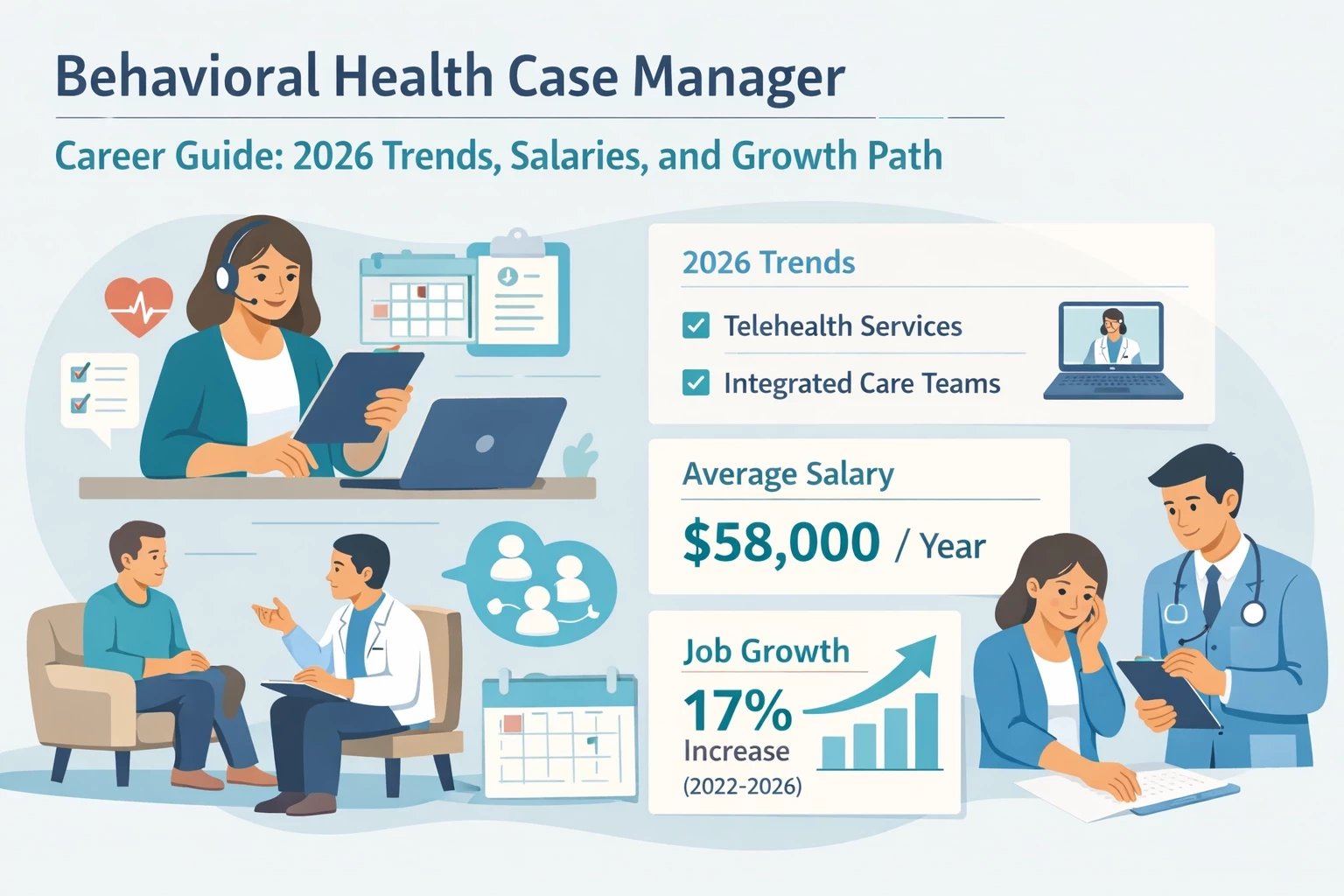
What Behavioral Health Case Managers Actually Do
Case managers coordinate care and case management services for clients with mental health conditions, substance use disorders, or co-occurring diagnoses.
You assess client needs, connect them to mental health services, mental health professionals, and other programs, track treatment progress, and advocate across provider networks.
Daily work includes:
- Intake assessments: Screen clients for service eligibility and risk factors
- Care plan development: Build individualized treatment plans with measurable goals in terms of client-specific metrics for success, and, oftentimes, medication management
- Service coordination: Link clients to housing, medical care, benefits, and community resources
- Documentation: Maintain records for compliance, billing, and continuity of care
- Crisis intervention: Provide stabilization and connect clients to emergency services when needed
You work between systems: hospitals, outpatient clinics, community agencies, or payer organizations, ensuring clients don't fall through gaps in getting care for serious mental health conditions.
Caseload size varies: 15-30 clients in intensive community programs offering individual and group therapy, 40-60 in hospital discharge planning, and 80-100+ in utilization review capacities or insurance settings.
How to Start: Entry Requirements
Minimum qualifications vary by employer, but most positions require:
- Bachelor's degree in social work, psychology, counseling, or a related field
- 0-2 years of experience in behavioral health, case management, or social services
- Strong communication and documentation skills
- Familiarity with electronic health records (EHR) systems
Preferred qualifications that increase competitiveness:
- Master's degree (MSW, MHC, MFT) for clinical case management roles
- Licensure (LCSW, LPC, LMFT) for positions requiring therapy or clinical assessments
- Certification as a Certified Case Manager (CCM) or Accredited Case Manager (ACM)
- Experience with specific populations (veterans, forensic, pediatric, geriatric)
If you're entering from direct care (behavioral health technician, peer support specialist, or residential counselor), highlight your crisis de-escalation skills and knowledge of community resources and local healthcare providers.
Employers value lived experience and direct client interaction for providers who often develop treatment plans central to successful client outcomes.
Salary by Setting: Hospital vs. Community Mental Health
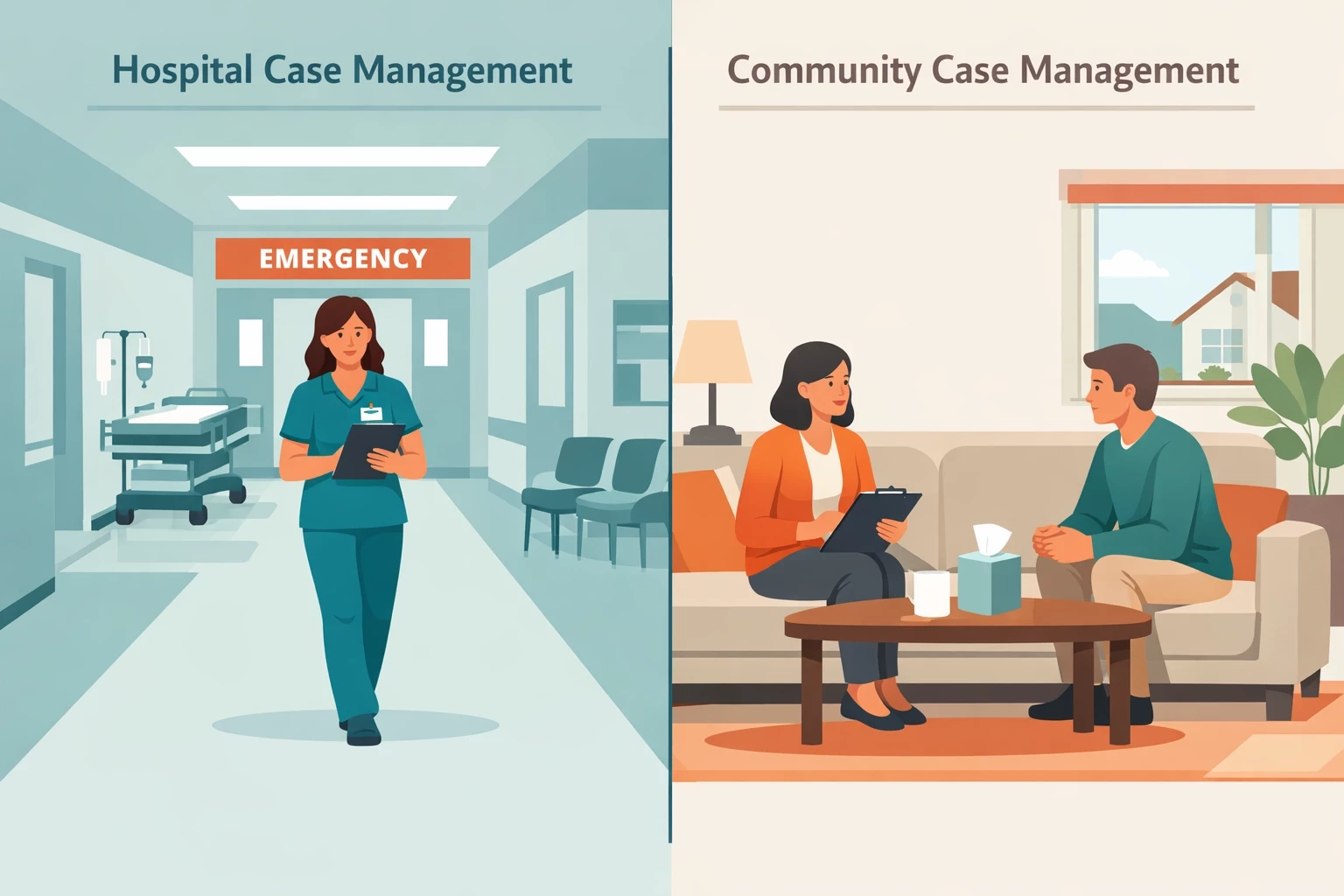
Compensation for behavioral case managers depends on employer type, geographic location, and role scope.
Here's what to expect in general:
Hospital-Based Case Management
Setting: Inpatient psychiatric units, emergency departments, and integrated medical-behavioral health programs
Salary range: $55,000–$72,000 annually for bachelor's-level roles; $65,000–$85,000 for master's-level or licensed clinicians as medical providers
Work structure: Fast-paced discharge planning, high patient turnover, structured shifts (often including evenings/weekends), and strong interdisciplinary collaboration with physicians and nursing staff.
Advancement potential: Move into utilization review, quality improvement, or care management leadership and executive roles within hospital systems.
Community Mental Health Case Management
Setting: Outpatient clinics, Assertive Community Treatment (ACT) teams, supportive housing programs, and crisis stabilization centers for clients suffering from acute mental illness episodes.
Salary range: $42,000–$58,000 annually for bachelor's-level roles; $52,000–$68,000 for master's-level or licensed clinicians
Work structure: Longer-term client relationships, community-based interventions (home visits, court accompaniment), flexible schedules, and grant-funded programs with variable resources.
Advancement potential: Specialize in forensic case management, housing navigation, or peer support program coordination. Move into program management or clinical supervision.
National median reference: The Bureau of Labor Statistics and sources such as ZipRecruiter report $86,180 annually for behavioral health care managers across all settings, though this includes senior and administrative roles.
Entry-level positions typically start 30-40% below this median.
Geographic variation matters. Case managers in California, Massachusetts, and New York earn 15-25% more than those in rural Southern or Midwestern states, but cost-of-living adjustments offset much of the difference.
2026 Trends: Value-Based Care and Remote Case Management

Two shifts are reshaping how case managers work and where employers are hiring for job postings:
Value-Based Care Integration
Payers and health systems are moving from fee-for-service to value-based reimbursement models that reward outcomes over volume.
Case managers now track metrics like:
- Readmission rates within 30 days of discharge
- Emergency department utilization for behavioral health crises
- Treatment engagement (appointment adherence, medication compliance)
- Social determinants of health (housing stability, food security, transportation access)
What this means for you: Employers want mental health case managers who can demonstrate impact through data.
Expect more training in quality improvement methodologies, population health management, and data analytics tools. If you can show how your interventions reduce costs or improve outcomes, you become essential infrastructure.
Hiring implications: Look for roles with titles like "Care Transition Coordinator," "Population Health Case Manager," or "Value-Based Care Navigator."
These positions often come with 10-15% higher pay than traditional case management roles.
Remote Case Management Expansion
Telehealth adoption during 2020-2022 permanently expanded remote work options for case managers.
Many community-based programs now offer hybrid or fully remote positions, especially for roles focused on:
- Care coordination across multiple provider sites
- Benefits navigation (Medicaid, Medicare, disability applications)
- Telephonic case management for insurance companies or managed care organizations
- Care management for rural populations with limited local services for behavioral health needs
Geographic flexibility: Remote roles allow you to work across county or regional boundaries, though state-specific regulations still apply. Most employers require you to hold a license (if applicable) in the state where the client resides.
Limitations to watch: Remote case management works best for clients with stable housing and technology access. Crisis intervention, home visits, and intensive community-based programs still require in-person presence. Don't expect full-time remote work in ACT teams or forensic case management.
Licensing Compacts: What Case Managers Need to Know
If you hold or plan to pursue clinical licensure (LCSW, LPC, LMFT, or psychology), two interstate compacts affect your ability to work across state lines:
Counseling Compact
Launched in 2023, the Counseling Compact allows Licensed Professional Counselors (LPCs) to practice teletherapy across participating states without obtaining multiple licenses. As of February 2026, 18 states have joined.
How this applies to case managers: If you're an LPC working in case management and your role includes therapy or clinical assessments, the compact simplifies multi-state practice. This matters most for remote case management positions serving clients in multiple states or for employers with contracts across compact states.
PSYPACT
The Psychology Interjurisdictional Compact (PSYPACT) enables licensed psychologists to provide telepsychology services across 40+ participating states through a single E.Passport credential.
How this applies to case managers: Relevant only if you hold a doctoral degree in psychology and provide psychological services. Most case managers do not qualify, but if you're advancing into integrated care or consultation roles, PSYPACT expands your practice options.
Social Work Compact
The Social Work Licensure Compact is gaining momentum but has limited adoption as of early 2026. Check state-specific status if you hold or are pursuing LCSW licensure and plan to work remotely.
Practical note: These compacts apply to clinical licensure, not case management certification. If you're working as a bachelor's-level case manager without clinical licensure, interstate compacts don't change your scope of practice.
However, they matter when coordinating care with licensed clinicians or if you're pursuing licensure to advance your career.
Career Advancement Pathways
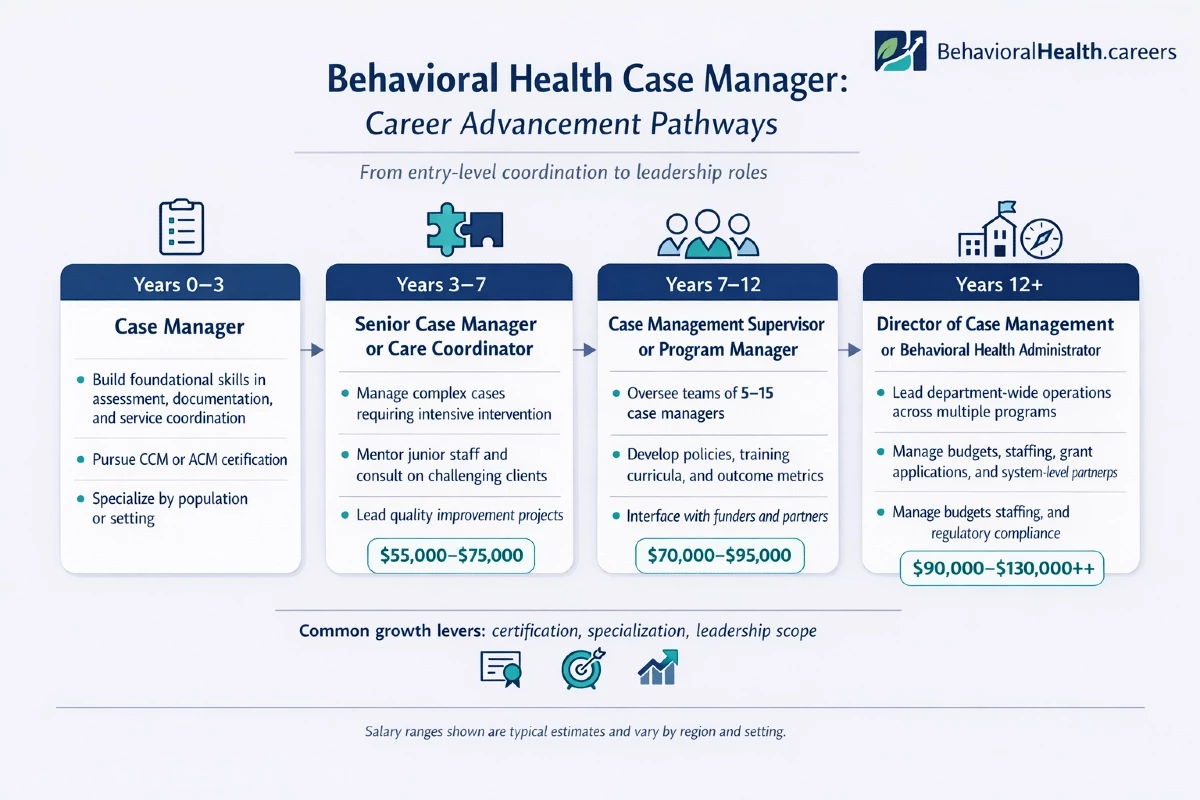
Case management offers clear progression from entry-level coordination to leadership roles:
Years 0-3: Case Manager
- Build foundational skills in assessment, documentation, and service coordination
- Pursue CCM or ACM certification to demonstrate competency
- Specialize by population (forensic, pediatric, geriatric) or setting (hospital, community, payer)
Years 3-7: Senior Case Manager or Care Coordinator
- Manage complex cases requiring intensive intervention
- Mentor junior staff and provide consultation on challenging clients
- Lead quality improvement projects or specialty programs
- Salary range: $55,000–$75,000
Years 7-12: Case Management Supervisor or Program Manager
- Oversee teams of 5-15 case managers
- Develop policies, training curricula, and outcome metrics
- Interface with funders, payers, and community partners
- Salary range: $70,000–$95,000
Years 12+: Director of Case Management or Behavioral Health Administrator
- Lead department-wide operations across multiple programs
- Drive strategic initiatives, grant applications, and system-level partnerships
- Manage budgets, staffing, and regulatory compliance
- Salary range: $90,000–$130,000+
Lateral moves: Transition into utilization review, clinical documentation improvement, or population health roles within integrated care systems. These positions often come with less direct client contact but higher compensation and predictable schedules.
What to Look for in Job Posts
When evaluating case management positions within the healthcare system, ask about:
- Caseload size: Anything above 60 active clients makes individualized care difficult
- Supervision structure: How often do you meet with a clinical supervisor or manager?
- On-call requirements: Are you expected to respond to crises outside business hours?
- Documentation time: Is administrative time built into your schedule or expected after hours?
- Professional development: Does the employer cover certification fees or continuing education?
Salary transparency note: Many behavioral health employers now include pay ranges in job posts, especially in states with pay transparency laws (California, Colorado, Connecticut, Maryland, Nevada, New York, Rhode Island, Washington).
If a post doesn't include salary information, ask directly during the screening call. Compensation varies too widely to waste time on mismatched expectations.
Find Your Next Case Management Role With Our Support
The case management workforce is expanding as payers and health systems invest in care coordination infrastructure.
Demand is strongest in integrated care settings, managed care organizations, and community-based programs serving complex populations.
Use BehavioralHealth.careers to filter by US-only positions, setting type (hospital, community, telehealth), and experience level.
Employers on the platform commit to salary transparency and clear role descriptions: no guessing what "competitive pay" actually means.
Whether you're entering the field or advancing into leadership, case management offers a structured career path with tangible impact. Start exploring opportunities that match your credentials and career goals.