

This guide is for:
- Job seekers exploring the field, switching settings, or moving into leadership
- Employers who want to understand candidate expectations, especially around salary transparency, supervision, and schedules
You will learn what “behavioral health” means in the US, the major career paths and work settings, licensure basics (without state-by-state detail), and how to job search efficiently on BehavioralHealth.careers.
At this time, many listings will use “Apply on employer site,” which will change over time as roles expand and we begin to offer exclusive opportunities specific to our ever-expanding board.

What Behavioral Health Means In The US
In the US, behavioral health is commonly used as an umbrella term that includes:
- Mental health conditions and care (therapy, psychiatry, crisis services)
- Substance use conditions and care (counseling, recovery support, treatment programs)
- Co-occurring care (mental health and substance use together)
- Integrated care models (behavioral health services coordinated with primary care and medical teams)
Behavioral health work happens everywhere people live, learn, work, and receive care. That includes hospitals, outpatient clinics, schools, community programs, residential treatment, telehealth, and more.
Who works in behavioral health (high level):
- Clinical licensed professionals who assess, diagnose (in some roles), and treat
- Clinical non-licensed support roles that help deliver day-to-day care
- Peer and community roles that support recovery, engagement, and navigation
- Operations and administrative roles that make care accessible and sustainable (admissions, utilization review, billing, compliance, HR, marketing)
Behavioral health professionals work with patients exhibiting unhealthy behaviors and provide care to individuals of all ages, including children. They play a vital role in supporting the well-being of patients and empowering communities by delivering individualized treatment and promoting mental wellness.
Demand for behavioral health professionals is growing, particularly in pediatric settings.
Across the country, the need for pediatric behavioral health professionals continues to rise, but there is a national shortage of providers to care for children with mental health conditions – approximately 1 in 5 children are affected.
Behavioral Health Career Paths At A Glance
Behavioral health careers are not one ladder. They are a set of pathways.
Students pursuing behavioral health careers can choose from different college degree levels, such as a 2-year college (associate degree), 4-year college (bachelor’s degree), or 6+ years of college (master’s or doctoral degrees), depending on their career goals.
Start by choosing the type of work you want to do, then match it to a role cluster and a setting. Student loan forgiveness for behavioral health professionals is also something you may want to consider.
High school and undergraduate students interested in behavioral health can gain real-world experience through internships, informational interviews, relevant courses, and on-site shadowing opportunities.
The Major BH Work Settings
Below are common behavioral health settings for job seekers to consider, what they are like, and what employers tend to prioritize.
Community Mental Health:
These settings focus on providing accessible behavioral health services to people in their local area. Professionals often work with diverse populations and collaborate with other agencies to support recovery and well-being. A key goal is to empower and support communities, helping to create healthier and more resilient social groups.
School-Based Behavioral Health:
Behavioral health professionals in schools work closely with students, teachers, and families to address mental health and behavioral challenges. There is a strong focus on children and their unique behavioral health needs.
Creating a supportive learning environment is essential, as guidance counselors and other professionals help identify and place students in settings that foster both academic and behavioral success.
Hospitals and Clinics:
These settings offer acute and ongoing care for individuals experiencing mental health crises or needing specialized treatment. Employers value teamwork, crisis intervention skills, and the ability to work with a range of patients, including children and adults.
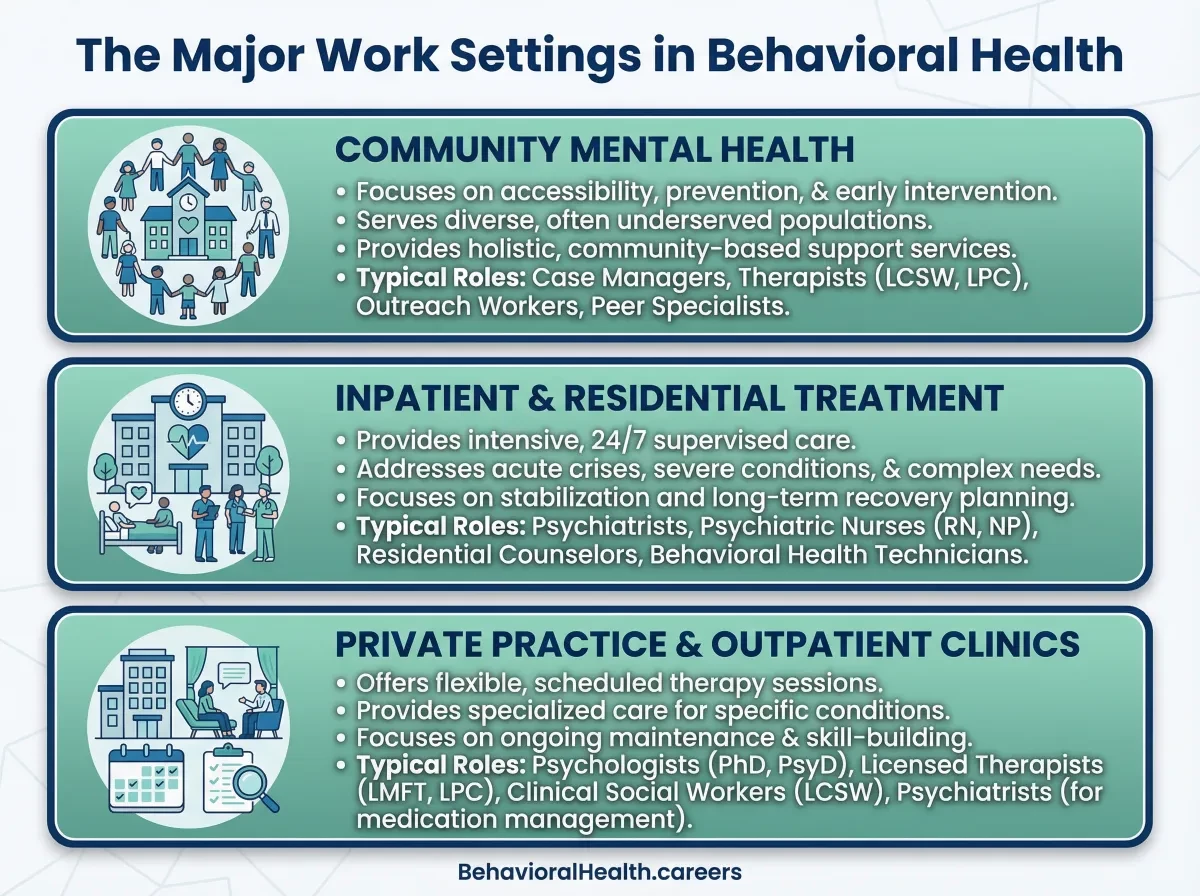
Inpatient And Residential (24/7 Care)
What it’s like: High structure, shift work, strong teamwork, safety-focused routines, crisis management.
Common hiring: RNs, psych techs/MHTs, counselors, social workers, psychiatrists, clinical leadership, utilization review roles, and admissions. Mental health technicians may assist patients with daily self-care activities such as feeding.
Outpatient, IOP, And PHP
What it’s like: Scheduled sessions and groups, documentation-heavy, productivity expectations vary, typically fewer overnight shifts.
Common hiring: Therapists (LCSW, LPC/LMHC, LMFT), Substance Abuse Counselors, care coordinators, billing, front desk, and program leadership.
Community Mental Health
What it’s like: High mission impact, complex social needs, coordination with housing, benefits, courts, and primary care.
MAT And OTP: Medication-Assisted Treatment + Opioid Treatment Programs
What it’s like: Highly regulated environment, multidisciplinary care, consistent attendance workflows, strong emphasis on compliance and documentation.
Many behavioral health professionals in these settings specialize in treating addiction and substance use disorders, providing therapy and support for individuals struggling with these challenges.
Common hiring: Nurses, counselors, medical providers, intake, compliance, and billing.
Hospital Behavioral Health Units
What it’s like: Acute care pace, interprofessional collaboration, strong protocols, shifts.
Common hiring: Psych RNs, psychiatric NPs, psychiatrists, social workers, techs, utilization review.
School-Based Behavioral Health
Common hiring: Case management, therapists, peer support specialists, community health workers, program supervisors.
What it’s like: Calendar-based schedules, coordination with educators, family systems, privacy, and consent considerations. Creating a supportive learning environment for children is essential, and effective collaboration between school professionals and parents helps address behavioral challenges and supports students’ well-being.
Common hiring: School psychologists, counselors, social workers, and behavior specialists.
Telehealth
What it’s like: Remote sessions, high reliance on documentation and scheduling, licensing boundaries matter, strong focus on rapport and workflow discipline.
Common hiring: Licensed therapists, psychiatrists/NPs, intake, care coordination, and billing.
Corrections And Forensic Settings
What it’s like: Safety-first environment, clear procedures, high need for boundaries, and teamwork.
Common hiring: Counselors, social workers, psychiatrists/NPs, program managers.
Crisis Services: Mobile Crisis, Stabilization Units, 988-Connected Providers
What it’s like: High acuity, rapid triage, de-escalation skills, shift work, strong protocols.
Common hiring: Clinicians, nurses, peers, dispatch/coordination, supervisors.
ABA / Autism Settings
What it’s like: Austim and ABA settings involve skill-building plans, measurable goals, structured supervision models, and family involvement.
Common hiring: BCBA roles, RBT roles, program managers, scheduling, and billing.
Role Clusters
This section is organized top-down: leadership first, then management, then clinical and frontline roles.
How To Use This Section
For each cluster, you will see:
- What the work is
- Typical requirements (US-focused, state variation acknowledged)
- Common titles
- Where hired
- Advancement options
- Salary transparency notes (how to evaluate offers and postings)
Executive And Leadership
Who this fits: People who want to run programs, operations, clinical quality, strategy, growth, and compliance.
Leadership and executive roles in behavioral health are responsible for shaping the employee experience, including supporting employees’ sense of purpose and well-being.
What These Roles Do
Leadership roles are accountable for outcomes across people, quality, access, compliance, finances, and patient experience. In behavioral health, leaders often balance:
- Clinical quality and safety
- Access and throughput (admissions, waitlists, length of stay)
- Regulatory and payer requirements
- Workforce retention and staffing models
Typical Requirements
- Often a bachelor’s or master’s degree, plus leadership experience
- Some roles strongly prefer or require a clinical license (for clinical leadership)
- Comfort with healthcare operations: budgets, staffing, policies, metrics
Common Titles
- Chief Executive Officer (CEO) / Executive Director
- Chief Operating Officer (COO)
- Chief Clinical Officer / Clinical Executive
- Chief Medical Officer (CMO)
- Vice President (Operations, Clinical, Growth)
- Compliance and Privacy Officer
- Quality and Risk Leader
- Revenue Cycle Director (often director-level, but can be executive in larger orgs)
Where They’re Hired
- Treatment centers (SUD and mental health)
- Community mental health organizations
- Hospital systems and behavioral health service lines
- Telehealth organizations
- ABA provider networks
Advancement
- Program leadership → multi-site leadership → regional leadership
- Clinical leader → executive leadership (often with operational training and measurable results)
Salary Transparency Notes
- Titles vary widely; insist on a salary range and ask how bonus targets are calculated
- Ask what you “own” (P&L, census, outcomes, retention, compliance metrics)
- Clarify on-call expectations and travel requirements
Middle Management
Who this fits: People who want to lead teams and manage programs while staying closer to day-to-day operations.
What these roles do: Middle managers in behavioral health careers oversee teams of employees, coordinate daily operations, and ensure that programs run smoothly.
They support employees by fostering a positive work environment, which helps the organization be recognized for its commitment to employee well-being and supportive culture.
Middle managers also bridge communication between staff and upper management, address challenges, and help implement organizational goals.
What These Roles Do
Middle managers translate strategy into consistent delivery:
- Staff schedules and coverage
- Caseload distribution and productivity
- Training, supervision, coaching
- Quality audits and documentation standards
- Coordination with admissions, UR, and billing
Typical Requirements
- Often requires relevant experience in the setting
- May require a license for clinical supervisory roles (varies by state and employer)
- Strong documentation, coaching, and escalation skills
Common Titles
- Program Director
- Site Director
- Clinical Supervisor / Lead Therapist
- Behavioral Health Nurse
- Nurse Manager
- Case Management Lead
- Intake Manager / Admissions Manager
Where They’re Hired
- Residential and inpatient programs
- Outpatient, IOP/PHP programs
- Community mental health
- Crisis services
Advancement
- Lead → supervisor → program director → multi-site leader → executive track
Salary Transparency Notes
- Ask whether you will carry a caseload plus management duties
- Ask about team size, vacancy rate, turnover, and expected response times
- Clarify overtime eligibility for non-exempt roles and bonus structures for exempt roles
Licensed Clinical
Who this fits: People seeking licensed practice in the US behavioral health system.
For a concise overview, see how the main behavioral health roles compare.
What These Roles Do: Licensed clinicians provide care to patients by assessing their needs, determining individualized treatment plans, and implementing interventions to address behavioral and mental health challenges.
They track progress by monitoring patient outcomes, documenting behavioral changes, and measuring the effectiveness of care plans to ensure optimal results.
Behavioral health therapists, whether in traditional or remote therapist roles, diagnose patient behaviors and design care plans to change negative behaviors and establish positive behaviors.
Substance abuse and mental health counselors specialize in managing patients experiencing addiction and substance use disorders in private clinics, mental health centers, or prison environments.
Research is also an important aspect of many behavioral health careers, helping to enhance treatment effectiveness and expand knowledge in the field. Coping strategies are frequently included in treatment plans to help patients manage psychological stress, addiction, or behavioral challenges.
What These Roles Do
Licensed clinicians provide assessment, diagnosis (in some roles), therapy, care coordination, medication management (in prescriber roles), and treatment planning.
Documentation quality matters as much as clinical skill in many settings.
Typical Requirements in General
- A relevant graduate degree and clinical training
- State licensure requirements vary and often include supervised hours and exams
- Some settings require specific credentials (for example, SUD counseling credentials often vary by state)
Examples of Common Titles
- Psychiatrist
- Psychiatric Mental Health Nurse Practitioner (PMHNP)
- Psychologist (Clinical, Counseling, School)
- Licensed Clinical Social Worker (LCSW)
- Licensed Professional Counselor (LPC) / Licensed Mental Health Counselor (LMHC)
- Licensed Marriage and Family Therapist (LMFT)
- Substance Use Counselor (state credentialing varies)
Where They’re Hired
- Outpatient therapy practices and groups
- Hospitals and ED consult services
- Residential and inpatient programs
- Community mental health
- MAT/OTP settings
- Telehealth providers
- Schools (school psychologist and related roles)
Advancement
- Specialist track (trauma, SUD, child and adolescent, forensic)
- Supervisor and clinical director track
- Teaching, training, and consulting track
Salary Transparency Notes
- Ask if pay is salary, hourly, per session, per RVU, or productivity-based
- Ask about no-show policies, admin time, and documentation expectations
- For hybrid roles: clarify in-person requirements and location radius
- In telehealth: confirm licensure coverage, malpractice coverage, and support resources
Non-Licensed Clinical Support
Who this fits: People who want patient-facing work and a faster entry into the field.
What these roles do: Non-licensed clinical support roles in behavioral health careers assist patients with daily tasks, such as feeding, grooming, and other self-care activities, to support their well-being.
These professionals help implement treatment plans, monitor patients, and track progress by documenting behavioral changes and treatment effectiveness over time.
Behavioral Health Technicians, Mental Health Technicians, and Psych Aides all assist patients with disorders such as PTSD; typical qualifications include an associate degree or a Certified Behavioral Health Technician (CBHT) credential.
A behavior technician assists behavior analysts by collecting, maintaining, and interpreting data on patient behaviors and care plan progress.
Behavioral Health Case Managers coordinate client care, often requiring a Bachelor’s degree in a related field or a Master of Social Work (MSW).
What These Roles Do
Support roles keep care running safely and consistently:
- Monitoring and supporting clients in residential or inpatient settings
- Leading skills groups or structured activities (training-dependent)
- De-escalation support and safety checks
- Intake coordination and follow-up
- Care coordination and referrals
Typical Requirements
- Often a high school diploma, an associate degree, or a bachelor’s degree, depending on role and employer
- Training in safety, documentation, and de-escalation is common
- Background checks and facility requirements are common in 24/7 settings
Common Titles
- Behavioral Health Technician (BHT) / Mental Health Technician (MHT)
- Psychiatric Technician / Psychiatric Aide
- Milieu Staff
- Care Coordinator
- Intake Coordinator
- Case Manager (requirements vary by employer and state)
Where They’re Hired
- Residential, inpatient, and crisis settings
- Community programs
- Hospital behavioral health units
Advancement
- Technician → lead tech → supervisor
- Support roles → case management → graduate school → licensed clinician track
- Intake/coordinator → admissions leadership → operations track
Salary Transparency Notes
- These roles often vary by shift differential (nights, weekends, holidays)
- Ask about overtime, staffing ratios, and safety supports
- Confirm whether training time is paid and whether certifications are reimbursed
Peer And Community
Who this fits: People who want community-based impact and engagement work, often including lived experience.
What these roles do: Peer Support Specialists and Community Health Workers inform patients and communities about available healthcare resources and services, helping to improve community health outcomes.
Certified peer specialists advocate for individuals with mental health and substance use challenges by sharing their recovery stories and supporting others in accessing care. They utilize their firsthand experience and knowledge of behavioral health challenges to educate and guide others toward improvement.
Peer Support Specialists require certification and a high school diploma to provide support based on lived experience.
What These Roles Do
Peer and community roles improve engagement and continuity:
- Supporting recovery goals and self-advocacy
- Navigating services and benefits
- Coordinating between clients, families, and care teams
- Running groups, outreach, follow-up, and appointment support
Typical Requirements
- Peer roles often have state-specific training and certification pathways
- Community roles can require a high school diploma to a bachelor’s degree, depending on scope
- Strong boundaries, communication, and documentation skills are critical
Common Titles
- Peer Support Specialist
- Recovery Coach
- Family Support Partner
- Community Health Worker (CHW)
- Outreach Specialist
Where They’re Hired
- Community mental health organizations
- Recovery community organizations
- Hospitals (navigation roles)
- Crisis services and stabilization programs
- SUD treatment programs
Advancement
- Peer lead → supervisor → program leadership
- Community roles → care coordination → management track
Salary Transparency Notes
- Ask whether travel is reimbursed and whether hours include evenings/weekends
- Ask about caseload expectations and whether you are expected to do field work
- Confirm training, supervision, and career ladder options
For a comparison of related roles, visit our resource on definitions for Mental Health Coach vs Behavioral Health Coach vs Therapist roles
Admin And Business-Critical Roles
Who this fits: People who want behavioral health mission work through operations, access, compliance, and revenue stability.
What These Roles Do
Business roles directly influence access to care:
- Admissions and intake: response time, scheduling, verification, conversion
- Utilization review (UR): payer authorizations, clinical reviews, documentation coordination
- Revenue cycle: coding, billing, denials, collections, payer relations
- Credentialing: provider enrollment, licensing and payer paneling workflows
- Compliance and privacy: policies, audits, training, incident response
- HR and talent: recruiting, onboarding, retention
- Marketing and outreach: referral relationships, community presence
Typical Requirements
- Varies from a high school diploma to a bachelor’s and beyond
- Some UR and compliance roles prefer clinical backgrounds
- Experience with healthcare documentation, payers, and privacy is a plus
Common Titles
- Admissions Coordinator / Admissions Specialist / Intake Specialist
- Utilization Review Specialist / Utilization Management Nurse
- Billing Specialist / Revenue Cycle Specialist
- Credentialing Specialist
- Compliance and Privacy Officer
- HR Generalist / Recruiter
- Outreach Coordinator / Community Liaison
- Marketing Manager (behavioral health specialization)
Where They’re Hired
- Treatment providers, clinics, hospitals
- Telehealth companies
- Multi-site provider groups
Advancement
- Specialist → lead → manager → director
- Admissions → operations leadership
- UR and compliance → quality, risk, executive operations
Salary Transparency Notes
- Ask what success looks like (conversion targets, response time, denial rate, days in AR)
- Confirm workflow tools (EHR, billing systems) and training
- For on-call compliance/privacy roles, confirm after-hours expectations
- Look at our Behavioral Health Salary Transparency resource
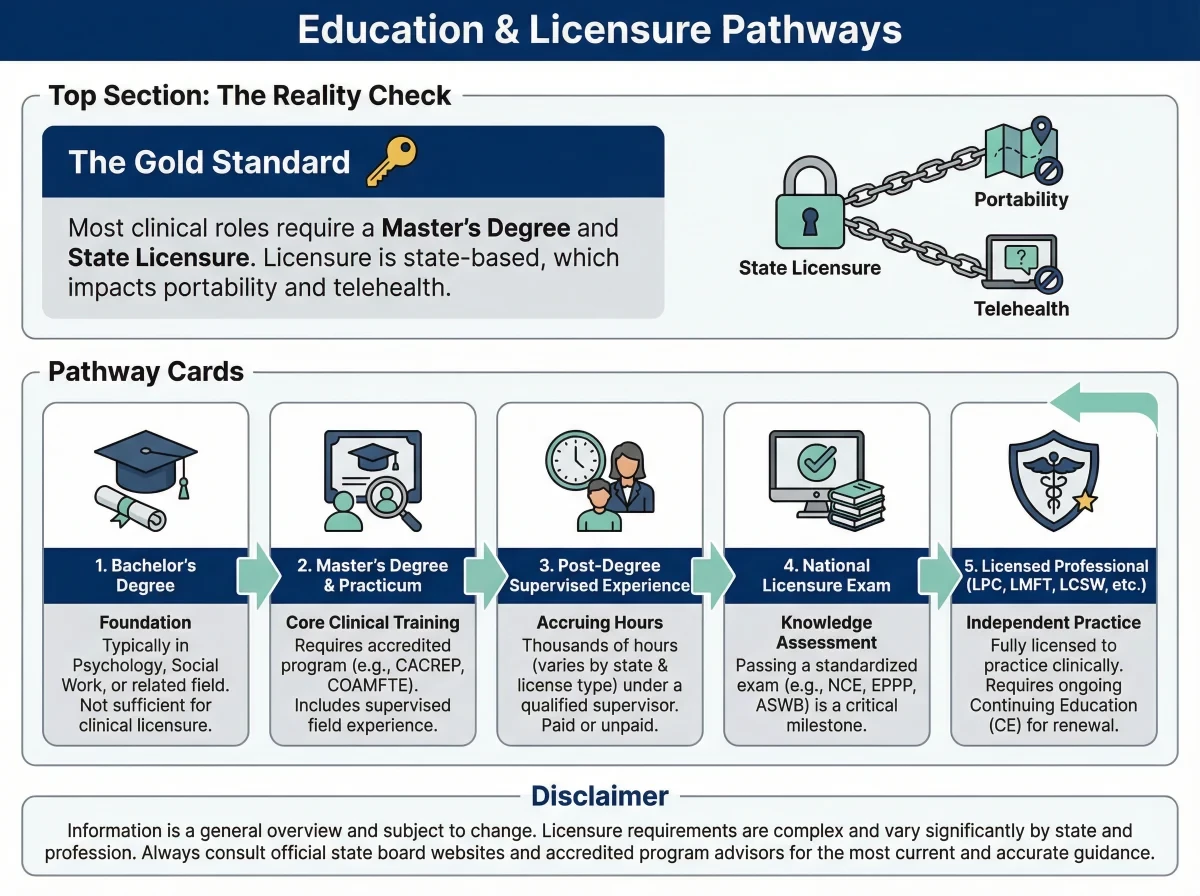
Education, Licensure, And Credentialing
Licensure in behavioral health is state-based. That creates real portability challenges, especially if you move or do telehealth across state lines.
To qualify for most clinical practice roles in behavioral health, you must complete at least a Master’s degree and obtain state licensure.
This typically involves completing all required coursework, supervised training modules, and submitting licensure applications as mandated by your state.
Licensure Concepts in Plain Language
- License: Legal permission to practice in a state (issued by a state board).
- Scope of practice: What your license allows you to do (can differ by state).
- Supervision: Structured oversight required before independent licensure (varies).
- Board exams: Many licenses require passing an exam.
- Continuing education: Ongoing training is required to renew a license.
Typical Degree Pathways By Category
- Executive/Operations: bachelor’s or master’s (MBA, MHA, MPH common), plus healthcare experience
- Licensed therapy roles: master’s degree is common (social work, counseling, marriage and family therapy)
- Psychology: doctoral training is common for licensed psychologist roles; school psychology has distinct pathways
- Prescribers: physician pathway (MD/DO) or advanced practice nursing pathway (APRN), plus specialty certification
- ABA/autism track: graduate training plus certification and supervised practice are common for BCBA roles
- Support roles: training ranges from on-the-job and certificates to associate/bachelor’s, depending on role and setting
The Portability of Behavioral Health Careers: A Reality Check
- If you are moving states, plan early. Processing times and requirements can vary.
- For telehealth, licensure is often tied to the client’s location. Verify state rules before accepting multi-state telehealth work.
- Some professions have interstate compacts or emerging pathways, but adoption and details vary.
Credentialing Versus Licensure
Many employers require credentialing beyond your license:
- Background checks, immunizations (in some settings), CPR, and facility-specific training
- Payer credentialing for providers who bill insurance (often handled by the employer, but it takes time)
Mini-checklist: Before You Apply
- Confirm the required license or credential
- Confirm supervision offered (if you need hours)
- Confirm client population and setting
- Confirm schedule, caseload, and documentation expectations
- Confirm salary range, bonus terms, and benefits
What Skills Make Candidates Stand Out to Behavioral Health Employers?
Behavioral health employers hire for reliability, documentation, teamwork, and boundaries as much as clinical knowledge.
Essential for behavioral health roles are the following skills: strong communication, empathy, observation, organizational skills, and adaptability.
The ability to meet personal goals and learn new things is also important for employees in this field. Developing good habits, coping strategies, and effective treatment plans is crucial for both professionals and their clients.
Organizational skills are especially helpful for patient care and treatment coordination. Additionally, observation skills are beneficial for behavioral health professionals to identify minor changes in patient behavior.
Clinical And Client-Facing Skills
- Trauma-informed approaches and de-escalation
- Cultural humility and respectful communication
- Group facilitation (common in IOP/PHP and residential)
- Safety awareness in 24/7 and crisis settings
- Strong handoffs, referrals, and coordination
Non-Clinical Skills Employers Notice
- Documentation quality and timeliness
- Team communication (especially shift-based settings)
- Professional boundaries and consistency
- Comfort with measurement and outcomes (even basic tracking)
- Time management and follow-through
Ethics, Confidentiality, And Privacy (High Level)
Many behavioral health roles involve sensitive personal information. Employers expect staff to follow privacy and confidentiality rules and internal policies, especially in healthcare settings.
Salary, Benefits, And Schedule Reality Check
Important: Salary varies by role, credential, setting, and state. When salary ranges are available from authoritative sources, they are included below as national reference points, not guarantees of offer amounts.
National Salary Reference Points
The following are examples of BLS-reported national pay figures for broad occupational categories that commonly appear in behavioral health hiring. Use these as a starting point, then calibrate to your state, setting, and exact title.
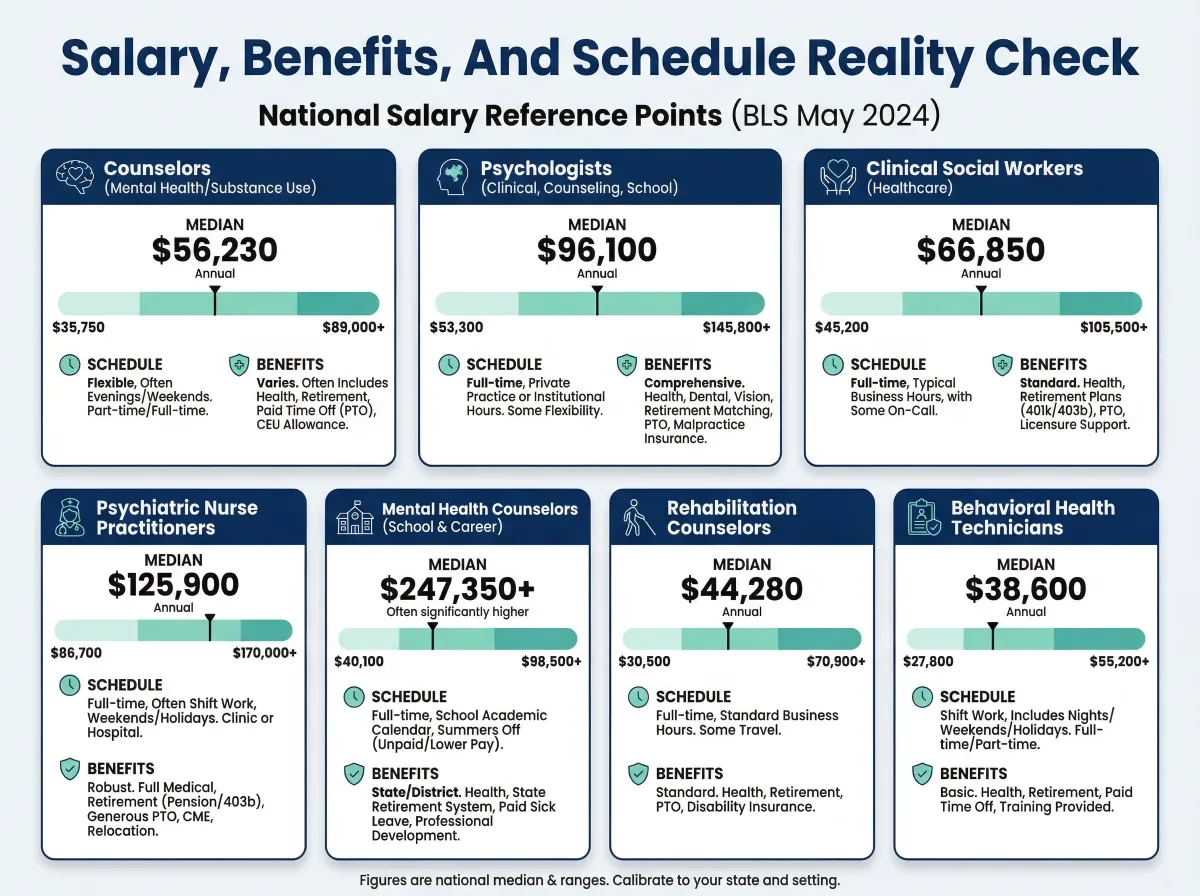
Role Categories with Median Salaries and Ranges
With Median Pay (as of May 2024) and Typical Range (10th to 90th percentile, when available).
Substance Use / Behavioral Disorder / Mental Health Counselors
- Median: $59,190
- Typical Range: $39,400 to $89,920
Psychologists (All)
- Median: $95,830
- Typical Range: $48,240 to $158,280
Social Workers (All)
- Median: $61,330
- Typical Range: $39,430 to $97,100
Psychiatric Technicians
- Median: $42,590
- Typical Range: $32,980 to $60,150
Psychiatric Aides
- Median: $41,590
- Typical Range: $30,920 to $58,530
Community Health Workers
- Median: $51,030
- Typical Range: $33,960 to $77,930
APRNs (Nurse Practitioners, Nurse Midwives, Nurse Anesthetists combined category)
- Median: $132,050
- Typical Range: $98,520 to $217,270
Medical And Health Services Managers
- Median: $117,960
- Typical Range: $69,680 to $219,080
What Factors Drive Pay In Behavioral Health?
- Region and cost of living: state and metro differences can be large
- Setting: hospitals and crisis settings often pay differently than outpatient clinics
- Licensure and scope: independent licenses and prescriber roles typically change pay bands
- Schedule and shift differentials: nights, weekends, and holidays can add meaningful compensation
- Productivity models: some therapy roles pay per session or use productivity targets
- Union environment: in some regions and systems, bargaining agreements influence pay
Benefits That Can Matter As Much As Base Pay
- Health insurance costs (premium share, deductible)
- Retirement match
- PTO and paid holidays
- Paid supervision and training support
- Loan repayment programs (role and employer dependent)
- Continuing education budget and paid CE time
- Clinical support: consultation time, group supervision, manageable documentation expectations
How To Negotiate And How To Ask For Salary Ranges
If a posting does not list pay:
- Ask early: “Can you share the salary range budgeted for this role?”
- Ask what pay is based on: license level, years of experience, shift, productivity, bilingual skills
- Ask about the full package: bonus, differential, on-call pay, supervision offered
If you are an employer: posting a clear salary range is one of the fastest ways to increase qualified applicants and reduce back-and-forth.
How To Find Jobs Faster On Behavioralhealthcareers
BehavioralHealth.careers is a US-only behavioral health job board built to connect candidates with roles sourced from employer career sites and ATS pages, as well as through constantly evolving outreach and industry partnerships.
Step 1: Search Like A Recruiter
Use filters that match how employers organize hiring:
- Role (therapist, counselor, tech, peer, director, admissions)
- Setting (residential, outpatient, hospital, crisis, telehealth)
- State (US-only)
- Specialty keywords (SUD, MAT, co-occurring, trauma, child and adolescent, ABA)
Step 2: Save Searches And Set Alerts
If the platform offers accounts, use them to:
- Save your best searches
- Create email alerts for new postings
- Track which roles you already applied to
Step 3: “Apply On Employer Site” Expectations
When you click apply:
- You may be routed to an ATS like Workday, Greenhouse, iCIMS, Lever, ADP, UKG, or a health system portal
- Keep a simple spreadsheet: job link, date applied, recruiter contact, follow-up date
- Reuse a clean “core resume” plus a role-tailored version
Step 4: Verify Employer Fit And Legitimacy
Before investing time:
- Confirm the employer is a real provider organization (site, address, leadership, locations)
- Confirm licensure requirements and supervision offered
- Confirm schedule, caseload, and documentation expectations
- Confirm pay range or ask for it before late-stage interviews
Step 5: Follow Up Like A Professional
A short follow-up message after applying can help:
- Restate your license and setting experience
- Reference the schedule fit and start date
- Ask for the salary range if it is not posted
Advancement And Long-Term Career Growth
Moving From Frontline To Leadership: A Common Arc
- Build reliability and documentation excellence
- Take on lead responsibilities (training, onboarding, shift lead, group facilitation)
- Move into supervision or coordination roles
- Add operational skills (metrics, staffing, budgets)
- Step into manager roles, then multi-program leadership
Specializations That Can Increase Mobility
- Co-occurring care
- Crisis and stabilization
- SUD and MAT/OTP experience
- Integrated behavioral health in medical settings
- Child and adolescent focus
- Forensic and corrections
- ABA/autism specialization (where relevant)
Outcomes And Measurement
More organizations want evidence of impact. Even if you are not a data person, you can stand out by:
- Tracking attendance and engagement
- Tracking discharge planning and follow-up completion
- Improving documentation timeliness
- Supporting quality initiatives
Burnout, Boundaries, And Sustainable Careers
Behavioral health can be meaningful and demanding. Sustainable careers are built intentionally.
Practical Ways To Reduce Burnout Risk
- Choose a setting that matches your energy and lifestyle (24/7 shifts vs office hours)
- Get clarity on caseload size and documentation expectations before accepting an offer
- Protect boundaries: schedule, on-call expectations, and role clarity
- Seek supervision and consultation, not just “being left alone”
- Use PTO and set rules for after-hours communication
Mini-checklist: Green Flags In Job Posts
- Salary range is listed
- Schedule is clear (including evenings/weekends)
- Supervision is described (if applicable)
- Caseload expectations are realistic and explained
- Benefits are summarized clearly
- The posting sounds like a real team, not vague promises
For Employers: How To Attract Great Candidates
If you want stronger applicants and faster hiring cycles:
Post The Details Candidates Actually Need
- Salary range (and whether bonuses are realistic)
- Schedule, shifts, remote expectations
- Licensure requirements and whether supervision is offered
- Caseload expectations, productivity model, and documentation time
- Safety supports for crisis and 24/7 settings
- Benefits highlights (PTO, CE budget, insurance costs, retirement match)
Use Clear, Inclusive Language
- Avoid vague “must thrive under pressure” lines without support details
- Be explicit about training, onboarding, and team structure
- List essential requirements separately from preferences
Next Steps
If you are exploring or advancing your behavioral health career:
- Start broad, then narrow by role, setting, and state
- Prioritize postings with salary ranges
- Ask for ranges early when they are not listed
- Use “Apply on employer site” as normal, and track applications consistently
Explore now:
- By role: therapist, counselor, technician, peer, director, admissions, billing
- By setting: inpatient/residential, outpatient/IOP/PHP, community mental health, MAT/OTP, crisis, telehealth
- By state: US-only listings
- Related resources on hiring for behavioral health employers in rural areas
FAQs on Careers in Behavioral Health
What counts as “behavioral health” in the US?
Behavioral health commonly includes mental health and substance use care, plus integrated models where behavioral health and medical teams coordinate care.
Do I need a license to work in behavioral health?
Not always. Many roles are non-licensed (tech, intake, some coordination roles), while therapy and many supervisory roles require state licensure. Requirements vary by role and state.
What is the fastest entry-level job in behavioral health?
Entry points often include behavioral health technicians, psychiatric aides/techs, intake coordinators, and some peer or community roles, depending on local pathways.
How does “Apply on employer site” work?
You will be routed from BehavioralHealth.careers to the employer’s ATS or career page to submit your application. Track your applications and follow up directly with the employer.
Why do salary ranges vary so much in behavioral health?
Pay can shift significantly by region, setting, licensure level, schedule differentials, and productivity model. Titles are not standardized across employers.
Should I apply if a job post does not list a salary?
You can, but ask early for the salary range budgeted for the role. Transparent employers usually provide a range quickly.
What should I ask about supervision if I need licensure hours?
Ask who supervises, how often, whether it is individual or group, whether it is paid time, and whether supervision aligns with your state board requirements.
What do employers want most in behavioral health candidates?
Reliability, strong documentation, teamwork, professional boundaries, and setting-specific skills like de-escalation for crisis or 24/7 programs.
Effective communication is also essential, especially the ability to convey important information clearly and sensitively to clients, families, and colleagues.
References and Resources
- U.S. Health Resources and Services Administration (HRSA), Glossary: Behavioral Health. (HRSA Data)
- HRSA Bureau of Health Workforce, Glossary: Behavioral Health Integration. (Bureau of Health Workforce)
- U.S. Department of Health and Human Services (HHS), Summary of the HIPAA Privacy Rule. (HHS.gov)
- National Council of State Boards of Nursing (NCSBN), APRN Consensus Model. (NCSBN)
- Behavior Analyst Certification Board (BACB), Board Certified Behavior Analysts (BCBA). (Behavior Analyst Certification Board)
- U.S. Bureau of Labor Statistics (BLS), Occupational Outlook Handbook, Substance Abuse, Behavioral Disorder, and Mental Health Counselors (pay and wage distribution). (Bureau of Labor Statistics)
- BLS, Occupational Outlook Handbook, Psychologists (pay and wage distribution). (Bureau of Labor Statistics)
- BLS, Occupational Outlook Handbook, Social Workers (pay and wage distribution). (Bureau of Labor Statistics)
- BLS, Occupational Outlook Handbook, Community Health Workers (pay and wage distribution). (Bureau of Labor Statistics)
- BLS, Occupational Outlook Handbook, Psychiatric Technicians and Aides (pay and wage distribution). (Bureau of Labor Statistics)
- BLS, Occupational Outlook Handbook, Nurse Anesthetists, Nurse Midwives, and Nurse Practitioners (pay and wage distribution). (Bureau of Labor Statistics)
- BLS, Occupational Outlook Handbook, Medical and Health Services Managers (pay and wage distribution). (Bureau of Labor Statistics


Pingback: How to Become a Behavioral Health Technician | And Get Hired