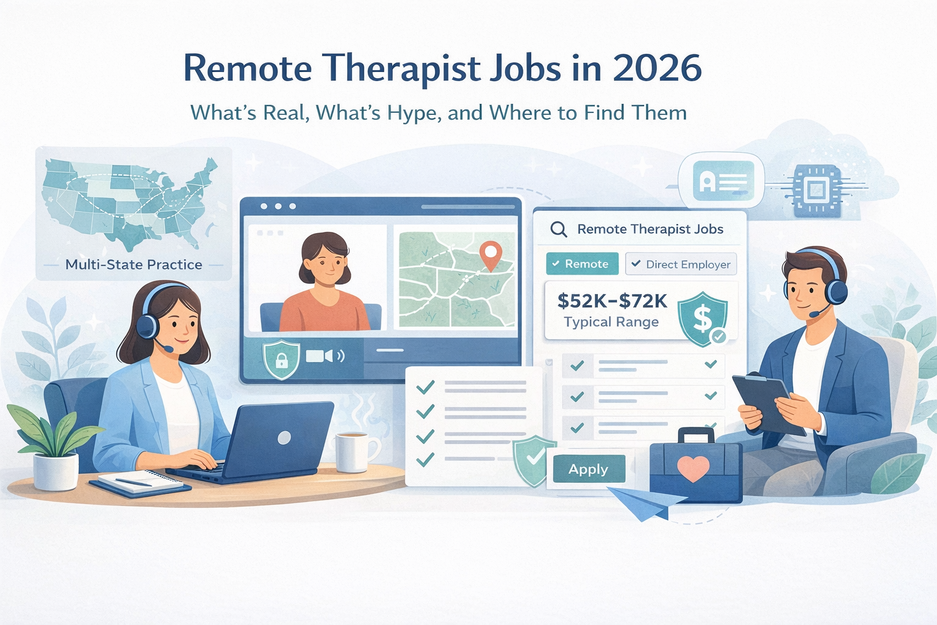
Remote therapy in 2026 is here to stay. It’s a high-stakes, highly credentialed career path with real opportunities and real limitations.
But those looking for low hanging fruit should be aware, most remote therapy roles require a Master’s degree and independent state licensure.
The “work from anywhere” dream is alive, but it comes with complex state compacts, evolving technology requirements, and a market that increasingly values specialized skills over a generalist approach. And remote therapists must comply with state regulations regarding telehealth practices and maintain confidentiality standards.
If you’re an LCSW, LPC, LMFT, or psychologist considering remote work, this guide cuts through the noise and charts a clear path to achieving the role you want.
Here’s what’s actually happening in the remote behavioral health job market right now. Remote therapist roles can include part-time, contract, and internship opportunities, offering flexibility for different career stages.
Types of Therapist Jobs You’ll See in 2026
If you’re looking at the landscape of remote therapist jobs in 2026, you’ll find it’s more diverse than ever before. There are opportunities that can fit just about any lifestyle or specialty you might have.
Whether you’re a mental health therapist who loves facilitating group therapy sessions, or you’re a licensed LCSW or LPC interested in designing treatment plans for adults, children, or families, there’s absolutely a role out there for you.
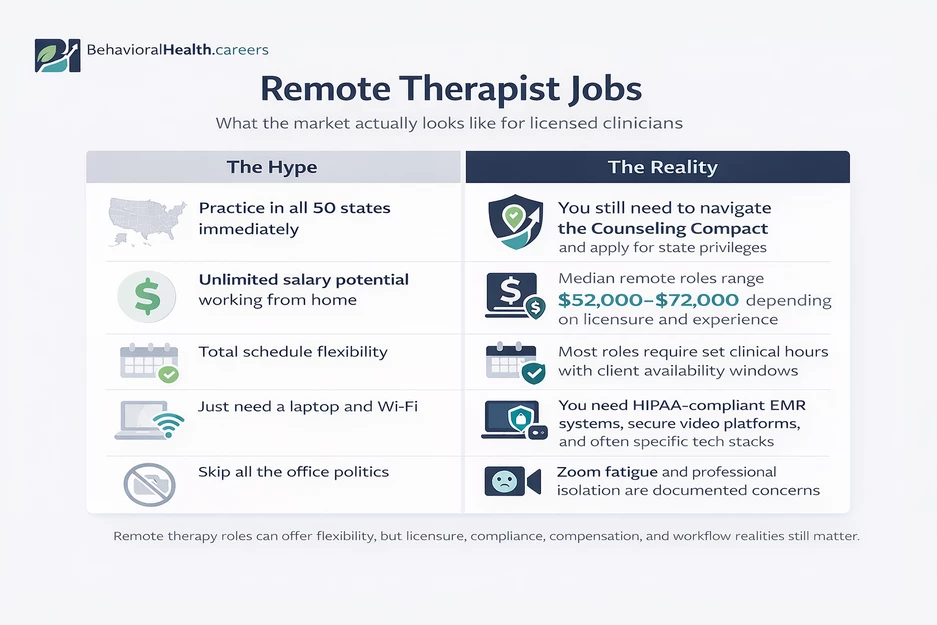
At a Glance: Remote Therapy Hype vs. Reality
The ‘Compact’ Revolution: What Multi-State Practice Actually Looks Like
As of February 2026, 39+ states have joined the Counseling Compact, which allows Licensed Professional Counselors (LPCs) to practice across state lines.
Similar compacts exist for Licensed Clinical Social Workers (LCSWs) through the Social Work Licensure Compact, and psychologists through the Psychology Interjurisdictional Compact (PSYPACT).
Remote therapists typically need to hold a valid license in their state of practice, such as LCSW, LMFT, or LPC, and must adhere to all relevant state regulations.
What this means: If you hold a license in a Compact member state, you can apply for “privilege to practice” in other member states without obtaining a full second license.
This isn’t automatic; you have to submit an application, pay fees (typically $50-$100 per state), and maintain your home state license in good standing.
What this doesn’t mean: You can’t just start practicing everywhere overnight. Each state still has its own scope of practice rules, continuing education requirements, and supervision mandates. You’ll need to track:
- Which states your home license grants Compact privileges
- Whether your specialty area (EMDR, play therapy, substance abuse counseling) has additional state requirements
- If your malpractice insurance covers multi-state practice
- Whether your employer’s agreements include specific states
Remote therapists are responsible for adhering to state-specific clinical guidelines and regulatory requirements, ensuring compliance with all applicable laws and standards.
The Compact has legitimately opened doors. A therapist licensed in Virginia can now see clients in Tennessee, Georgia, and Kentucky without jumping through full licensure hoops. But you’re still operating within a regulatory framework, not a free-for-all.
Continuing education is often required for remote therapists to maintain their licenses and stay updated on best practices in telehealth.
What are the Benefits of Remote Work for Therapists?
In a fundamental way, remote work has transformed the therapeutic profession, offering you a level of flexibility and work-life balance that seemed almost impossible just a few years ago.
And for many providers, it’s helped to reduce burnout and enhance self-care opportunities. It’s always been imperative to prioritize your own well-being while serving your clients.
And with remote roles, you can now achieve your professional goals while actively maintaining your own mental health and honoring your personal commitments in ways that traditional practice settings simply couldn’t accommodate.
Salary Transparency Is Crucial to Hiring for Remote Therapy Roles
In 2026, therapists are ghosting job postings that don’t list pay.
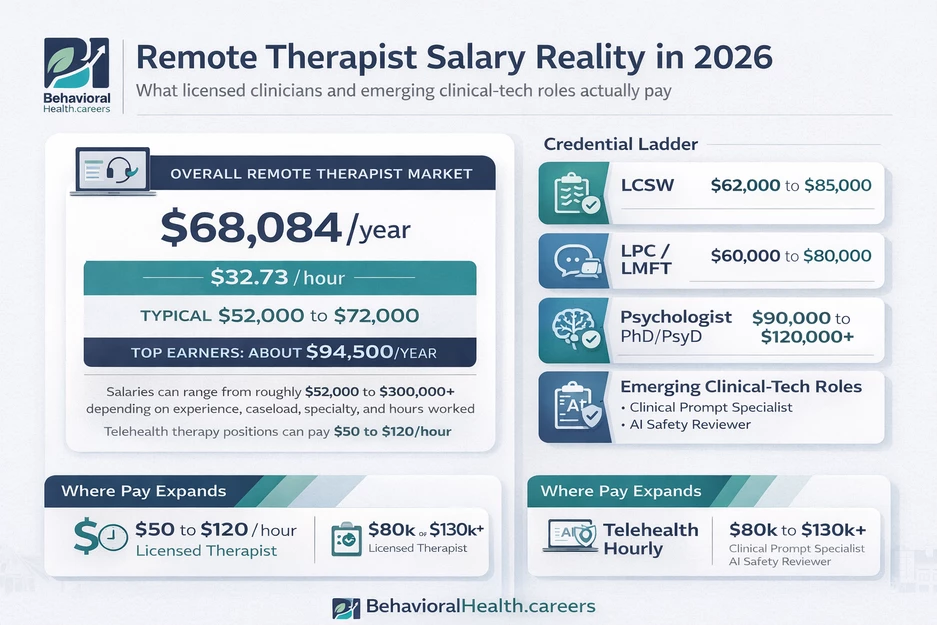
According to recent market data, the average remote therapist earns $68,084 per year ($32.73/hour), with most positions clustering between $52,000–$72,000 at the 25th to 75th percentile.
Top earners at the 90th percentile reach approximately $94,500 annually.
Salaries for remote therapists can range from roughly $52,000 to over $300,000 depending on experience and hours, and telehealth therapy positions can pay between $50 and $120 an hour.
But here’s where credential level matters significantly:
- Licensed Clinical Social Worker (LCSW): $62,000–$85,000
- Licensed Professional Counselor (LPC) / Licensed Marriage and Family Therapist (LMFT): $60,000–$80,000
- Psychologist (PhD/PsyD): $90,000–$120,000+
- Emerging clinical tech roles (Clinical Prompt Specialist, AI Safety Reviewer): $80,000–$130,000+
Many remote therapist jobs are contract-based and may lack employer-provided benefits. Part-time and internship opportunities are also available, offering flexibility for different career stages and schedules.
BehavioralHealth.careers prioritizes listings with clear salary ranges because we know your time matters. Salary transparency isn’t a nice-to-have anymore, it’s table stakes. If an employer won’t post a range upfront, that’s data about how they value your time during the hiring process.
While job listings for remote therapists can be found on platforms like Indeed, FlexJobs, LinkedIn, and Working Nomads, our growing number of exclusive opportunities makes the niche job board site you are currently visiting one of the top sources for such roles in the space.
What raises remote pay:
- Advanced certifications (DBT, EMDR, trauma-informed care)
- Supervisory responsibilities or clinical supervision provision
- Testing and assessment expertise
- Specialized populations (forensic, pediatric, eating disorders)
- Bilingual capabilities
The Rise of ‘Clinical AI’ and Non-Clinical Remote Roles
Remote therapy in 2026 isn’t just back-to-back video sessions anymore. The field has expanded into adjacent roles that didn’t exist five years ago:
Clinical Content Review: Tech companies building mental health apps need licensed clinicians to review AI-generated therapeutic content, crisis protocols, and safety features.
These roles typically pay $75,000–$110,000 and involve evaluating whether chatbot responses are clinically appropriate.
- AI Safety and Prompt Engineering: As large language models get integrated into mental health tools, companies hire therapists to “red team” these systems, testing for harmful outputs, bias, or inappropriate crisis responses. Pay ranges $80,000–$130,000+ depending on technical proficiency.
- Virtual-First Hybrid Models: Some organizations offer 3 days clinical + 2 days administrative work (program development, staff training, quality assurance). In these hybrid and program development roles, therapists may assist and contribute to interdisciplinary teams, supporting program development and collaborative care, as well as professional growth. This structure actively prevents burnout while keeping you connected to clinical practice.
- Asynchronous Therapy Platforms: Text-based or message therapy roles where you respond to clients on a flexible schedule rather than live sessions. Therapists often facilitate group sessions and discussions in these settings, supporting client engagement and progress. These appeal to therapists who want to avoid video fatigue but still provide direct care.
If you’ve been practicing for 5+ years and feel burned out on traditional session work, these adjacent roles offer a legitimate career pivot without leaving the field entirely.
Some remote therapist jobs may also require specific certifications in therapeutic techniques or modalities, such as CBT or DBT.
The Remote Therapy Tech Stack of 2026: It’s More Than Just Zoom
Remote therapy requires fluency with technology that goes beyond basic video calls. Therapists must utilize secure, HIPAA-compliant platforms for video conferencing and Electronic Health Records (EHR), and maintain a private, secure space for sessions.
A reliable high-speed internet connection (at least 10 Mbps) is essential for clear video sessions.
Therapists providing telehealth services must also be familiar with using secure technology platforms for therapy delivery and documentation. Employers expect you to navigate:
- HIPAA-Compliant Video Platforms: Doxy.me, VSee, SimplePractice Telehealth, or proprietary platforms. Standard Zoom accounts don’t meet compliance requirements.
- Electronic Health Records (EHR/EMR): TherapyNotes, SimplePractice, ICANotes, or Valant. You’ll document sessions, track treatment plans, and manage billing within these systems.
- Client Communication Tools: Secure messaging systems, appointment reminders, and intake form platforms that meet privacy standards.
- Asynchronous Care Platforms: Some roles use tools like Blueprint or Talkspace where clients send messages and you respond within specific timeframes.
- Virtual Waiting Rooms and Scheduling: Automated systems that reduce no-shows and manage your calendar.
If you’re not comfortable with technology, that’s a genuine barrier to remote work. The good news: most platforms are learnable within a week or two of regular use.
During interviews, ask what systems the employer uses and whether they provide training.
Remote Work Is a Marathon, Not a Sprint
Here’s what nobody tells you about remote therapy until you’re six months in: Zoom fatigue is real, and professional isolation hits harder than you expect.
The challenges of remote therapist jobs include not only professional isolation and burnout, but also technical difficulties during sessions that can disrupt the therapeutic process.
Sitting in the same room conducting back-to-back sessions without physical transition time between clients drains you differently than in-person work.
You don’t get the mental reset of walking a client to the door, chatting with a colleague in the hallway, or physically moving between spaces.
Additionally, providing therapy remotely can sometimes limit your ability to assess non-verbal cues from clients, which can impact treatment outcomes.
What to look for in remote roles:
- Clinical supervision or consultation groups built into your schedule: Not just available if you ask, but required and protected time.
- Administrative days or half-days: Roles that offer 1 day per week for documentation, treatment planning, and professional development without client sessions.
- Clear caseload caps: If an employer says “unlimited earning potential,” that often means “we’ll overload you with clients.” Look for explicit caseload limits (typically 20-25 clients per week for full-time roles).
- Team connection rituals: Regular staff meetings, peer consultation, or case reviews that keep you connected to colleagues.
Remote work is sustainable when it’s structured with your wellbeing in mind. It burns you out when employers treat “remote” as “available 24/7 with infinite capacity.”
Career Growth and Development in a Remote World
Are you wondering how the remote revolution could change your therapy practice?
The reality is that working remotely has opened up incredible new pathways for career growth and development that you might not have considered before. You’re no longer limited by where you live geographically.
This means you can access specialized training opportunities, connect with clients from diverse backgrounds that you’d never meet otherwise, and join professional networks with therapists from around the world; all from your laptop as you set your own schedule.
It’s okay to feel excited about these possibilities because they truly can transform how you practice and grow as a therapist.
Therapist Support and Community: Staying Connected from Afar
Working as a remote therapist doesn’t mean you have to go it alone – and it’s okay to feel like the isolation is getting to you sometimes.
The reality is that staying connected to a supportive community is more important than ever for your mental health and professional effectiveness.
You might notice that without regular colleague interactions or the energy of a shared workspace, it’s harder to feel motivated or confident in your practice. That’s completely normal.
Building those connections with other therapists, joining professional groups, or even scheduling regular check-ins with mentors can make all the difference in how you show up for your clients and yourself.
Your Action Plan: Three Steps to Find Legitimate Online Therapist Jobs
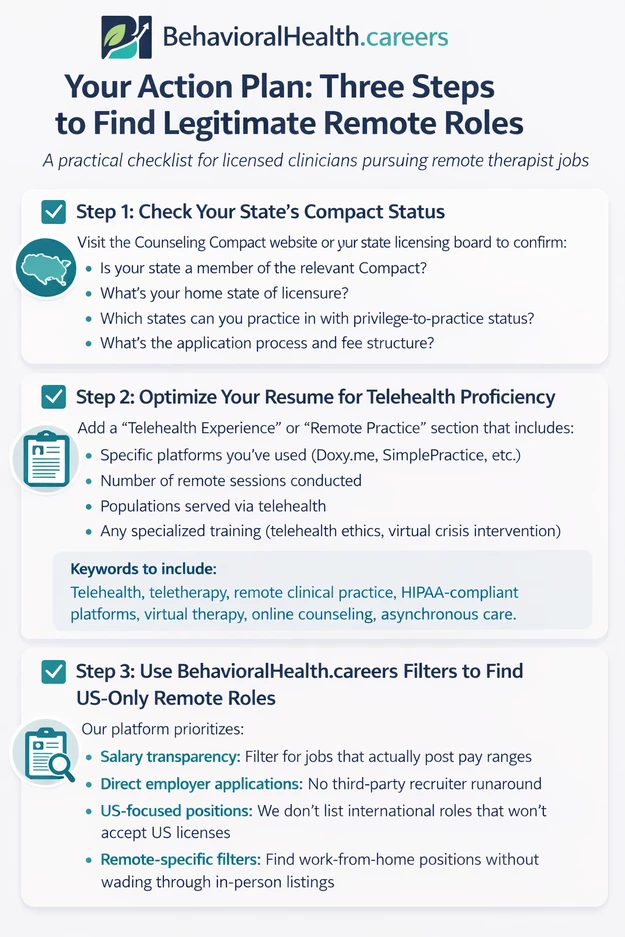
[ ] Step 1: Check Your State’s Compact Status
Visit the Counseling Compact website or your state licensing board to confirm:
- Is your state a member of the relevant Compact?
- What’s your home state of licensure?
- Which states can you practice in with privilege-to-practice status?
- What’s the application process and fee structure?
[ ] Step 2: Optimize Your Resume for Telehealth Proficiency
Add a “Telehealth Experience” or “Remote Practice” section that includes:
- Specific platforms you’ve used (Doxy.me, SimplePractice, etc.)
- Number of remote sessions conducted
- Populations served via telehealth
- Any specialized training (telehealth ethics, virtual crisis intervention)
Keywords to include: Telehealth, teletherapy, remote clinical practice, HIPAA-compliant platforms, virtual therapy, online counseling, asynchronous care.
[ ] Step 3: Use BehavioralHealth.careers Filters to Find US-Only Remote Roles
Our platform prioritizes:
- Salary transparency: Filter for jobs that actually post pay ranges
- Direct employer applications: No third-party recruiter runaround
- US-focused positions: We don’t list international roles that won’t accept US licenses
- Remote-specific filters: Find work-from-home positions without wading through in-person listings
The Future of Remote Roles in Behavioral Health
Remote therapist jobs are real, abundant, and here to stay. The market shows consistent demand with salaries ranging from $52,000–$94,500+ depending on credentials, specialization, and role type
The hype to ignore: You won’t make $120,000+ as a generalist remote therapist without advanced degrees or specialized expertise. You can’t practice everywhere instantly: state Compacts require applications and ongoing compliance.
But here’s reality to embrace: Remote work offers genuine flexibility, access to underserved populations, and elimination of commute time. With the right employer, clear boundaries, and intentional professional connection, remote therapy is a sustainable, rewarding career path.
Explore remote behavioral health positions with salary transparency and direct employer applications. Your next role is out there: and now you know exactly what to look for.
FAQs on Remote Therapist Jobs
Can I practice across state lines with a remote job?
Yes, if you hold a license in a Compact member state and apply for privileges in other member states. You cannot practice in non-Compact states without obtaining a full license in that state. Always confirm with your employer which states their organization is credentialed to provide services in.
Do remote jobs pay less than in-person positions?
Not necessarily. Remote roles often eliminate commute costs and may offer comparable or higher salaries depending on the employer.
However, some employers use “remote” as justification for below-market pay. Always compare offers against our salary transparency data for your credential level and specialty.
What about clinical supervision hours for pre-licensed therapists?
Many remote employers offer supervision for LMSWs, LPC-Associates, and other pre-licensed clinicians. Confirm during interviews:
- Is supervision provided at no cost?
- How many hours per week?
- Is the supervisor licensed in your state?
- Will they sign off on hours for your state board?
Some states restrict telepsychiatry and telehealth practice for pre-licensed clinicians, so verify your state’s rules before accepting remote roles.
How do I avoid scams or low-quality employers?
Red flags include:
- No salary range posted
- “Unlimited earning potential” based on pure commission
- Vague job descriptions without specific licensure requirements
- Requests for payment upfront for training or credentialing
- Promises of immediate multi-state practice without mentioning Compacts
Use BehavioralHealth.careers to find vetted employers who post clear requirements and compensation.
References
American Counseling Association. (n.d.). Counseling Compact. https://www.counseling.org/advocacy/counseling-compact
Association of Social Work Boards. (2025, June 12). Social Work Licensure Compact on track for implementation timeline. https://www.aswb.org/social-work-licensure-compact-on-track-for-implementation-timeline/
Counseling Compact Commission. (n.d.). Compact jurisdictions. https://counselingcompact.gov/map/compact-states/
Counseling Compact Commission. (2026, January 5). The Counseling Compact is live for licensees in Arizona, Minnesota, and Ohio. https://counselingcompact.gov/
Office of the National Coordinator for Health Information Technology. (n.d.). What is the recommended bandwidth for different types of health care providers? U.S. Department of Health and Human Services. https://www.healthit.gov/faq/what-recommended-bandwidth-different-types-health-care-providers
Psychology Interjurisdictional Compact Commission. (n.d.). About PSYPACT. https://psypact.gov/page/About
Psychology Interjurisdictional Compact Commission. (n.d.). PSYPACT participating states map. https://psypact.gov/page/psypactmap
Social Work Licensure Compact. (n.d.). Home. https://swcompact.org/
U.S. Bureau of Labor Statistics. (2025). Psychologists: Occupational Outlook Handbook. U.S. Department of Labor. https://www.bls.gov/ooh/life-physical-and-social-science/psychologists.htm
U.S. Bureau of Labor Statistics. (2025). Substance abuse, behavioral disorder, and mental health counselors: Occupational Outlook Handbook. U.S. Department of Labor. https://www.bls.gov/ooh/community-and-social-service/substance-abuse-behavioral-disorder-and-mental-health-counselors.htm
ZipRecruiter. (2025). Remote therapist salary in the United States. https://www.ziprecruiter.com/Salaries/Remote-Therapist-Salary