Let’s get down to it: behavioral health job seekers want clear pay ranges and expectations.
And employers benefit, too, because transparency improves trust, speeds time-to-fill, and reduces mismatched applicants.
This guide from BehavioralHealth.careers focuses on statewide rules that clearly require pay ranges in job postings, plus practical tips for remote roles.
Check official sources: Pay transparency requirements change. Always verify current rules with official state resources before relying on a posting.
Disclaimer: This is general information, not legal advice. Requirements change. Verify with official state resources and counsel.
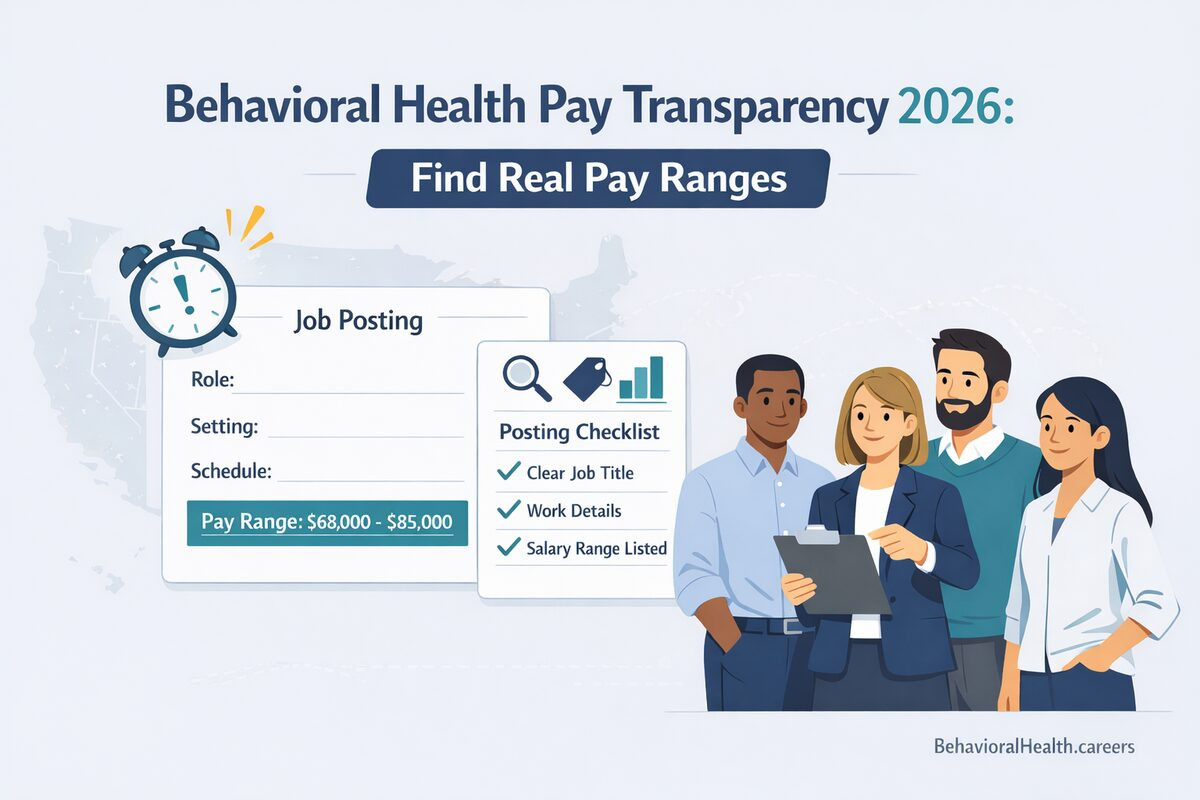
TL;DR on Behavioral Health Salary Transparency from BehavioralHealth.careers
Pay transparency laws are rules that require employers to share compensation information, often a salary range, during hiring. These laws, also known as salary transparency laws, are legal requirements that mandate employers to disclose salary information, such as salary ranges, in job postings to promote pay equity, transparency, and fairness for job applicants.
In 2026, the biggest impact is on job postings: some states require pay ranges (and sometimes benefits) in ads, while others require disclosure later. Requirements vary by state, so confirm using official sources.
Salary transparency laws are becoming more common across the United States. For example, New York City began requiring salary ranges in job postings starting in May 2023.
What pay transparency usually means
Salary range or pay range
- The employer’s good-faith minimum and maximum for the role’s base pay (hourly or salary), depending on how the job is paid.
Base pay vs total compensation
- Base pay: the hourly rate or annual salary.
- Total compensation: base pay plus variable pay (like bonuses) and other pay components.
Bonuses, commissions, shift differentials
- Bonuses: may be discretionary or non-discretionary; some laws treat certain bonuses as compensation.
- Commission: common in some roles; may be included as part of compensation disclosures.
- Shift differentials and on-call pay: especially relevant in behavioral health settings (overnights, weekends, holidays).
Benefits and non-wage compensation
- Some states require a general description of benefits in postings (examples can include health coverage, paid time off, retirement plans), and sometimes other compensation elements.
Common employer approaches
- Range listed in the job posting (required in certain states and increasingly common everywhere).
- Range provided during the process (for example, upon request, during interview, or at offer stage), depending on the jurisdiction.
Why this matters in the behavioral health space
Behavioral health hiring has special factors that make pay clarity more important than in many other fields:
- Hard-to-fill roles: transparency reduces churn from “wrong fit” applicants. Behavioral health organizations and companies face increasing competition for talent and must offer higher pay or other benefits to attract and retain providers. Community-based providers often face budgetary limitations, making it difficult to match the higher pay offered by hospitals or insurance companies.
- Shift-based work: differentials, overtime practices, and weekend coverage can materially change pay.
- Productivity and caseload expectations: unclear expectations can increase burnout risk and turnover.
- Credential tiers and supervision: pay can vary significantly by license level, supervision status, and setting.
- Team-based care reality: clear pay bands help candidates understand role scope (tech/aide vs case management vs licensed clinician).
Retention strategies in these organizations cannot depend solely on salaries due to cost and financial limitations.
Organizations must find creative ways to help staff feel valued and supported beyond just money or salary.
Investing in staff development, offering growth opportunities such as mentorship and skills training, and using technology to reduce documentation burdens can help improve retention and reduce burnout among providers.
What job seekers should look for in a salary range posting
- Does the posting clearly state a salary range?
- Are benefits and other compensation details included?
- Is the information up to date and specific to the role/location?
- Does the posting reflect pay equity principles, indicating fair and unbiased compensation practices?
Job seeker checklist: what a strong pay range posting includes
[ ] Clear base pay range (min and max)
[ ] Pay type is stated (hourly vs salary)
[ ] Location is clear (onsite, hybrid, remote) and where remote is allowed
[ ] Schedule expectations are clear (shifts, weekends, holidays, on-call)
[ ] Shift differentials and on-call pay are explained when relevant
[ ] Bonus, incentive, or commission structure is summarized when relevant
[ ] Benefits summary is included (at least high level)
[ ] Caseload or productivity expectations are described when relevant (high level)
[ ] Credential and experience requirements are explicit (license level, degree, years)
[ ] Supervision and support are described for pre-licensed or early-career clinicians
[ ] The posting explains what moves pay within the range (experience, credentials,
bilingual pay, leadership duties, setting, shift coverage)
Employer fundamentals: what to disclose
Pay transparency requirements differ by state, and sometimes by role location, employer size, and how the job is advertised.
Salary transparency laws require employers to provide standard charge information, such as salary ranges and benefits, in job postings.
Across many statewide laws, the most commonly required or expected elements include:
- A pay range (hourly or salary), typically in good faith.
- Clear pay type (hourly vs salary) and how pay is structured.
- In some states, a general description of benefits and other compensation.
- In some states, timing rules (at posting vs later in the process).
Salary transparency can help level the playing field for job seekers by giving everyone the same information to negotiate salaries. Increased salary transparency can also reduce gender and racial wage gaps in the workplace.
Practical default for behavioral health and mental health employers posting nationally: write postings as if a candidate is comparing offers across states and employers. Clarity is a recruiting advantage even where not required.
States that clearly require pay ranges in job postings statewide
Only states with clear statewide requirements to include pay ranges in job postings are listed here. This is not a full 50-state list.
California
- What is typically required
- Include a pay scale in job postings for positions that may be filled in California.
- Be prepared to provide a pay scale to current employees for their position upon request.
- Notes for remote or multi-state postings
- If the role can be performed in California or may be filled in California, treat the posting as potentially covered and verify details.
- Source reference
- California Department of Industrial Relations, Division of Labor Standards Enforcement (DLSE) Equal Pay Act FAQ.
Colorado
- What is typically required
- Include a compensation range and a general description of benefits and other compensation in job postings.
- Notes for remote or multi-state postings
- If you are recruiting for a role that can be performed in Colorado, consider the posting potentially covered and confirm current guidance.
- Source reference
- Colorado Department of Labor and Employment (CDLE) Equal Pay for Equal Work Act guidance.
Hawaii
- What is typically required
- Covered employers must include an hourly rate or salary range in job listings.
- Notes for remote or multi-state postings
- If hiring into Hawaii or listing roles open to Hawaii candidates, confirm whether the employer-size threshold applies and how the role is targeted.
- Source reference
- Hawaii Civil Rights Commission, Act 203 Pay Transparency FAQs.
Illinois
- What is typically required
- Covered employers must include the role’s pay scale and benefits in internal and external job postings tied to Illinois.
- Notes for remote or multi-state postings
- Illinois coverage can include roles performed at least partly in Illinois or roles that report to an Illinois supervisor, office, or work site. Verify details.
- Source reference
- Illinois Department of Labor Equal Pay Act Salary Transparency guidance.
Maryland
- What is typically required
- Job postings must include the wage range, a general description of benefits, and any other compensation offered for the position.
- Notes for remote or multi-state postings
- Maryland provides guidance on how the law applies to postings tied to Maryland. Verify treatment of remote roles and where the work will be performed.
- Source reference
- Maryland Department of Labor Wage Range Transparency FAQs.
Minnesota
- What is typically required
- Covered employers must include the starting salary range, a general description of benefits, and other compensation (or list a fixed pay rate if no range).
- Notes for remote or multi-state postings
- If the job could be performed in Minnesota or the posting targets Minnesota candidates, consider the posting potentially covered and verify.
- Source reference
- Minnesota Statutes, section 181.173.
New Jersey
- What is typically required
- Covered employers must include a wage or salary range and a general description of benefits and other compensation in postings.
- Notes for remote or multi-state postings
- Confirm how coverage is determined for roles that can be performed in New Jersey or that are targeted to New Jersey candidates.
- Source reference
- New Jersey Department of Labor and Workforce Development pay and benefits transparency guidance.
New York
- What is typically required
- Covered employers must include a compensation range (and related required details) in job advertisements, including postings for promotions or transfers.
- Notes for remote or multi-state postings
- New York guidance addresses postings that could be performed in New York and certain remote scenarios tied to New York-based supervision or offices. Verify details.
- Source reference
- New York State Department of Labor pay transparency guidance.
Vermont
- What is typically required
- Covered employers must include compensation or a range of compensation in job advertisements.
- Notes for remote or multi-state postings
- Vermont law includes specific definitions for covered “remote positions” tied to Vermont offices. Verify whether the role is considered Vermont-based.
- Source reference
- Vermont Act 155 (as enacted).
Washington
- What is typically required
- Covered employers must include a wage scale or salary range, plus a general description of benefits and other compensation in job postings.
- Notes for remote or multi-state postings
- Washington guidance addresses how job-posting requirements apply when the hired worker will be Washington-based. Verify how “Washington-based” is defined and applied.
- Source reference
- Washington State Department of Labor and Industries Equal Pay and Opportunities Act guidance.
Watch list: verify current requirements
This watch list is not exhaustive. It highlights states where rules are commonly misunderstood or are actively changing.
Connecticut
- Why it's on the watch list
- Often confused with job-posting requirements, but disclosure is typically handled during the hiring process rather than mandated in postings.
- What to verify
- When the pay range must be provided, and whether any newer proposals change job-posting expectations.
- Source reference
- NCSL overview on pay range disclosure timing.
Nevada
- Why it’s on the watch list
- Common confusion about whether ranges must appear in postings versus being provided during the process.
- What to verify
- Timing of required disclosure and which roles or employers are covered.
- Source reference
- NCSL overview on pay range disclosure timing.
Rhode Island
- Why it’s on the watch list
- Frequently misunderstood as a job posting mandate, but requirements often relate to disclosure during the process.
- What to verify
- When a range must be provided and to whom.
- Source reference
- NCSL overview on pay range disclosure timing.
Oregon
- Why it's on the watch list
- Proposed legislation has described job posting wage and benefit disclosure requirements with an operative date in 2026, so employers should confirm their current status.
- What to verify
- Whether the measure was enacted, the final requirements (pay range, benefits, other compensation), and any implementation rules.
- Source reference
- Oregon Legislature staff measure summary for HB 2746 (2025 session).
Remote and multi-state postings
Remote hiring creates one recurring challenge: pay transparency rules may be triggered based on where the job can be performed, where the employee will sit, and how the posting is targeted.
These rules are designed to ensure access to fair compensation information for job seekers in various settings and communities, regardless of location.
This varies by state, so treat this section as practical planning guidance, not compliance advice.
Employer decision checklist for remote and multi-state roles
1) Define where the job can be performed
[ ] Any US state
[ ] A defined list of states
[ ] Only one state
2) Define where the employee will actually work
[ ] Known (state is specified)
[ ] Unknown (candidate location flexible)
3) Define how the job is advertised
[ ] National posting
[ ] Targeted to specific states (geo-targeted ads, state-specific boards)
[ ] Posted through third parties (staffing, aggregators)
4) Choose a posting strategy
[ ] Use a posting format that meets the strictest state(s) you recruit in
[ ] Create state-specific versions of the posting
[ ] Restrict candidate location and state that clearly in the posting
5) Validate the posting content
[ ] Pay range and pay type are clear (hourly vs salary)
[ ] Benefits and other compensation are described where required or expected
[ ] Differentials, on-call pay, and shift expectations are explicit when relevant
[ ] Credential and supervision expectations are explicit
[ ] Confirm state-specific rules for where the role can be performed
Pay transparency: a mini-audit for behavioral health job postings
Pay transparency mini-audit for behavioral health job postings
Note: Using transparent data helps ensure fair compensation practices and allows providers to negotiate fair contracts with payers and insurers based on actual market reimbursement rates.
Compensation basics
[ ] Pay range included (hourly or salary)
[ ] Pay type is clear (hourly vs salary)
[ ] Range appears realistic and usable (not excessively broad)
[ ] Base pay is clearly separated from variable pay when relevant
[ ] Differentials and on-call pay described when applicable
[ ] Bonus, incentive, or commission described when applicable
Benefits and other compensation
[ ] Benefits summary included if required or recommended
[ ] Other compensation elements included if required (stipends, sign-on, retention)
Role and work expectations
[ ] Location and remote eligibility clearly stated (including allowed states if relevant)
[ ] Schedule expectations included (shift, weekends, holidays, on-call)
[ ] Credential requirements clearly stated (license level, degree, certifications)
[ ] Supervision support described for pre-licensed roles when applicable
[ ] Caseload or productivity expectations included where relevant (high level)
Multi-state check
[ ] The posting has been reviewed against the state(s) where the role can be performed
[ ] Any required pay transparency elements for those states are included (verify)
Behavioral health-specific best practices
Write ranges for shift-based roles
- Use an hourly base range plus a short “typical add-ons” line: differentials, overtime eligibility, weekend or overnight premiums, and on-call pay.
- If differentials vary by site or schedule, state the rule clearly (for example, “overnight differential applies to shifts starting after X pm”).
Present caseload and productivity expectations without misleading candidates
- Use ranges and plain language (for example, “typical weekly sessions” or “average daily census expectations”) and clarify what affects them (acuity, setting, documentation time, no-show rates).
- Pair expectations with support details: onboarding, templates, clinical supervision, and admin support.
List supervision and licensure support clearly
- For associate or pre-licensed roles, spell out:
- supervision frequency
- who provides supervision
- whether supervision hours are supported or reimbursed
- any training or exam support
Handle multi-credential pay bands without confusing candidates
- Use credential-based bands (for example, LMSW vs LCSW) with separate ranges, or a single range with explicit “credential premiums.”
- State the minimum credentials required to start, and what upgrades pay (license attainment, years post-licensure, specialty certs).
Why transparent ranges improve hiring outcomes
Clear ranges reduce late-stage drop-off, improve applicant self-selection, and support more consistent offers across teams.
Transparent paycheck information not only benefits employees but also builds trust with patients, making them more likely to return for services and boosting retention.
Common mistakes and myths
- Posting a range so wide that it is not meaningful.
- Listing total compensation without clarifying base pay.
- Not stating hourly vs salary.
- Hiding requirements that materially change pay (on-call, weekends, overnights).
- Treating “remote” as one thing without stating where candidates can live.
- Assuming one state rule applies everywhere.
- Using “DOE” without providing a real range.
- Posting a range that does not reflect what you would actually pay.
- Omitting benefits that candidates expect at least a summary.
- Posting one national range when pay is actually location-adjusted, without explaining why.
- Overlooking the fact that some employees may be concerned about how pay transparency will affect their compensation or workplace dynamics.
FAQs on Salary Transparency for Behavioral Health Workers
What are pay transparency laws in terms of the behavioral health industry?
There are rules that require employers to share compensation information, often a pay range, during hiring. Some states require ranges in job postings, while others require disclosure later.
Which states require salary ranges in job postings in 2026?
This guide lists states with clear statewide job-posting pay range requirements and is updated periodically. Always verify with official state sources.
Do pay transparency laws apply to remote jobs?
Sometimes. Coverage can depend on where the job can be performed, where the employee will be located, and how the posting is targeted.
What should a behavioral health salary range include, base pay vs bonus?
A strong posting separates base pay from bonuses, incentives, shift differentials, and other variable pay.
Can employers post a very wide pay range?
A range that is excessively broad may not help candidates and may raise compliance questions in some states. Employers should use realistic ranges they expect to pay.
Are benefits required to be listed?
In some states, yes. Even where not required, a high-level benefits summary improves candidate trust and self-selection.
What should job seekers look for beyond the pay range?
Pay type, differentials, on-call expectations, schedule, location requirements, credential requirements, supervision support, and caseload expectations where relevant.
How should behavioral health employers describe caseload expectations?
Use plain language ranges and clarify what affects workload (setting, acuity, documentation support, no-show rates).
Does “salary range in job postings” mean base pay only?
Often, it refers to base pay, but some states also require benefits and other compensation descriptions. Read the state’s official guidance.
Should employers include salary differentials in the posting?
If differentials materially change pay, including them improves accuracy and reduces offer-stage surprises. Some states also require broader compensation disclosures.
What is behavioral health pay transparency?
Behavioral health pay transparency refers to the practice of making the costs of mental health services clear, accessible, and understandable to patients before they receive care.
This shift is crucial because behavioral health care is often fraught with hidden costs, complex insurance, and a lack of network providers, which can cause patients to delay or avoid necessary treatment.
What is the No Surprises Act and what are Good Faith Estimates?
The No Surprises Act requires providers to give 'good faith estimates' to uninsured or self-pay patients, reducing the fear of unexpected, exorbitant fees. Good Faith Estimates are estimates of expected charges for services for uninsured or self-pay patients upon request or scheduling.
What recent actions has CMS taken regarding behavioral health pay transparency and hospital price transparency?
CMS is taking action to expand access to behavioral health services through coverage of intensive outpatient services and is proposing to establish payment for intensive outpatient program services provided by Opioid Treatment Programs effective January 1, 2024.
CMS is also proposing to strengthen hospital price transparency regulations to enhance public access to standard charge information and improve the ability of the public to understand and meaningfully use hospital charges for items and services. Additionally, the proposed rule includes actions to promote health equity for tribal communities.
Why are price transparency, price, and payment rates important in healthcare?
Price transparency, including clear information about prices and payment rates, helps patients and providers make informed decisions, compare costs, and plan for care. These measures promote competition, improve behavioral health access, and support hospital financial planning.
Further Related Materials from BehavioralHealth.careers
- Careers in Behavioral Health
- Behavioral Health Technician vs Mental Health Technician vs Psych Aide
- Intake Coordinator and Admissions Specialist Career Guide
- LCSW Career Guide and Mental Health Counselor Career Guide
- Therapist onboarding checklist
- RBT Career Guide for Registered Behavior Technicians
- Our Psychometrist job definition and career guide
- BCBA Career Guide: Salary Ranges, Specializations, and Credentials
- Student Loan Repayment Guide for Behavioral Health Professionals
- Psychiatric Technician Jobs 101: Our Complete Guide
- Behavioral Health Executive Jobs: Paths to the C-Suite
How do we keep our guide updated?
Pay transparency rules change frequently. We review official state guidance and statutes, plus reputable tracking sources, and update the “Updated on” date when changes are confirmed.
References and Resources
- National Conference of State Legislatures, “Help Wanted! States Get Down to Business of Filling Vacant Jobs” (Nov 28, 2023). (NCSL)
- California Department of Industrial Relations, DLSE Equal Pay Act FAQ (pay scale in postings and related guidance). (CDLE)
- Colorado Department of Labor and Employment, Equal Pay for Equal Work Act guidance (job posting compensation disclosures). (Vermont General Assembly)
- Hawaii Civil Rights Commission, Act 203 Pay Transparency FAQs (PDF). (Illinois Department of Labor)
- Illinois Department of Labor, Equal Pay Act Salary Transparency guidance (job posting pay scale and benefits). (Illinois Department of Labor)
- Maryland Department of Labor, Wage Range Transparency FAQs (job posting wage range, benefits, other compensation). (MD Department of Labor)
- Minnesota Statutes, section 181.173 (salary range disclosure in job postings). (MN Revisor's Office)
- New Jersey Department of Labor and Workforce Development, pay and benefits transparency guidance. (CDLE)
- New York State Department of Labor, pay transparency guidance for job advertisements. (Vermont General Assembly)
- Vermont Act 155 (as enacted), compensation disclosure in job advertisements and remote-position definitions (PDF).
- Washington State Department of Labor and Industries, Equal Pay and Opportunities Act guidance (job posting wage scale or range, benefits, other compensation). (Washington L&I)
- Oregon Legislature, HB 2746 staff measure summary (2025 session) describing proposed job posting wage and benefit disclosures and operative timing (PDF). (olis.oregonlegislature.gov)