
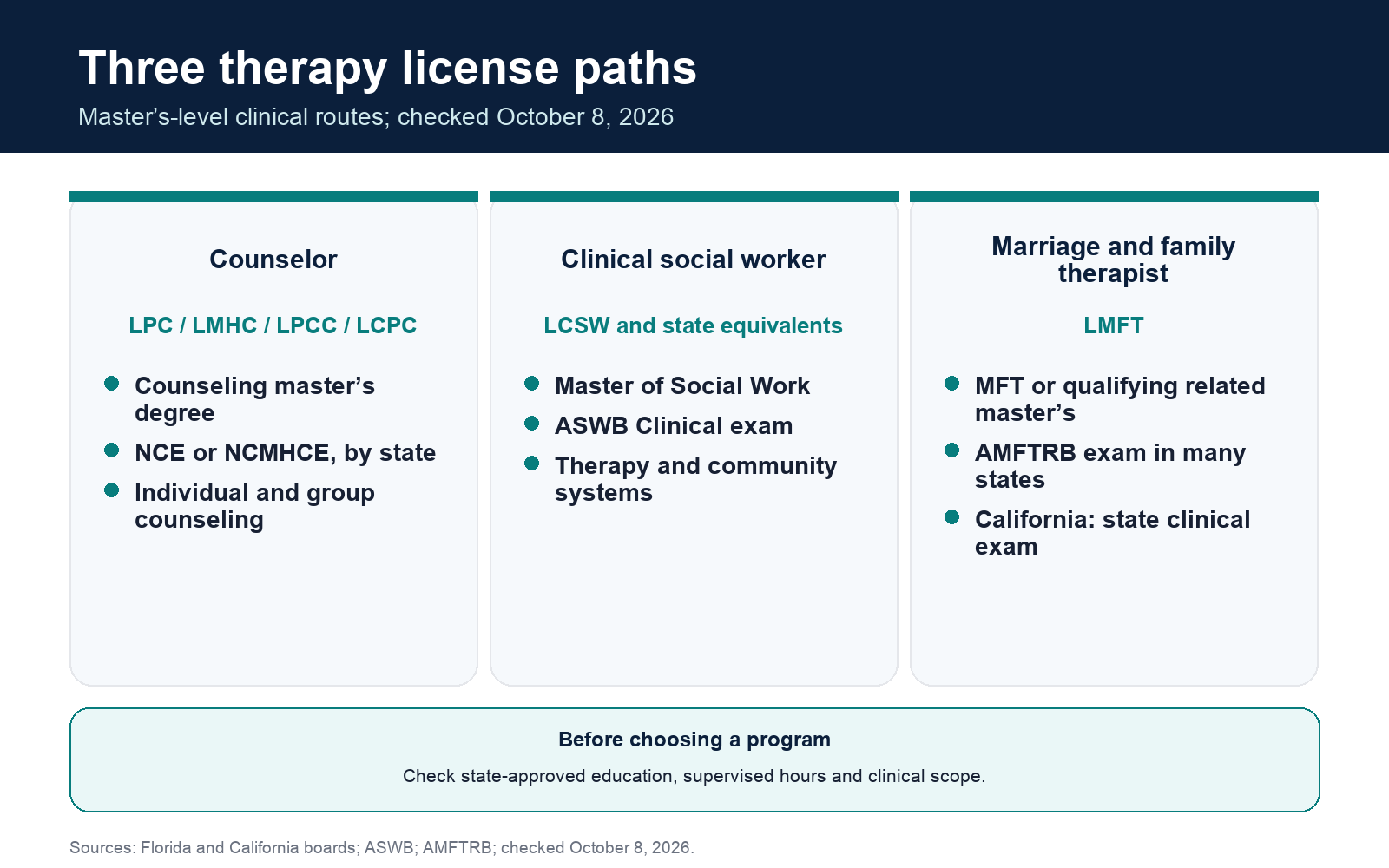
There are three main types of therapy licenses for master’s-level clinicians in the United States: the professional counselor license (licensed professional counselor or LPC, licensed mental health counselor or LMHC, and other state names such as LPCC and LCPC), the clinical social worker license (LCSW), and the marriage and family therapist license (LMFT).
LPC and LMHC are not different professions. They are different state names for the same counseling license.
All three licenses let you assess and diagnose mental health conditions such as anxiety, depression, and trauma-related disorders, build treatment plans, and provide psychotherapy in your state. They differ in the degree you earn, the national exam you take, and the training focus behind the license.
On our board, many therapist jobs accept more than one of them. Of 248 therapist listings on BehavioralHealth.careers on October 7, 2026, 66% named two or more license types, and 44% named all three professions.
Therapy license comparison table
| Attribute | Professional counselor | Clinical social worker | Marriage and family therapist |
|---|---|---|---|
| License names | LPC, LMHC, LPCC, LCPC, and others by state | LCSW, and in some states LICSW or LCSW-C | LMFT |
| Degree | Master’s in counseling, often clinical mental health counseling | Master of Social Work (MSW) | Master’s in marriage and family therapy or a closely related field |
| Program accreditor | CACREP, among others accepted by states | CSWE | COAMFTE, among others accepted by states |
| National exam | NCMHCE or NCE, from NBCC, depending on the state | ASWB Clinical exam | AMFTRB national MFT exam |
| Training focus | Individual and group counseling, wellness and development | People in their environment: family, community, and access to services | Relationships and family systems |
| Multistate compact | Counseling Compact, live in 10 states as of October 1, 2026 | Social Work Licensure Compact, enacted in 35 states, not yet issuing licenses | No compact yet |
| Named in our therapist listings | 171 of 248 (69%) named at least one counselor license | 161 of 248 (65%) | 131 of 248 (53%) |
Sources are linked in each section below. Supervised hours and exam rules vary by state. Psychologists, who hold a doctoral degree in psychology and a separate license, and psychiatrists, who are physicians, are different professions.
Our guide to therapists, counselors, social workers, psychologists and psychiatrists compares them.
What employers ask for
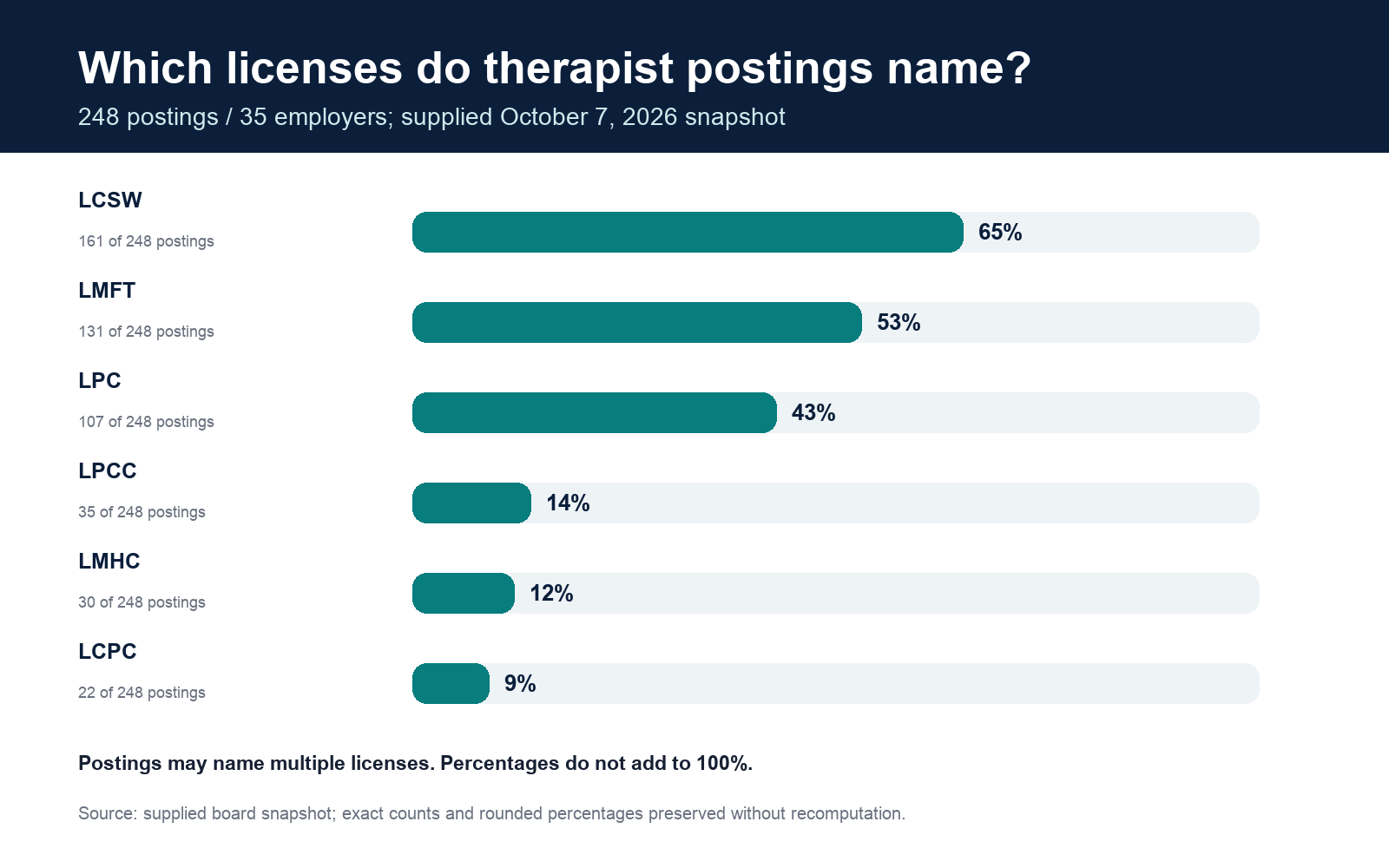
Before choosing a license, it helps to know how employers actually write therapist job postings. We searched the titles and descriptions of the 248 licensed therapist listings on our board on October 7, 2026, from 35 employers:
| License named in the posting | Listings | Share of 248 |
|---|---|---|
| LCSW or licensed clinical social worker | 161 | 65% |
| LMFT or marriage and family therapist | 131 | 53% |
| LPC or licensed professional counselor | 107 | 43% |
| LPCC | 35 | 14% |
| LMHC | 30 | 12% |
| LCPC | 22 | 9% |
Listings can name more than one license, so the shares add up to more than 100%. Counted together, the counselor licenses (LPC, LPCC, LMHC, LCPC, or the spelled-out title) appeared in 171 listings, slightly more than the LCSW.
Two patterns stand out. First, 163 of the 248 listings (66%) named two or more license types, and 110 (44%) named a license from each of the three professions.
For many outpatient and telehealth therapy jobs on our board, holding a full clinical license in the state where your clients are matters more than which of the three you hold.
Second, the LCSW is the single most-named acronym because counselor licenses go by several names, which splits their count.
These numbers describe our board, which leans toward outpatient, telehealth, and group practice employers. Hospitals, schools, and community agencies may weigh licenses differently.
Licensed professional counselors and licensed mental health counselors: LPC, LMHC, LPCC and LCPC
The professional counselor license is the same credential under different state names.
Texas uses LPC, Florida and New York use LMHC, California uses LPCC, and Illinois and Maryland use LCPC.
A few states have more than one tier, such as an associate-level license during supervision and a clinical license afterward.
Degree. A master’s degree in counseling, usually in clinical mental health counseling. Many states require or prefer a program accredited by the Council for Accreditation of Counseling and Related Educational Programs (CACREP).
Florida, for example, requires at least 60 semester hours, 700 hours of supervised practicum, internship, or field experience with at least 280 hours of direct client services, and, beginning July 1, 2025, a degree from a program accredited by CACREP, MPCAC, or an equivalent body.
Exam. Most states use an exam from the National Board for Certified Counselors (NBCC): the National Clinical Mental Health Counseling Examination (NCMHCE) or the National Counselor Examination (NCE).
Which one your state requires varies; California, for example, uses the NCMHCE.
See NBCC’s pages on the NCMHCE and state licensure.
Supervised hours. In Florida, the LMHC requires two years of post-master’s experience with 1,500 hours of face-to-face psychotherapy and at least 100 hours of supervision over at least 100 weeks.
In California, the LPCC requires 3,000 supervised hours over at least 104 weeks as a registered Associate Professional Clinical Counselor (APCC), plus the California Law and Ethics exam.
Portability. The Counseling Compact lets eligible independently licensed professional counselors apply for privileges to practice in other operational member states. Applicants must hold their qualifying license in their home state of residence; a supervised associate credential does not qualify.
As of October 1, 2026, ten states are issuing privileges: Arizona, Arkansas, Georgia, Indiana, Louisiana, Minnesota, Ohio, Oklahoma, Tennessee, and Wyoming. Another 29 states and the District of Columbia are working toward implementation.
Our guide on how to become a licensed mental health counselor, state by state covers the counselor path in more depth.
The LCSW: licensed clinical social worker
Degree. A Master of Social Work from a program accredited by the Council on Social Work Education (CSWE).
According to CSWE, most state and U.S. territory requirements stipulate that a social worker pursuing licensure or sitting for a licensing exam be a graduate of a CSWE-accredited program.
Exam. The ASWB Clinical exam, from the Association of Social Work Boards. It has 122 questions, 110 scored and 12 unscored, with a four-hour time limit.
Supervised hours. Florida’s LCSW requires two years of post-master’s supervised experience with 1,500 hours of face-to-face psychotherapy and at least 100 hours of supervision over at least 100 weeks.
California’s LCSW requires 3,000 hours over at least 104 weeks as a registered Associate Clinical Social Worker, plus the California Law and Ethics exam.
Portability. The Social Work Licensure Compact has been enacted in 35 states, but multistate licenses are not available yet. The compact’s data system is estimated to be complete in spring 2027.
What sets it apart. Social work training covers the systems around a client, such as family, community, and access to services, alongside therapy.
The MSW also leads to non-clinical social work roles in case management, policy, and administration, which gives the degree the widest range of jobs outside therapy.
Our guide to mental health social workers covers the path and pay.
The LMFT: licensed marriage and family therapist
Degree. A master’s degree in marriage and family therapy or a closely related field. In Florida, a degree from a program accredited by the Commission on Accreditation for Marriage and Family Therapy Education (COAMFTE) qualifies on its own.
Graduates of CACREP programs, and of other institutionally accredited programs whose degree is conferred before September 1, 2032, must also show coursework in 11 areas, including family systems, human sexuality, and psychopathology, plus a supervised practicum.
The current Florida statute sets the 2032 cutoff; part of the board webpage still displays the older 2027 date.
Exam. Many states use the AMFTRB national MFT exam, which has 180 multiple-choice questions and a four-hour time limit. California requires its LMFT Clinical exam.
Supervised hours. Florida’s LMFT requires two years of post-master’s experience with 1,500 hours of face-to-face psychotherapy, at least 200 of them relational, and at least 100 hours of supervision over at least 100 weeks.
California’s LMFT requires 3,000 hours over at least 104 weeks, plus the California Law and Ethics exam. Eligible hours can include supervised work as an MFT trainee before graduation; post-degree hours generally require Associate Marriage and Family Therapist (AMFT) registration, with a limited 90-day exception.
Portability. There is no interstate compact for MFTs yet, so practicing in another state means getting licensed there.
What sets it apart. MFT training treats relationships as the unit of care. LMFTs work with couples and families as well as individual clients, and the license is common in private practice and in programs that serve children and families.
LPC vs LMHC
They are the same profession. Licensed professional counselors and licensed mental health counselors hold the same counseling license under two different state names, though the hours and exams behind it still vary by state.
If you move from a state that issues the LPC to one that issues the LMHC, you apply for licensure by endorsement or through the Counseling Compact if both states are live members.
LCSW vs LPC
Both licenses let you diagnose and provide psychotherapy, and employers on our board often accept either. Choose the LCSW if you want the option of social work roles outside therapy, such as hospital social work, case management, or program leadership, or if you’re drawn to work that connects clients with community services.
Choose the counselor license if you want a degree focused on counseling from the first semester. The LPC currently has the more advanced interstate compact, which matters for telehealth.
LMFT vs LCSW
The LMFT is the more specialized license, built around relationships and family systems. The LCSW is broader. If you know you want to work with couples and families, the MFT degree trains you for that directly. If you want the widest range of jobs, the MSW offers more.
On our board, 65% of therapist listings named the LCSW and 53% named the LMFT.
LPC vs LMFT
Counselors train in individual and group counseling, while MFTs train in relational and family systems work. Both can see individual clients. The counselor license has an interstate compact and the LMFT does not.
Pay by license
On our board, pay tracks the job more than the license. Many listings accept all three licenses for the same job. With that caveat, here is what listings in each role category posted on October 7, 2026:
| Role category | Salaried listings | Employers | Median posted minimum | Median posted maximum | Median midpoint |
|---|---|---|---|---|---|
| Licensed counselor or therapist | 88 | 20 | $70,000 | $95,000 | $79,750 |
| Clinical social worker (LCSW) | 8 | 4 | Too few to report a median | ||
| Marriage and family therapist | 3 | 2 | Too few to report a median |
The median minimum and median maximum are calculated separately, so they don’t describe any single listing. We report a median only when at least 10 listings from three or more employers stand behind it, so the social worker and MFT rows stay blank.
The eight salaried LCSW listings had midpoints from $72,500 to $100,540, and LifeStance Health posted four of them. The counselor category includes many listings that also accept LCSWs and LMFTs.
These role categories come from how we classify each job, so their counts differ from the license-mention counts above.
Hourly counselor and therapist listings, common in telehealth, had a median posted minimum of $34.78 and a median posted maximum of $44 an hour across 81 listings from 14 employers, with Talkspace and Hazel Health posting 40 of them.
For national survey data, see our salary pages for mental health counselors, marriage and family therapists, and behavioral health social workers.
Renewal and continuing education
All three licenses must be renewed on a schedule your state board sets, and most states require continuing education hours for renewal. The hours, topics, and renewal cycle vary by state and by license, so check your board’s rules once you’re licensed.
How to choose a therapy license
- Pick the degree for the work you want. Couples and family work points to the MFT. Community, hospital, and case management work points to the MSW. Individual counseling in clinics and private practice fits all three.
- Check your state’s names and rules. Look up your state board before you enroll. Confirm the license name, the exam, the supervised hours, and which program accreditations it accepts.
- Think about telehealth. If you want to see clients in more than one state, the Counseling Compact is issuing privileges now, but only among its 10 live member states, so check whether yours is one. The Social Work Compact isn’t issuing licenses yet, and there is no MFT compact yet.
- Look at local job postings. Search the jobs you’d want in five years and see which licenses they name.
Frequently asked questions
What is the difference between LPC and LMHC?
Only the name. Both are state names for the professional counselor license, and the requirements are similar in structure, though hours and exams differ by state.
Which therapy license is the most versatile?
The LCSW opens the widest range of jobs, because the MSW also leads to non-clinical social work. For therapist jobs specifically, our data shows employers accept all three licenses for many roles.
Can an LMFT see individual clients?
Yes. LMFTs treat individual clients as well as couples and families, within their state’s scope of practice.
Do all states license LPCs, LCSWs, and LMFTs?
All states license counselors, clinical social workers, and marriage and family therapists, but the license names, tiers, and requirements differ. Check your state board for the exact rules.
Which license pays the most?
Our data can’t isolate a premium for any one license. Of our 248 therapist listings, 110 named all three professions for the same job, so in those postings the pay belongs to the job, not the license.
Find therapist jobs with posted pay
BehavioralHealth.careers lists behavioral health jobs with posted pay wherever employers disclose it.
Compare pay on our salary pages by role, or search open LPC jobs, LCSW jobs, and LMFT jobs.
Our guide to remote therapist jobs covers telehealth roles.
Our content and salary data methods page explains how we collect and report pay.