
In narrow terms, a mental health social worker is a social worker who assesses and treats people living with mental health conditions and connects them with the services they need to stay well.
Most clinical roles require a Master of Social Work (MSW) and, for independent practice, a clinical license such as the Licensed Clinical Social Worker (LCSW).
Getting there usually takes two years of graduate school plus about two years of supervised clinical work, though the exact hours and exams depend on your state.
Pay depends heavily on which rung of the license ladder you’re on. On our job board on October 7, 2026, eight salaried LCSW listings from four employers posted ranges with midpoints between $72,500 and $100,540.
That is too small a sample for a median, so treat it as a snapshot, not a national rate.
National survey data from the Bureau of Labor Statistics (BLS) puts the median for the occupation it calls “mental health and substance abuse social workers” at $60,280.
What a mental health social worker does
Mental health social workers work with clients and families on two fronts at once: the clinical problem and the practical conditions around it.
A typical caseload mixes therapy with coordination.
Common duties include:
- completing psychosocial assessments and, for licensed clinicians, diagnosing mental health conditions
- providing individual, family, or group therapy
- building treatment and safety plans with clients
- coordinating care with psychiatrists, nurses, counselors, and primary care
- connecting clients to housing, benefits, transportation, and other community resources
- advocating for clients’ rights within schools, courts, hospitals, and insurance systems
- documenting care and meeting the record-keeping rules of the agency and the payer
The scope of practice depends on the license.
A social worker without a clinical license can usually do case management, assessment, advocacy, and, at the master’s level, therapy under supervision.
Diagnosing and providing psychotherapy on your own requires the clinical license in your state.
Where mental health social workers work
Social workers in mental health practice in almost every part of the care system:
- outpatient mental health clinics and group practices
- telehealth practices
- hospitals, including psychiatric units and emergency departments
- community mental health centers and county behavioral health departments
- substance use treatment programs
- schools and university counseling centers
- residential and inpatient treatment programs
- private practice, once fully licensed
The settings on our board lean toward outpatient and telehealth practices because those employers post the most jobs through the applicant tracking systems we pull from.
Hospital, county, and school jobs are just as real a part of the field and are often posted on their own career sites.
How to become a mental health social worker
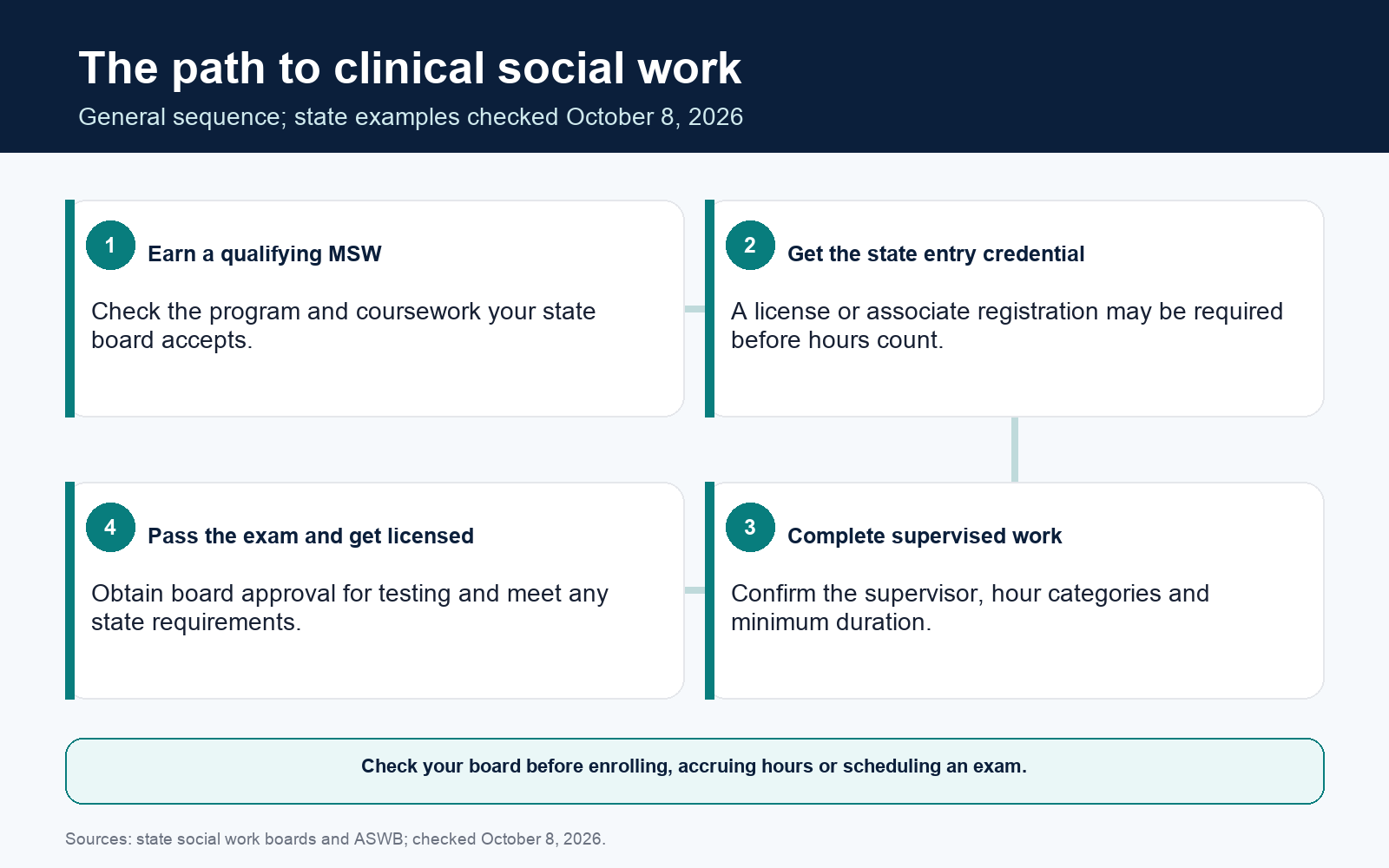
The path has four stages. The names of the licenses and the number of hours change from state to state, so always confirm with your state’s social work board before you plan your timeline.
1. Earn a social work degree from a CSWE-accredited program
The Council on Social Work Education (CSWE) accredits baccalaureate, master’s, practice doctorate, and post-master’s fellowship programs.
According to CSWE, most state and U.S. territory requirements stipulate that a social worker pursuing licensure or sitting for a licensing exam be a graduate of a CSWE-accredited program.
A Bachelor of Social Work (BSW) qualifies you for entry-level, non-clinical roles and, in some states, a bachelor’s-level license.
For mental health work, the MSW is the standard. Most MSW programs include a clinical or mental health concentration and supervised field placements, which are often the first place students work with clients in a mental health setting.
2. Get an entry-level license after graduation
Many states issue a master’s-level license, often called the LMSW or LSW, after you graduate and pass the ASWB Masters exam. A few states have dropped that exam; Illinois, for example, no longer requires it for the LSW.
Other states use a registration instead.
In California, MSW graduates register with the Board of Behavioral Sciences as an Associate Clinical Social Worker (ASW). Hours count only after registration, except under a 90-day rule for new graduates. In Florida, graduates register as a clinical social worker intern.
3. Complete supervised clinical experience
This is the longest stage. Two state examples show how much the details vary:
- Florida: two years of post-master’s supervised experience with 1,500 hours of face-to-face psychotherapy and at least 100 hours of supervision spread over at least 100 weeks. The MSW must include 24 semester hours (or 32 quarter hours) of clinically oriented coursework, including psychopathology. (Source: Florida Board of Clinical Social Work, Marriage & Family Therapy and Mental Health Counseling.)
- California: 3,000 hours of supervised experience over at least 104 weeks as a registered ASW. (Source: California Board of Behavioral Sciences.)
Ask employers whether they provide clinical supervision toward licensure and whether they pay for it, since outside supervision is an added cost if you have to arrange it yourself.
4. Pass the ASWB Clinical exam and apply for the clinical license
The Association of Social Work Boards (ASWB) offers licensing exams at several levels, including Bachelor’s, Masters, Advanced Generalist, and Clinical.
Each exam has 122 questions, 110 scored and 12 unscored, with a four-hour time limit, under the 2026 ASWB exam blueprint.
Most states use the Clinical exam for the LCSW or its equivalent, though Illinois, for example, has added an alternative path that combines an exam attempt with extra supervised experience. Some states add their own requirements on top.
California requires its Law and Ethics exam in addition to the ASWB Clinical exam. Florida requires an 8-hour laws and rules course, a 3-hour HIV/AIDS course, and a 2-hour domestic violence course.
The clinical license goes by different names, including LCSW, LICSW, and LCSW-C, but it means the same thing: you can diagnose, provide psychotherapy, and practice independently within your state’s rules.
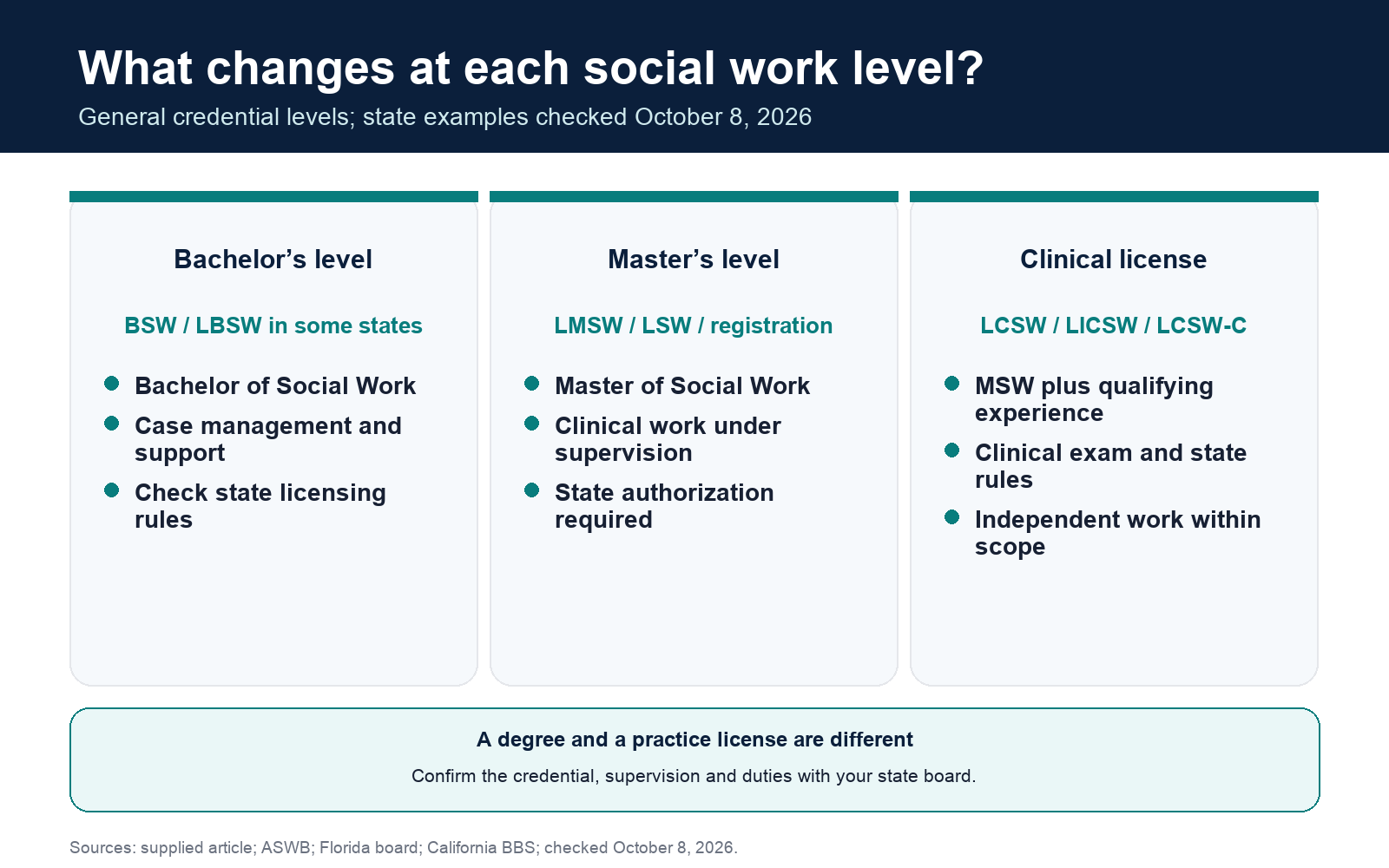
The license ladder at a glance
| Stage | Typical title | Degree | What you can do | Exam |
|---|---|---|---|---|
| Bachelor’s level | BSW, LBSW in some states | BSW | Case management and support roles | ASWB Bachelors, where licensed |
| Master’s level | LMSW, LSW, or a state registration | MSW | Assessment and therapy under supervision | ASWB Masters, in most states |
| Clinical | LCSW, LICSW, LCSW-C | MSW plus supervised hours | Diagnosis, psychotherapy, independent practice | ASWB Clinical, plus any state exams |
Titles and exam rules vary by state. Check your state social work board.
Mental health social worker salary
We report posted pay from our own board rather than survey estimates. On October 7, 2026, social worker listings with an annual salary looked like this:
| Listings | Count | Employers | Posted ranges |
|---|---|---|---|
| Clinical social worker (LCSW) | 8 | 4 | Midpoints from $72,500 to $100,540 |
| Master’s-level social worker (MSW, LSW) | 2 | 2 | $60,000 to $76,000 and $60,000 to $63,000 |
We report a median only when at least 10 listings from three or more employers stand behind it, so the table shows ranges instead. LifeStance Health posted four of the eight LCSW listings, so one employer’s pay bands shape them.
Two master’s-level listings can’t show a pattern, but both midpoints ($68,000 and $61,500) sat below the lowest LCSW midpoint.
Many LCSWs also apply to jobs we classify as counselor or therapist roles, which often accept the LCSW, LPC and LMFT alike. Those 88 salaried listings had a median posted range of $70,000 to $95,000 on the same date. We left out one listing whose posted range looked like a data entry error.
We also saw four contract (1099) autism evaluator listings open to LCSWs, all from one employer, that posted $80 to $95 an hour. Contract hourly rates don’t include benefits or paid time off, so we don’t compare them with salaried pay.
For a national view, our behavioral health social worker salary page uses BLS Occupational Employment and Wage Statistics data for May 2025. It lists a median of $60,280 for mental health and substance abuse social workers, with the middle 80% earning between $39,740 and $104,170.
State medians range from $39,930 in South Carolina to $79,380 in New York. The BLS figures include social workers at every license level and setting, which is one reason they sit below the LCSW postings on our board. Our healthcare social worker salary page covers medical settings.
Can you practice across state lines?
Not yet with a single license. The Social Work Licensure Compact has been enacted in 35 states, according to the compact’s July 7, 2026 update, but multistate licenses are not available yet.
The compact’s data system is estimated to be complete in spring 2027, and the commission has not announced a date when applications for multistate licenses will open.
Until then, a social worker who wants to see clients in another state, including by telehealth, needs a license in that state.
Our social work licensure compact guide tracks the details.
Mental health social worker vs counselor vs therapist
Clinical social workers, licensed counselors, and marriage and family therapists all provide psychotherapy, and employers often hire them for the same jobs.
Of 248 therapist listings on our board on October 7, 161 (65%) named the LCSW, and 66% named two or more license types. The main differences are training and focus.
Social work training puts more weight on the systems around a client, such as family, community, and access to services, which is why social workers are common in hospitals, community mental health, and care coordination roles.
See our guide to the differences between therapists, counselors, social workers, psychologists and psychiatrists.
FAQs on Mental Health Social Worker Roles
How long does it take to become a mental health social worker?
Plan on about eight years for a clinical license, often longer: a four-year bachelor’s degree, a two-year MSW, and roughly two more years of supervised work. Students with a BSW can sometimes finish the MSW in about a year through advanced standing. Hours and timelines vary by state.
Can you work in mental health with only a bachelor’s degree in social work?
Yes, in case management, intake, and support roles. Providing psychotherapy and diagnosing require a master’s degree and, for independent practice, a clinical license.
What’s the difference between an LMSW and an LCSW?
The LMSW, or your state’s equivalent, is the master’s-level license you can hold right after graduation. The LCSW is the clinical license you earn after supervised experience and the clinical exam. It allows independent clinical practice.
Do mental health social workers diagnose?
Licensed clinical social workers can diagnose mental health conditions within their state’s scope of practice. Social workers without a clinical license generally work under supervision.
Find mental health social worker jobs
BehavioralHealth.careers lists behavioral health jobs with posted pay wherever employers disclose it.
Search open LCSW jobs and social worker jobs to compare settings and supervision support. For pay benchmarks, see our salary pages by role.
Our content and salary data methods page explains how we collect and report pay.