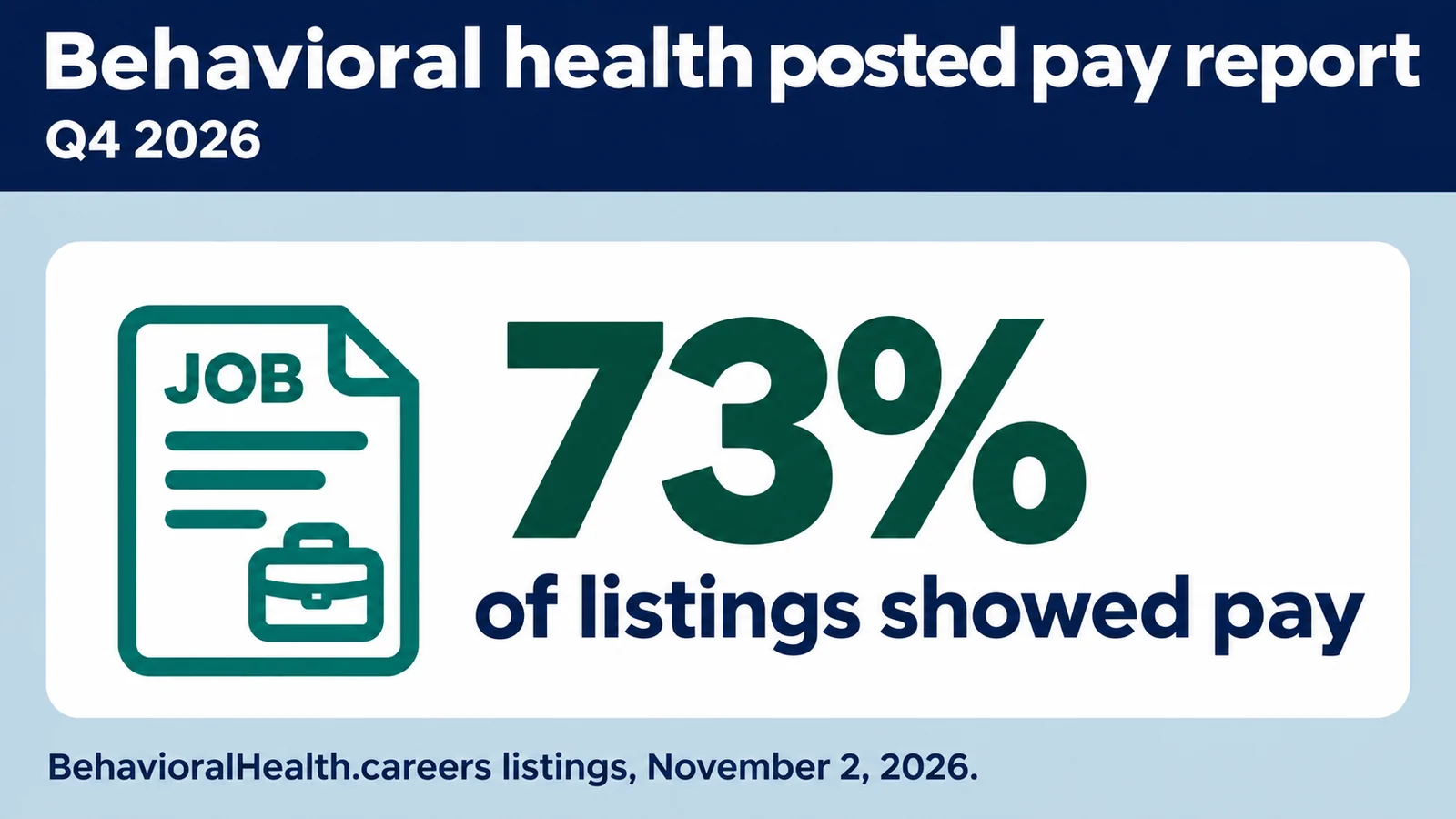
On November 2, 2026, 996 of the 1,364 live job listings on BehavioralHealth.careers, 73 percent, showed a pay range or rate.
This behavioral health salary report breaks that down: which employers post compensation, the median posted salary or hourly rate for each role, how wide the ranges run, and whether state pay transparency laws change behavior.
Unlike salary surveys of mental health professionals, it uses only pay that employers put in live job postings.
The short version: most behavioral health employers on our board post pay. Listings in states with a posting law showed pay more often, and employer mix may explain part of the difference.
This one-day snapshot can’t show whether the laws caused it.
The biggest gaps are in prescriber and psychiatrist roles, in remote telehealth listings, and at 13 employers whose listings had no pay we could capture.
The findings
- 73 percent of listings showed pay. That’s 996 of 1,364. Hourly pay (590 listings) outnumbered salaries (406).
- RBT roles post pay most often. 93 percent of RBT and behavior technician listings showed pay. Psychiatric nurse practitioner and physician assistant listings were lowest, at 45 percent.
- Most employers post pay on at least some jobs. 55 of 68 employers showed pay on at least one listing, and 25 showed it on every listing. For 13, we captured no pay on any listing.
- States with a posting law showed pay more often. 84 percent of listings in those states showed pay, against 64 percent in states without one. Take out the 13 employers with no captured pay anywhere, and the gap narrows to 88 percent against 75 percent.
- The typical multi-state employer posted at the same rate in both kinds of state. Of 23 employers with at least three listings in each, 10 posted pay on every listing in both, and 2 posted none anywhere. Six posted pay more often in law states and three more often elsewhere.
- Remote listings show pay less often. 56 percent of remote listings showed pay, against 78 percent of listings not marked remote.
- Most salary ranges are fairly tight. In the median salaried range, the top was 22 percent above the bottom.
How we measured
We read every published listing on BehavioralHealth.careers on November 2, 2026, through the site’s own data feed, with a forced fresh read so cached data couldn’t skew the counts. A listing counts as showing pay when it has a posted range or a single posted rate, in hours or years.
Most of that pay came from the job description itself. Employers’ structured pay fields supplied 153 figures. Almost all the rest, 838, came from pay stated in the description text, which our system reads conservatively. We count only hourly and annual pay our system can read.
Some listings state pay in other forms, such as a per-session fee, a base salary plus incentives, or a sign-on bonus alone, and a few state it in plain forms our system currently misses.
Of the 368 listings without captured pay, 174 mention a dollar figure somewhere in the text, so the share of listings that state some pay is higher than 73 percent.
Employers are counted by company, so a company with separate hiring feeds for different roles counts once. Role groups come from the role tag on each listing. We report a median only when at least 10 listings from at least three employers stand behind it.
Our content and salary data methods page explains the approach in full.
The board leans toward outpatient, telehealth and ABA employers that post jobs through applicant tracking systems. These figures describe that market, not every behavioral health employer in the country.
Median posted salary and hourly pay by role
| Role | Median posted range | Listings (n) | Employers |
|---|---|---|---|
| Registered Behavior Technicians and behavior technicians | $20 to $25 an hour | 307 | 13 |
| Behavioral and mental health technicians | $18 to $22 an hour | 41 | 8 |
| Care coordination, case management and intake | $23 to $24.95 an hour | 20 | 8 |
| Therapists, counselors and clinical social workers (salaried) | $63,800 to $97,800 a year | 146 | 21 |
| Therapists, counselors and clinical social workers (hourly) | $40 to $49.56 an hour | 133 | 18 |
| BCBAs and BCaBAs (salaried) | $85,000 to $102,000 a year | 48 | 8 |
| BCBAs and BCaBAs (hourly) | $65 to $75 an hour | 11 | 3 |
| Licensed psychologists | $111,000 to $144,000 a year | 15 | 4 |
| Psychiatric nurse practitioners and physician assistants | $151,000 to $177,500 a year | 62 | 10 |
| Psychiatrists | $300,000 to $357,995 a year | 34 | 5 |
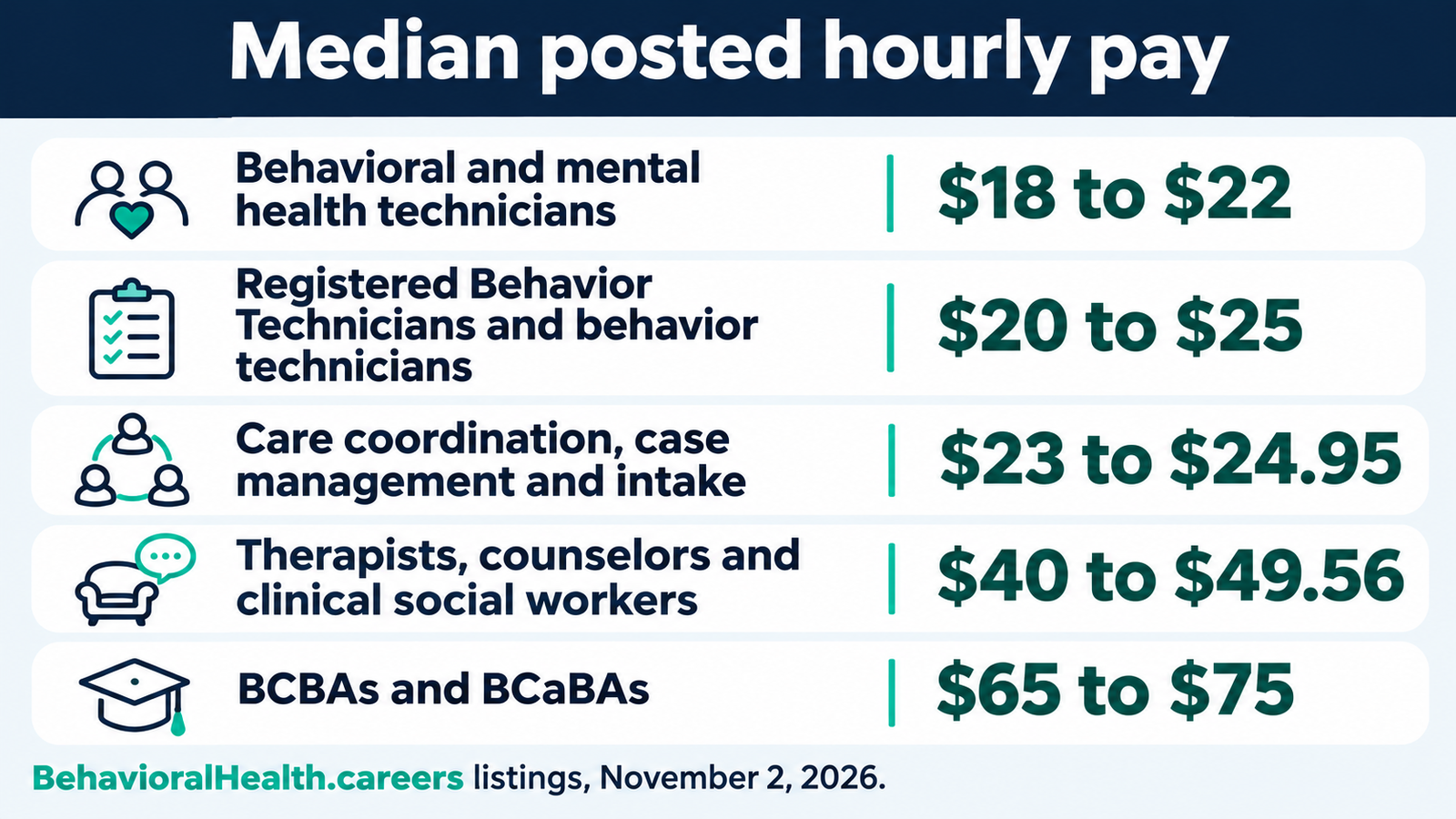
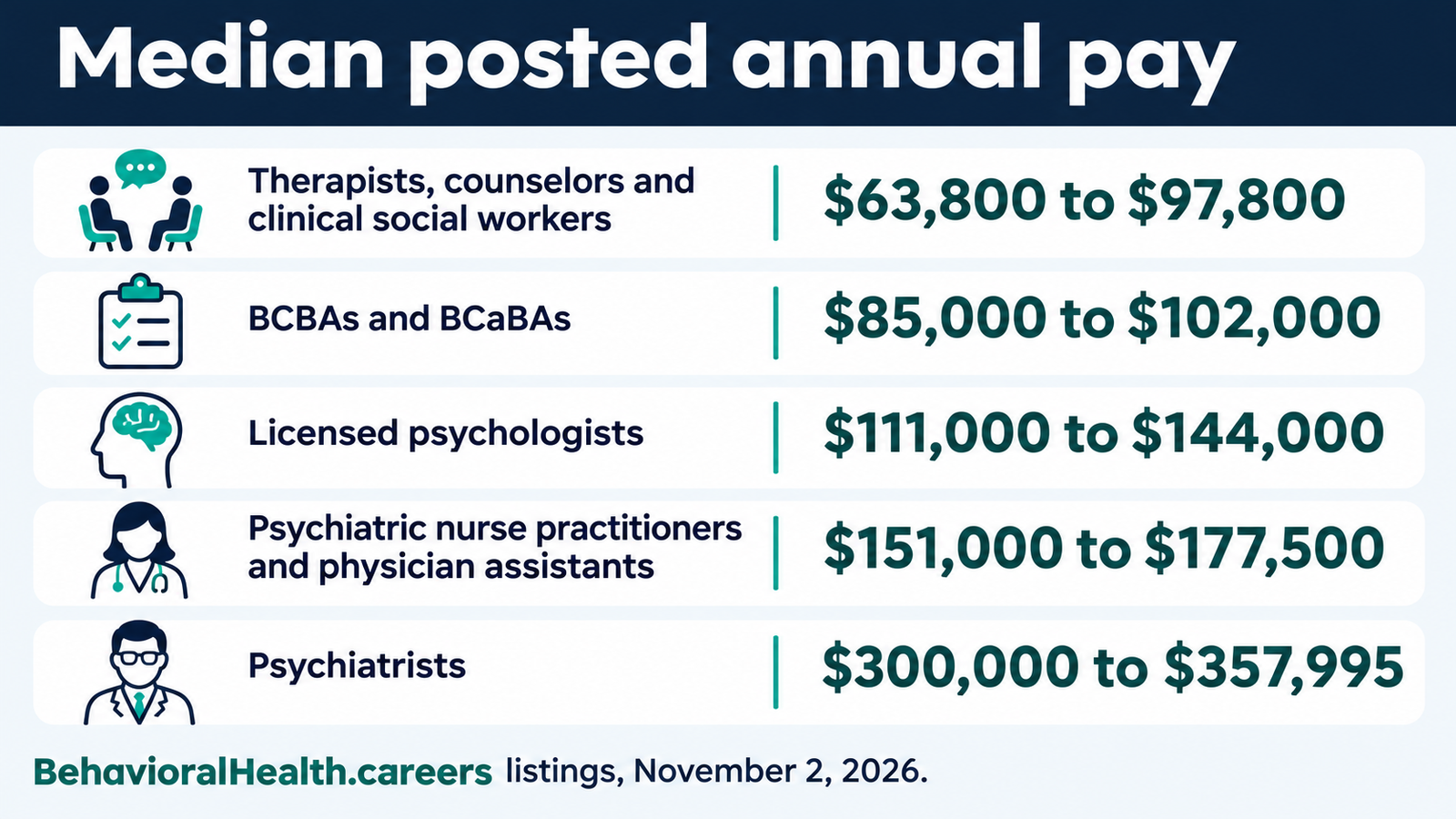
Source: BehavioralHealth.careers live listings, November 2, 2026. Median of posted minimums to median of posted maximums; the two medians are calculated separately. We report medians, not averages, so a few very high or low postings don’t pull the figures. The salaried BCBA figure leaves out one employer whose stored pay doesn’t match the pay stated in its own listings; with it included, the median is $90,000 to $102,000.
A few figures lean on one employer. LifeStance Health posted 18 of the 34 salaried psychiatrist listings and 10 of the 15 psychologist listings. Two telehealth companies, Talkspace and Hazel Health, posted 61 of the 133 hourly therapist listings with pay, all as single rates, and one ABA provider posted 7 of the 11 hourly BCBA listings.
Peer support had too few listings with pay to report a median. Five employers posted hourly nurse pay, but LPN and RN rates sit too far apart for one median to mean much: from about $30 an hour for Denver roles open to LPNs and RNs to $63 to $75 for inpatient RNs in Santa Rosa, California.
Posted ranges show what employers plan to offer at hire, not what mental health counselors, therapists and other professionals earn after a few years in a role. For national annual salary survey data by role and state, see our salary pages.
Our ranking of mental health careers by posted pay puts these roles side by side.
Which roles show pay, and which don’t
| Role | Listings | Showed pay | Share |
|---|---|---|---|
| RBTs and behavior technicians | 352 | 326 | 93% |
| Licensed psychologists | 24 | 20 | 83% |
| Behavioral and mental health technicians | 81 | 59 | 73% |
| Therapists, counselors and social workers | 385 | 279 | 72% |
| BCBAs and BCaBAs | 101 | 72 | 71% |
| Care coordination, case management and intake | 45 | 26 | 58% |
| Psychiatrists | 79 | 43 | 54% |
| Nurses (RN, LPN and LVN) | 27 | 14 | 52% |
| Psychiatric nurse practitioners and physician assistants | 149 | 67 | 45% |
Roles with fewer than 20 listings, and a catch-all “other” group, are left out of this table.
Groups here follow the role tag on each listing. Articles that group roles by job title will show slightly different counts.
ABA employers mostly post pay, though one ABA employer posted no pay on any of its 25 BCBA listings. The largest gaps sit in prescriber and psychiatrist jobs. One telehealth company accounts for 43 of the 82 nurse practitioner and physician assistant listings without a captured range; its listings describe per-session pay, which we don’t count as a posted range.
Another employer’s nine nurse practitioner listings state an annual salary our system missed, so the true share in that group is closer to half.
Employers whose listings had no pay we could capture
Of the 68 employers with live listings, 55 showed pay on at least one listing. Twenty-five showed pay on every listing they posted. For 13, we captured no pay on any listing.
Six of the 13 are psychiatric hospitals in Texas and Nevada. Four are telehealth companies. The rest are an addiction treatment provider and two ABA providers.
Some of them describe pay in ways our system doesn’t count as a posted range, such as a base salary with incentives or a per-session fee. Others give no pay information at all.
Do pay transparency laws make a difference?
Listings in states with a posting law showed pay more often, and employer mix may explain part of the difference. A one-day snapshot like this one can’t show whether the laws caused it.
We grouped listings by the state named in their location and compared states with a posting law in force on November 2, 2026, with states without one.
Listings that named no state, mostly remote roles, were left out. The groups describe the state named in the listing. Coverage for a particular employer or posting depends on the applicable law.
| Group | Listings | Showed pay | Share |
|---|---|---|---|
| States with a posting law | 583 | 490 | 84% |
| States without a posting law | 606 | 386 | 64% |
| States with a posting law, excluding the 13 employers with no captured pay anywhere | 554 | 490 | 88% |
| States without a posting law, excluding the same 13 employers | 516 | 386 | 75% |
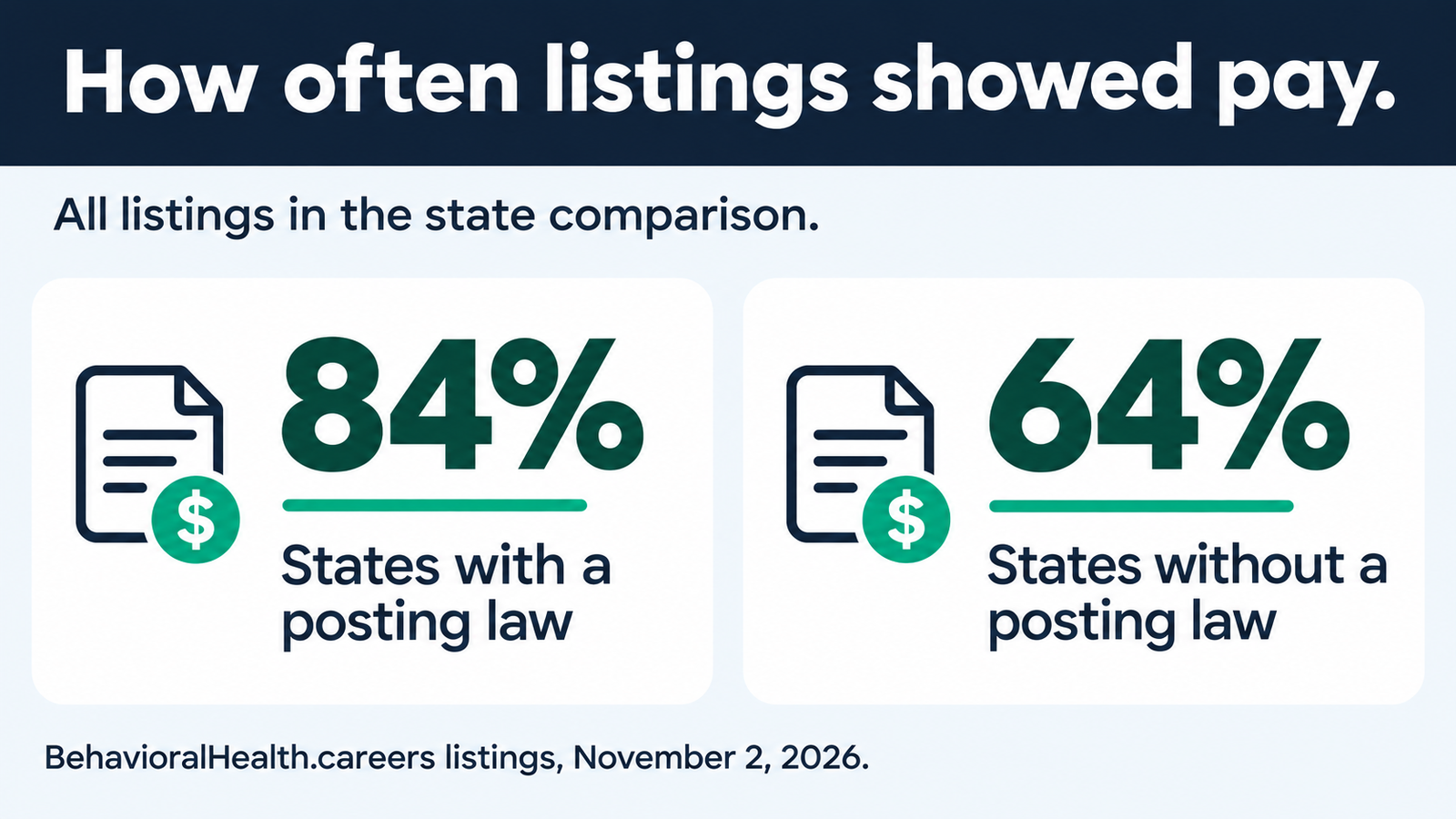
Part of the gap comes from the 13 employers with no captured pay on any listing. Most of their listings are in states without a posting law, including 47 from six psychiatric hospitals in Texas and Nevada. Take those 13 out of both groups, and a gap of about 14 points remains.
The clearest test is employers that hire in both kinds of state. Twenty-three employers had at least three listings in each. The typical one posted pay at the same rate in both: 10 posted pay on every listing in both kinds of state, and 2 posted none anywhere. Six posted pay more often in law states, and three more often elsewhere.
Pooled, their listings showed pay 82 percent of the time in states with a law (333 of 405) and 74 percent in states without one (309 of 415), and part of that pooled gap reflects where each employer’s listings happen to be.
Other differences between the two groups could explain some of what remains. Remote listings, which show pay less often, make up 23 percent of listings in states without a posting law and 14 percent in states with one. Employer and role mix differ too. The snapshot does not establish how much each factor contributed to the gap. Posting laws now apply in six of the ten states with the most listings on our board.
Our guide to behavioral health pay transparency laws by state lists the current requirements.
Remote listings show pay less often
Among the 335 remote listings (marked remote by the employer or with remote, virtual or telehealth in the title), 189 showed pay, or 56 percent. Listings not marked remote showed pay 78 percent of the time (807 of 1,029). Two telehealth employers account for 87 of the 146 remote listings without a captured range, and both describe pay in forms we don’t count, such as per-session fees or base pay plus incentives.
For remote job seekers, that means asking about pay early matters more.
Our remote behavioral health jobs guide covers what remote roles post.
How wide the ranges run
Most posted ranges are narrow enough to be useful. Across 402 salaried ranges, the median top was 22 percent above the bottom, about $80,000 to $97,800 on an $80,000 base. Hourly ranges ran a little wider, with the median top 29 percent above the bottom across 403 ranges.
About one salaried range in six (69 of 402) had a top at least 1.5 times its bottom. Wide ranges can reflect several license levels or experience bands in one posting, but they tell a candidate less.
Another 191 listings posted a single figure instead of a range, mostly for therapist and RBT jobs.
What this means for employers
- Posting pay is the norm in this field. Nearly three in four listings on our board show it. A posting without pay stands out, and not in a good way.
- Keep the range honest. A median range on our board runs about 22 percent from bottom to top. If yours runs far wider, say what moves someone through it, such as license level or years of experience.
- Post the same way everywhere. Ten of the 23 multi-state employers on our board post pay on every listing in both groups of states. A consistent pay-disclosure policy can simplify posting, while location-specific rules can still require benefits, application details or other disclosures.
- Prescriber, psychiatrist and remote roles are where you can stand out. These are the categories where candidates see pay least often.
Our staffing agencies vs direct hiring guide covers how pay in a posting affects direct hiring.
What this means for job seekers
Most listings on our board show pay, so you can compare offers before you apply. When a listing doesn’t, ask for the range early.
In states with a posting or disclosure law, you may be entitled to it. Use the role medians above as a starting benchmark, and remember that one employer can shape a figure.
Frequently asked questions
What share of behavioral health job postings include pay?
On BehavioralHealth.careers on November 2, 2026, 73 percent of live listings (996 of 1,364) showed a pay range or rate. For comparison, Indeed reported that 59 percent of all U.S. job postings on its site included pay in May 2025 (Indeed). Our board covers one field and a narrower set of employers, so the two figures aren’t directly comparable.
Which behavioral health jobs are most likely to show pay?
RBT and behavior technician jobs, at 93 percent, followed by licensed psychologist jobs at 83 percent. Psychiatric nurse practitioner and physician assistant jobs were least likely, at 45 percent.
Do employers post pay only where the law requires it?
Most don’t. Of 23 employers hiring in states with and without posting laws, 10 posted pay on every listing in both, and the typical one posted at the same rate in both. Across all listings, states with a posting law showed pay more often, 84 percent against 64 percent, and employer mix may explain part of that difference.
How often is this report updated?
Quarterly. The next edition will use a January 2027 read of the board.
Sources
- BehavioralHealth.careers live listings, read November 2, 2026 (1,364 published listings).
- Indeed, Pay transparency across high-earning sectors, 2025.
- State posting laws in force on November 2, 2026, as listed in our pay transparency laws by state guide: California, Colorado, Connecticut, the District of Columbia, Hawaii, Illinois, Maine, Maryland, Massachusetts, Minnesota, New Jersey, New York, Vermont, Virginia and Washington.