This US-only guide is for job seekers and career changers who want a clear, practical comparison of common behavioral health roles.
It’s also useful for employers who want consistent language for job posts.
Titles, scope of practice, and licensure requirements vary by state and by employer, so always verify details with your state licensing board and the specific job description.
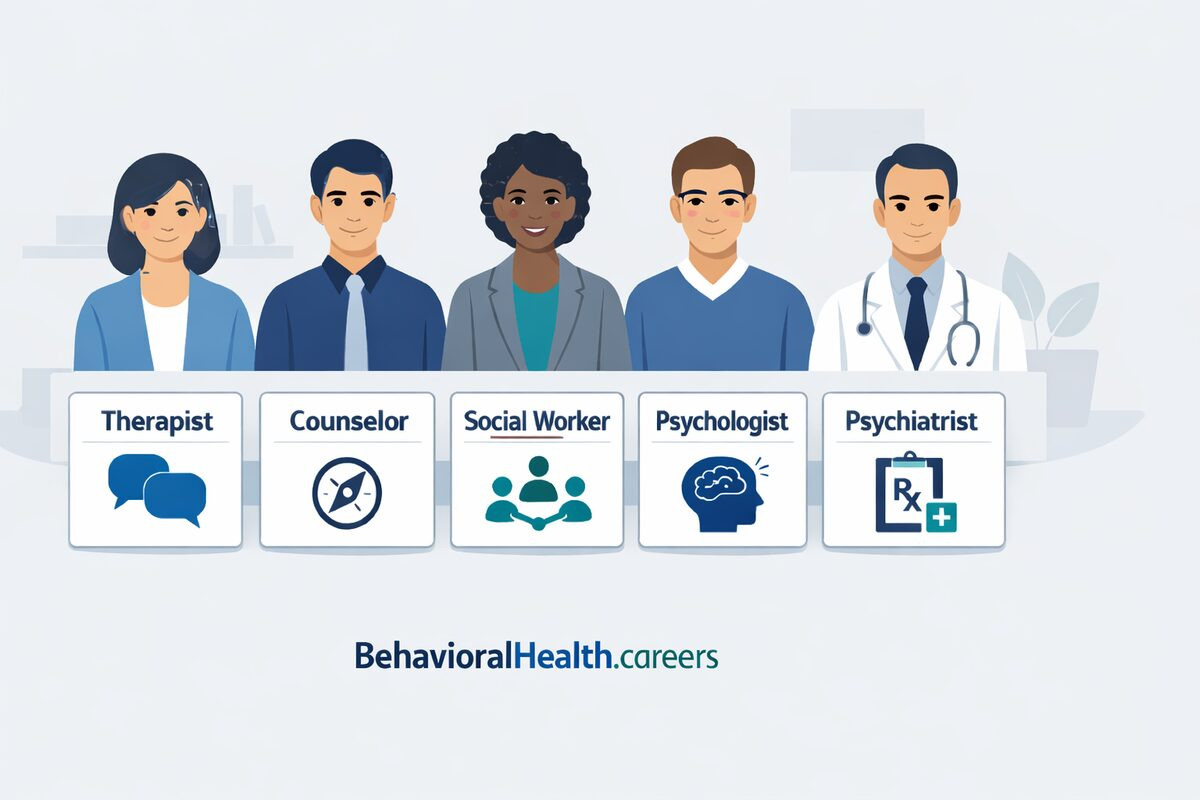
At-a-glance cheat sheet
- Therapist: An umbrella term for mental health professionals who provide talk therapy. Therapists may hold licenses such as licensed professional counselor (LPC), licensed clinical psychologist, or licensed clinical social worker (LCSW), each qualified to diagnose and treat mental illness.
- Counselor: Typically a licensed master’s-level mental health professional focused on counseling and psychotherapy. Many are licensed professional counselors (LPCs) who can diagnose and treat mental illness in various settings.
- Social worker: Trained in systems, resources, and advocacy. A licensed clinical social worker (LCSW) is a mental health professional who can provide therapy and treat mental illness in medical, private practice, or group settings.
- Psychologist: Usually a doctoral-trained mental health professional. A licensed clinical psychologist can diagnose and treat mental illness, provide therapy, and perform psychological testing and assessment, but typically cannot prescribe medication.
- Psychiatrist: A medical doctor (MD or DO) specializing in mental health. Psychiatrists are mental health professionals with medical training who can diagnose, treat, and prescribe medication for mental illness, and may also provide psychotherapy.
Quick overview
A “therapist” is often an umbrella title for licensed clinicians who provide talk therapy. Counselors typically hold counseling licenses (like LPC or LMHC). Social workers may provide therapy (often as LCSWs) and also coordinate services.
Psychologists usually have doctoral training and may do assessment plus therapy, but are not medical doctors.
Psychiatrists are medical doctors (MD or DO) with specialized training in mental illness who can diagnose, treat, and prescribe medication for mental health conditions. Titles and scopes vary by state.
Definitions in plain English
Therapist
- “Therapist” usually describes someone providing psychotherapy, not a single license.
- Therapists may be licensed mental health professionals at the masters level or doctoral level, including licensed professional counselors (LPC), licensed clinical psychologists, and licensed clinical social workers (LCSW).
- In job ads, it may refer to counselors, clinical social workers, psychologists, or marriage and family therapists.
- The key question: What license and scope does the role require?
Counselor (LPC/LMHC/LCPC and related)
- Counselors are typically masters level clinicians who have completed graduate school in counseling or a related field.
- License titles commonly include Licensed Professional Counselor (LPC), Licensed Mental Health Counselor (LMHC), Licensed Clinical Professional Counselor (LCPC), or similar (state-dependent).
- Counseling is often therapy based and focused on specific treatment methods to address mental health issues and support clients.
- School counselors are a distinct path, working in K-12 educational settings to provide academic, career, and personal support to students.
- Often works in outpatient clinics, community programs, schools, and group practices.
Social worker (BSW/MSW and clinical LCSW)
- A profession focused on individuals and systems (resources, access, policy, family and community context), often emphasizing social justice and advocacy.
- Clinical social workers hold a degree in social work (MSW) and may become licensed clinical social workers (LCSW) to provide therapy and treat mental illness.
- Non-clinical social work roles may emphasize case management, care coordination, and community services.
Psychologist (PhD/PsyD)
- Psychologists complete graduate school at the doctoral level (PhD or PsyD).
- May become licensed clinical psychologists, with specializations such as clinical psychology or forensic psychology.
- Clinical psychologists diagnose and treat mental health disorders, provide therapy, and use a variety of treatment methods, including psychological testing and assessment (depending on role and setting).
- Licensure and allowed activities vary by state and job type.
Psychiatrist (MD/DO)
- A psychiatrist is a medical doctor (MD) or doctor of osteopathic medicine (DO) specializing in mental illness and mental health disorders.
- Can prescribe medication and may provide psychotherapy, consultation, and care coordination.
- May pursue additional training in subspecialties such as addiction psychiatry.
- Psychiatrists often collaborate with other mental health professionals, including social workers, psychologists, and counselors, to provide comprehensive care.
- Works in hospitals, clinics, community settings, and private practice (among others).
What “licensed” means and why it varies
- “Licensed” generally means the state has granted legal permission to practice a profession under a defined scope.
- Being a licensed clinical or licensed mental health professional indicates advanced training, supervised experience, and the ability to diagnose and treat mental health disorders and mental illness.
- Requirements differ across states (education, supervised hours, exams, background checks, and renewal rules).
- Employers may add requirements (specific populations, settings, documentation standards, certifications, or experience).
What each mental health professional does day to day: real-world, non-clinical detail
Therapist as an umbrella title in many settings
Common responsibilities
- Conduct intakes and ongoing sessions (per role and setting)
- Offer psychotherapy using various forms of treatment methods, such as cognitive therapy, behavioral therapy, group therapy, integrative or holistic therapy, psychoanalytic or psychodynamic therapies, and humanistic therapy
- Document sessions and maintain clinical records
- Coordinate with a care team (with appropriate permissions)
- Support treatment planning and goal tracking
Types of therapy offered:
- Cognitive therapy: Focuses on a person's thoughts, helping them recognize and change unhealthy thinking patterns.
- Behavioral therapy: Targets learning and behavior, using techniques like reward and punishment to change unhealthy behaviors.
- Group therapy: Involves one or more behavioral providers leading a group of patients to address specific issues, such as substance abuse.
- Integrative or holistic therapy: Combines multiple approaches to therapy based on the client's individual needs.
- Psychoanalytic or psychodynamic therapies: Help individuals understand unconscious issues and conflicts that affect their lives.
- Humanistic therapy: Based on the belief that people can make rational choices and develop their maximum potential, often using a client-centered approach.
Common populations/settings
- Outpatient mental health
- Community-based programs
- Schools, college counseling, or workplace programs (varies)
- Specialty clinics (trauma, substance use services, family work, etc.)
What employers often screen for
- Required license (and good standing)
- Setting-specific experience (school-based, community mental health, inpatient, etc.)
- Documentation comfort (EHR proficiency)
- Ability to work with a team and follow policies
Counselor
Common responsibilities
- Provide counseling, including individual, group, couples, or family therapy (based on training and job scope)
- Maintain treatment plans and progress notes
- Coordinate referrals and community supports
- Participate in supervision/consultation (especially early-career)
Counseling focuses on specific issues and is designed to help a person address a particular problem, such as addiction or stress management.
Counselors and therapists typically hold master's degrees and focus on goal-oriented talk therapy for emotional or relationship issues.
Common populations/settings
- Outpatient clinics and group practices
- Community mental health and nonprofit agencies
- Employee assistance programs (EAP) and telehealth providers
- Schools or college settings (role-dependent)
What employers often screen for
- Master’s degree in counseling or related field (as required)
- License status (associate, provisional, fully licensed, varies by state)
- Supervised experience hours toward full licensure (where relevant)
- Professional boundaries, reliability, and documentation quality
Social worker
Common responsibilities
- Assess needs across clinical and social factors (housing, benefits, safety, supports)
- Coordinate services and referrals
- Provide therapy if clinically licensed and the role includes it, including delivering mental health services to address mental health problems and mental health challenges
- Work with interdisciplinary teams and community partners
Common populations/settings
- Hospitals and integrated care settings
- Child welfare, schools, and community agencies
- Government agencies and community programs
- Behavioral health clinics and crisis programs (varies)
What employers often screen for
- Degree level (BSW/MSW) aligned to the role
- Licensure level (and clinical licensure if therapy is required)
- Care coordination experience and resource navigation
- Strong documentation and communication across teams
Psychologist
Common responsibilities
- Diagnose and treat mental disorders and mental health issues
- Provide psychotherapy (when part of the job)
- Administer and interpret assessments/testing (when required)
- Write evaluation reports and share findings appropriately
- Consult with care teams, schools, or organizations
Common populations/settings
- Private practice and specialty clinics
- Hospitals and integrated care
- Schools (school psychology roles)
- Academic and research-affiliated settings (role-dependent)
- Government agencies
- Criminal justice settings (forensic psychology roles)
What employers often screen for
- Doctoral degree and psychologist licensure
- Assessment/testing competencies if the job requires them
- Report writing and case conceptualization skills
- Experience with specific populations (pediatrics, adult, neuropsych, etc.)
Psychiatrist
Common responsibilities
- Diagnose and treat mental health disorders and mental illness
- Treat patients directly in various settings
- Perform medical procedures, including writing prescriptions for psychiatric medications
- Manage medications and monitor response and safety
- Coordinate with therapy providers and primary care
- Provide consultation in hospitals, clinics, or crisis settings
- May pursue additional training in subspecialties such as addiction psychiatry
A collaborative approach between a psychiatrist and a psychologist or counselor can enhance treatment outcomes, as is the basis for the Collaborative Care Model for Mental Health, a framework increasingly seen in larger treatment settings.
Common populations/settings
- Inpatient psychiatry, emergency, consult-liaison
- Outpatient psychiatry clinics
- Community mental health and integrated care
- Private practice and telepsychiatry (varies)
What employers often screen for
- Medical license, training, and credentialing fit for the setting
- Comfort with high-acuity environments (if applicable)
- Collaboration style with therapy teams
- Documentation, compliance, and risk management practices
Education and training timeline comparison
Below are common patterns. Many mental health professionals complete graduate school at the master's or doctoral level, depending on their role.
Some positions, such as therapists and counselors, typically require a master's degree and are considered Master's level providers, while psychologists usually hold a doctoral degree.
Specialized training or additional training may be required for certain roles or subspecialties, such as psychiatrists who complete medical school and further residency or fellowship training.
Specific credit requirements, supervised-hour totals, and exam rules vary by state.
Therapist: umbrella for various types of therapist
- Typical degrees: Therapists are often licensed mental health professionals who have completed graduate school at the Masters level (such as an MA, MS, MSW, or MFT) or higher (sometimes doctoral).
- Supervised hours: Common for independent practice (varies widely)
- Exams/background checks: Often required for licensure and employment (state/employer dependent) for both traditional and remote therapist jobs.
Counselor
- Typical degrees: Counselors are typically masters level clinicians who earn a master's degree in counseling or a related field. After completing additional supervised training, they may become licensed professional counselors (LPCs) or licensed mental health counselors (LMHCs).
- Supervised hours: Commonly required after graduation, before independent licensure
- Exams/background checks: Typically includes a licensing exam and employer screening
Social worker
- Typical degrees: Social workers earn a degree in social work (BSW for many entry roles; MSW for clinical roles and many advanced jobs). For clinical positions, they may become a licensed clinical social worker (LCSW) or licensed clinical social professional, which allows them to provide therapy in medical settings, private practice, or group practices.
- Supervised hours: Typically required for clinical licensure
- Exams/background checks: Often includes a licensing exam; employment screening varies
Psychologist
- Typical degrees: Usually doctoral (PhD/PsyD), often plus internship and supervised practice. Psychologists may become licensed clinical psychologists, specializing in clinical psychology, which focuses on assessment and treatment of mental health disorders, or in areas such as forensic psychology, which applies psychological principles to legal and criminal justice settings.
- Supervised hours: Commonly required for licensure
- Exams/background checks: Licensing exams and employer checks vary by state/setting
Psychiatrist
- Typical degrees: Medical school (MD/DO) followed by residency in psychiatry; psychiatrists are medical doctors with specialized training in mental health.
- Training structure: Residency is multi-year and specialty-based; psychiatrists may pursue additional training or specialized training through fellowships in subspecialties such as addiction psychiatry, child and adolescent psychiatry, or geriatric psychiatry.
- Licensure/credentialing: Physician licensure and employer credentialing requirements apply
Which path fits best: support for self-selection
Strengths and preferences to consider
- You enjoy relationship-based, ongoing talk therapy: counselor or clinically licensed therapist path (license-dependent)
- You care about systems, access, and community resources: social work (especially MSW) is often a strong match
- You like testing, measurement, and formal assessment: psychologist roles often emphasize assessment more than other paths
- You want a medical model and prescribing scope: psychiatry is the most medical pathway
- You want flexibility across settings and roles: social work can be highly versatile; counseling can be very direct-care focused
- You want research and academic options: doctoral psychology roles may offer more research-heavy opportunities (role-dependent)
Simple decision map: if you like X, consider Y
- If you want to start working quickly, consider behavioral health technician, intake, or peer support, then plan your degree path.
- If you want therapy as your core job and prefer a master’s route, consider counseling licensure (titles vary by state).
- If you want therapy plus systems and resource navigation, consider MSW to clinical social work.
- If you want to specialize in assessment/testing, consider doctoral psychology.
- If you want medical training and prescribing, consider psychiatry (MD/DO).
Common myths and misunderstandings about mental health occupations
- Myth: “Therapist and psychologist are the same.”
Reality: “Therapist” is often a general title; psychologists are typically doctoral-trained and may do assessment/testing depending on role.
- Myth: “Counselor is not a licensed clinician.”
Reality: Many counselors are licensed clinicians, but license names and scopes vary by state.
- Myth: “Social workers only do case management.”
Reality: Many social workers do care coordination, and clinically licensed social workers can also provide therapy.
- Myth: “You need a PhD to do therapy.”
Reality: Many therapists are master’s-level licensed clinicians (depending on state and role).
- Myth: “Psychiatrists only prescribe.”
Reality: Many psychiatrists focus on medication management, but training can include psychotherapy and consultative work; role varies by setting.
- Myth: “Any master’s degree lets you become licensed.”
Reality: States and boards often specify program content, practicum/internship requirements, and exams.
- Myth: “Licensure is the same nationwide.”
Reality: Licensure titles, supervised hours, and scopes vary by state. Always verify with your state board.
- Myth: “Job titles tell you the scope of practice.”
Reality: Two jobs with the same title can require different licenses and duties depending on the employer and state.
- Myth: “Telehealth means fewer rules.”
Reality: Telehealth practice still depends on state licensure, employer policy, and payer requirements.
Pay and job outlook
Pay and demand vary widely by role, setting, geography, and licensure level. Common drivers include:
- Setting: hospital vs outpatient vs community programs
- Geography: regional cost of living and local demand
- Licensure level: associate vs independently licensed vs leadership roles
- Specialization and population served: employer needs and role complexity
- Schedule and coverage: evenings, weekends, and shift differentials in some settings
- Payer mix and employer type: nonprofit, health system, private practice, government, and contractor models
For outlook and national pay summaries, use the Occupational Outlook Handbook as a starting point, then compare with job postings in your target state and setting.
How to choose your next step: a practical plan
- Pick a target role and setting (example: outpatient counseling, hospital social work, school psychology).
- Verify state requirements using your state licensing board website and a few real job postings.
- Choose an entry job now if you need experience while you plan school (intake, tech roles, peer support, care coordination support).
- Map your education path and timeline (degree, practicum/internship, supervision steps).
- Build experience in the target setting (volunteer, internship, part-time role, or relevant support job).
- Reassess after 90 days based on what you enjoyed, what employers require, and your long-term goals.
Related career pathways inside BehavioralHealth.careers
If you want to go deeper, explore these guides on BehavioralHealth.careers:
- Careers in Behavioral Health
- Mental Health Counselor Career Guide
- LCSW Career Guide
- Behavioral Health Nurse Career Guide
- Peer Support Specialist Career Guide
- Behavioral Health Technician vs Mental Health Technician vs Psych Aide
- Behavioral Health Case Manager and Care Coordinator Career Guide
- Intake Coordinator and Admissions Specialist Career Guide
- Therapist Onboarding Checklist (for employers and clinical leaders)
- The Rise of the Geropsychiatrist
- Mental Health Coach vs Behavioral Health Coach vs Therapist roles
FAQs
Is a counselor the same as a therapist?
Often, counselors are therapists in the general sense because they provide psychotherapy. The difference is usually the specific license and scope required by the state and employer.
What’s the difference between an LCSW and a counselor?
An LCSW is a clinically licensed social worker, with training that often emphasizes systems and services plus therapy. A counselor typically follows a counseling licensure path focused on psychotherapy. Exact scope varies by state.
Can psychologists prescribe medication?
Generally, no. Prescribing is typically within medical practice, such as psychiatry. If you are researching a specific state, verify rules with that state’s psychology board.
Do psychiatrists do therapy?
Some do, but many roles emphasize evaluation and medication management. The mix depends on the practice setting and how the role is structured.
What degree do I need to become a therapist?
It depends on the underlying license the employer requires. Many therapy roles require a master’s degree and licensure, while others may require doctoral training.
What’s the fastest way to start working in behavioral health?
Common faster-entry roles include behavioral health technician, intake/admissions support, peer support, and care coordination support. Requirements vary by state and employer.
Which role does the most assessment work?
Psychologists often have the strongest focus on formal assessment and testing, depending on the role.
Which role is most medical?
Psychiatry is the most medical pathway because psychiatrists are physicians (MD/DO) and can prescribe.
Which role is most community and systems oriented?
Social work roles often emphasize systems, resources, and coordination across services, especially in hospitals and community settings.
Can these roles work via telehealth?
Many can, depending on state licensure rules, employer policies, and payer requirements. Telehealth does not remove licensing or documentation requirements.
How long does each path take?
Timelines vary. Counseling and clinical social work often require a master’s plus supervised experience for independent licensure. Psychology typically requires doctoral training. Psychiatry requires medical school plus residency.
What should I ask in an informational interview?
Ask about day-to-day workload, documentation expectations, supervision support, typical career progression, and what licenses or experiences are most valued in that setting.
What should employers include in job posts to reduce confusion?
Specify required license (and state), accepted equivalents, supervision offered, primary setting, expected caseload, documentation expectations, and the pay range.
References and Resources
- BLS Occupational Outlook Handbook: Substance Abuse, Behavioral Disorder, and Mental Health Counselors. (Bureau of Labor Statistics)
- BLS Occupational Outlook Handbook: Social Workers. (Bureau of Labor Statistics)
- BLS Occupational Outlook Handbook: Psychologists. (Bureau of Labor Statistics)
- BLS Occupational Outlook Handbook: Physicians and Surgeons (licensure, medical school, residency). (Bureau of Labor Statistics)
- American Psychiatric Association: What is Psychiatry? (American Psychiatric Association)
- ACGME Program Requirements: Psychiatry (program length and training framework). (acgme.org)