
A psychology degree opens different doors at each level, and the pay gap between them is large.
On BehavioralHealth.careers in October 2026, jobs open to a bachelor’s in psychology, such as behavior technician, behavioral health technician and case manager, posted median ranges of about $18 to $25 an hour.
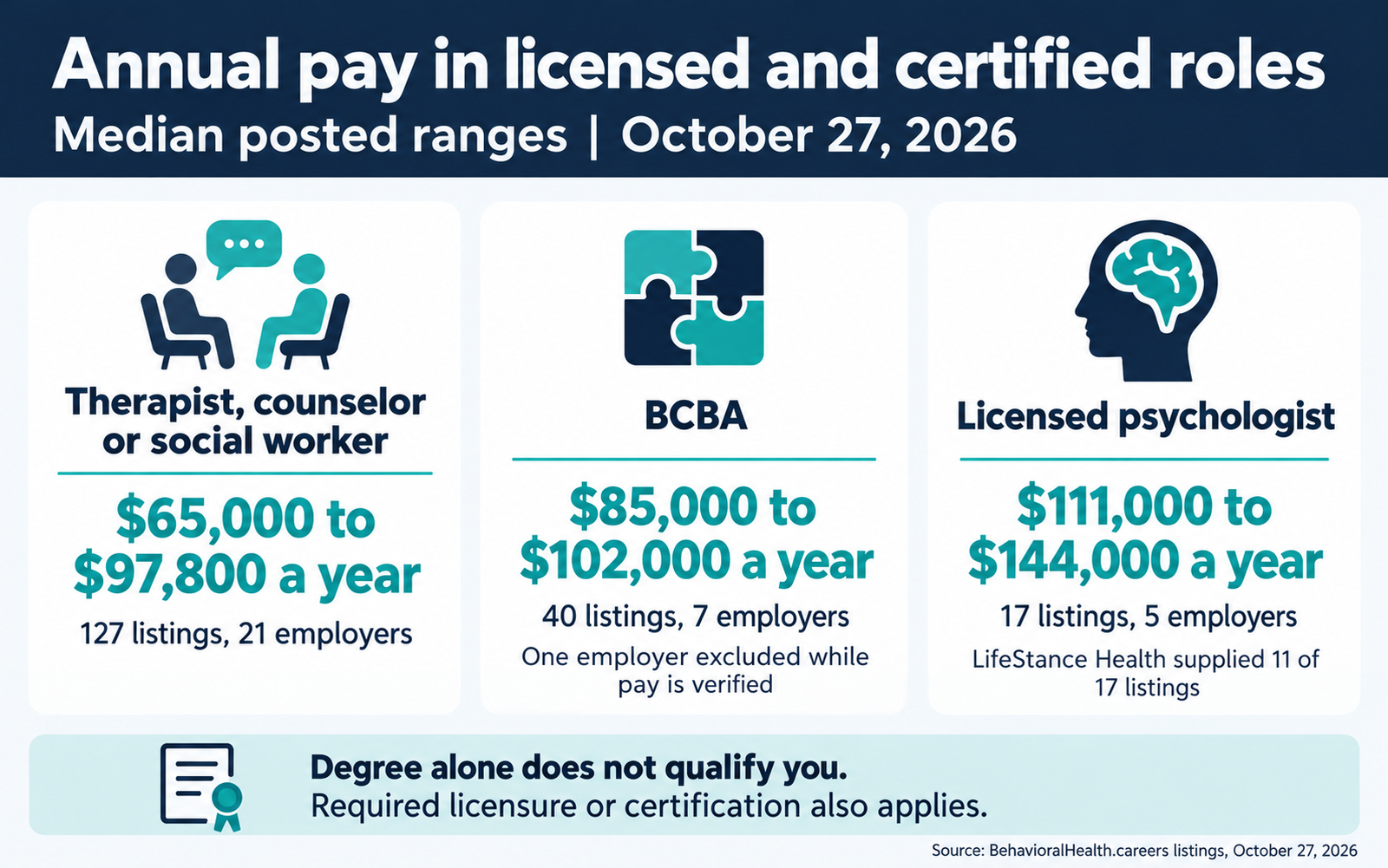
Therapist, counselor and social worker roles, which need a master’s degree, posted a median of $65,000 to $97,800 a year. Psychologist roles, which need a doctorate and a license, posted $111,000 to $144,000, in a small sample led by one employer.
This guide covers what behavioral health employers actually ask for at each degree level, what they pay, and how often the listings name psychology at all.
Every pay figure comes from live job postings on our board, read on October 27, 2026.
Jobs with a psychology degree at a glance
| Degree | Behavioral health jobs | Listings naming psychology in a degree clause | Median posted pay on our board |
|---|---|---|---|
| Bachelor’s | Registered behavior technician (RBT), behavior technician | 58 of 339 (17%); when named, usually preferred, not required | $20 to $25 an hour (301 listings, 14 employers) |
| Bachelor’s | Behavioral or mental health technician (BHT, MHT) | 8 of 58 (14%), from 2 employers; most listings don’t ask for a bachelor’s | $18 to $22 an hour (33 listings, 7 employers) |
| Bachelor’s | Case manager | 11 of 33 (33%); usually one of several accepted degrees | $23.00 to $25.42 an hour (17 listings, 8 employers) |
| Master’s | Therapist, counselor or social worker (with a state license) | 55 of 338 (16%); one of several accepted master’s degrees, plus a license | $65,000 to $97,800 a year (127 listings, 21 employers) |
| Master’s | Board Certified Behavior Analyst (BCBA) | 21 of 79 (27%); one of several accepted master’s degrees, plus BCBA certification | $85,000 to $102,000 a year (40 listings, 7 employers) |
| Doctorate | Licensed psychologist | 4 of 26 (15%); PhD or PsyD plus a license, some requiring an APA-accredited program | $111,000 to $144,000 a year (17 listings, 5 employers) |
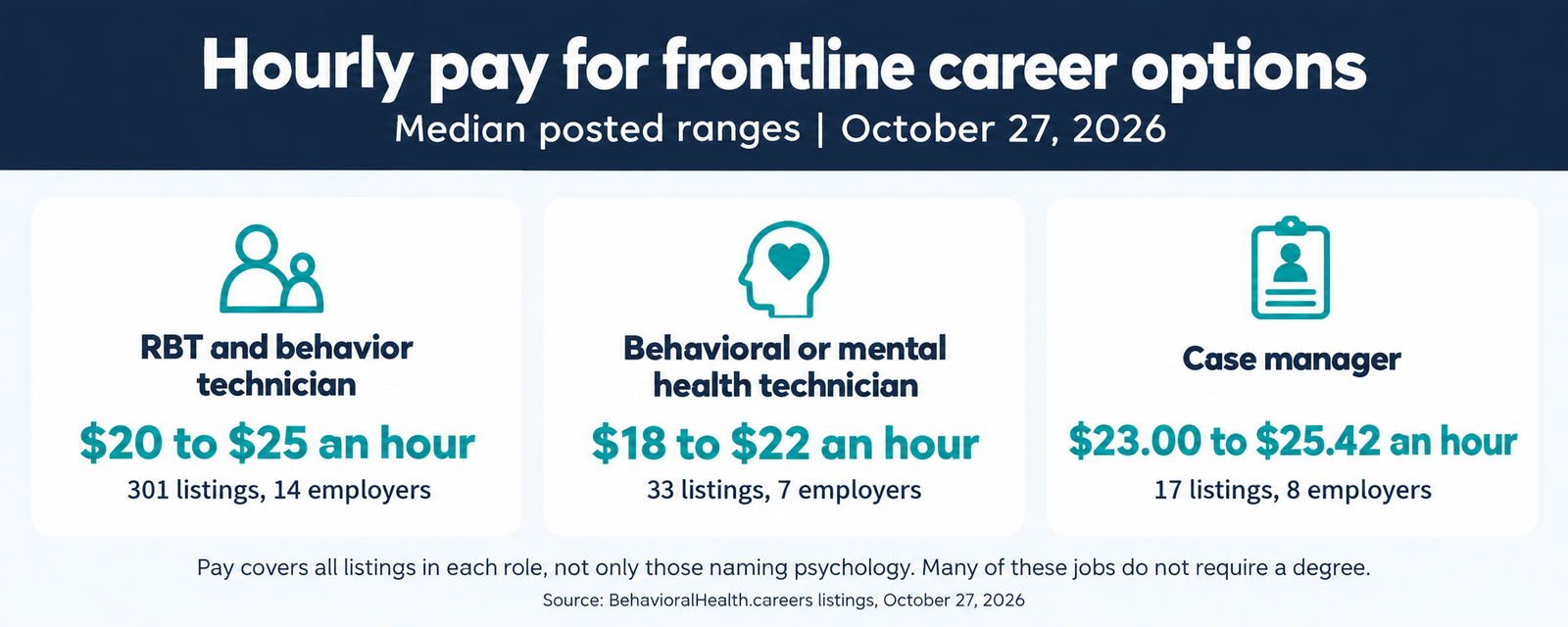
Source: BehavioralHealth.careers live listings, October 27, 2026. Pay covers all listings in each role, not only those naming psychology. A median is shown only when at least 10 listings from at least 3 employers support it. The BCBA figure leaves out one employer’s listings while we verify its pay data. The psychologist figure leans on one employer, LifeStance Health, which posted 11 of the 17 salaried listings.
What you can do with a bachelor’s in psychology
On our board, 194 listings named psychology in a degree requirement or preference. In every role, most listings don’t name psychology at all.
At the bachelor’s level, the ones that do cluster in a few kinds of jobs.
Registered behavior technician (RBT) and behavior technician
RBTs deliver applied behavior analysis (ABA) sessions, often with children with autism, under a BCBA’s supervision. It is the largest entry point on the board: 339 listings from 20 employers.
Psychology shows up here as a plus, not a gate.
Of 48 bachelor’s-level clauses naming psychology in RBT and behavior technician listings, from 3 employers, 45 called the degree preferred.
A typical line from Acorn Health: “Bachelor’s Degree in psychology or related field preferred.” The credential that matters is the RBT certification itself, which requires a 40-hour training, a competency assessment and an exam; see our guide to becoming an RBT.
Posted pay: median $20 to $25 an hour (301 listings, 14 employers). See our RBT salary page.
Behavioral health technician and mental health technician
BHTs and MHTs support patients in psychiatric hospitals, residential programs, eating disorder programs and detox units: observing, running groups and daily routines, and helping keep the unit safe under nurses’ and clinicians’ direction.
Some employers ask for a bachelor’s. The Emily Program lists “Bachelor’s degree in psychology, social work, behavioral health, or a related field” for a behavioral health technician role in Columbus, Ohio.
Most don’t: 48 of the 58 BHT and MHT listings on our board don’t mention a bachelor’s degree at all, so a bachelor’s, in psychology or any field, is not required for most of these jobs.
Posted pay: median $18 to $22 an hour (33 listings, 7 employers).
Our BHT vs MHT vs psych aide comparison explains the titles.
Case manager
Case managers connect people to housing, benefits, medical care and treatment, and track progress on a care plan. Psychology is usually one of several accepted degrees.
Bright Harbor Healthcare in New Jersey asks for a “Bachelor’s degree in Social Work, Psychology, or a related field,” or a high school diploma plus at least three years of experience. Lighthouse Behavioral Health Solutions in Ohio lists the same kind of degree as desired for a case manager role in substance use treatment.
Posted pay: median $23.00 to $25.42 an hour (17 listings, 8 employers), the highest starting median of the bachelor’s-level roles in this guide (hourly listings only).
See our behavioral health case manager guide.
Intake, substance use and activity roles
A few more paths can be open with a bachelor’s:
- Intake and admissions: intake coordinators handle calls, insurance checks and scheduling.
See our intake coordinator guide.
- Substance use counseling (BLS data, not board listings): substance abuse and behavioral disorder counselors typically need at least a bachelor’s degree, according to the Bureau of Labor Statistics, though requirements range from a high school diploma to a master’s depending on the state and setting, and many states add their own addiction counselor credential.
Our substance abuse counselor guide covers the CADC and LADC rules by state.
- Recreation therapy: Northern California Behavioral Health System lists a “Bachelor’s degree in Psychology or related field with a CTRS certification” for an adjunctive therapist role.
The CTRS credential has its own recreational therapy coursework, qualifying professional experience and exam requirements (NCTRC), so a psychology major needs added preparation to qualify.
For a wider view of starting roles, including ones open with a high school diploma or associate degree, see our entry-level behavioral health jobs guide.
Is a bachelor’s in psychology enough?
For a first job in behavioral health, often. For licensed clinical roles, no. Our board’s pay data and national survey data both suggest a bachelor’s is a starting point.
Bachelor’s-level pay sits in a narrow band. The bachelor’s-level roles on our board post median ranges between $18 and $25 an hour; $25 an hour full time is about $52,000 a year. Licensed therapist, counselor and social worker roles, which need a master’s and a license, post a median of $65,000 to $97,800 a year.
Few graduates say the work matches the degree. In the 2023 National Survey of College Graduates, only 26 percent of employed psychology bachelor’s holders said their job was closely related to psychology; 37 percent said somewhat related and 38 percent not related.
Among master’s holders, 73 percent said closely related, and among doctoral holders, 89 percent (APA Monitor on Psychology, March 2026).
A bachelor’s in psychology is common: US colleges awarded 129,609 of them in 2021-22, more than 6 percent of all bachelor’s degrees that year (NCES Digest of Education Statistics, table 318.20).
Many frontline listings ask for an RBT credential, and many don’t require a degree at all, so a credential and client-facing experience carry weight alongside the degree.
Jobs with a master’s degree in psychology
Therapist or counselor
All states require mental health counselors to be licensed, and the typical entry-level education is a master’s degree, according to the Bureau of Labor Statistics.
On our board, 46 therapist, counselor and social worker listings named psychology in a master’s-level clause, from 12 employers, usually as one of several accepted fields alongside a license requirement.
Sandstone Care, hiring a mental health therapist in Virginia, asks for a “master’s degree in behavioral health science (Clinical Social Work, Psychology, Marriage and Family Therapy, or related field)” and an active Virginia license.
A psychology master’s is not automatically a path to licensure. Each license type, and each state, sets its own coursework and supervised-hour rules, so check that a program qualifies for the license you want before you enroll.
Our therapy license comparison explains the LPC, LMHC, LCSW and LMFT routes.
Posted pay: median $65,000 to $97,800 a year (127 salaried listings, 21 employers), or $34.98 to $48.18 an hour for hourly roles (119 listings, 17 employers).
See our mental health counselor salary page.
Board Certified Behavior Analyst (BCBA)
BCBA certification requires a master’s degree, behavior-analytic coursework, supervised fieldwork and an exam. Employers accept several master’s fields. Behavioral Health Works lists a “Master’s degree in ABA, psychology, special education, child development, or a related field” with BCBA certification. On our board, 21 BCBA listings named psychology this way, from 4 employers.
Posted pay: median $85,000 to $102,000 a year (40 listings, 7 employers, leaving out one employer’s listings while we verify its pay data).
See our guide to becoming a BCBA.
Jobs with a doctorate in psychology
Clinical and counseling psychologists typically need a PhD or PsyD, and most states require a license to practice psychology or use the title “psychologist,” according to the Bureau of Labor Statistics. School psychologists typically need at least a master’s degree in school psychology, and industrial-organizational psychologists typically need a master’s.
Some psychologist listings on our board say so directly. Eating Recovery Center’s virtual psychologist roles ask for a “Doctorate of Psychology (PsyD) or Doctorate of Philosophy (PhD) in Psychology from an APA Accredited program” and current licensure, posted at $90,000 to $130,000.
Blackbird Health’s contract pediatric neuropsychologist role asks for a PhD or PsyD in clinical or school psychology from an APA- or CPA-accredited program, at $110 to $135 an hour.
Posted pay: median $111,000 to $144,000 a year (17 salaried listings, 5 employers). One employer, LifeStance Health, posted 11 of the 17, so treat this as a narrow sample. BLS reports a May 2025 median of $99,110 for psychologists across all specialties.
See our psychologist salary page.
Psychology degree jobs outside behavioral health
Psychology graduates also work outside behavioral health, in fields this board doesn’t cover. If you want to stay close to mental health and substance use care, the roles above are where employers are hiring and posting pay now.
Graduate school or work first: how to choose your next step
- Starting with a bachelor’s: look at RBT, BHT and case manager listings in your area. Many ask for an RBT credential, and several don’t require a degree, so plan for the credential as well as the degree.
- Planning a master’s: decide on the license or certification first (counseling, marriage and family therapy, social work, or BCBA), then pick a program that qualifies for it in your state.
- Considering a doctorate: check that the program is APA-accredited. Some psychologist listings on our board, such as Eating Recovery Center’s, ask for it.
- Comparing offers: use posted pay. Browse current jobs with posted pay.
Frequently asked questions
What jobs can you get with a psychology degree? In behavioral health, a bachelor’s in psychology is accepted, and often preferred, for frontline roles such as registered behavior technician, behavioral health technician and case manager, though many of these jobs don’t require a degree.
A master’s in a field that meets your state’s licensing rules, plus a license, leads to therapist and counselor roles; a qualifying master’s plus coursework, supervised fieldwork and an exam leads to BCBA certification. A doctorate plus a license leads to psychologist roles.
What can you do with just a bachelor’s in psychology? On our board, the main options are RBT and behavior technician, behavioral or mental health technician, case manager, and some intake roles.
The three largest groups had median posted pay of about $18 to $25 an hour in October 2026. In RBT listings especially, psychology is usually a preferred degree, not a requirement.
Can you be a therapist with a bachelor’s in psychology? No. Licensed therapist and licensed professional counselor roles require a master’s degree and a state license.
Some substance use counselor jobs accept a bachelor’s, but they are not licensed therapy roles. With a bachelor’s, you can work in support roles on a treatment team while you decide on graduate school.
What is the highest paying job with a psychology degree? Among the roles on our board that a psychology degree leads to, licensed psychologists posted the highest pay: a median of $111,000 to $144,000 a year in October 2026, from a small sample led by one employer. That path requires a doctorate and a license.
Is a psychology degree worth it? It depends on how far you take it. Only 26 percent of employed psychology bachelor’s holders say their job is closely related to psychology, compared with 73 percent of master’s holders and 89 percent of doctoral holders.
On our board, median pay rises from about $18 to $25 an hour in bachelor’s-level roles to $65,000 to $97,800 a year in master’s-level licensed roles.
Sources and methodology
- Posted pay and listing counts: BehavioralHealth.careers live listings, read October 27, 2026 (1,279 listings). Pay medians cover all listings in each role group; the minimum is the median of all posted minimums and the maximum the median of all posted maximums. A median is shown only when at least 10 listings from at least 3 employers support it. “Names psychology” means the listing’s description includes a required or preferred degree (associate, bachelor’s, master’s or doctorate) that lists psychology in the same clause; 194 listings did.
- Federal data: Bureau of Labor Statistics, Occupational Outlook Handbook: Psychologists and Substance Abuse, Behavioral Disorder, and Mental Health Counselors, both last modified August 27, 2026.
- Degree relevance: Stamm, Schwartz, Page and Assefa, “Datapoint: Perceived relevance of psychology education to jobs,” Monitor on Psychology, March 2026, using the 2023 National Survey of College Graduates. Percentages may not sum to 100 because of rounding.
- Degrees awarded: NCES Digest of Education Statistics, table 318.20, 2021-22 academic year.
- Our content and salary data methods page explains how we collect and check posted pay.