


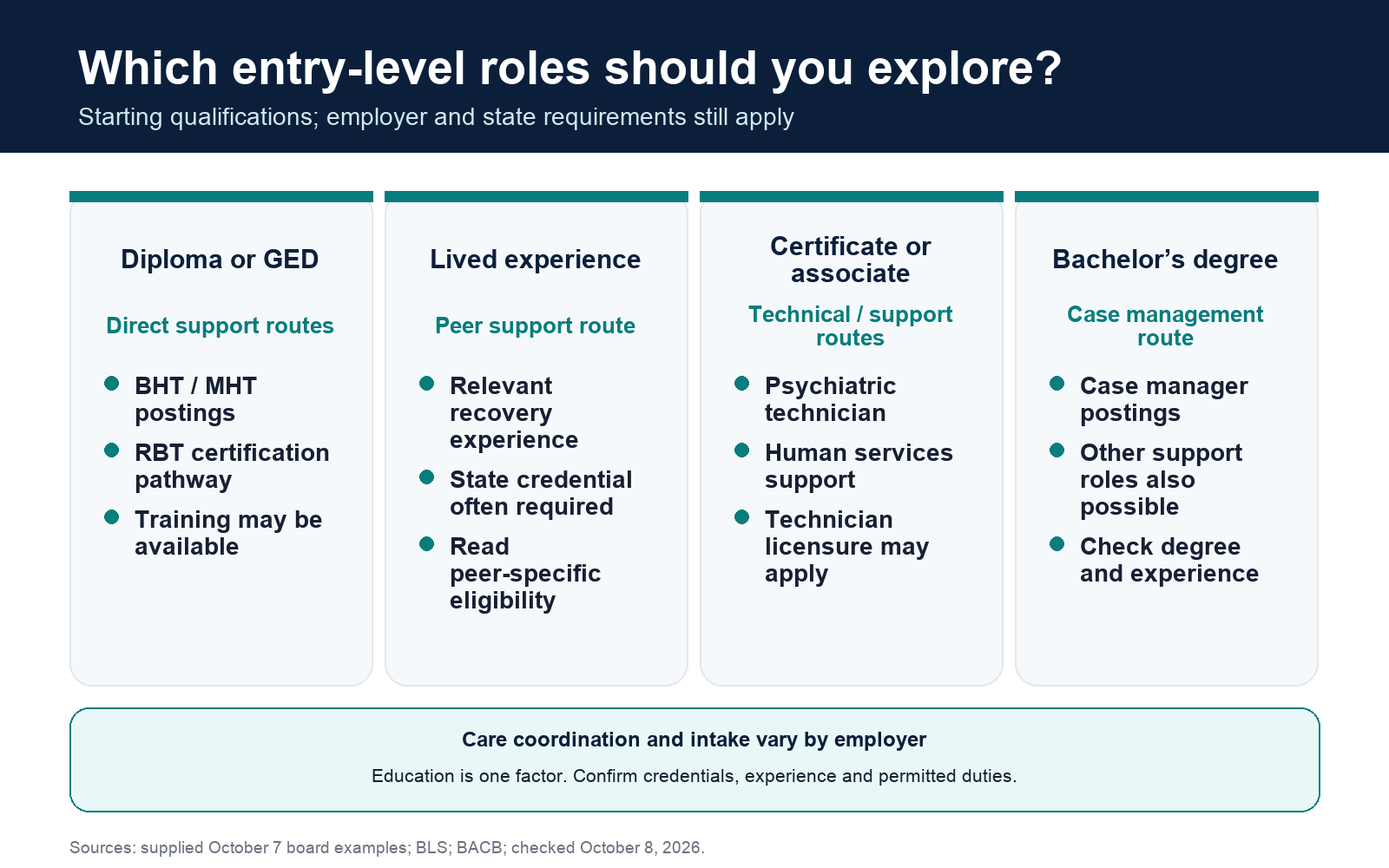
You can start a behavioral health career without a license, and in most entry-level roles without a degree. What you hold right now decides which doors are open:
| What you have now | Roles to look at | Median posted pay on our board |
|---|---|---|
| High school diploma or GED | Registered Behavior Technician (RBT); behavioral health or mental health technician (BHT, MHT); peer support specialist, with lived experience and state certification | RBT $20 to $25 an hour; BHT and MHT $18 to $22 an hour; peer support $24.52 to $26.50 an hour |
| A postsecondary certificate or associate degree | Psychiatric technician where a state or employer requires one; human services assistant roles with more responsibility | No board median; federal figures below |
| A bachelor’s degree | Case manager | Too few posted ranges on our board to report |
| Varies by employer | Care coordinator; intake and admissions coordinator | Care coordinator $23.09 to $24.90 an hour; intake too few posted ranges to report |
Pay: median of employer-posted minimums to median of employer-posted maximums among BehavioralHealth.careers listings with posted pay, October 7, 2026.
Counts are below each role.
The biggest entry-level employer group on the board by far is ABA. RBT and behavior technician roles made up 347 of 1,150 live listings.
The sections below show what employers on the board ask for in each role, using the text of their own postings.
How we sorted these jobs
“Entry-level” here means a role without an independent clinical license requirement. Some routes below still require state certification, registration, or, for psychiatric technicians in certain states, a role-specific license.
For each role, we searched the full text of every live listing on October 7, 2026, and counted how many mention a high school diploma or GED, an associate degree, or a bachelor’s degree.
A mention is not always a requirement. Some postings list a degree as preferred, and some list two routes. Treat the counts as a guide to what employers in this field ask for.
Pay figures come only from listings with a posted range. When fewer than 10 listings or fewer than three employers stand behind a figure, we leave it out.
Our content and salary data methods page explains how we collect pay.
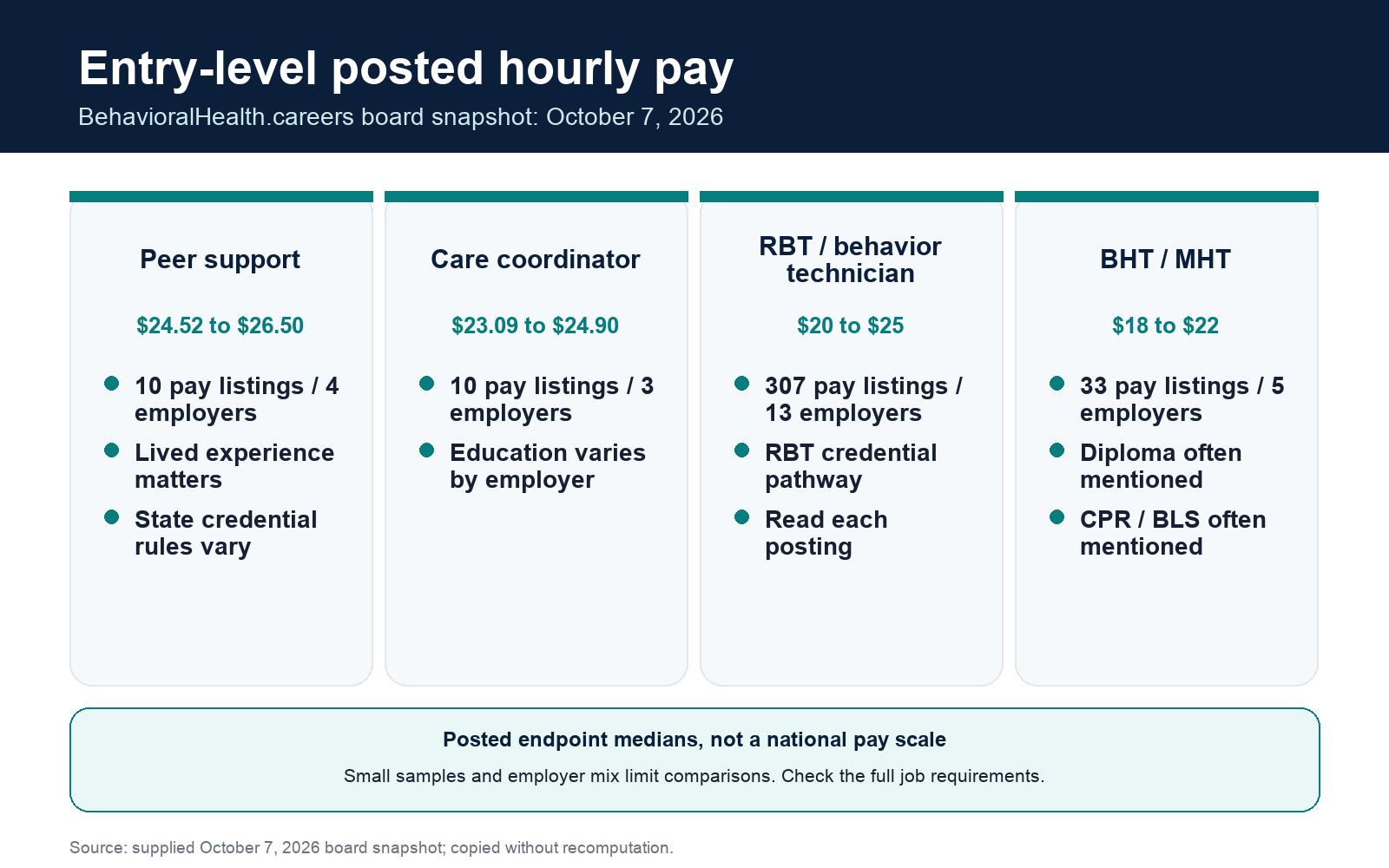
Peer and care coordination groups each have only 10 pay listings; these are not national wage estimates.
With a high school diploma or GED
Registered Behavior Technician (RBT)
RBTs deliver applied behavior analysis (ABA) sessions in clinics, homes and schools, often for children on the autism spectrum, under the supervision of a BCBA or BCaBA.
The credential has national requirements set by the Behavior Analyst Certification Board (BACB RBT Handbook):
- You must be at least 18 when you apply and have at least a high school education or the equivalent.
- You must pass a criminal background check and an abuse registry check no more than 180 days before paying for your application, subject to the handbook’s stated exceptions. Your Attesting Certificant must also complete the application attestation on its required timetable.
- You must complete a 40-hour training that meets the 2026 curriculum requirements in no less than 5 and no more than 180 days.
- You must pass an initial competency assessment within 90 days before you apply, then pass the RBT exam.
- Before you provide services as an RBT, a qualified RBT Supervisor or RBT Requirements Coordinator must add you as a supervisee in the BACB portal so your certification is active. You then need ongoing supervision for at least 5% of your behavior-analytic service hours each calendar month.
Some employers on the board advertise paid training, with titles that include “Behavior Technician Training Provided.” On October 7, 293 of 347 RBT and behavior technician postings mentioned the RBT credential, and 206 mentioned a high school diploma or GED.
Posted pay: $20 to $25 an hour across 307 listings from 13 employers. The largest RBT employers on the board were Finni Health (49 listings), OOS Management Corp (39), Centria Autism (32), Acorn Health (27), and Life Skills Autism Academy (26).
Our RBT salary guide reports $20 to $22 an hour from national salary surveys. Our figure comes from what employers on this board post, which is why the two differ.
For the full certification path, read how to become a Registered Behavior Technician, and for where the credential leads, our guide to ABA therapy jobs from RBT to BCBA.
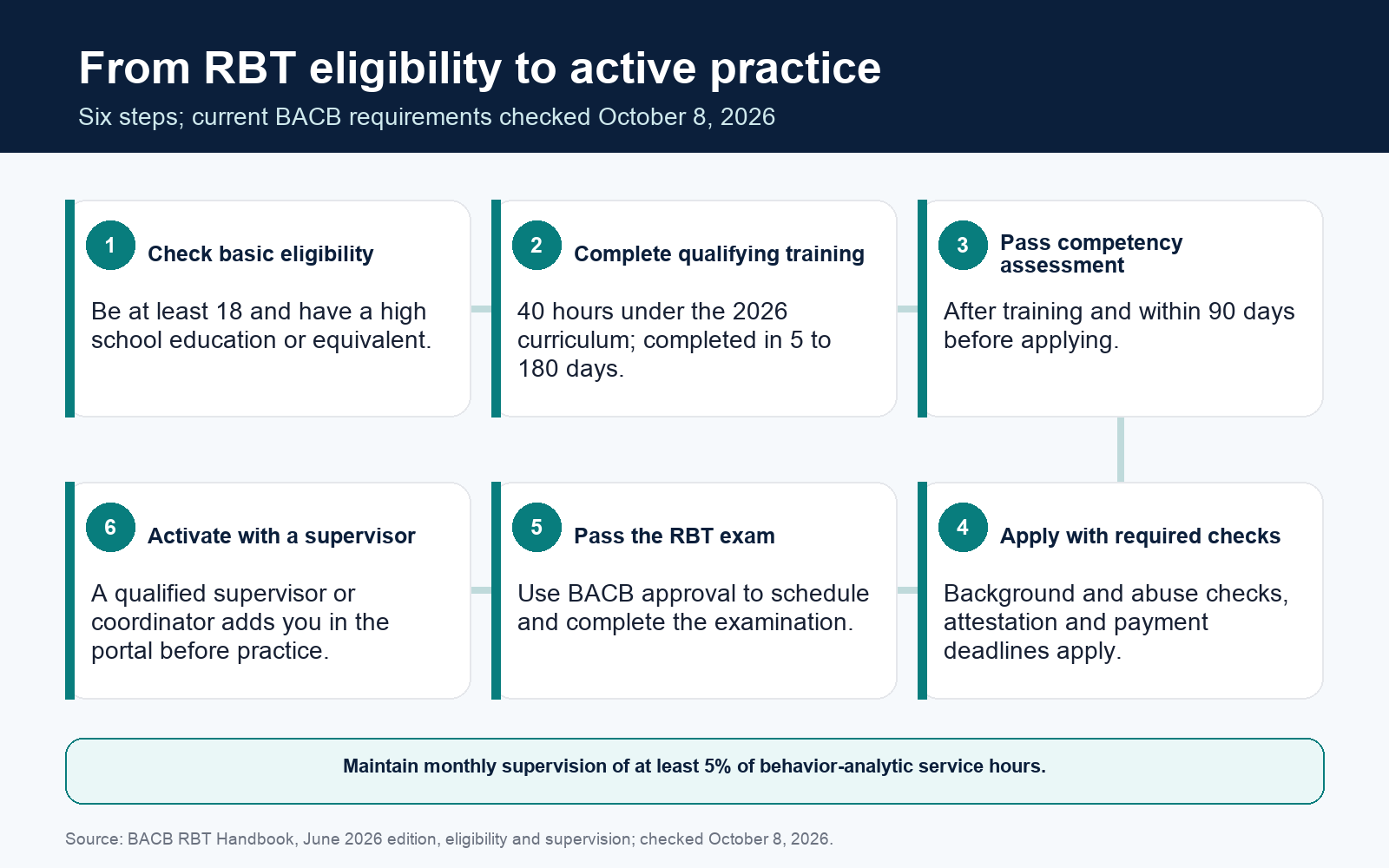
Background and abuse checks are within 180 days before payment, subject to handbook exceptions. The application attestation has its own 90-day payment deadline. Exam passage alone does not activate practice.
Behavioral health technician and mental health technician
BHTs and MHTs work on inpatient psychiatric units, in residential programs, and in addiction treatment. The work is observation, safety checks, helping people through daily routines on the unit, and documentation.
The titles overlap heavily, and our comparison of BHT, MHT and psych aide roles sorts them out.
Federal data sets a low bar for entry. Psychiatric aides typically need a high school diploma or equivalent; psychiatric technicians typically need a postsecondary certificate, and some states require technicians to be licensed (BLS Occupational Outlook Handbook).
Employers on our board match that. Of 60 BHT and MHT postings, 54 mentioned a high school diploma or GED, and 43 mentioned CPR or Basic Life Support certification.
Posted pay: $18 to $22 an hour across 33 listings from 5 employers. Federal figures for May 2025 put the median at $44,910 a year for psychiatric aides and $45,130 for psychiatric technicians (BLS).
Our behavioral health technician salary guide and psychiatric aide salary guide have state-by-state numbers.
For the steps into the role, see how to become a behavioral health technician.
Peer support specialist
Peer support specialists use their own lived experience of recovery from a mental health or substance use condition to support people in treatment and recovery. The certification most employers look for is issued by your state.
Voluntary national credentials exist, such as the National Certified Peer Specialist credential from Mental Health America and the Florida Certification Board, but they don’t replace state certification or let you work across state lines (SMI Adviser).
In 2023, HHS published National Model Standards for Peer Support Certification to encourage states to align their programs (HHS).
On October 7, 10 of the 12 peer support and recovery coach postings on the board mentioned lived experience, and 8 mentioned a peer or recovery certification.
Posted pay: $24.52 to $26.50 an hour across 10 listings from 4 employers. That figure comes from a small group of listings and moves week to week.
Our peer support specialist salary guide adds federal and Medicaid context.
Training hours, exams and supervised hours differ by state; our guide to peer support certification requirements by state covers each one.
With a certificate or associate degree
Two routes reward education past high school without requiring a bachelor’s degree.
The first is psychiatric technician work. BLS says technicians typically need a postsecondary certificate, and some states license the role (BLS).
If your state licenses psychiatric technicians, check its board before you enroll in a program.
The second is human services work. Social and human service assistants typically need a high school diploma, and BLS notes that their duties are often set by their level of education (BLS).
Some employers prefer an associate or bachelor’s degree in human services. The federal median was $45,930 a year in May 2025 (BLS); our social and human service assistant salary guide has state figures.
Addiction counseling is another option in some states. Substance abuse and behavioral disorder counselors typically need a bachelor’s degree, but requirements range from a high school diploma to a master’s degree depending on the state and the setting (BLS).
Our guide to CADC and LADC requirements by state lists them.
On our board, associate degrees showed up as one option among several. Among BHT and MHT postings, 11 mentioned one, and every one of those also mentioned a high school diploma or GED.
With a bachelor’s degree
Case manager
Case managers connect people to housing, benefits, medical care and community services, and track progress on a care plan. A bachelor’s degree matters more here.
On October 7, 14 of 15 case manager postings on the board mentioned a bachelor’s degree, 8 also mentioned a high school diploma or GED, and 1 was listed as master’s level. Too few posted ranges to report a pay median. Our behavioral health case manager career guide covers the role.
A bachelor’s degree in the roles above
A bachelor’s degree also shows up in RBT postings. Among RBT and behavior technician postings, 39 mentioned a bachelor’s degree without mentioning a diploma.
Most of the board’s entry-level jobs still open with a diploma, so a degree is rarely the only way in. Its larger payoff comes later, as the foundation for the graduate degree that BCBA certification and clinical licenses require.
Roles where requirements vary: care coordination and intake
Care coordinators schedule and track care across a treatment team, often in outpatient and virtual programs. Few of these postings named a specific degree: 3 of 16 mentioned a bachelor’s degree. For related work, see our behavioral health case manager career guide.
Posted pay: $23.09 to $24.90 an hour across 10 listings from 3 employers.
Intake coordinators are often the first person someone talks to when they reach out for treatment. They take calls and referrals, verify insurance and schedule assessments.
Requirements vary by employer, so read each posting. On October 7, 12 intake and admissions listings (excluding nurse and clinician intake roles) came from 9 employers, too few posted ranges to report a pay median. Our intake coordinator career guide covers the job in detail.
Where each starting role can lead
Entry-level roles are a first rung, and each one has a common next step:
- RBT to BCaBA or BCBA. The BCBA is a graduate-level certification (BACB), and the BCaBA is its assistant-level counterpart. See how to become a BCBA and our ABA career ladder guide.
- BHT or MHT to nursing. An RN license opens psychiatric nursing roles. See our guide to behavioral health nurse jobs.
- Case manager to licensed counselor or social worker. Licensed counselors need a master’s degree, supervised clinical hours and an exam (BLS). See how to become a licensed mental health counselor, our mental health counselor salary guide and our behavioral health social worker salary guide.
- Peer support to peer supervisor. See our peer support specialist career guide.
Employers hiring for entry-level roles on the board
Psychiatric hospitals hire mental health technicians for inpatient units.
On October 7, technician listings came from Dallas Behavioral Healthcare Hospital (6), Northern California Behavioral Health System (3), Reno Behavioral Healthcare Hospital (2) and Desert Parkway Behavioral Healthcare Hospital (1). San Antonio Behavioral Healthcare Hospital had 1 mental health technician opening among therapist, intake nurse, intake counselor, utilization review and discharge coordination roles.
Addiction treatment programs hire across technician, case management and peer roles. The Recovery Village had 14 technician listings, Boca Recovery Center had 5 technician and 6 case manager listings, and Lighthouse Behavioral Health Solutions had 4 peer support listings.
Questions to ask before you accept
The hourly rate is only part of an offer. Ask about the terms around it:
- Is there a shift differential for evenings, nights or weekends?
- For RBTs: are hours guaranteed, and are late client cancellations paid?
- Is training paid, including the 40-hour RBT training or a peer certification course?
- Will you pay for certification, CPR or tuition toward a degree?
- What de-escalation and safety training do new technicians get, and when?
- Who supervises me, and how often do we meet?
FAQs on Entry Level Behavioral Health Careers
Can I work in behavioral health without a degree?
Yes. RBT, behavioral health technician and peer support roles typically require a high school diploma or GED. On October 7, 2026, 54 of 60 BHT and MHT postings on our board mentioned a diploma or GED. RBT and peer roles add a credential, which many employers help you earn.
What is the highest-paying entry-level behavioral health job?
Among entry-level roles with enough posted pay to report on October 7, 2026, peer support had the highest median range at $24.52 to $26.50 an hour, followed by care coordinators at $23.09 to $24.90 and RBTs at $20 to $25.
Treat both of the top figures with care: peer support rests on 10 listings from 4 employers and care coordination on 10 listings from 3 employers, the minimum we report, and both change week to week. Peer support also requires lived experience, and 8 of 12 peer postings on our board mentioned a certification.
Do I need certification to be a behavioral health technician?
A professional certification usually isn’t required, but most postings ask for CPR or Basic Life Support.
On our board, 43 of 60 BHT and MHT postings mentioned CPR or BLS, and 54 mentioned a high school diploma or GED. Some states license psychiatric technicians, and some employers require a certificate, so check the posting and your state.
How fast can I become an RBT?
The 40-hour training takes at least 5 days, and the competency assessment and exam follow. Our RBT certification guide walks through a realistic timeline.
Sources
- BehavioralHealth.careers live listings and listing text, read October 7, 2026 (1,150 published listings).
- Behavior Analyst Certification Board, RBT Handbook.
- U.S. Bureau of Labor Statistics, Occupational Outlook Handbook: Psychiatric Technicians and Aides and Social and Human Service Assistants, May 2025 wage data.
- U.S. Bureau of Labor Statistics, Occupational Outlook Handbook: Substance Abuse, Behavioral Disorder, and Mental Health Counselors.
- Behavior Analyst Certification Board, BCBA certification.
- U.S. Department of Health and Human Services, HHS publishes national model standards for peer worker certifications, June 6, 2023.
- SMI Adviser, peer specialist certification.

Pingback: How to Become a Behavioral Health Technician | And Get Hired